Wood Based Battery Market Size, Share & Demand Report By Material Type (Cellulose Nanofiber, Lignin, Others), By Application (Consumer Electronics, Electric Vehicles, Energy Storage Systems, Wearable Devices), By End-Use Industry (Electronics, Automotive, Energy & Utilities, Industrial) By Region & Segment Forecasts, 2026–2034
USD 3950
Market Overview
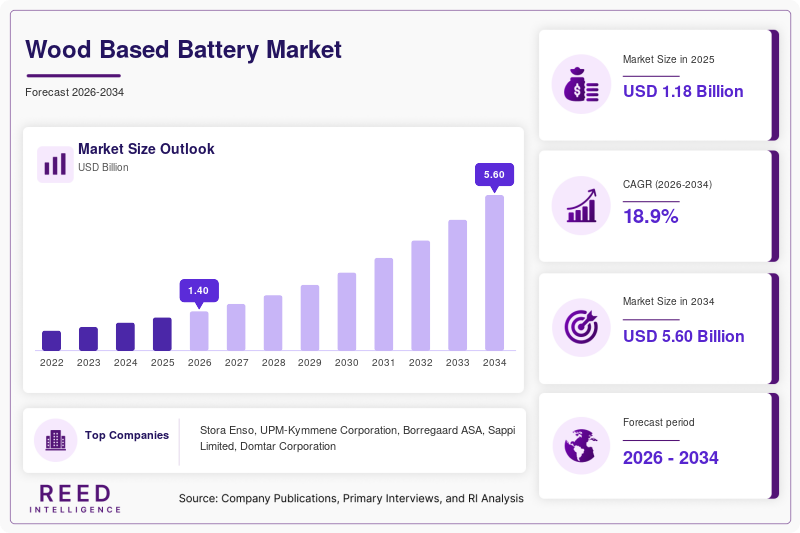
The global Wood Based Battery Market size was valued at USD 1.18 billion in 2026 and is projected to reach approximately USD 4.76 billion by 2034, expanding at a CAGR of 18.9% during the forecast period (2026–2034). The market is gaining momentum as industries seek sustainable alternatives to conventional lithium-ion battery components. Wood-based materials, particularly lignin and cellulose-derived nanofibers, are emerging as viable substitutes due to their renewable nature, cost efficiency, and favorable electrochemical properties. Increasing demand for eco-friendly energy storage solutions across electric vehicles, consumer electronics, and grid storage applications is contributing to consistent market expansion.
A significant global factor supporting this growth is the transition toward circular economy models, where renewable raw materials and biodegradable components are prioritized. Governments and private organizations are investing in bio-based innovations to reduce reliance on finite mineral resources such as cobalt and lithium. This shift is encouraging research into wood-derived electrodes and separators, thereby strengthening the commercial viability of wood-based batteries.
Key Highlights
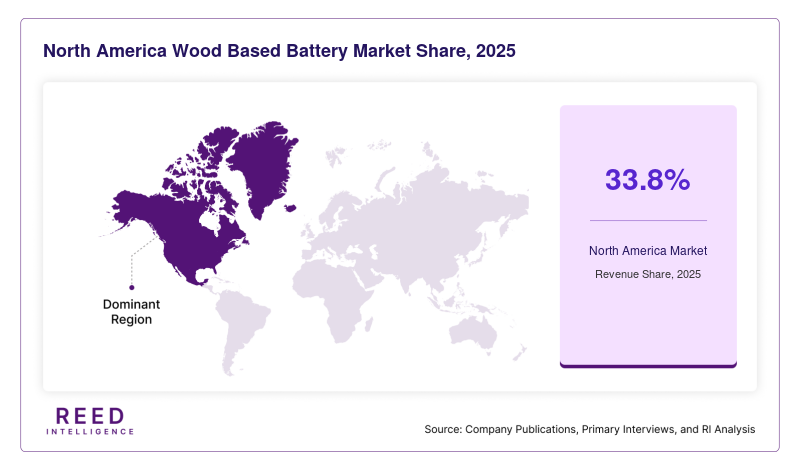
- North America dominated the market with a 33.8% share in 2025,.
- Asia Pacific is expected to grow at the fastest CAGR of 20.7% during 2026–2034.
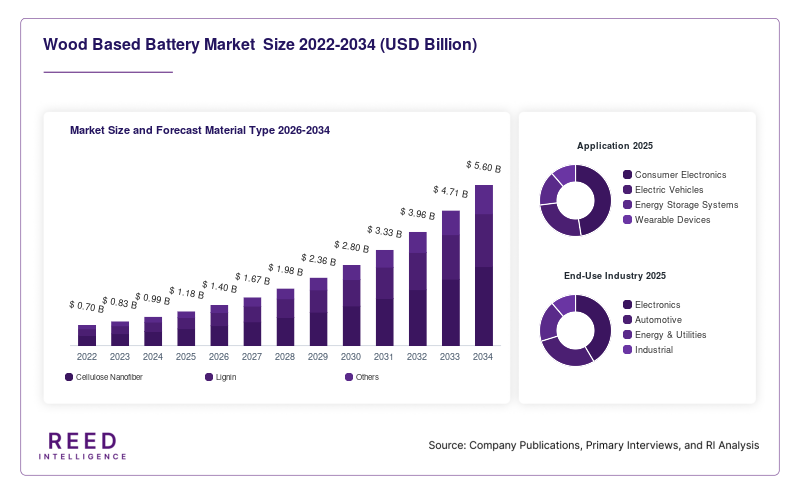
- By material type, cellulose nanofiber-based batteries accounted for the largest share of 42.6%, while lignin-based batteries are projected to grow at a CAGR of 21.4%.
- By application, consumer electronics led with a 39.2% share, whereas electric vehicles are expected to expand at a CAGR of 22.1%.
- The United States remained the dominant country, with market values of USD 420 million in 2024 and USD 465 million in 2025.
Market Trends
Rising adoption of biodegradable battery components
The increasing environmental impact of traditional batteries has led to a shift toward biodegradable materials in energy storage systems. Wood-based batteries, utilizing lignin and cellulose, offer an environmentally responsible alternative without compromising performance. Manufacturers are focusing on replacing synthetic polymers and rare metals with organic materials derived from wood pulp. This trend is particularly visible in consumer electronics, where companies are under pressure to reduce electronic waste. Furthermore, advancements in nanotechnology have enhanced the conductivity and durability of wood-derived materials, making them suitable for commercial applications. The trend is expected to intensify as regulatory frameworks tighten around hazardous battery disposal and sustainability reporting requirements.
Integration of wood-based materials in flexible and wearable electronics
The demand for lightweight, flexible, and wearable electronic devices is influencing battery design innovation. Wood-based batteries are increasingly being explored for their flexibility and mechanical strength, especially when processed into nanocellulose structures. These materials can be engineered into thin, bendable forms, making them suitable for smart textiles, medical wearables, and portable devices. The trend is supported by ongoing research in bio-based conductive materials that can maintain performance under mechanical stress. As the wearable technology market expands, wood-based batteries are positioned as a key enabling component, offering both functionality and sustainability benefits.
Market Drivers
Growing demand for sustainable energy storage solutions
The global emphasis on sustainability is a primary driver of the wood based battery market. Industries are actively seeking alternatives to conventional batteries that rely on scarce and environmentally damaging materials. Wood-based batteries utilize renewable resources such as lignin and cellulose, which are abundant and biodegradable. This reduces environmental impact throughout the product lifecycle, from production to disposal. Additionally, companies are aligning with environmental, social, and governance (ESG) goals, further boosting demand for eco-friendly battery technologies. The ability of wood-based materials to reduce carbon footprints while maintaining competitive performance is encouraging their adoption across multiple sectors.
Technological advancements in bio-based nanomaterials
Advancements in nanotechnology have significantly improved the performance of wood-derived battery components. Cellulose nanofibers and lignin-based polymers are being engineered to enhance conductivity, stability, and energy density. These innovations are enabling wood-based batteries to compete with traditional lithium-ion systems in terms of efficiency and lifespan. Research institutions and private companies are investing in scalable production techniques, which is reducing costs and accelerating commercialization. As these technologies mature, they are expected to unlock new applications in high-performance energy storage, thereby driving market growth.
Market Restraint
Limited commercialization and scalability challenges
Despite promising research outcomes, the large-scale commercialization of wood-based batteries remains limited. Manufacturing processes for bio-based materials are still evolving, and achieving consistent quality at scale poses challenges. The lack of established supply chains for lignin and nanocellulose-based components further complicates production. Additionally, performance metrics such as energy density and long-term stability are still under development, which restricts widespread adoption in critical applications like electric vehicles. These challenges result in higher initial costs compared to conventional batteries, making it difficult for manufacturers to compete on price. For example, pilot-scale facilities often struggle to maintain uniform material properties, leading to variability in battery performance. Overcoming these limitations will require significant investment in infrastructure and standardization.
Market Opportunities
Expansion in electric vehicle applications
The rapid growth of the electric vehicle industry presents a significant opportunity for the wood based battery market. Automakers are exploring sustainable battery technologies to reduce environmental impact and comply with stricter emissions regulations. Wood-based batteries, with their renewable materials and potential cost advantages, are being considered for next-generation EV platforms. Research into lignin-based electrodes has shown promising results in improving energy storage capacity while reducing reliance on rare metals. As EV production scales globally, the demand for sustainable battery alternatives is expected to rise, creating new growth avenues for wood-based technologies.
Development of grid-scale energy storage solutions
The increasing adoption of renewable energy sources such as solar and wind is driving the need for efficient grid-scale energy storage systems. Wood-based batteries offer a sustainable solution for large-scale storage due to their low environmental impact and potential cost efficiency. Utilities and energy providers are investing in bio-based battery technologies to support grid stability and energy distribution. The ability of wood-derived materials to be produced in large quantities makes them suitable for stationary storage applications. As renewable energy capacity expands, the demand for eco-friendly storage solutions is expected to create substantial opportunities for market growth.
Segmental Analysis
By Material Type
Cellulose nanofiber-based batteries dominated the market in 2024, accounting for approximately 42.6% of the total share. These materials offer high mechanical strength, flexibility, and excellent electrochemical properties, making them suitable for a wide range of applications. The ability to engineer cellulose at the nanoscale has enabled the development of lightweight and durable battery components. Additionally, the abundance and renewability of cellulose make it a cost-effective option for manufacturers. The increasing demand for sustainable and high-performance materials is further driving the adoption of cellulose nanofiber-based batteries across industries.
Lignin-based batteries are expected to be the fastest-growing subsegment, with a CAGR of 21.4% during the forecast period. Lignin, a byproduct of the paper and pulp industry, is gaining attention for its potential as a low-cost and sustainable battery material. Its unique chemical structure allows for efficient energy storage and conductivity. The growing focus on utilizing industrial waste and reducing production costs is supporting the development of lignin-based batteries. As research continues to improve their performance, these batteries are expected to play a significant role in the market's growth.
By Application
Consumer electronics emerged as the dominant application segment in 2024, holding a market share of 39.2%. The demand for lightweight, portable, and eco-friendly devices is driving the adoption of wood-based batteries in this segment. Manufacturers are increasingly incorporating sustainable materials into their products to meet consumer preferences and regulatory requirements. The compatibility of wood-based batteries with compact designs makes them ideal for smartphones, laptops, and wearable devices.
Electric vehicles are projected to be the fastest-growing application segment, with a CAGR of 22.1%. The shift toward sustainable transportation is encouraging automakers to explore alternative battery technologies. Wood-based batteries offer potential advantages in terms of cost, sustainability, and material availability. As advancements in technology improve their performance, these batteries are expected to gain traction in the EV market.
By End-Use Industry
The electronics industry dominated the market in 2024, accounting for a significant share due to the widespread use of batteries in various devices. The increasing demand for sustainable and high-performance components is driving the adoption of wood-based batteries in this industry. Companies are focusing on reducing their environmental impact by incorporating renewable materials into their products.
The energy and utilities sector is expected to be the fastest-growing end-use industry, with a CAGR of 20.3%. The growing adoption of renewable energy sources is driving the need for efficient energy storage solutions. Wood-based batteries offer a sustainable alternative for grid-scale storage, supporting the integration of renewable energy into the power grid.
Regional Analysis
North America
North America accounted for approximately 33.8% of the global wood based battery market share in 2025 and is expected to grow at a CAGR of 17.5% during the forecast period. The region benefits from strong research infrastructure and early adoption of sustainable technologies. Government initiatives promoting renewable energy and green manufacturing are supporting market growth. Additionally, the presence of key industry players and collaborations between academia and industry are accelerating innovation in wood-based battery technologies.
The United States dominates the regional market, driven by substantial investments in clean energy and advanced materials research. A key growth factor is the increasing focus on reducing dependence on imported battery materials, which has led to the exploration of domestic, renewable resources such as wood. This strategic shift is fostering innovation and strengthening the country's position in the global market.
Europe
Europe held a market share of around 27.4% in 2025 and is projected to grow at a CAGR of 18.2% from 2026 to 2034. The region's strong commitment to sustainability and circular economy principles is a major driver. Strict environmental regulations and ambitious carbon neutrality goals are encouraging the adoption of bio-based materials in various industries, including energy storage.
Germany leads the European market due to its advanced manufacturing capabilities and focus on green technologies. A unique growth factor is the integration of wood-based batteries into renewable energy systems, particularly in decentralized energy networks. This approach is enhancing energy efficiency and supporting the transition to sustainable energy solutions.
Asia Pacific
Asia Pacific is expected to register the fastest CAGR of 20.7% during the forecast period, with a market share of 24.6% in 2025. Rapid industrialization, increasing energy demand, and growing environmental awareness are driving market growth. The region is also witnessing significant investments in battery manufacturing and research, which is supporting the development of wood-based technologies.
China dominates the regional market, supported by its large-scale manufacturing capabilities and strong focus on renewable energy. A key growth factor is the government's emphasis on reducing carbon emissions, which is encouraging the adoption of sustainable materials in battery production. This is creating a favorable environment for market expansion.
Middle East & Africa
The Middle East & Africa region accounted for 7.1% of the market share in 2025 and is expected to grow at a CAGR of 16.3%. The market is gradually developing, driven by increasing investments in renewable energy projects and infrastructure development. The adoption of sustainable technologies is gaining momentum as countries seek to diversify their energy sources.
The United Arab Emirates leads the regional market, with a focus on innovation and sustainability. A unique growth factor is the integration of wood-based batteries into solar energy projects, which is enhancing energy storage capabilities and supporting the region's renewable energy goals.
Latin America
Latin America held a market share of 7.1% in 2025 and is projected to grow at a CAGR of 17.1%. The region is experiencing growing interest in sustainable technologies, supported by government initiatives and increasing environmental awareness. The availability of raw materials such as wood is also contributing to market growth.
Brazil dominates the regional market, driven by its abundant forest resources and focus on bio-based industries. A key growth factor is the development of local supply chains for wood-derived materials, which is reducing production costs and supporting the commercialization of wood-based batteries.
Competitive Landscape
The wood based battery market is moderately fragmented, with several emerging players and established companies investing in bio-based battery technologies. Key companies are focusing on research and development to enhance product performance and scalability. Strategic collaborations, partnerships, and acquisitions are common as companies aim to strengthen their market position.
Stora Enso is recognized as a leading player in the market, leveraging its expertise in renewable materials to develop innovative battery solutions. The company recently announced a pilot project for lignin-based battery components, highlighting its commitment to sustainable energy storage. Other companies are also investing in advanced manufacturing techniques and expanding their product portfolios to meet growing demand.
Key Players
- Stora Enso
- UPM-Kymmene Corporation
- Borregaard ASA
- Sappi Limited
- Domtar Corporation
- Nippon Paper Industries
- WestRock Company
- International Paper Company
- CelluForce Inc.
- American Process Inc.
- GranBio Technologies
- Lignolix Inc.
- Green Science Alliance
- VTT Technical Research Centre
- Blue World Technologies
Recent Developments
- Stora Enso launched a pilot facility for lignin-based battery materials to support large-scale production.
- UPM-Kymmene Corporation announced a partnership with a technology firm to develop cellulose-based battery components for consumer electronics.
- Borregaard ASA introduced a new lignin-derived material designed for use in energy storage applications, enhancing battery performance and sustainability.
Wood Based Battery Market Segments
Material Type
- Cellulose Nanofiber
- Lignin
- Others
Application
- Consumer Electronics
- Electric Vehicles
- Energy Storage Systems
- Wearable Devices
End-Use Industry
- Electronics
- Automotive
- Energy & Utilities
- Industrial
By Region
- North America
- Europe
- APAC
- Middle East and Africa
- LATAM