Wood Moisture Tester Market Size, Share Demand Report By Type (Pin-Type Moisture Testers, Pinless Moisture Testers), By Application (Construction, Furniture Manufacturing, Wood Processing, Others), By End-Use (Industrial, Residential, Commercial), By Region & Segment Forecasts, 2026–2034
USD 3950
Market Overview
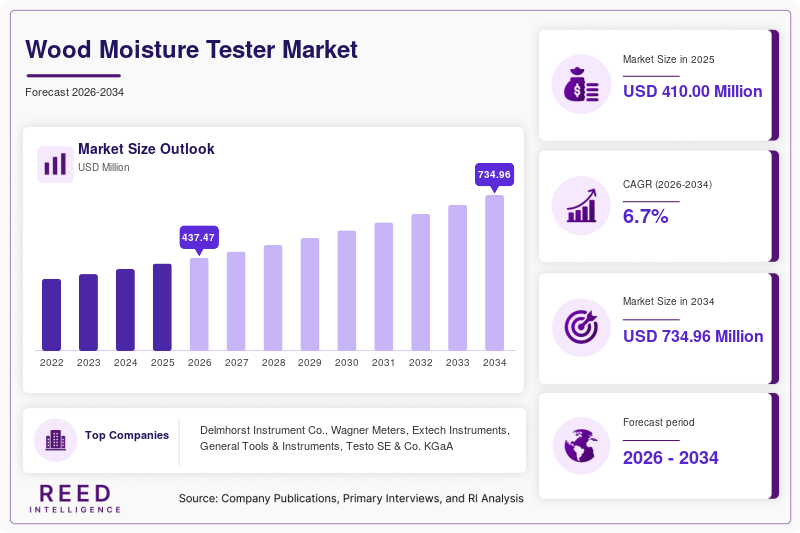
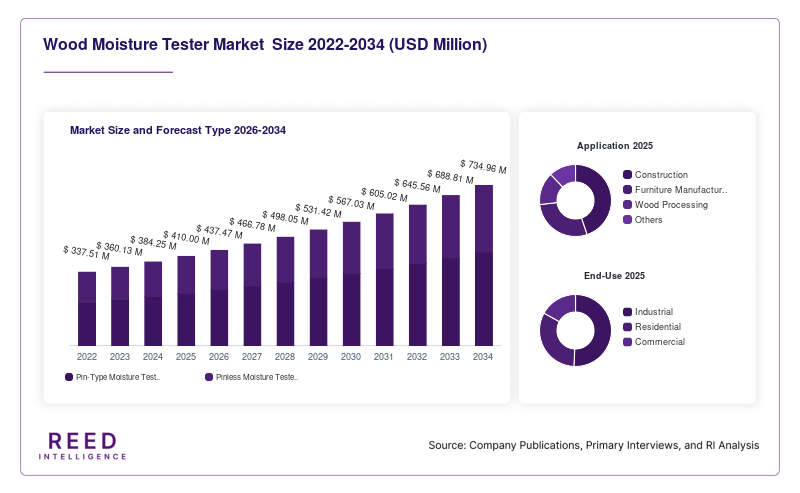
The global Wood Moisture Tester Market size was valued at approximately USD 410 million in 2026 and is projected to reach USD 685 million by 2034, expanding at a CAGR of 6.7% during the forecast period. The steady growth of the construction and woodworking industries has significantly influenced demand, as accurate moisture measurement is essential to ensure durability, safety, and quality of wood-based products. Increasing adoption of engineered wood, furniture manufacturing, and flooring installations has further elevated the need for reliable moisture testing solutions.
A key global factor supporting market growth is the rising emphasis on quality control and material efficiency across construction and manufacturing sectors. Improper moisture levels can lead to structural damage, warping, and product failure, prompting industries to adopt advanced moisture testing devices. Additionally, the integration of digital technologies, such as wireless connectivity and real-time data tracking, is enhancing usability and driving adoption among professionals and DIY users alike.
Key Highlights
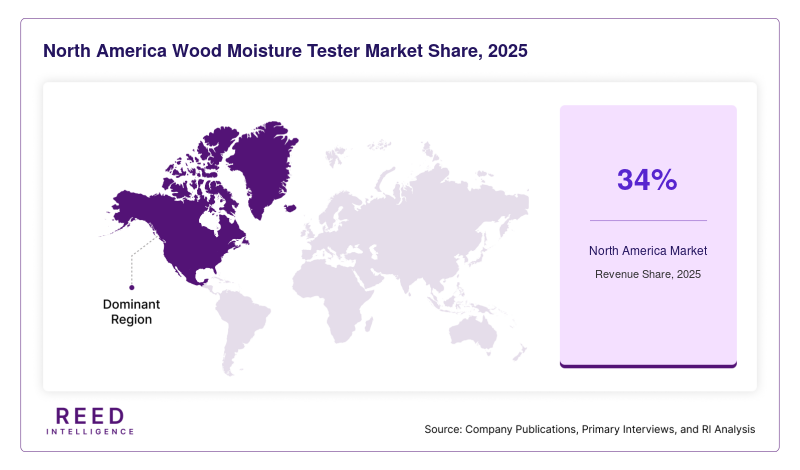
- North America dominated the market with a 34% share.
- Asia Pacific is the fastest-growing region with a CAGR of 7.9%.
- Pin-type testers led the type segment with a 58% share, while pinless testers are the fastest-growing at a CAGR of 7.5%.
- Construction applications accounted for the largest share at 46%, while furniture manufacturing is the fastest-growing at a CAGR of 7.2%.
- The United States recorded market values of USD 98 million in 2024 and USD 104 million in 2025, maintaining its leadership position.
Market Trends
Integration of Smart and Digital Features in Testing Devices
The Wood Moisture Tester Market is witnessing a shift toward smart and connected devices that offer enhanced functionality and ease of use. Manufacturers are integrating Bluetooth connectivity, mobile applications, and cloud-based data storage into moisture testers. These features allow users to monitor moisture levels in real time, track historical data, and generate reports for quality assurance. This trend is particularly beneficial for large-scale construction projects and industrial wood processing facilities, where consistent monitoring is critical. The adoption of digital interfaces and user-friendly displays also reduces human error and improves accuracy. As digital transformation continues across industries, demand for technologically advanced moisture testers is expected to increase steadily.
Growing Preference for Non-Destructive Testing Methods
Another notable trend in the market is the increasing preference for non-destructive moisture testing solutions, particularly pinless testers. Unlike traditional pin-type devices that penetrate the wood surface, pinless testers use electromagnetic sensors to measure moisture without causing damage. This is especially important for high-value wood products such as hardwood flooring, antique furniture, and decorative panels. The ability to preserve material integrity while ensuring accurate readings has made non-destructive testing highly attractive. Additionally, advancements in sensor technology have improved the accuracy and reliability of these devices, further driving their adoption across both professional and consumer segments.
Market Drivers
Expansion of the Global Construction Industry
The rapid growth of the global construction sector is a primary driver for the Wood Moisture Tester Market. With increasing urbanization and infrastructure development, the demand for wood-based materials in residential and commercial construction is rising significantly. Moisture testing is essential in construction to prevent issues such as mold growth, structural instability, and material degradation. Contractors and builders are increasingly adopting moisture testers to ensure compliance with quality standards and building regulations. Additionally, the growing use of engineered wood products, which require precise moisture control during installation, further supports market growth. As construction activities expand globally, the need for reliable moisture measurement tools continues to rise.
Rising Awareness of Wood Quality and Durability
Another important driver is the increasing awareness among consumers and manufacturers regarding the importance of maintaining optimal moisture levels in wood products. Excess moisture can lead to swelling, cracking, and fungal growth, while insufficient moisture can cause shrinkage and brittleness. This has led to greater adoption of moisture testers in industries such as furniture manufacturing, flooring, and woodworking. Educational initiatives and industry standards are also promoting the use of moisture testing equipment. As quality assurance becomes a priority across supply chains, the demand for accurate and efficient moisture testing solutions is expected to grow steadily.
Market Restraint
High Cost of Advanced Testing Devices
One of the key restraints affecting the Wood Moisture Tester Market is the relatively high cost of advanced testing devices, particularly those equipped with digital and non-destructive technologies. While basic pin-type testers are affordable, high-end models with features such as wireless connectivity, data logging, and enhanced accuracy can be expensive. This limits their adoption among small-scale woodworkers, individual contractors, and emerging markets with budget constraints. Additionally, the cost of maintenance and calibration adds to the overall expense, further discouraging potential users.
The impact of this restraint is evident in price-sensitive regions, where users often rely on traditional or less accurate methods for moisture measurement. For example, small furniture workshops may avoid investing in advanced testers due to limited financial resources, leading to inconsistencies in product quality. This can hinder market growth, especially in developing economies. However, ongoing technological advancements and increased competition among manufacturers are expected to gradually reduce costs, making advanced moisture testing solutions more accessible over time.
Market Opportunities
Growth in DIY and Home Improvement Activities
The increasing popularity of DIY (do-it-yourself) projects and home improvement activities presents a significant opportunity for the Wood Moisture Tester Market. Homeowners and hobbyists are becoming more involved in woodworking, furniture restoration, and flooring installation. This trend has created a growing demand for easy-to-use, portable moisture testing devices. Manufacturers are responding by developing compact and affordable testers tailored for non-professional users. The expansion of e-commerce platforms has also made these products more accessible, further supporting market growth. As consumer interest in DIY projects continues to rise, the demand for user-friendly moisture testers is expected to increase.
Technological Advancements in Sensor Accuracy
Advancements in sensor technology offer substantial growth opportunities for the market. Innovations in electromagnetic sensing and calibration techniques are improving the accuracy and reliability of moisture testers. These advancements enable devices to provide precise readings across different wood types and environmental conditions. Additionally, the development of multi-material testers that can measure moisture in various materials, including concrete and drywall, is expanding the application scope. This versatility enhances the value proposition of moisture testers, making them more attractive to a wider range of industries. As technology continues to evolve, the market is likely to benefit from increased adoption and product differentiation.
Segmental Analysis
By Type
Pin-type testers dominated the market in 2024, accounting for a 58% share. These devices are widely used due to their affordability, simplicity, and ability to provide accurate readings by directly penetrating the wood surface. They are commonly preferred by professionals in construction and woodworking industries where precision is critical. The widespread availability and ease of use of pin-type testers make them a popular choice, particularly in developing markets. Additionally, their ability to measure moisture at different depths enhances their effectiveness in various applications.
Pinless testers are the fastest-growing subsegment, with a CAGR of 7.5%. Their non-destructive nature makes them highly suitable for high-value wood products and finished surfaces. The growing demand for preserving material integrity, especially in furniture and flooring applications, is driving their adoption. Technological advancements have improved the accuracy of pinless testers, making them a viable alternative to traditional devices. As awareness of non-destructive testing benefits increases, the adoption of pinless testers is expected to rise significantly.
By Application
The construction segment held the largest share of 46% in 2024. Moisture testing is essential in construction to prevent structural issues and ensure compliance with building standards. The increasing use of wood in construction projects has further boosted demand for moisture testing devices. Contractors rely on these tools to maintain quality and avoid costly repairs. The segment’s dominance is also supported by the growing adoption of engineered wood materials, which require precise moisture control.
Furniture manufacturing is the fastest-growing application segment, with a CAGR of 7.2%. The demand for high-quality furniture products is driving the need for accurate moisture testing. Manufacturers use these devices to ensure product durability and prevent defects such as warping and cracking. The rise of custom and premium furniture markets is also contributing to growth. As consumers increasingly prioritize quality, the adoption of moisture testing devices in furniture manufacturing is expected to expand.
By End-Use
The industrial segment dominated the market in 2024, accounting for a 52% share. Large-scale wood processing facilities and manufacturing units require accurate moisture measurement to maintain product quality and optimize production processes. The use of advanced moisture testing devices in industrial settings ensures consistency and efficiency. Additionally, the integration of digital technologies in industrial equipment is enhancing the functionality of moisture testers.
The residential segment is the fastest-growing, with a CAGR of 7.0%. The increasing popularity of DIY projects and home improvement activities is driving demand for moisture testing devices among homeowners. Portable and user-friendly testers are gaining traction in this segment. The availability of affordable devices through online platforms is also supporting growth. As more consumers engage in woodworking and renovation projects, the residential segment is expected to witness significant expansion.
Regional Analysis
North America
North America held a dominant share of 34% in the Wood Moisture Tester Market in 2025 and is expected to grow at a CAGR of 6.3% during the forecast period. The region’s strong construction industry, coupled with strict building standards, drives the demand for moisture testing devices. High awareness regarding material quality and durability further supports market growth.
The United States remains the dominant country in this region, driven by its advanced construction sector and widespread adoption of quality control practices. A unique growth factor is the increasing use of engineered wood products in residential construction, which requires precise moisture measurement to ensure performance and longevity.
Europe
Europe accounted for approximately 27% of the market share in 2025 and is projected to grow at a CAGR of 6.1%. The region’s focus on sustainable construction and energy-efficient buildings is driving the adoption of moisture testing devices. Regulatory standards also play a significant role in promoting product usage.
Germany leads the European market due to its strong woodworking and furniture manufacturing industries. A unique growth factor is the emphasis on sustainable forestry practices, which requires accurate moisture measurement to optimize wood processing and reduce waste.
Asia Pacific
Asia Pacific held a 23% share in 2025 and is the fastest-growing region, with a CAGR of 7.9%. Rapid urbanization, infrastructure development, and expanding manufacturing activities are key factors driving market growth in this region.
China dominates the Asia Pacific market, supported by its large-scale construction projects and manufacturing capabilities. A unique growth factor is the increasing export of wood products, which requires strict quality control measures, including moisture testing.
Middle East & Africa
The Middle East & Africa region accounted for 9% of the market share in 2025 and is expected to grow at a CAGR of 5.8%. Growth is driven by expanding construction activities and increasing investments in infrastructure projects.
The United Arab Emirates is a key market in this region, benefiting from large-scale construction projects and high standards for building quality. A unique growth factor is the adoption of advanced construction technologies, which includes the use of moisture testing devices.
Latin America
Latin America held a 7% share in 2025 and is projected to grow at a CAGR of 5.9%. The region’s growing construction and furniture industries are driving demand for moisture testers.
Brazil leads the market in Latin America, supported by its expanding construction sector. A unique growth factor is the increasing use of wood in residential construction, which necessitates accurate moisture measurement to ensure structural integrity.
Competitive Landscape
The Wood Moisture Tester Market is moderately competitive, with several established players focusing on product innovation and technological advancements. Leading companies are investing in research and development to enhance product accuracy, durability, and user experience. Strategic partnerships, product launches, and geographic expansion are common strategies adopted by market participants.
A leading player in the market is Delmhorst Instrument Co., known for its wide range of moisture testing solutions and strong distribution network. The company has recently introduced advanced digital moisture meters with enhanced connectivity features, catering to evolving customer needs. Other key players are also focusing on expanding their product portfolios to address diverse application requirements. The competitive landscape is expected to intensify as new entrants introduce cost-effective solutions and existing players continue to innovate.
Key Players
- Delmhorst Instrument Co.
- Wagner Meters
- Extech Instruments
- General Tools & Instruments
- Testo SE & Co. KGaA
- PCE Instruments
- Trotec GmbH
- Protimeter (Amphenol)
- Lignomat USA Ltd.
- GANN Mess- u. Regeltechnik GmbH
- Kett Electric Laboratory
- Dr. Meter
- Tavool
- Calculated Industries
- Klein Tools
Recent Developments
- In 2025, Wagner Meters launched a new Bluetooth-enabled moisture tester with real-time data tracking capabilities.
- In 2024, Testo SE & Co. KGaA expanded its product portfolio with advanced pinless moisture meters designed for multi-material applications.
- In 2025, General Tools & Instruments introduced a compact, user-friendly moisture tester targeting DIY consumers and small-scale woodworkers.
Wood Moisture Tester Market Segments
Type
- Pin-Type Moisture Testers
- Pinless Moisture Testers
Application
- Construction
- Furniture Manufacturing
- Wood Processing
- Others
End-Use
- Industrial
- Residential
- Commercial
By Region
- North America
- Europe
- APAC
- Middle East and Africa
- LATAM