Woodworking CNC Tool Market Size, Share & Demand Report By Tool Type (Cutting Tools, Router Bits, Drill Bits, End Mills), By Application (Furniture Manufacturing, Cabinet Making, Custom Woodworking, Decorative Woodwork), By End-Use Industry (Industrial Woodworking, Commercial Interior Design, Residential Construction, Craft & Artisan Workshops), and By Region Forecasts, 2026–2034
USD 3950
Market Overview
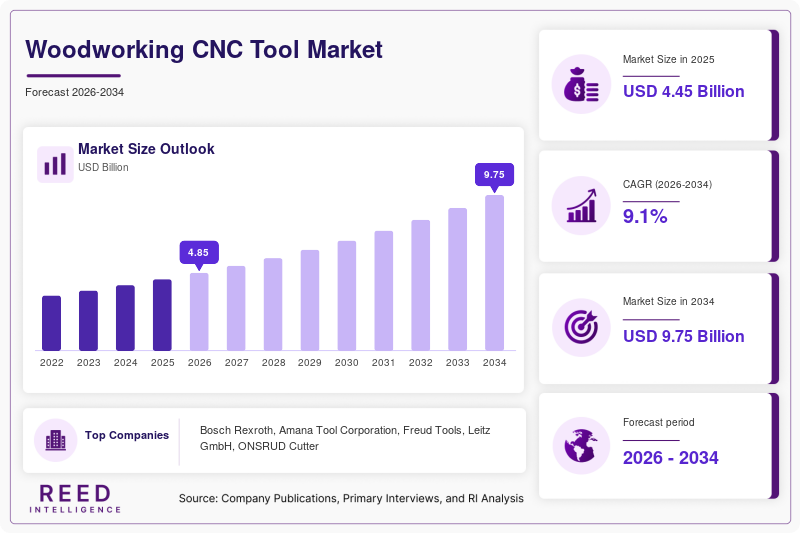
The Woodworking CNC Tool Market size is projected to reach a value of USD 4.85 billion in 2026 and is expected to expand to USD 9.72 billion by 2034, registering a CAGR of 9.1% during 2026–2034. The market growth is primarily driven by the rapid automation of woodworking operations across furniture manufacturing, interior design, and industrial carpentry sectors. Increasing demand for precision-engineered wood products, combined with rising adoption of computer numerical control (CNC) systems, has significantly improved production efficiency, reduced material waste, and enhanced customization capabilities across global woodworking industries.
One of the key global factors supporting market expansion is the shift toward smart manufacturing and Industry 4.0 integration in woodworking facilities. Manufacturers are increasingly investing in CNC routers, cutting tools, and digital design software to improve operational accuracy and reduce manual labor dependency. Additionally, the growing construction and real estate sectors are boosting demand for high-quality wooden fixtures, furniture, and decorative elements, further accelerating CNC tool adoption.
Key Highlights
- North America dominated the market with a 34.2% share in 2025.
- Asia Pacific is expected to grow at the fastest CAGR of 11.2% during 2026–2034.
- By tool type, cutting tools accounted for the largest share of 39.6%, while CNC router bits are projected to grow at a CAGR of 12.1%.
- By application, furniture manufacturing led with a 42.3% share, whereas custom woodworking applications are expected to expand at a CAGR of 11.5%.
- The United States remained the dominant country, with market values of USD 620 million in 2024 and USD 685 million in 2025.
Market Trends
Integration of Smart CNC Automation Systems
The woodworking industry is experiencing a strong shift toward fully automated CNC systems integrated with IoT-enabled monitoring and AI-based optimization tools. These smart systems allow operators to track machine performance in real time, optimize cutting paths, and reduce material waste significantly. Manufacturers are increasingly investing in digital twin technology and predictive maintenance solutions to enhance tool lifespan and minimize downtime. This trend is particularly strong among large-scale furniture producers and industrial woodworking facilities that require high precision and continuous production cycles. As digital manufacturing ecosystems expand, CNC tools are becoming more interconnected with cloud-based design platforms, enabling seamless workflow automation and higher production efficiency across global woodworking operations.
Rising Demand for Precision Customization in Furniture Production
Customization has become a major trend in the woodworking sector, driven by consumer preferences for personalized furniture designs and modular interior solutions. CNC woodworking tools are increasingly used to achieve intricate designs, complex geometries, and high-precision detailing that traditional tools cannot efficiently deliver. This demand is especially strong in premium residential and commercial interior projects. Manufacturers are adopting multi-axis CNC machines and advanced tool heads to improve design flexibility and reduce production time. Additionally, small and medium-sized woodworking workshops are investing in compact CNC tools to meet rising demand for short-run, customized furniture batches, further accelerating market penetration.
Market Drivers
Expansion of Furniture and Construction Industries
The global expansion of the furniture and construction sectors is a major driver of the Woodworking CNC Tool Market. Rapid urbanization, rising disposable incomes, and increased housing development projects have significantly boosted demand for high-quality wooden furniture and interior fixtures. CNC woodworking tools enable manufacturers to meet this growing demand with improved speed, precision, and scalability. In commercial construction, CNC tools are widely used for producing decorative panels, cabinetry, and structural wooden components. The ability to reduce labor costs and material waste further enhances their adoption. As infrastructure development continues across emerging economies, the demand for efficient woodworking solutions is expected to grow steadily.
Technological Advancements in CNC Tooling Systems
Continuous technological innovation in CNC tooling systems is another key growth driver. Modern woodworking CNC tools now incorporate advanced materials such as carbide and diamond-coated cutting heads, improving durability and performance. Additionally, innovations in multi-axis machining and adaptive control systems have significantly enhanced cutting precision and operational efficiency. Software advancements, including CAD/CAM integration, have streamlined design-to-production workflows, allowing manufacturers to execute complex woodworking designs with minimal manual intervention. These technological improvements are encouraging both large manufacturers and small workshops to upgrade from traditional woodworking tools to CNC-based systems, thereby accelerating overall market growth.
Market Restraint
High Initial Investment and Maintenance Costs
One of the primary restraints affecting the Woodworking CNC Tool Market is the high cost associated with CNC machinery and tooling systems. Small and medium-sized woodworking businesses often face financial barriers when adopting advanced CNC tools due to significant upfront investment requirements. Additionally, maintenance costs, including tool replacement, calibration, and software upgrades, further increase operational expenses. The need for skilled operators and technical training also adds to overall costs. In price-sensitive markets, especially in developing regions, these financial constraints limit widespread adoption, slowing down market penetration despite growing demand for automation.
Market Opportunities
Growth of Smart Furniture and Modular Interior Solutions
The rising popularity of smart furniture and modular interior design presents a significant opportunity for the Woodworking CNC Tool Market. As consumers increasingly demand multifunctional and space-efficient furniture, manufacturers are relying on CNC tools to produce highly precise and customizable components. Modular furniture requires accurate machining to ensure seamless assembly and structural stability, which CNC systems can efficiently deliver. Additionally, the growing trend of smart homes is encouraging integration of technologically advanced wooden fixtures, further expanding demand for CNC-based woodworking solutions. This shift is expected to create strong opportunities for tool manufacturers and software developers.
Expansion in Emerging Economies
Emerging economies in Asia Pacific, Latin America, and parts of Africa offer substantial growth opportunities due to rapid industrialization and urban expansion. Countries such as India, Vietnam, and Brazil are witnessing increased investment in furniture manufacturing and construction industries, driving demand for efficient woodworking technologies. Local manufacturers are gradually transitioning from manual woodworking methods to automated CNC systems to improve productivity and compete in global markets. Government initiatives supporting manufacturing modernization and foreign direct investment are further accelerating adoption, creating a favorable environment for CNC woodworking tool suppliers.
Segmental Analysis
By Tool Type
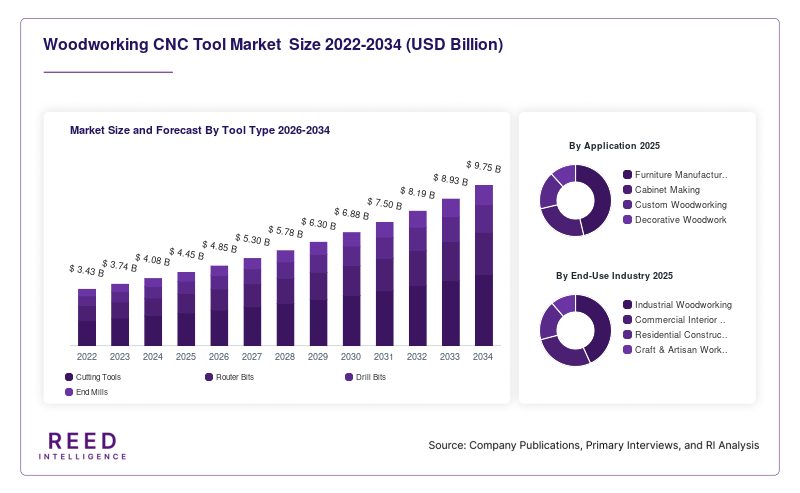
Cutting tools dominated the market with a 41.8% share in 2024, driven by widespread use in precision woodworking applications such as furniture shaping and panel cutting. These tools are essential for achieving smooth finishes and high accuracy in CNC machining processes across industrial woodworking facilities.
Router bits are emerging as the fastest-growing subsegment, expected to register a CAGR of 12.1%. Growth is driven by increasing demand for detailed engraving, carving, and decorative woodworking applications. Advancements in carbide and diamond-coated materials are further enhancing durability and performance.
By Application
Furniture manufacturing accounted for 44.2% share in 2024, making it the dominant application segment. The demand is fueled by large-scale production of residential and office furniture, where CNC tools ensure efficiency and design consistency.
Custom woodworking applications are projected to grow at a CAGR of 11.5%, driven by rising demand for personalized furniture and architectural woodwork. Increasing consumer preference for unique interior designs is accelerating adoption of CNC-based customization.
By End-Use Industry
Industrial woodworking held a 39.5% share in 2024, driven by mass production requirements and high automation adoption in manufacturing facilities. CNC tools are extensively used for standardized production processes in this segment.
Commercial interior design is the fastest-growing segment with a CAGR of 10.9%, supported by rising investments in retail spaces, offices, and hospitality infrastructure. Demand for visually appealing and precise wooden installations is driving CNC tool utilization
Regional Analysis
North America
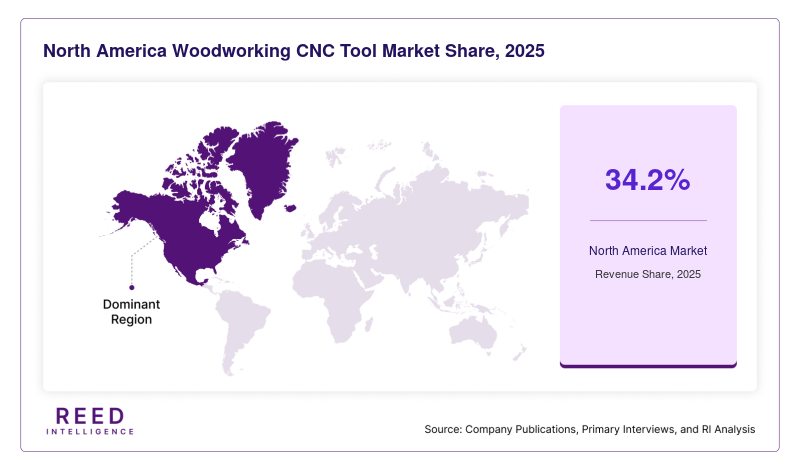
North America accounted for approximately 34.2% of the global Woodworking CNC Tool Market share in 2025, with a projected CAGR of 8.3% during the forecast period. The region remains a mature yet innovation-driven market, supported by strong adoption of automation technologies in woodworking industries. Demand is primarily driven by advanced furniture manufacturing and high-end interior design applications across residential and commercial sectors.
The United States dominates the regional landscape due to its well-established manufacturing base and strong presence of CNC equipment suppliers. A key growth factor is the increasing integration of smart manufacturing systems and robotics in woodworking facilities, enabling higher efficiency and reduced production costs.
Europe
Europe held around 27.5% market share in 2025, with a CAGR of 8.7% projected through 2034. The region benefits from a strong tradition of furniture craftsmanship combined with modern CNC technology adoption. Demand is particularly high in Germany, Italy, and Poland, where woodworking industries are highly developed.
Germany leads the regional market, supported by advanced industrial automation infrastructure. A major growth factor is the rising focus on sustainable manufacturing practices, encouraging the use of precision CNC tools to reduce material waste.
Asia Pacific
Asia Pacific accounted for nearly 22.8% market share in 2025, with the fastest CAGR of 11.2% during 2026–2034. Rapid urbanization, expanding middle-class population, and booming construction activities are key growth drivers in the region.
China dominates the market due to its large-scale furniture production industry. A significant growth factor is the increasing investment in smart factories and export-oriented manufacturing, boosting CNC tool adoption.
Middle East & Africa
The Middle East & Africa region held approximately 8.1% market share in 2025, with a CAGR of 9.0% expected through 2034. Growth is driven by increasing construction projects and rising demand for luxury interiors in urban centers.
The United Arab Emirates leads the region, supported by strong real estate development. A key growth factor is the rising adoption of modern woodworking technologies in high-end commercial and hospitality projects.
Latin America
Latin America accounted for nearly 7.4% market share in 2025, with a CAGR of 8.5% forecasted. Growth is supported by expanding furniture manufacturing industries and increasing residential construction activities.
Brazil dominates the regional market due to its strong woodworking industry base. A major growth factor is the increasing investment in industrial modernization and CNC tool adoption in small and medium enterprises.
Competitive Landscape
The Woodworking CNC Tool Market is moderately fragmented, with key players focusing on innovation, product durability, and digital integration. Leading companies include Bosch Rexroth, Amana Tool, Freud Tools, Leitz GmbH, and ONSRUD Cutter. Bosch Rexroth leads the market with a strong portfolio of advanced CNC tooling systems and automation solutions. Recently, the company expanded its smart tooling division with IoT-enabled CNC monitoring systems to enhance production efficiency and predictive maintenance capabilities.
Key Players List
- Bosch Rexroth
- Amana Tool Corporation
- Freud Tools
- Leitz GmbH
- ONSRUD Cutter
- Mitsubishi Materials Corporation
- Vortex Tool Company
- LMT Onsrud LP
- Dimar Group
- Karnasch Professional Tools
- Woodtech Tooling
- Leuco Tool Corporation
- Tigra GmbH
- Ceratizit Group
- VSM Abrasives
Recent Developments
- Bosch Rexroth launched an AI-enabled CNC monitoring system to improve predictive maintenance in woodworking applications.
- Leitz GmbH introduced a new generation of diamond-coated cutting tools designed for extended operational life.
- Amana Tool expanded its product portfolio with high-precision router bits optimized for automated CNC woodworking systems.
Woodworking CNC Tool Market Segments
By Tool Type
- Cutting Tools
- Router Bits
- Drill Bits
- End Mills
By Application
- Furniture Manufacturing
- Cabinet Making
- Custom Woodworking
- Decorative Woodwork
By End-Use Industry
- Industrial Woodworking
- Commercial Interior Design
- Residential Construction
- Craft & Artisan Workshops
By Region
- North America
- Europe
- APAC
- Middle East and Africa
- LATAM