Workholding Devices Market Size, Share Demand Report By Type (Chucks, Vises, Clamps), By Application (Automotive, Aerospace, General Manufacturing) By Region & Segment Forecasts, 2026–2034
USD 3950
Workholding Devices Market Size
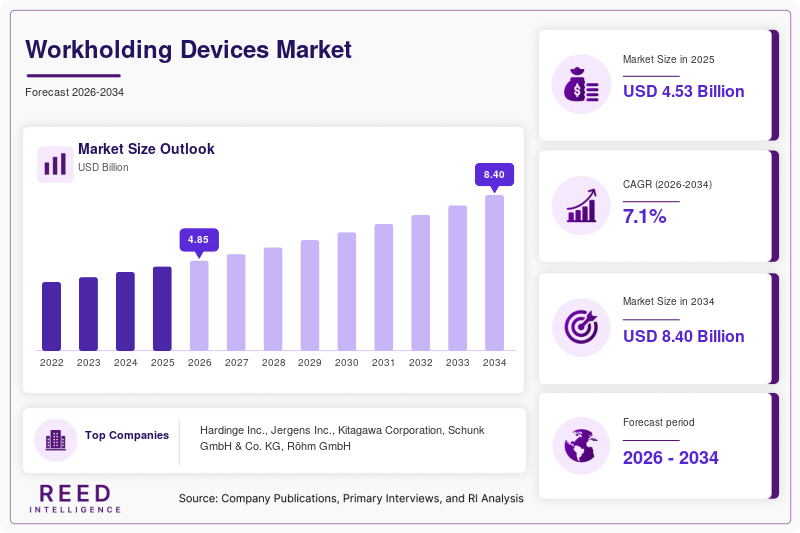
Global workholding devices market size is projected at USD 4.85 billion in 2026 and is expected to hit USD 8.49 billion by 2034 with a CAGR of 7.1%. Demand for workholding equipment is closely linked to machining, metalworking, automated production, and precision manufacturing activity. Detailed data by product type, application, machine compatibility, and region is essential for evaluating production requirements, technology adoption, purchasing patterns, and the competitive landscape among global and specialized workholding manufacturers.
Key takeaways
- Asia Pacific dominated the global market with approximately 42.3% share in 2026, while the region is also projected to record the fastest CAGR of about 8.0% through 2034.
- Chucks represented the largest product category at approximately 38.7% share in 2026, while clamps are projected to expand at around 7.8% CAGR through 2034.
- Automotive applications accounted for approximately 34.8% of global revenue, supported by high-volume machining, engine components, transmission parts, and electric vehicle manufacturing.
- General manufacturing contributed approximately 39.6% share, reflecting demand from CNC machining, metal fabrication, industrial equipment, and precision component production.
- India represents an emerging country opportunity, with the market projected to reach approximately USD 470 million by 2034, expanding at a CAGR of about 9.3% during 2026–2034.
The global workholding devices market encompasses equipment used to securely position, locate, clamp, support, and stabilize workpieces during machining, fabrication, inspection, and automated manufacturing operations. Global production is estimated at more than 21 million workholding units annually, including standard and customized chucks, vises, clamps, fixtures, pallets, and modular systems. Chucks contribute approximately 38.7% of market revenue, followed by vises at 33.5% and clamps at 27.8%. Adoption is increasing as manufacturers deploy multi-axis CNC machines, robotic loading systems, flexible manufacturing cells, and high-speed machining processes that require repeatable positioning and low setup times.
Workholding Devices Market Trends
Automation, Smart Fixturing, and High-Precision Workholding
Technology development is moving workholding systems toward automated, sensor-enabled, and digitally monitored solutions. Hydraulic and pneumatic actuation, quick-change mechanisms, zero-point clamping, modular fixtures, and electronically controlled systems are increasingly integrated with CNC machines and robotic cells. Smart workholding systems can monitor clamping pressure, detect incorrect positioning, and provide feedback to manufacturing control systems, improving process consistency during high-volume production.
Sector-specific requirements are also influencing product design. Automotive manufacturers increasingly require rapid-change systems for flexible production of internal-combustion and electric vehicle components, while aerospace manufacturers prioritize lightweight fixtures, low-deflection clamping, and micron-level repeatability. Medical-device, electronics, and precision-engineering manufacturers are adopting compact workholding solutions for smaller components. Additive manufacturing is additionally creating demand for hybrid workholding systems capable of securing complex geometries during secondary machining.
Workholding Devices Market Drivers
Expansion of CNC and Automated Manufacturing
Increasing deployment of CNC turning centers, machining centers, multi-axis machines, and robotic manufacturing cells is strengthening demand for reliable workholding equipment. Modern production lines require repeatable positioning, high clamping force, fast loading, and reduced setup times. Automated chucks, pneumatic clamps, hydraulic fixtures, and zero-point systems can shorten changeover periods and support continuous production, making advanced workholding increasingly important in high-volume manufacturing environments.
Workholding Devices Market Restraints
High Cost of Advanced and Customized Systems
Advanced workholding systems can require substantial initial investment, particularly when manufacturers need customized fixtures, hydraulic actuation, sensors, quick-change tooling, or machine-specific interfaces. Complex systems can cost several times more than standard mechanical devices and may require specialized engineering and maintenance. Small and medium-sized manufacturers with low production volumes may continue using conventional vises and manual clamps, limiting penetration of premium workholding technologies.
Workholding Devices Market Opportunities
Smart Workholding for Flexible Production
Growing adoption of Industry 4.0 manufacturing creates opportunities for connected workholding products equipped with sensors, automated actuation, and digital monitoring. Manufacturers can integrate clamping data with CNC and manufacturing execution systems to improve process control and predictive maintenance. Demand for flexible production also supports modular fixtures and quick-change systems capable of handling multiple part geometries. Growth in electric vehicles, aerospace components, robotics, and precision medical devices further expands opportunities for specialized workholding solutions.
Challenges in Workholding Devices Market
Balancing Precision, Flexibility, and Production Efficiency
Workholding manufacturers must balance clamping force, dimensional accuracy, accessibility, flexibility, and operating speed across increasingly complex production environments. Excessive clamping pressure can deform thin or delicate components, while insufficient force can cause vibration and workpiece movement. Manufacturers also face challenges in developing fixtures compatible with different machine platforms and component geometries. Maintaining micron-level repeatability over prolonged industrial use requires high-quality materials, precision manufacturing, and regular maintenance.
Workholding Devices Market Segmentation Analysis
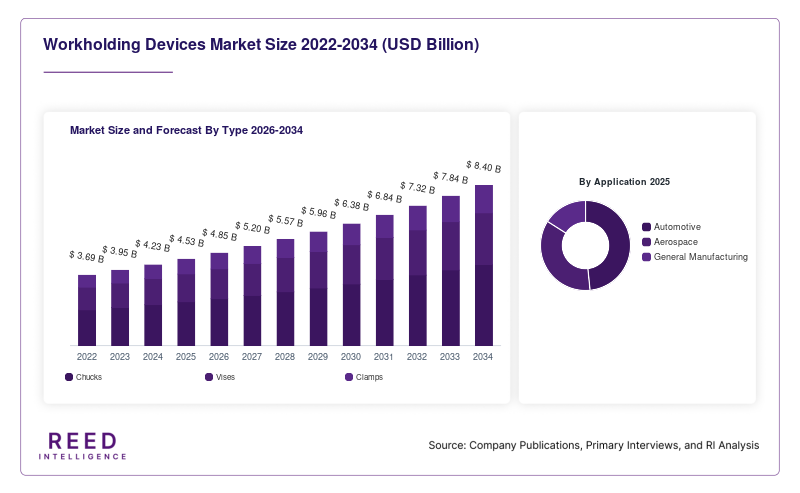
By type, chucks represented approximately 38.7% of 2026 revenue, followed by vises at 33.5% and clamps at 27.8%. By application, general manufacturing accounted for approximately 39.6%, automotive 34.8%, and aerospace 25.6%. Demand is increasingly shifting toward automated and quick-change equipment as manufacturers seek higher machine utilization, shorter setup cycles, improved repeatability, and greater production flexibility.
By Type
Chucks accounted for approximately 38.7% of global revenue in 2026 and represent the largest product category. Global annual production is estimated at more than 8.1 million units, covering three-jaw, four-jaw, collet, power, hydraulic, and pneumatic configurations. Standard industrial chucks commonly range from 80 mm to more than 1,000 mm in diameter, depending on machine requirements. CNC turning, grinding, milling, and rotary machining applications generate substantial demand. Hydraulic and pneumatic models are increasingly preferred for automated production because they provide repeatable clamping force and faster workpiece loading.
Vises represented approximately 33.5% share, with annual global production estimated at 7.0 million units. Products include machine vises, precision vises, modular vises, self-centering vises, and pneumatic or hydraulic variants. Typical jaw widths range from 50 mm to 300 mm, while precision models can provide repeatability within several micrometers. Vises are widely used in CNC machining centers, milling operations, toolrooms, fabrication facilities, and small-batch production. Modular and quick-change designs are gaining adoption because they allow manufacturers to accommodate different workpiece dimensions without extensive setup changes.
Clamps contributed approximately 27.8% of revenue and account for an estimated 5.9 million units of annual production. The category includes toggle clamps, pneumatic clamps, hydraulic clamps, edge clamps, swing clamps, and modular clamping systems. Industrial designs can provide clamping forces ranging from several hundred newtons to more than 10,000 newtons depending on configuration. Automated clamps are increasingly integrated into robotic production cells and machining fixtures, particularly where rapid part loading, unobstructed machining access, and repeatable positioning are required.
By Application
Automotive applications represented approximately 34.8% of 2026 revenue and consume an estimated 7.3 million workholding units annually. Engine blocks, cylinder heads, transmission housings, brake components, shafts, wheels, and electric vehicle components require accurate positioning throughout machining operations. High-volume automotive production favors hydraulic chucks, pneumatic clamps, modular fixtures, and quick-change systems. Manufacturers increasingly use automated workholding to support production rates exceeding several hundred components per shift while maintaining tight dimensional tolerances and consistent machining quality.
Aerospace applications accounted for approximately 25.6% share, corresponding to around 5.4 million units of annual workholding demand. Aircraft structural components, turbine parts, landing-gear components, engine parts, and precision assemblies require high rigidity and controlled clamping to minimize deformation. Lightweight aluminum, titanium, nickel alloys, and composite materials create specialized workholding requirements. Precision fixtures with repeatability commonly within 5–20 micrometers are used for demanding machining operations where component accuracy, accessibility, and surface protection are critical.
General manufacturing represented approximately 39.6% of market revenue and generates more than 8.3 million units of annual demand. The segment includes industrial machinery, electronics, metal fabrication, pumps, valves, agricultural equipment, energy components, and precision engineering. Manufacturers use standard and modular vises, chucks, clamps, and fixtures across CNC milling, turning, drilling, grinding, and assembly operations. Flexible workholding systems are particularly valuable for facilities producing multiple component sizes and smaller production batches.
Workholding Devices Market Regional Analysis
North America Workholding Devices Market
North America accounted for approximately 27.5% of global revenue in 2026, supported by advanced CNC machining, aerospace manufacturing, automotive production, and industrial automation. The United States contributes more than 85% of regional demand, followed by Canada and Mexico. Automotive and aerospace together represent nearly 62% of regional consumption, while general manufacturing contributes approximately 38%. Demand is increasingly oriented toward automated hydraulic, pneumatic, and quick-change workholding systems.
Europe Workholding Devices Market
Europe represented approximately 24.3% share in 2026, with Germany, Italy, France, the United Kingdom, and Switzerland serving as major contributors. Germany accounts for nearly 31% of European demand due to its automotive and industrial machinery base. Automotive represents approximately 35% of regional consumption, aerospace 27%, and general manufacturing 38%. Precision machining, advanced machine tools, and Industry 4.0 investments support demand for digitally integrated workholding.
Asia Pacific Workholding Devices Market
Asia Pacific held approximately 42.3% of global revenue in 2026 and is projected to register the fastest CAGR of around 8.0% through 2034. China, Japan, South Korea, India, and Taiwan are major contributors. General manufacturing contributes approximately 41% of regional demand, automotive 35%, and aerospace 24%. Large-scale machining capacity, electronics manufacturing, automotive production, and expanding automation investments are driving substantial requirements for standardized and customized workholding.
Latin America Workholding Devices Market
Latin America accounted for approximately 3.5% share in 2026, with Brazil and Mexico contributing more than 70% of regional demand. Automotive applications represent about 39%, general manufacturing 42%, and aerospace approximately 19%. Increasing investment in automotive assembly, metalworking, industrial machinery, and nearshoring manufacturing facilities is supporting demand for CNC-compatible workholding products and automated fixtures.
Middle East & Africa Workholding Devices Market
Middle East & Africa contributed approximately 2.4% of global revenue in 2026. The United Arab Emirates, Saudi Arabia, South Africa, and Turkey are significant regional contributors. General manufacturing accounts for approximately 46% of demand, automotive 31%, and aerospace 23%. Investments in industrial diversification, defense manufacturing, energy equipment, metal fabrication, and advanced machining facilities are creating additional requirements for precision workholding equipment.

Top players in Global Workholding Devices Market
- Hardinge Inc.
- Jergens Inc.
- Kitagawa Corporation
- Schunk GmbH & Co. KG
- Röhm GmbH
- Güthle Presspresstechnik GmbH
- Hainbuch GmbH
- Gimatic S.r.l.
- 5th Axis Inc.
- Kurt Manufacturing Company
- TE-CO Manufacturing LLC
- SMW Autoblok GmbH
- Hyfore Workholding
Recent Developments in Global Workholding Devices Market
- 2026, January: Workholding manufacturers expanded automated hydraulic and pneumatic clamping portfolios designed for robotic machine tending and high-volume CNC production.
- 2025, November: Industry suppliers increased development of sensor-enabled workholding systems capable of monitoring clamping force, component position, and fixture status.
- 2025, August: Precision tooling manufacturers introduced additional modular and quick-change workholding solutions aimed at reducing CNC setup and changeover times.
- 2025, April: Advanced machining suppliers expanded lightweight and high-rigidity fixtures for aerospace components made from titanium, aluminum, and composite materials.
- 2024, October: Workholding technology providers strengthened zero-point clamping and automated palletization solutions for flexible manufacturing cells and multi-machine production environments.
Workholding Devices Market Segments
By Type
- Chucks
- Vises
- Clamps
By Application
- Automotive
- Aerospace
- General Manufacturing
By Region
- North America
- Europe
- APAC
- Middle East and Africa
- LATAM