Workholding Market Size, Share, Growth Demand Report by Type (Mechanical, Hydraulic, Pneumatic, Magnetic), By Application (Milling, Drilling, Grinding, Turning, Welding), By End-Use Industry (Automotive, Aerospace, Electronics, Industrial Machinery, Energy), By Distribution Channel (Direct Sales, Distributors, Online Channels), By Region & Segment Forecasts, 2026–2034
USD 3950
Market Overview
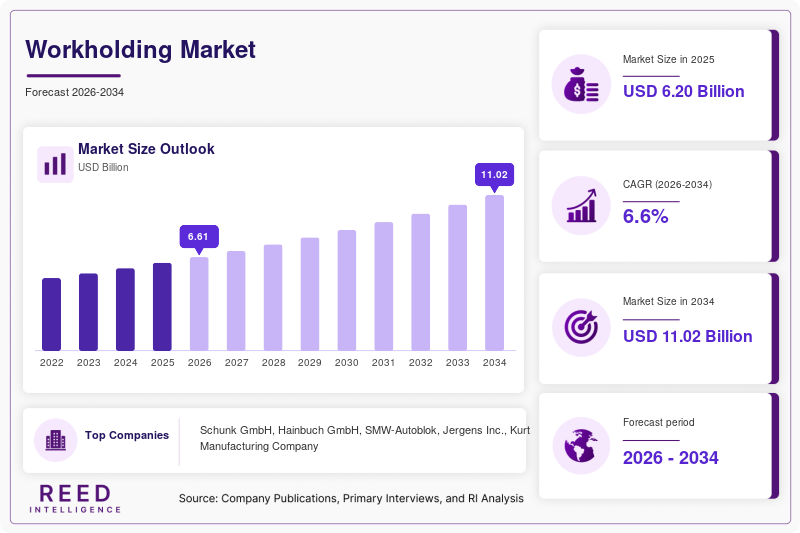
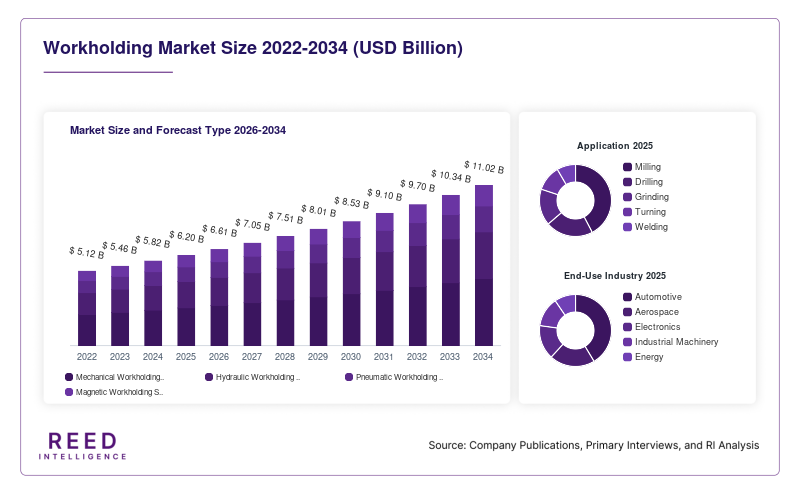
The Workholding Market Size was valued at approximately USD 6.2 billion in 2026 and is projected to reach USD 10.4 billion by 2034, expanding at a CAGR of 6.6% during the forecast period (2026–2034). The market growth is primarily supported by the rising adoption of precision machining systems, expansion of CNC-based manufacturing, and increasing demand for high-efficiency production across automotive and aerospace industries.
A key global factor driving the Workholding Market size is the rapid expansion of advanced manufacturing ecosystems, where automation and digital machining technologies are improving production accuracy and reducing cycle times. This has significantly increased demand for high-performance workholding solutions across industrial applications.
Key Highlights
- Dominant Region (2025): Asia Pacific held 36% share, supported by large-scale manufacturing bases and strong CNC machine adoption across China, Japan, and India.
- Fastest-Growing Region: North America is projected to grow at a CAGR of 6.9% (2026–2034) due to rising automation in precision machining industries and increased adoption of smart manufacturing technologies.
- Leading Subsegment (Type): Mechanical workholding systems dominated with 48% share in 2025, driven by cost efficiency and widespread industrial adoption.
- Fastest-Growing Subsegment (Type): Hydraulic workholding systems are expected to grow at a CAGR of 7.4%, supported by demand for high-force clamping applications in aerospace and heavy machining.
- Dominant Country (2024): China accounted for approximately USD 1.3 billion, driven by strong industrial expansion and manufacturing output growth.
- Dominant Country (2025): China increased to USD 1.5 billion, supported by rapid CNC integration and industrial automation investments.
Market Trends
Integration of Smart and Sensor-Based Workholding Systems
The Workholding Market is undergoing a significant transformation with the integration of smart and sensor-enabled fixturing systems that allow real-time monitoring of machining parameters such as clamping force, vibration levels, and tool positioning accuracy. These intelligent systems are increasingly being integrated into connected manufacturing environments, where data-driven decision-making improves operational efficiency. The growing adoption of predictive maintenance and digital twin technologies is further enhancing the value proposition of smart workholding systems in high-precision manufacturing facilities.
Shift Toward Modular and Flexible Fixturing Solutions
Another key trend shaping the Workholding Market is the increasing shift toward modular and reconfigurable fixturing systems designed for flexible manufacturing environments. These systems allow manufacturers to quickly adapt to changing production requirements, particularly in industries where product customization and small batch production are becoming more common. Modular solutions significantly reduce machine downtime and setup time, making them highly suitable for aerospace prototyping, automotive tooling, and precision component manufacturing applications.
Market Drivers
Growth in CNC and Automated Machining Adoption
The rising adoption of CNC machining centers across global manufacturing industries is one of the most important growth drivers for the Workholding Market. CNC machines require highly precise and stable workholding systems to ensure machining accuracy, repeatability, and surface finish quality. As manufacturers increasingly shift toward automated production lines, the demand for advanced clamping systems capable of supporting high-speed machining operations continues to rise steadily across multiple end-use industries.
Rising Demand from Automotive and Aerospace Manufacturing
The automotive and aerospace sectors are significantly contributing to the expansion of the Workholding Market, as both industries require extremely precise machining of complex components made from advanced materials. Increasing production of electric vehicles, lightweight aircraft structures, and high-performance engine components is creating sustained demand for high-accuracy workholding systems. These systems ensure dimensional stability during machining, which is critical for meeting strict industry quality and safety standards.
Market Restraint
High Initial Investment and Maintenance Complexity
Despite strong growth potential, the Workholding Market faces certain limitations due to high initial investment requirements and ongoing maintenance complexity associated with advanced fixturing systems. Hydraulic and smart workholding solutions often require specialized installation, skilled labor, and regular calibration, which increases operational costs for small and mid-sized manufacturers. This cost barrier can limit adoption in price-sensitive markets, particularly in developing economies where industrial automation is still in early stages.
Market Opportunities
Expansion of Additive Manufacturing Support Fixtures
The increasing adoption of additive manufacturing is opening new opportunities for the Workholding Market, particularly in post-processing applications where 3D-printed components require secondary machining operations. Specialized fixtures designed for hybrid manufacturing environments are gaining traction, as they provide stability during milling, drilling, and finishing processes. This emerging application area is expected to create new revenue streams for manufacturers developing advanced and adaptable workholding systems.
Growth in Emerging Manufacturing Economies
Rapid industrialization across Southeast Asia, Latin America, and parts of the Middle East is generating strong opportunities for expansion in the Workholding Market. These regions are witnessing increased investment in automotive assembly plants, electronics manufacturing units, and general industrial production facilities. As manufacturing capacity expands, demand for cost-effective and scalable workholding systems is expected to grow steadily, particularly in mid-tier industrial applications.
Segmental Analysis
By Type
The Workholding Market is segmented into mechanical, hydraulic, pneumatic, and magnetic systems, each serving distinct industrial requirements. Mechanical workholding systems dominated with 48% share in 2025, largely due to their cost-effectiveness, durability, and widespread use in general machining applications. In contrast, hydraulic systems are expected to witness faster growth at a CAGR of 7.4%, driven by their ability to deliver high clamping force and stability required in aerospace and heavy-duty machining operations.
By Application
Applications include milling, drilling, grinding, turning, and welding processes across manufacturing industries. Milling accounted for 34% share in 2025, supported by its extensive use in precision component production across automotive and industrial machinery sectors. Grinding applications are projected to grow at a CAGR of 7.1%, driven by rising demand for high-surface-quality components in aerospace and advanced engineering applications.
By End-Use Industry
The market is segmented into automotive, aerospace, electronics, industrial machinery, and energy sectors. Automotive dominated with 39% share in 2025, driven by high-volume production of engine, chassis, and drivetrain components. Aerospace is expected to grow at a CAGR of 7.5%, supported by increasing aircraft production and rising demand for lightweight, high-precision structural components.
By Distribution Channel
Distribution channels include direct sales, distributors, and online procurement platforms. Direct sales accounted for 52% share in 2025, as OEMs prefer customized solutions and long-term supplier relationships. Online channels are expected to grow at a CAGR of 7.0%, supported by increasing digitalization of industrial procurement processes and growing availability of standardized tooling systems.
Regional Analysis
North America
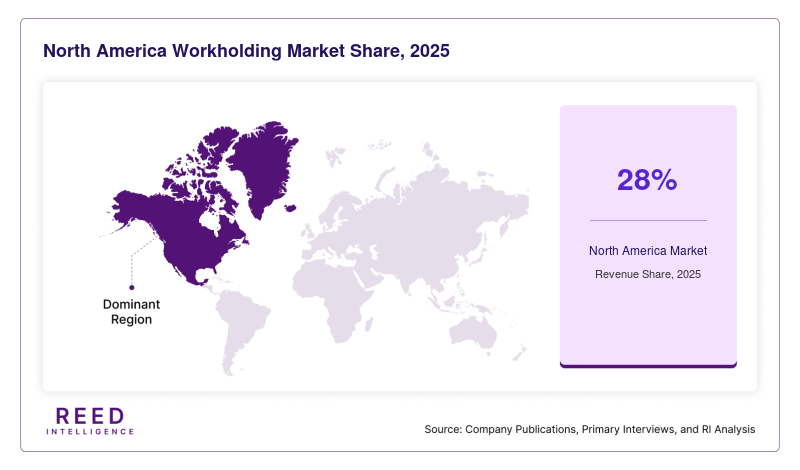
North America accounted for 28% share of the Workholding Market in 2025 and is expected to expand at a CAGR of 6.9% (2026–2034). The region is witnessing strong growth due to the rapid adoption of advanced manufacturing technologies, including CNC automation and robotic machining systems. The United States remains the primary contributor, supported by strong aerospace production, defense manufacturing, and increasing investment in smart factory infrastructure.
Europe
Europe held 26% share in 2025 and is projected to grow at a CAGR of 6.2% (2026–2034). Growth in this region is strongly influenced by its well-established automotive manufacturing base and precision engineering industry. Germany continues to dominate regional demand due to its advanced machine tool ecosystem and strong focus on high-precision industrial production systems used in automotive and mechanical engineering sectors.
Asia Pacific
Asia Pacific dominated with 36% share in 2025 and is expected to grow at a CAGR of 6.7% (2026–2034). The region’s growth is driven by large-scale industrialization, expanding manufacturing output, and increasing exports of industrial machinery and automotive components. China leads the region due to its massive CNC machine deployment, strong manufacturing infrastructure, and continuous investment in industrial automation technologies.
Middle East & Africa
The Middle East & Africa region accounted for 6% share in 2025 and is projected to grow at a CAGR of 6.5% (2026–2034). Growth is primarily driven by economic diversification efforts in countries such as the UAE and Saudi Arabia, where governments are actively investing in non-oil industrial sectors. Increasing development of manufacturing zones and industrial clusters is further supporting demand for advanced machining infrastructure.
Latin America
Latin America held 4% share in 2025 and is expected to grow at a CAGR of 6.3% (2026–2034). Brazil leads regional demand due to its expanding automotive production base and increasing industrial machinery manufacturing activities. The region is gradually strengthening its manufacturing ecosystem through foreign direct investment and modernization of production facilities.
Competitive Landscape
The Workholding Market is moderately competitive, with leading players focusing on innovation in automation, modular fixturing systems, and sensor-integrated solutions. Companies are increasingly investing in digital manufacturing compatibility to support Industry 4.0 adoption across machining environments.
Schunk GmbH leads the market with a strong portfolio of advanced clamping and gripping systems, including sensor-enabled solutions designed for real-time machining monitoring. Hainbuch GmbH and SMW-Autoblok continue to strengthen their positions through precision clamping technologies and hydraulic system innovations. Meanwhile, Gerardi SPA focuses on modular fixturing systems, and Jergens Inc. is expanding its automation-ready fixture offerings across North America.
Key Players List
- Schunk GmbH
- Hainbuch GmbH
- SMW-Autoblok
- Jergens Inc.
- Kurt Manufacturing Company
- Lang Technik
- Okuma Corporation
- Gerardi SPA
- Kitagawa NorthTech
- Vektek LLC
- 3R Systems
- Norelem GmbH
- Roemheld GmbH
- AMF Andreas Maier GmbH
- Erowa AG
Recent Developments
- Schunk expanded its smart clamping systems with integrated IoT monitoring capabilities.
- Hainbuch introduced next-generation modular workholding solutions for flexible manufacturing.
- SMW-Autoblok increased hydraulic system production for aerospace machining applications.
- Jergens launched new automation-ready fixture systems for CNC integration.
- Gerardi enhanced modular fixturing platforms for high-speed machining environments.
- Kitagawa introduced upgraded precision chuck systems for turning operations.
- Several companies expanded digital procurement platforms for industrial tooling systems.
Workholding Market Segments
Type
- Mechanical Workholding Systems
- Hydraulic Workholding Systems
- Pneumatic Workholding Systems
- Magnetic Workholding Systems
Application
- Milling
- Drilling
- Grinding
- Turning
- Welding
End-Use Industry
- Automotive
- Aerospace
- Electronics
- Industrial Machinery
- Energy
Distribution Channel
- Direct Sales
- Distributors
- Online Channels
By Region
- North America
- Europe
- APAC
- Middle East and Africa
- LATAM