Workwear And Uniforms Market Size, Share & Trends Analysis Report By Product Type (General Workwear, Protective Workwear, Corporate & Service Uniforms, Healthcare & Hospitality Uniforms, High-Visibility Workwear), By Material (Cotton & Cotton Blends, Polyester & Synthetic Fabrics), By End Use (Manufacturing, Construction, Healthcare, Hospitality & Foodservice), By Distribution Channel (Direct Sales, Uniform Rental & Managed Services, Distributors & Retail, Online Channels) Forecasts, 2026–2034
USD 3950
Workwear And Uniforms Market Size
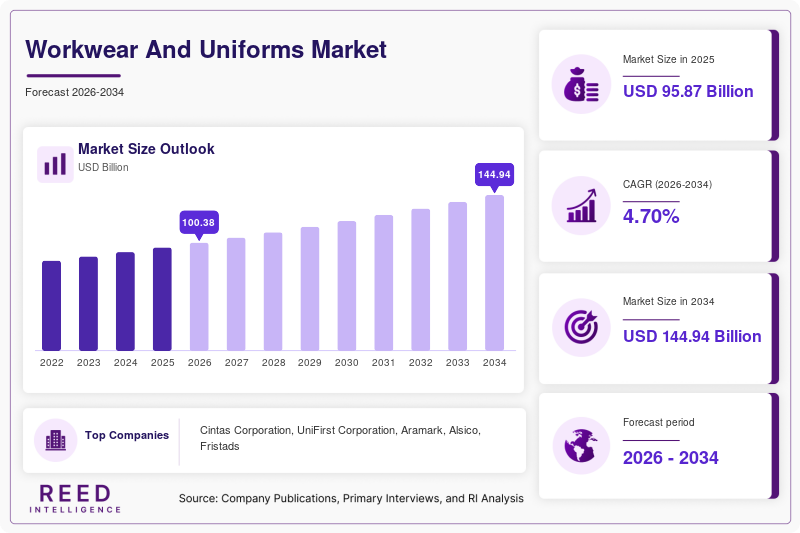
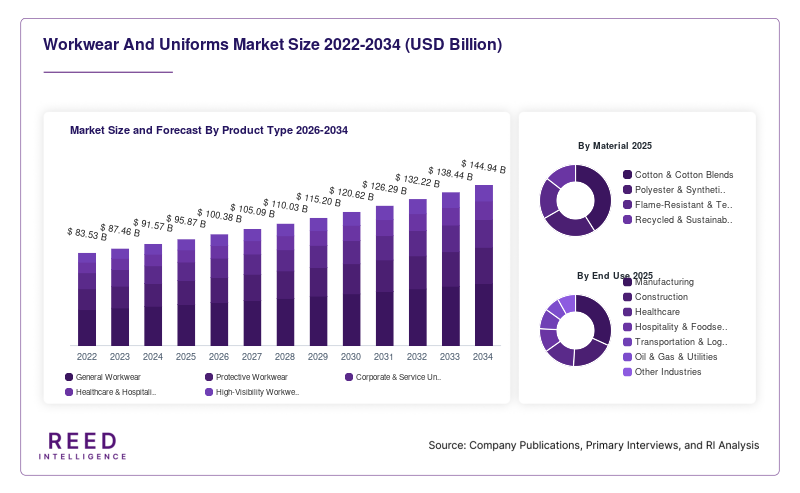
The global workwear and uniforms market size was valued at USD 95.87 Billion in 2025 and is projected to grow from USD 100.17 Billion in 2026 to USD 144.94 billion by 2034, registering a CAGR of 4.70% during the forecast period from 2026 to 2034.
Workwear and uniform demand is supported by a large global workforce, workplace-safety requirements, employer branding, employee retention initiatives, and recurring garment replacement. The International Labour Organization reported in January 2026 that global unemployment was projected to remain at 4.9% in 2026, while the broader global jobs gap was projected at 408 million people, illustrating the continued scale of the global labor market.
The market is also shifting from basic apparel procurement toward managed uniform programs and technically specified garments. Cintas reported USD 11.26 billion in fiscal 2026 revenue and 8.3% organic revenue growth, while its offering spans uniforms, protective clothing, facility services and safety products. The company's proposed USD 5.5 billion acquisition of UniFirst would combine processing capacity, route networks, supply chains and technology across approximately 1.5 million business customers in North America.
Safety regulation directly creates requirements for protective workwear. In the U.S., OSHA's construction PPE rule effective January 2025 explicitly requires employers to ensure PPE properly fits workers. In Europe, PPE Regulation (EU) 2016/425 remains the principal framework for protective equipment, with updated harmonized standards issued by the European Commission in June 2026.
Workwear And Uniforms Market Drivers
Workplace safety requirements sustain recurring protective-wear demand
Workwear is not purely discretionary apparel when garments are specified for workplace hazards. OSHA requires employers to provide appropriate PPE where employees are exposed to hazardous conditions, while its construction rule explicitly requires properly fitting PPE. In lead-exposure applications, OSHA specifically identifies protective clothing such as coveralls as part of required protective measures. This creates recurring procurement across construction, manufacturing, utilities, chemical processing, transportation and other hazardous occupations. Europe applies a similarly formal regulatory framework through Regulation (EU) 2016/425, which establishes design and manufacturing requirements for PPE placed on the EU market. The commercial effect is a relatively resilient demand base for flame-resistant garments, high-visibility clothing, protective coveralls, chemical-resistant apparel and specialized industrial uniforms. Replacement cycles are also shortened when garments are damaged, contaminated or no longer meet applicable specifications.
Large employment bases across industrial and service sectors create broad uniform demand
Workwear demand is distributed across both industrial and service occupations. U.S. Bureau of Labor Statistics data show 6.4 million workers in construction and extraction occupations in May 2025, while private payroll data for August 2026 recorded approximately 6.1 million construction employees and 8.7 million manufacturing production and nonsupervisory employees. India provides another major workforce base: its 2025 Periodic Labour Force Survey showed construction accounting for 12.0% of employment and manufacturing 12.1%. These employment pools generate different procurement requirements, ranging from rugged garments for construction and manufacturing to branded shirts, trousers and service apparel for hospitality, logistics and retail. Consequently, market growth does not depend on one industry alone. Uniform programs also create recurring replacement demand because employers typically purchase multiple garments per employee and replenish inventory as workers join, leave or change roles.
Employer outsourcing is increasing the value of uniform programs
The commercial model is moving beyond garment sales toward rental, laundering, repair, replacement, inventory management and compliance services. Cintas reported that its Uniform Rental and Facility Services segment generated approximately USD 7.98 billion in fiscal 2025, with growth attributed to new business, additional products and services sold to existing customers and price increases. In fiscal 2026, Cintas' total revenue increased 8.9% to USD 11.26 billion, with the company highlighting investments in technology, capacity and talent. This model changes purchasing behavior because customers can outsource garment procurement and maintenance rather than maintaining internal uniform inventories. It also creates higher customer retention through route networks, laundering infrastructure and service contracts. The proposed Cintas-UniFirst combination illustrates the strategic value of scale in processing, distribution and service infrastructure.
Workwear And Uniforms Market Restraints
Raw-material, labor and supply-chain costs can pressure margins
Workwear manufacturers must balance durability and technical performance against material and production costs. Cotton, polyester, specialty fibers, dyes, trims and protective finishes can all affect garment costs, while global sourcing exposes suppliers to freight, currency and geopolitical risks. VF's 2026 filing illustrates this exposure: the company reported that its products were sourced from independent manufacturers primarily located in Asia and highlighted global supply-chain and geopolitical risks. Workwear companies also cannot always substitute the cheapest materials because garments may need to meet specific durability, visibility, flame-resistance or protective requirements. Higher costs can therefore translate into higher employer procurement prices or lower manufacturer margins. Smaller uniform suppliers may have less purchasing power than large rental-service providers, making scale an important factor in procurement and production economics.
Sustainability requirements increase product-development complexity
The workwear industry faces pressure to reduce textile waste while maintaining durability and safety performance. Fristads reports that approximately 98% of its product-related emissions come from producing workwear, including raw-material production, dyeing, finishing and sewing. The company has therefore emphasized durability, repair, reuse, recycling and alternative materials including recycled polyester, organic cotton and circular fibers. Sustainability can increase design and sourcing complexity because recycled or lower-impact materials must still satisfy performance requirements and employer specifications. For uniform-rental companies, extending garment life can reduce replacement volumes but requires repair, sorting and reverse-logistics infrastructure. The market therefore faces a trade-off between reducing environmental impact, maintaining protective performance and controlling total ownership costs.
Workwear And Uniforms Market Opportunities
Managed uniform services provide a scalable recurring-revenue opportunity. Employers increasingly have reasons to outsource uniform procurement, cleaning, repair, replacement and inventory management. Cintas' fiscal 2026 results demonstrate the scale of this model, while its proposed UniFirst acquisition would combine service locations, processing capacity, route networks and supply-chain infrastructure. The opportunity extends beyond traditional industrial uniforms into healthcare, hospitality, foodservice, logistics and corporate service apparel. Digital inventory management can further improve size allocation and replenishment, reducing the amount of unused garment stock held by employers.
Technical and sustainable workwear can increase product value per garment. Employers increasingly need apparel that combines durability, comfort, weather protection, visibility and hazard-specific protection. OSHA's 2025 construction PPE rule places explicit emphasis on proper fit, while EU PPE requirements establish formal conformity requirements for protective equipment. At the same time, manufacturers such as Fristads are developing garments around durability, repair, reuse and recycled materials. This creates room for products that reduce replacement frequency, improve worker comfort and satisfy sustainability procurement requirements without compromising required protection.
Segmental Analysis
By Product Type
General workwear accounts for approximately 34% of the global market in 2025, making it the largest product category. The segment includes durable shirts, trousers, jackets, coveralls and utility garments used where the primary requirements are durability, comfort, identification and workplace practicality rather than specialized hazard protection. Its customer base spans construction, manufacturing, maintenance, logistics, utilities and service businesses. Large employers typically require standardized colors, logos and garment specifications across their workforce, creating recurring replacement demand. Cintas and UniFirst both operate broad uniform and workwear programs that serve businesses across multiple industries.
Protective Workwear: Protective workwear is the fastest-growing product category, with a CAGR of approximately 5.8%. Its expansion is linked to occupational-safety requirements and increasing attention to proper fit and task-specific protection. OSHA's construction standard now explicitly requires PPE to fit affected workers, while EU PPE rules establish health and safety requirements for protective equipment. Flame-resistant, chemical-resistant, high-visibility and specialized industrial garments therefore maintain demand even when discretionary apparel spending is weaker.
By Material
Cotton and cotton-blend fabrics represent approximately 39% of the market in 2025, supported by comfort, breathability and familiarity across general workwear, healthcare, hospitality and service uniforms.
Recycled & Sustainable Materials: Recycled and sustainable materials are the fastest-growing material category at approximately 8.1% CAGR. Sustainability programs are increasingly moving from corporate reporting into product specifications. Fristads, for example, is transitioning toward recycled polyester, organic cotton and circular fibers while emphasizing durability and repairability. The growth mechanism is therefore not simply consumer preference; institutional procurement requirements can influence fabric selection across large uniform programs.
By End Use
Manufacturing represents approximately 24% of the market in 2025. Factories require garments that tolerate repeated washing, abrasion, heat, machinery environments and specific workplace hazards. India's 2025 labor statistics show manufacturing at 12.1% of employment, while U.S. payroll data show 8.7 million private manufacturing production and nonsupervisory employees in August 2026.
Healthcare: Healthcare is the fastest-growing end-use category at approximately 6.0% CAGR. Hospitals and healthcare facilities require standardized apparel across clinical and support staff, while infection-control, laundering, comfort and identification requirements influence garment specifications. Expansion of healthcare employment and continued professionalization of facility services support recurring uniform procurement.
By Distribution Channel
Direct sales account for approximately 37% of the market in 2025, particularly among large organizations that negotiate standardized uniform contracts directly with manufacturers or managed-service providers.
Uniform Rental & Managed Services: Uniform rental and managed services are the fastest-growing channel at approximately 6.3% CAGR. The model converts apparel purchasing into a recurring service that can include garment supply, laundering, repair, replacement and inventory management. Cintas' Uniform Rental and Facility Services business generated USD 7.98 billion in fiscal 2025, illustrating the commercial scale of this model.
Regional Analysis
North America Workwear And Uniforms Market
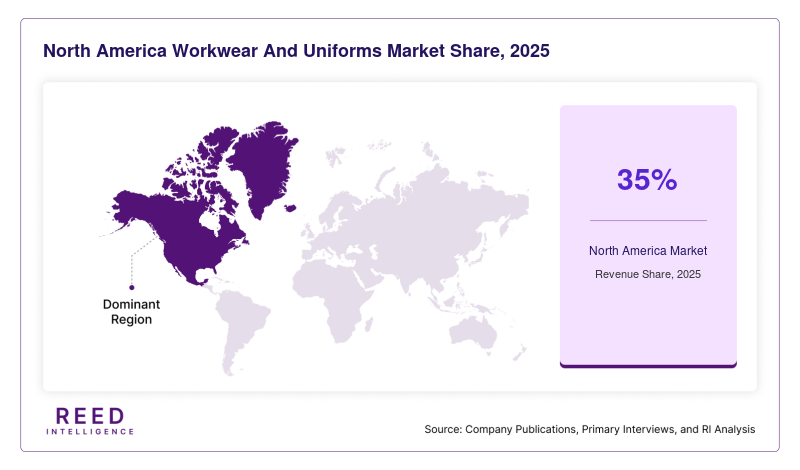
North America represents approximately 35% of the global workwear and uniforms market in 2025, supported by a large industrial and service workforce, established uniform-rental infrastructure and stringent occupational-safety requirements.
The U.S. has a particularly strong recurring demand base. BLS data show 6.4 million workers in construction and extraction occupations in May 2025, while August 2026 payroll data recorded approximately 6.1 million construction employees and 8.7 million manufacturing production and nonsupervisory employees. These workers represent substantial addressable demand for industrial workwear, high-visibility clothing, protective apparel and employer-branded uniforms.
Regulation is an important commercial mechanism. OSHA's construction PPE rule, effective January 13, 2025, explicitly requires properly fitting PPE. OSHA specifically noted that poor-fitting protective clothing can reduce protection and discourage use. This increases the relevance of broader size ranges and better garment-fitting systems.
The service model is also highly developed. Cintas generated USD 11.26 billion in fiscal 2026 revenue, with its offering covering uniforms, protective clothing, safety and facility services. Its proposed acquisition of UniFirst would expand the combined customer base to approximately 1.5 million businesses across North America.
North America is projected to grow at approximately 4.2% CAGR through 2034.
Europe Workwear And Uniforms Market
Europe accounts for approximately 27% of the global market in 2025. Demand is supported by industrial employment, healthcare, construction, logistics, hospitality and formal occupational-safety requirements.
The regulatory environment is particularly important for protective workwear. Regulation (EU) 2016/425 establishes requirements for PPE design and manufacture, while the European Commission issued updated harmonized PPE standards in June 2026 and subsequently amended the standards decision in September 2026. This creates technical barriers to entry but also supports demand for certified protective products.
Sustainability is another important regional purchasing factor. Workwear manufacturers are increasing the use of recycled fibers, organic materials and circular-service models. Fristads reported that it had rolled out a repair, reuse and recycling service across its markets in 2024, moving sustainability beyond garment design into product lifecycle management.
European demand is therefore increasingly differentiated by garment durability, environmental performance, conformity documentation and lifecycle cost rather than purchase price alone.
Europe is projected to expand at approximately 4.4% CAGR.
APAC Workwear And Uniforms Market
APAC represents approximately 25% of the global market in 2025 and is the fastest-growing region, with a CAGR of approximately 6.1%.
The region has a very large industrial workforce and extensive manufacturing supply chains. India's 2025 employment data show manufacturing representing 12.1% of employment and construction 12.0%, providing a substantial domestic user base for workwear. China, Japan, South Korea, India and Southeast Asian manufacturing centers also contribute to regional demand across factories, logistics, construction and infrastructure projects.
The purchasing mechanism differs from mature North American and European markets. Price remains important among smaller employers, while multinational manufacturers often require standardized global safety specifications. This creates parallel demand for basic uniforms and technically specified garments.
Industrial expansion, infrastructure development, occupational-safety awareness and international supply-chain standards support higher-value protective clothing. Manufacturers with regional production and distribution capabilities can also serve both domestic customers and multinational procurement programs.
The main constraints include fragmented distribution, price competition, differences in national safety standards and varying levels of formal uniform adoption. APAC is projected to maintain the fastest regional growth at approximately 6.1% CAGR.
Middle East and Africa Workwear And Uniforms Market
Middle East and Africa account for approximately 7% of the global market in 2025 and are projected to expand at approximately 5.2% CAGR.
Construction, oil and gas, utilities, logistics, hospitality and large infrastructure programs create significant requirements for protective clothing and standardized uniforms. In hot climates, garment design increasingly needs to balance protection with breathability, moisture management and thermal comfort.
The region also has a strong institutional customer base because large construction and energy projects frequently impose standardized safety and identification requirements across contractors. This favors suppliers able to deliver high-visibility garments, flame-resistant apparel and technical workwear at scale.
The principal constraints are price sensitivity among smaller businesses, imported-product dependence in some markets and differences in procurement standards. Demand is stronger in Gulf markets with large infrastructure and hospitality investment, while African markets offer longer-term opportunities through industrialization and formalization of workplace-safety practices.
Latin America Workwear And Uniforms Market
LATAM represents approximately 6% of the global market in 2025 and is projected to grow at approximately 5.4% CAGR.
Manufacturing, construction, mining, energy, agriculture, logistics and hospitality form the principal customer base. Brazil and Mexico provide the region's largest industrial and commercial demand centers, while mining and energy projects create specialized requirements for flame-resistant, high-visibility and durable workwear.
Purchasing behavior varies considerably between multinational employers and smaller local businesses. Large companies tend to specify standardized garments and safety certifications, while smaller employers remain more price-sensitive and may purchase through distributors rather than managed-service programs.
The regional opportunity is therefore strongest where formal occupational-safety requirements intersect with industrial expansion. Local distribution and after-sales availability remain important because employers need consistent garment sizing, replacement stock and access to specialized products.
Competitive Landscape
The workwear and uniforms market combines apparel manufacturers, protective-equipment specialists, uniform distributors and large managed-service companies. Competition is based on garment durability, technical certifications, fit, comfort, customization, distribution reach and the ability to provide lifecycle services.
Cintas has a particularly broad managed-service model covering uniforms, protective clothing, safety products and facility services. Its fiscal 2026 revenue reached USD 11.26 billion, while organic revenue grew 8.3%. The proposed acquisition of UniFirst for approximately USD 5.5 billion would combine processing capacity, route networks, service infrastructure, supply chains and technology. UniFirst shareholders approved the transaction in June 2026, although completion remained subject to regulatory processes at that point.
Apparel brands compete through specialized product portfolios and distribution. VF Corporation reported that Dickies was its largest Work brand before the company sold the business to Bluestar Alliance for USD 600 million in November 2025. The transaction changed the competitive structure by moving one of the best-known workwear brands into a standalone ownership platform.
Key Market Players
- Cintas Corporation
- UniFirst Corporation
- Aramark
- Alsico
- Fristads
- MASCOT International
- Engelbert Strauss
- Blåkläder
- Snickers Workwear
- Carhartt
- VF Corporation
- Bluestar Alliance / Dickies
- Honeywell
- 3M
- Ansell
- DuPont
- Kimberly-Clark
- Lakeland Industries
- Portwest
- Delta Plus
- uvex group
- Würth Group
- Elis
- Berendsen
- Hultafors Group
Recent Market Developments
- September 2026 – European Commission: The European Commission updated the harmonized standards framework supporting PPE Regulation (EU) 2016/425, maintaining technical conformity requirements for protective equipment sold in the EU.
- July 2026 – Cintas: Cintas reported USD 11.26 billion in fiscal 2026 revenue, up 8.9%, with organic revenue growth of 8.3%. The company highlighted investments in technology, capacity and talent.
Workwear And Uniforms Market Segments
By Product Type
- General Workwear
- Protective Workwear
- Corporate & Service Uniforms
- Healthcare & Hospitality Uniforms
- High-Visibility Workwear
By Material
- Cotton & Cotton Blends
- Polyester & Synthetic Fabrics
- Flame-Resistant & Technical Fabrics
- Recycled & Sustainable Materials
By End Use
- Manufacturing
- Construction
- Healthcare
- Hospitality & Foodservice
- Transportation & Logistics
- Oil & Gas & Utilities
- Other Industries
By Distribution Channel
- Direct Sales
- Uniform Rental & Managed Services
- Distributors & Retail
- Online Channels
By Region
- North America
- Europe
- APAC
- Middle East and Africa
- LATAM