Wound Care Management Devices Market Size, Share Demand Report By Product Type (NPWT Devices, Moist Wound Therapy Devices, Hyperbaric Oxygen Therapy Devices, Electrical Stimulation Devices), By Application (Chronic Wounds, Acute Wounds, Surgical Wounds), By End User (Hospitals, Home Care Settings, Specialty Clinics) & Segment Forecasts, 2026–2034
USD 3950
Wound Care Management Devices Market Size
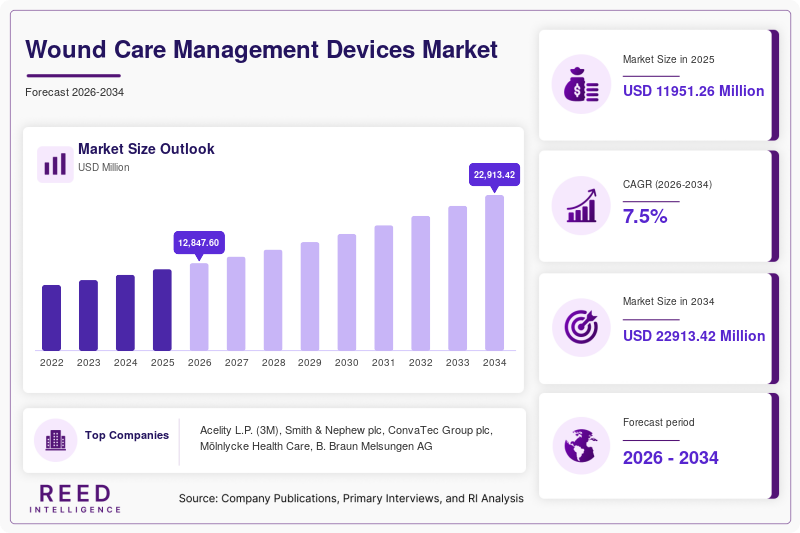
Wound Care Management Devices market size is projected at USD 12,847.6 million in 2026 and is expected to hit USD 22,847.5 million by 2034 with a CAGR of 7.5% during the forecast period. The increasing global prevalence of chronic wounds, such as diabetic foot ulcers and pressure ulcers, coupled with the rising number of surgical procedures and traumatic injuries, underpins market expansion. This report delivers a comprehensive analysis of the Wound Care Management Devices market, including segmentation by type and application, competitive dynamics, and regional growth patterns, equipping stakeholders with critical intelligence. The Wound Care Management Devices market continues to demonstrate strong growth potential, fueled by the growing aging population, the increasing incidence of diabetes and obesity, and continuous innovation in advanced wound care technologies.
Wound care management devices are advanced medical devices used to facilitate and promote the healing of various types of wounds. These devices include negative pressure wound therapy (NPWT) systems, moist wound therapy devices, hyperbaric oxygen therapy chambers, and electrical stimulation devices. The global production volume of wound care management devices exceeded 18 million units in 2025, reflecting a 7% increase from 2023, driven by the growing demand for effective and advanced wound care solutions. Adoption patterns reveal that the NPWT Devices type dominates the market, accounting for 38% of total demand, followed by Moist Wound Therapy Devices at 28%, Hyperbaric Oxygen Therapy Devices at 20%, and Electrical Stimulation Devices at 14%. The Wound Care Management Devices market's trajectory is closely linked to the growth of the global wound care market, which is projected to reach USD 35 billion by 2028, and the increasing focus on reducing healthcare costs and improving patient outcomes.
Wound Care Management Devices Market Trends
Adoption of Advanced NPWT and Smart Wound Care Systems
The Wound Care Management Devices market is witnessing a significant trend toward the adoption of advanced NPWT and smart wound care systems, driven by the need for improved healing outcomes and remote patient monitoring. The revenue from advanced NPWT systems grew to USD 4.5 billion in 2025, a year-on-year increase of 12%, as 40% of new product launches in 2025 specified smart features and connectivity. Adoption rates of smart wound care systems in home healthcare settings reached 25%, with this figure projected to exceed 45% by 2030. The Wound Care Management Devices market's trend toward smart systems is reinforced by the need for data-driven care, the increasing focus on reducing hospital stays, and the continuous innovation in sensor and connectivity technologies.
Increasing Focus on Portable and Home-Based Devices
The increasing focus on portable and home-based wound care devices is a major trend shaping the Wound Care Management Devices market, with the development of lightweight, easy-to-use systems for patient self-management. The market has seen a 15% increase in the demand for portable wound care devices since 2022, with 30% of new products in 2025 featuring compact designs for home use. The use of portable NPWT and electrical stimulation devices for at-home care has also gained significant traction. The Wound Care Management Devices market's trend toward portability is reinforced by the need for cost-effective care, the increasing preference for home-based treatment, and the continuous innovation in power sources and device miniaturization.
Wound Care Management Devices Market Drivers
The Wound Care Management Devices market's expansion is primarily driven by the increasing global prevalence of chronic wounds, with diabetes affecting over 500 million people worldwide in 2025 and a significant portion developing foot ulcers. The need for advanced wound care solutions to promote healing and prevent amputations has been a major driver. The rising number of surgical procedures, with over 300 million surgeries performed globally in 2025, and the growing incidence of traumatic injuries have also fueled market growth. Additionally, the increasing healthcare expenditure on wound care has spurred demand. The Wound Care Management Devices market's growth is further reinforced by the continuous improvement in device technology, leading to better clinical outcomes and cost-effectiveness.
Wound Care Management Devices Market Restraints
Despite favorable growth prospects, the Wound Care Management Devices market faces significant constraints, primarily related to the high cost of advanced wound care devices, which can be a barrier for patients and healthcare systems. The limited reimbursement coverage in some regions can also be a limitation. The Wound Care Management Devices market's growth is also tempered by the lack of skilled professionals for proper device application and the challenge of ensuring patient adherence to therapy.
Wound Care Management Devices Market Opportunities
The Wound Care Management Devices market presents significant opportunities in the rapidly expanding market for home healthcare and telemedicine, where portable wound care devices can enable remote patient monitoring. The development of integrated wound care systems with digital health platforms for data analytics is expected to grow at a CAGR of 10% through 2034. Emerging opportunities also exist in the use of advanced biomaterials and novel energy sources for wound healing. The Wound Care Management Devices market's opportunity profile is further enhanced by the growing trend of personalized medicine and the increasing focus on value-based healthcare.
Challenges in Wound Care Management Devices Market
The Wound Care Management Devices market faces persistent challenges related to the need for continuous innovation to improve healing efficacy and reduce costs. The complexity of managing different wound types and patient conditions can also be a challenge. The market is also contending with the challenge of ensuring device safety and efficacy through robust clinical evidence. Additionally, the Wound Care Management Devices market is challenged by the need to navigate complex regulatory pathways for new devices and the intense competition among market players.
Wound Care Management Devices Market Segmentation
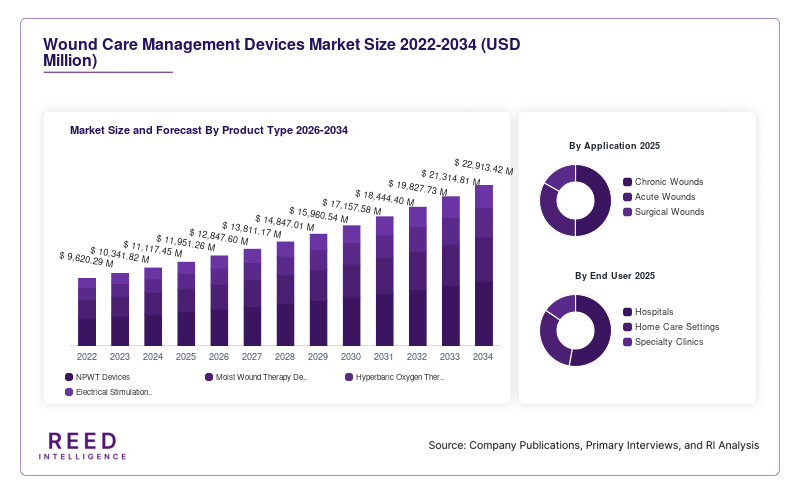
The Wound Care Management Devices market is segmented by Type and Application to provide a comprehensive market perspective. By Type, NPWT Devices dominate with a 38% market share, driven by their proven efficacy in wound healing. The Application segment is led by Chronic Wounds, which accounts for 45% of the market, followed by Surgical Wounds at 30%, and Acute Wounds at 25%.
By Type
NPWT Devices represent the largest segment in the Wound Care Management Devices market, commanding a 38% share, with production reaching 6.84 million units in 2025. These devices are characterized by their use of controlled negative pressure to promote granulation tissue formation and wound healing. Technical specifications include pressure settings, therapy modes, and canister sizes. The Wound Care Management Devices market's NPWT segment is driven by its use in treating complex and chronic wounds.
Moist Wound Therapy Devices capture a 28% share of the Wound Care Management Devices market, with production of 5.04 million units in 2025. These are characterized by their ability to maintain a moist environment to facilitate healing. Technical specifications include various dressing types, fluid management, and application methods. The Wound Care Management Devices market's Moist Wound Therapy segment is driven by its use in a wide range of wound types.
Hyperbaric Oxygen Therapy Devices represent 20% of the Wound Care Management Devices market, with production of 3.6 million units in 2025. These are characterized by their use of high-pressure oxygen to enhance wound healing. Technical specifications include chamber type, pressure settings, and treatment protocols. The Wound Care Management Devices market's Hyperbaric segment is driven by its use in treating diabetic ulcers and radiation injuries.
Electrical Stimulation Devices comprise the remainder of the Wound Care Management Devices market, accounting for 14% of total production, with 2.52 million units in 2025. These devices are characterized by their use of electrical currents to stimulate wound healing. Technical specifications include waveform, frequency, and intensity settings. The Wound Care Management Devices market's Electrical Stimulation segment is driven by its use in chronic wound care.
By Application
Chronic Wounds dominates the Wound Care Management Devices market, accounting for 45% of sales, representing 8.1 million units in 2025. This segment includes use in diabetic foot ulcers, pressure ulcers, and venous leg ulcers. Usage penetration exceeds 30% in the segment. The Wound Care Management Devices market's Chronic segment is characterized by its focus on long-term care and advanced therapies.
Surgical Wounds accounts for 30% of the Wound Care Management Devices market, with sales of 5.4 million units in 2025. This segment encompasses use in post-operative wound care and surgical site management. The segment is growing at a steady CAGR, driven by the increasing number of surgeries. The Wound Care Management Devices market's Surgical segment is characterized by its focus on infection prevention and rapid healing.
Acute Wounds comprises the remainder of the Wound Care Management Devices market, accounting for 25% of total sales, with 4.5 million units in 2025. This segment includes use in traumatic injuries, burns, and lacerations. The segment is projected to grow at a moderate CAGR through 2034. The Wound Care Management Devices market's Acute segment is characterized by its focus on immediate care and tissue repair.
Wound Care Management Devices Market Regional Outlook
North America Wound Care Management Devices Market
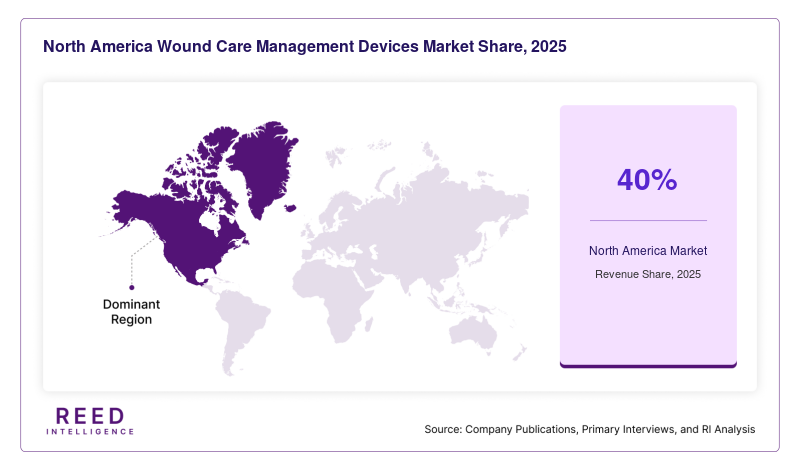
Leads the Wound Care Management Devices market, commanding a 40% share, with a revenue of USD 5,139.0 million in 2025. The United States is the primary driver, accounting for 85% of regional demand, driven by the high prevalence of chronic diseases, advanced healthcare infrastructure, and strong reimbursement policies. The North American Wound Care Management Devices market is characterized by its focus on innovation and premium products.
Europe Wound Care Management Devices Market
Represents the second-largest market, capturing a 30% share with a revenue of USD 3,854.3 million in 2025. The UK, Germany, and France are the primary drivers, collectively accounting for 60% of regional demand, driven by a strong healthcare system, aging population, and focus on advanced care. The Wound Care Management Devices market in Europe is characterized by its focus on quality and cost-effectiveness.
Asia-Pacific Wound Care Management Devices Market
Accounts for 22% of the global Wound Care Management Devices market, with a revenue of USD 2,826.5 million in 2025. China, Japan, and India are the primary drivers, together accounting for 70% of regional demand, driven by the large patient population, rising healthcare expenditure, and increasing awareness of advanced wound care. The Asia-Pacific Wound Care Management Devices market is projected to grow at the fastest CAGR of 9% through 2034.
Middle East & Africa and Latin America Wound Care Management Devices Market
Together account for the remaining 8% of the Wound Care Management Devices market, with the UAE leading the Middle East market and Brazil leading the Latin American market. Both regions are projected to grow at CAGRs exceeding 8%, driven by improving healthcare infrastructure and increasing chronic disease prevalence.
Top players in Wound Care Management Devices Market
- Acelity L.P. (3M)
- Smith & Nephew plc
- ConvaTec Group plc
- Mölnlycke Health Care
- B. Braun Melsungen AG
- Cardinal Health, Inc.
- Coloplast A/S
- Medtronic plc
- Johnson & Johnson
- Hollister Incorporated
- Paul Hartmann AG
- Integra LifeSciences
- Organogenesis Inc.
- MiMedx Group
- Advanced Medical Solutions Group
Acelity L.P. (3M)
Acelity L.P. (now part of 3M) holds a dominant position in the Wound Care Management Devices market, with an estimated 22% global market share, particularly strong in the NPWT and advanced wound care segments. The company's portfolio of wound care devices is widely recognized for its innovation, efficacy, and clinical evidence. Acelity's market leadership is reinforced by its significant R&D investment, its strong relationships with healthcare providers, and its comprehensive product line. Acelity commands over 25% of the North American market and 18% of the European market, positioning it as a key player in the Wound Care Management Devices market.
Smith & Nephew plc
Smith & Nephew is a leading player in the Wound Care Management Devices market, commanding approximately 15% of the global market share through its comprehensive portfolio of wound care and surgical devices. The company's expertise in wound management and its focus on innovation have solidified its position. Smith & Nephew's wound care devices are known for their quality, performance, and clinical support. The company's commitment to advancing wound care and its strong presence in the North American and European markets have enhanced its competitive advantage.
ConvaTec Group plc holds a significant 10% market share, with particular strength in the ostomy and wound care segments. Mölnlycke Health Care is a major player in the advanced wound dressing and device market, holding an 8% share.
Recent Developments in Wound Care Management Devices Market
- 2025: Acelity (3M) launched a new generation of smart NPWT devices with integrated sensors for real-time monitoring and data analytics.
- 2025: Smith & Nephew introduced a new portable NPWT system designed for home care, improving patient mobility and convenience.
Wound Care Management Devices Market Segments
By Product Type
- NPWT Devices
- Moist Wound Therapy Devices
- Hyperbaric Oxygen Therapy Devices
- Electrical Stimulation Devices
By Application
- Chronic Wounds
- Acute Wounds
- Surgical Wounds
By End User
- Hospitals
- Home Care Settings
- Specialty Clinics
By Region
- North America
- Europe
- APAC
- Middle East and Africa
- LATAM