Woven Wire Mesh Market Size, Share & Trends Analysis Report By Material (Stainless Steel, Carbon Steel, Galvanized Steel, Aluminum, Copper & Brass, Nickel & Specialty Alloys), By Weave Type (Plain Weave, Twilled Weave, Dutch Weave, Pre-Crimped & Lock-Crimped Weave, Other Weaves), By Application (Filtration & Separation, Mining & Aggregate Screening, Architecture & Decorative, Food & Pharmaceutical, Industrial & Process Equipment, Agriculture & Aquaculture, Others) and By Region (North America, E
USD 3950
Woven Wire Mesh Market Size
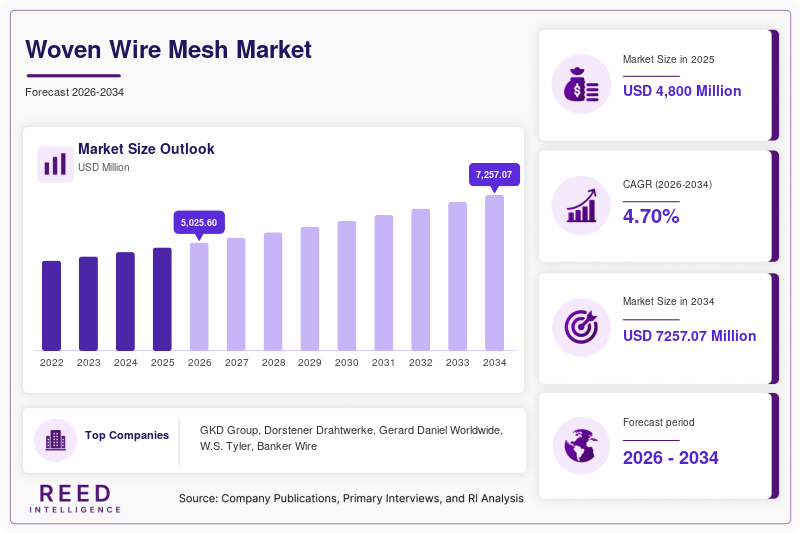
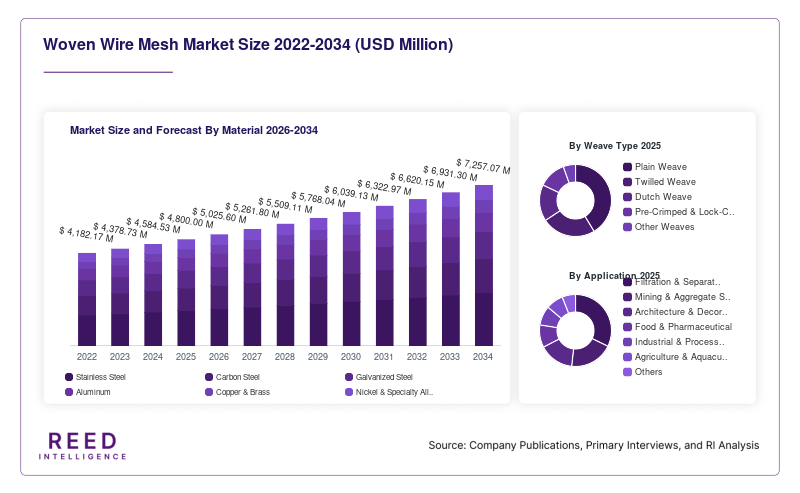
The global woven wire mesh market is valued at USD 4,800 Million in 2025 and USD 5,025.60 Million in 2026. The market is projected to reach USD 7,257.07 Million by 2034, registering a 4.70% CAGR during the forecast period.
The woven wire mesh market comprises metallic wire fabrics produced by interlacing warp and weft wires to create defined openings for screening, filtration, separation, shielding, reinforcement, protection and architectural purposes. ASTM E2016 defines industrial woven wire cloth as woven wire fabric used for general applications including particle separation and notes that it can be manufactured from primary metals or metal-alloy wires suitable for weaving.
The performance of woven wire mesh depends on a combination of wire diameter, mesh count, aperture, open area, weave pattern and material. GKD explains that plain, twill and satin-type structures alter flexibility, strength and permeability, while Dutch weaves can combine fine filtration with high strength through different warp and weft wire dimensions.
Woven Wire Mesh Market Drivers
Filtration, screening and separation requirements are sustaining broad industrial mesh consumption
Woven wire mesh remains difficult to replace in applications that require precise, stable openings combined with mechanical strength and resistance to heat, corrosion or aggressive process conditions.
ASTM E2016 establishes industrial woven wire cloth specifications around mesh count, opening dimensions, wire diameter and tolerances, reinforcing the role of controlled geometry in industrial separation applications.
The technology is used across chemical processing, food and beverage, polymer filtration, environmental protection, mining and water treatment. GKD's portfolio covers particle separation, liquid filtration, polymer filtration, hot-gas filtration, wastewater treatment and mining separation, while Costacurta supplies woven mesh for chemical, food, construction and heat-treatment applications.
This broad industrial footprint reduces dependence on any single end market. Even where one sector slows, demand can persist through replacement screening, process filtration, water treatment and maintenance requirements.
Infrastructure, aggregates processing and resource extraction continue to require durable screening media
Construction materials and mining operations depend on controlled classification and dewatering. Woven mesh provides interchangeable screening surfaces with defined openings and a relatively simple mechanical construction.
USGS reported approximately 870 million tons of U.S. construction sand and gravel production in 2025 and identified infrastructure, manufacturing, energy and data-center construction as factors supporting demand in 2026.
GKD and Gerard Daniel illustrate the connection between aggregate and mineral-processing activity and woven mesh. GKD offers heavy woven screening media and mining solutions for concentrate dewatering and tailings treatment, while Gerard Daniel supplies screens for frac sand, crushed limestone, roofing granules and other mineral products.
The replacement nature of screening media is particularly important because mesh is exposed to abrasion, impact and repeated mechanical loading, creating recurring demand even when overall equipment investment is moderate.
Architectural designers are expanding woven mesh into functional and aesthetic building systems
Architectural metal mesh has moved beyond simple guarding and infill into visible design elements that manage transparency, light, circulation, acoustics and visual separation.
GKD's architectural products combine decorative appearance with shading, acoustic, protective and facade functions, while Banker Wire offers rigid and flexible architectural mesh systems, multiple finishes and customized patterns.
TWP's 2026 design analysis highlights warm metallic finishes, custom weaves, mixed-material interiors and lightweight sustainable applications as emerging decorative wire-mesh themes.
This is creating a broader specification opportunity for mesh suppliers because architectural projects often require custom panel dimensions, finishes, mounting systems, curved components and project-specific fabrication rather than commodity rolls alone.
Woven Wire Mesh Market Restraints
Restraint 1: Volatility in metal prices can pressure mesh manufacturers and project margins
Woven mesh is directly exposed to the cost of wire rod and alloy inputs, especially stainless steel, nickel-containing alloys, copper and aluminum.
Because mesh suppliers must balance finished-product pricing with customer contracts and competitive quotations, abrupt changes in input costs can temporarily compress margins or lengthen procurement decisions. The breadth of alloy choices also creates sourcing complexity where customers require certified grades or specialized corrosion and temperature performance.
This effect is particularly relevant for fine mesh and specialty-alloy products, where material content and manufacturing precision represent a greater proportion of total product cost.
Fine and specialty mesh manufacturing requires tight process control and increases production complexity
Fine filtration cloth requires accurate wire diameter, stable weaving tension, consistent apertures and tight tolerances. GKD and Gerard Daniel emphasize customized engineering and quality control for application-specific mesh, while ASTM specifications establish requirements for mesh and wire tolerances.
More complex weaves such as Dutch, reverse Dutch and multilayer structures can be more difficult and costly to manufacture than standard square mesh. This raises qualification and production costs and limits rapid substitution between suppliers for applications where a particular weave, alloy or aperture must be reproduced precisely.
Woven Wire Mesh Market Opportunities
Hydrogen, battery and environmental filtration applications are opening higher-value mesh demand
The energy transition is creating new applications for metal mesh beyond established screening and filtration.
GKD's current portfolio includes electrode mesh for electrolysis as well as mesh solutions for fuel cells, hydrogen infrastructure, battery systems, hot-gas filtration and environmental applications.
These applications can require specialized porosity, conductivity, corrosion resistance, temperature performance and dimensional stability, allowing mesh manufacturers to compete on engineered functionality rather than commodity price.
Environmental filtration is another emerging opportunity. GKD's CAPTURION system is designed to capture tire wear, microplastics and other pollutants in runoff, and in September 2026 its filter technology was tested at the Dutch Formula 1 Grand Prix in Zandvoort.
Digital design and custom fabrication are increasing the value of architectural mesh
Architectural customers increasingly require mesh that is designed around the geometry of a building rather than supplied solely as standardized material.
GKD supplies customized architectural fabrics and offers project engineering, while Banker Wire supports rigid and flexible systems, pattern selection, finishes, BIM resources and project applications.
This creates opportunities for suppliers to expand beyond woven material into cut-to-size panels, framed assemblies, tension systems, coated finishes, complex forms and integrated architectural components.
Weave Type Analysis
Plain Weave remains the dominant weave because it combines manufacturing simplicity with broad screening and filtration utility
Plain weave is the most widely used structure because each warp wire passes over and under adjacent weft wires, creating a stable square opening. Gerard Daniel identifies plain square mesh as the most common weave and notes its broad suitability for screening, sieving and filtering.
The Plain Weave segment accounts for 49% of the global market in 2026 and is projected to register a 4.50% CAGR.
Its broad use across general industrial screening, food, chemical, construction and filtration applications makes it the market's largest weave category.
Dutch Weave is the fastest-growing major weave as fine filtration requirements become more sophisticated
Dutch weaves use different wire configurations in the warp and weft to create fine, stable filtration structures.
The Dutch Weave segment accounts for 14% of the global market in 2026 and is projected to register a 5.70% CAGR, making it the fastest-growing major weave category.
Gerard Daniel describes plain Dutch weave as using thicker warp wires and finer shute wires, generating high stability and fine filtration performance. GKD likewise offers several Dutch and reversed-Dutch structures for demanding industrial filtration.
Application Analysis
Filtration & Separation remains the dominant application because woven mesh provides precise particle and fluid control
The Filtration & Separation segment accounts for 34% of the global market in 2026 and is projected to register a 4.80% CAGR.
The application spans liquid filtration, gas filtration, polymer filtration, food processing, chemical processing, environmental systems, water treatment and medical applications. GKD's current industrial portfolio includes mesh for polymer filtration, hot-gas filtration, chemical processing, environmental protection, healthcare and water treatment.
Fine Dutch and specialty weaves are particularly important where controlled pore size, low pressure drop and high mechanical stability must be combined.
Architecture & Decorative is the fastest-growing application as woven mesh becomes a visible building material
The Architecture & Decorative segment accounts for 16% of the global market in 2026 and is projected to register a 6.20% CAGR, making it the fastest-growing major application.
The category includes facades, ceilings, partitions, railings, elevator interiors, cabinets, hospitality interiors, sun-control systems and media facades.
GKD's 2026 projects include a customized OMEGA 1540 mesh at the Korus Concert Hall and extensive mesh cladding at the LAX Metro Transit Center. Banker Wire's 2026 project portfolio similarly documents applications in corporate, hospitality and residential interiors.
Woven Wire Mesh Market Regional Analysis
APAC Woven Wire Mesh Market
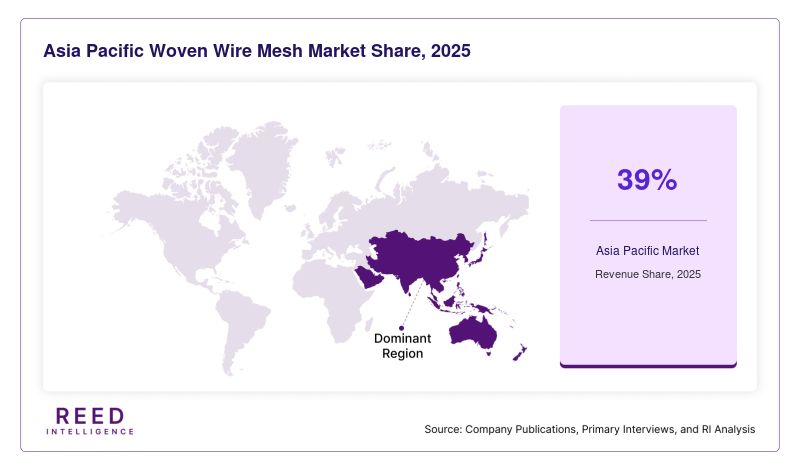
APAC remains the dominant regional market because it combines large manufacturing ecosystems in electronics, automotive, chemicals, food processing, construction and machinery with extensive metalworking and wire-production capabilities.
The APAC region accounts for 39% of the global market in 2026 and is projected to register a 5.40% CAGR.
China, Japan, South Korea, India and Southeast Asia contribute to demand through industrial manufacturing, electronics, mining, food processing and infrastructure. Major mesh suppliers maintain production or distribution capabilities in the region; GKD operates production in China and describes global manufacturing across multiple continents, while Dorstener has weaving operations in China in addition to European facilities.
The region's combination of manufacturing scale and export-oriented supply chains also supports the production of both commodity and specialty woven mesh.
North America Woven Wire Mesh Market
North America is projected to register a 4.70% CAGR, supported by filtration, mining, aggregates, food processing, aerospace, architecture, water treatment and manufacturing.
The U.S. has a particularly broad supplier base spanning manufacturers, distributors and fabricators. TWP, McNICHOLS, Gerard Daniel, Banker Wire, Cleveland Wire Cloth and Dorstener Wire Tech serve industrial and architectural requirements across the market.
Construction and infrastructure activity also supports screening and building-material applications. USGS identified manufacturing, energy, infrastructure and data-center construction as important factors supporting construction-material demand in 2026.
Europe Woven Wire Mesh Market
Europe is projected to register a 4.60% CAGR, supported by advanced filtration, food processing, chemicals, automotive manufacturing, mining, water treatment and architectural design.
The region remains a major innovation and engineering center for woven mesh. GKD, Dorstener and Costacurta all provide specialized woven products and engineered components, while GKD continues to develop mesh applications in hydrogen, environmental protection and industrial filtration.
Architectural demand is also supported by Europe's strong specification culture, with recent GKD installations demonstrating use of customized metal fabrics in public transportation and cultural infrastructure.
Middle East and Africa Woven Wire Mesh Market
The Middle East and Africa market is projected to register a 4.50% CAGR, supported by construction, mining, oil and gas, water treatment, agriculture and industrial processing.
Demand is increasingly linked to water infrastructure, mineral processing and industrial filtration because these applications benefit from durable corrosion-resistant and wear-resistant mesh.
GKD and Dorstener both maintain products for water, environmental, energy and industrial applications, while Costacurta lists desalination and treatment of polluting effluents among its broader energy and chemical applications.
LATAM Woven Wire Mesh Market
LATAM is projected to register a 4.80% CAGR, supported by mining, food processing, agriculture, water treatment, construction and industrial manufacturing.
Mining and mineral processing are especially relevant because woven screening media can be replaced regularly in abrasive operating environments. Agricultural and food-processing uses provide additional demand for general-purpose and corrosion-resistant mesh.
International suppliers with regional distribution and fabrication networks can address demand through both standardized products and application-specific screening and filtration assemblies.
Woven Wire Mesh Market Competitive Landscape
The woven wire mesh market is characterized by competition among global technical-mesh manufacturers, specialized wire-cloth producers, architectural mesh suppliers and value-added distributors.
GKD Group is a major technology-focused supplier with a broad portfolio of industrial and architectural metal mesh. Its industrial business covers filtration, screening, water, mining, energy, food, healthcare and automotive applications, while its architectural business provides customized metal fabrics, facades, ceilings and interior solutions.
Dorstener Drahtwerke combines wire production with woven wire cloth, sintered wire cloth, pre-crimped mesh, welded mesh and engineered filtration products. It serves machinery, automotive, aerospace, construction, chemical, energy, medical, environmental and agricultural applications.
Key Market Players
- GKD Group
- Dorstener Drahtwerke
- Gerard Daniel Worldwide
- W.S. Tyler
- Banker Wire
- Costacurta S.p.A.-VICO
- TWP Inc.
- McNICHOLS
- Cleveland Wire Cloth & Manufacturing Co.
- Locker Wire Weavers
- Belleville Wire Cloth
- Edward J. Darby & Son
- Marco Specialty Steel
- Wire Cloth Manufacturers
- Boegger Industrial Limited
Recent Developments
July 2026 – GKD supplied a customized OMEGA 1540 woven metal mesh installation for the Korus Concert Hall in Pétange, Luxembourg. The mesh was used on the ceiling and rear wall, demonstrating the increasing use of customized woven metal fabrics in cultural and architectural projects.
June 2026 – Banker Wire highlighted flexible woven wire mesh at 1125 17th Street in Denver. The project used woven mesh as an exterior and interior architectural element within a repositioned commercial property, illustrating demand for mesh systems that combine transparency, material texture and spatial definition.
Woven Wire Mesh Market Segments
By Material
- Stainless Steel
- Carbon Steel
- Galvanized Steel
- Aluminum
- Copper & Brass
- Nickel & Specialty Alloys
By Weave Type
- Plain Weave
- Twilled Weave
- Dutch Weave
- Pre-Crimped & Lock-Crimped Weave
- Other Weaves
By Application
- Filtration & Separation
- Mining & Aggregate Screening
- Architecture & Decorative
- Food & Pharmaceutical
- Industrial & Process Equipment
- Agriculture & Aquaculture
- Others
By Region
- North America
- Europe
- APAC
- Middle East and Africa
- LATAM