X Linked Adrenoleukodystrophy Market Size, Share & Demand Report By Therapy Type (Gene Therapy, Enzyme Replacement Therapy, Stem Cell Transplantation, Pharmacological Treatment), By Disease Type (Cerebral Adrenoleukodystrophy, Adrenomyeloneuropathy, Addison-Only Phenotype), By Diagnosis Method (Genetic Testing, Newborn Screening, Imaging Techniques), By End-Use (Hospitals, Specialty Clinics, Research Institutes), By Region & Segment Forecasts, 2025–2034
USD 3950
Market Overview
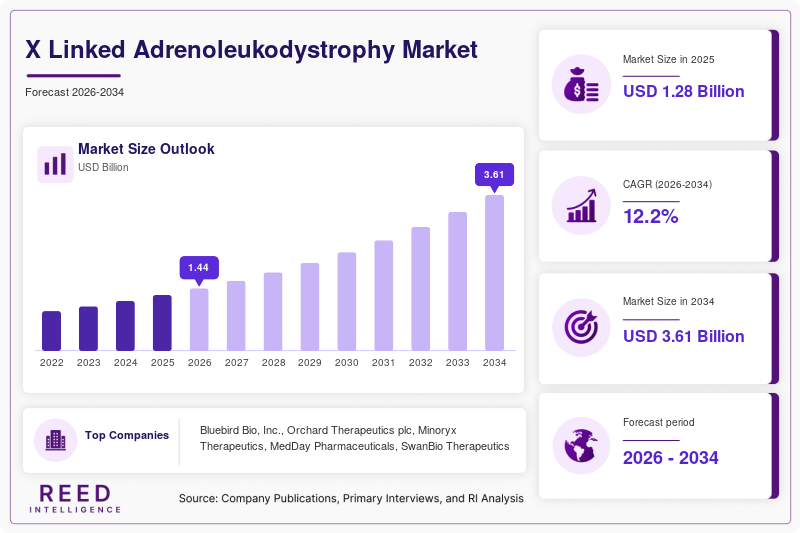
The global X Linked Adrenoleukodystrophy Market size was valued at approximately USD 1.28 billion in 2025 and is projected to reach USD 3.62 billion by 2034, registering a compound annual growth rate (CAGR) of 12.2% during the forecast period (2025–2034). The market reflects steady expansion driven by advancements in rare disease diagnostics, improved treatment pipelines, and rising awareness of genetic disorders.
A key global factor supporting the growth of the X Linked Adrenoleukodystrophy Market is the increasing adoption of newborn screening programs across developed and emerging economies. Early detection has significantly improved treatment outcomes, particularly in cerebral forms of the disease, thereby increasing demand for therapies such as gene therapy, stem cell transplantation, and pharmacological interventions.
Key Highlights
- North America dominated the market with a 41.3% share in 2025, while Asia Pacific is expected to register the fastest CAGR of 14.1% through 2034.
- By therapy type, gene therapy emerged as the leading subsegment with a 36.5% share, while enzyme replacement therapy is projected to grow fastest at a CAGR of 13.8%.
- By end-use, hospitals led with a 48.2% share, whereas specialty clinics are anticipated to expand at a CAGR of 13.2%.
- The United States accounted for USD 520 million in 2025 and is estimated to reach USD 585 million in 2026, maintaining its position as the dominant country.
Market Trends
Advancements in Gene Therapy Platforms
Gene therapy has emerged as a transformative trend within the X Linked Adrenoleukodystrophy Market. Innovations in viral vector delivery systems and genome-editing technologies have enabled targeted correction of ABCD1 gene mutations. Clinical success in autologous hematopoietic stem cell-based gene therapy has accelerated regulatory approvals and commercial adoption. This trend is reshaping the treatment landscape by offering long-term therapeutic benefits, reducing reliance on symptomatic management approaches.
Expansion of Newborn Screening Programs
The global expansion of newborn screening initiatives is significantly influencing market growth. Countries are increasingly integrating adrenoleukodystrophy screening into standard neonatal panels, enabling early diagnosis before symptom onset. This shift has improved patient outcomes and increased treatment uptake rates. Furthermore, early detection has driven demand for preventive therapies and monitoring services, contributing to a broader patient pool and sustained market expansion.
Market Drivers
Rising Prevalence of Rare Genetic Disorders
The growing identification of rare genetic diseases, including X linked adrenoleukodystrophy, has contributed to increased demand for diagnostic and therapeutic solutions. Improved genetic testing technologies have enabled accurate diagnosis, leading to higher reported prevalence rates. This has encouraged healthcare providers to adopt specialized treatment protocols, thereby boosting the X Linked Adrenoleukodystrophy Market.
Increasing Investment in Orphan Drug Development
Pharmaceutical companies and biotech firms are increasingly investing in orphan drug development due to favorable regulatory incentives, including market exclusivity and tax benefits. This has resulted in a robust pipeline of innovative therapies targeting adrenoleukodystrophy. The availability of funding and strategic collaborations has accelerated clinical trials and product commercialization, driving sustained market growth.
Market Restraint
High Cost of Treatment and Limited Accessibility
One of the primary challenges in the X Linked Adrenoleukodystrophy Market is the high cost associated with advanced therapies, particularly gene therapy and stem cell transplantation. These treatments often require specialized infrastructure and expertise, limiting their availability to developed healthcare systems. Additionally, reimbursement challenges in several regions further restrict patient access to these therapies. The financial burden on healthcare systems and patients remains a critical barrier, especially in low- and middle-income countries, thereby constraining overall market growth.
Market Opportunities
Expansion in Emerging Markets
Emerging economies present significant growth opportunities for the X Linked Adrenoleukodystrophy Market. Increasing healthcare expenditure, improving diagnostic capabilities, and rising awareness of rare diseases are creating a favorable environment for market expansion. Governments are also investing in healthcare infrastructure, which is expected to enhance access to advanced treatments and support market growth.
Development of Personalized Medicine Approaches
The integration of personalized medicine into rare disease treatment is opening new avenues for innovation. Tailored therapeutic strategies based on genetic profiling are expected to improve treatment efficacy and patient outcomes. This approach is particularly relevant for adrenoleukodystrophy, where disease progression varies significantly among patients. As precision medicine technologies evolve, they are likely to create new revenue streams and strengthen the overall market outlook.
Segmental Analysis
By Therapy Type
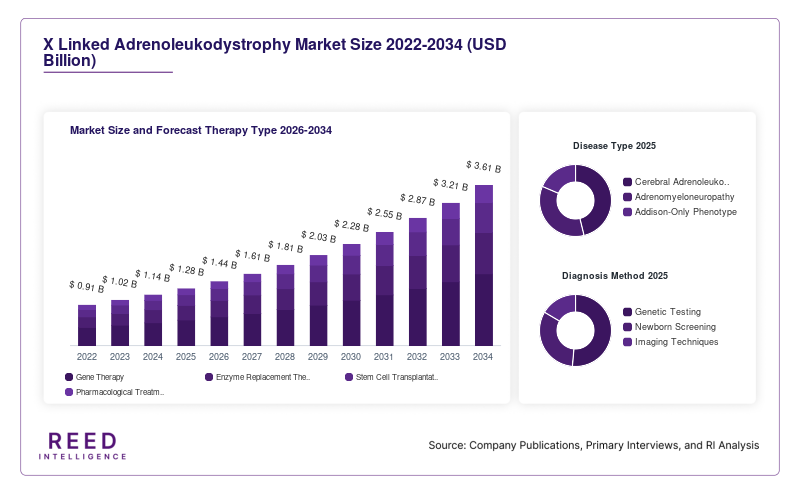
Gene therapy dominated the X Linked Adrenoleukodystrophy Market in 2025, accounting for 36.5% of the total share. This dominance was attributed to its ability to address the root cause of the disease by correcting genetic mutations. Increasing clinical success rates and regulatory approvals further strengthened its position.
Enzyme replacement therapy is expected to grow at the fastest CAGR of 13.8% through 2034. Its growth will be driven by ongoing research efforts aimed at improving enzyme delivery mechanisms and reducing treatment-related complications. The development of next-generation formulations is expected to enhance patient compliance and expand adoption.
By Disease Type
Cerebral adrenoleukodystrophy emerged as the dominant subsegment, holding a 42.7% share in 2025. The severity and rapid progression of this form of the disease led to higher treatment demand and increased clinical focus.
Adrenomyeloneuropathy is projected to grow at a CAGR of 12.9% during the forecast period. Its growth will be supported by increasing diagnosis rates and the development of targeted therapies aimed at managing neurological symptoms.
By Diagnosis Method
Genetic testing dominated the market with a 51.4% share in 2025. The accuracy and reliability of genetic diagnostics made it the preferred method for identifying adrenoleukodystrophy.
Newborn screening is expected to witness the fastest growth at a CAGR of 14.5%. The expansion of screening programs and government initiatives promoting early diagnosis will drive this segment’s growth.
By End-Use
Hospitals held the largest share of 48.2% in 2025, owing to their advanced treatment capabilities and access to specialized healthcare professionals. The availability of comprehensive care facilities supported their dominance.
Specialty clinics are anticipated to grow at a CAGR of 13.2% through 2034. Their focus on personalized care and specialized treatment approaches will drive increased patient preference.
Regional Analysis
North America
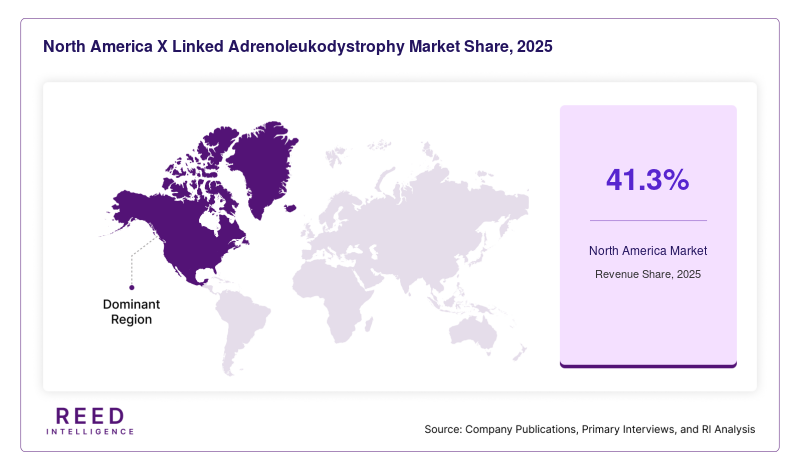
North America accounted for 41.3% of the global X Linked Adrenoleukodystrophy Market share in 2025 and will grow at a CAGR of 11.6% during the forecast period. The region’s established healthcare infrastructure, strong research capabilities, and early adoption of advanced therapies contributed to its dominant position.
The United States led the regional market due to the presence of advanced diagnostic systems and a strong pipeline of gene therapy products. The country’s emphasis on rare disease research and widespread implementation of newborn screening programs supported early diagnosis and treatment adoption.
Europe
Europe held a 27.5% share of the X Linked Adrenoleukodystrophy Market in 2025 and is expected to grow at a CAGR of 11.9% through 2034. The region’s market growth is supported by favorable regulatory frameworks and increased funding for rare disease research.
Germany dominated the European market due to its well-established healthcare system and strong focus on genetic testing. The country’s investment in clinical research and collaborations between academic institutions and pharmaceutical companies contributed to sustained growth.
Asia Pacific
Asia Pacific captured 18.2% of the global market share in 2025 and is projected to expand at the fastest CAGR of 14.1%. The region is witnessing rapid improvements in healthcare infrastructure and growing awareness of rare diseases.
China emerged as the dominant country due to increasing healthcare investments and the expansion of diagnostic facilities. The government’s focus on improving access to healthcare services and promoting genetic screening programs has accelerated market growth.
Middle East & Africa
The Middle East & Africa region accounted for 6.1% of the X Linked Adrenoleukodystrophy Market in 2025 and is anticipated to grow at a CAGR of 10.8%. Limited awareness and infrastructure challenges have historically constrained market growth.
Saudi Arabia led the regional market due to government initiatives aimed at enhancing healthcare services. Investments in specialized treatment centers and genetic research programs have contributed to improved diagnosis and management of rare diseases.
Latin America
Latin America held a 6.9% share of the global market in 2025 and is expected to grow at a CAGR of 11.2% during the forecast period. Increasing healthcare investments and growing awareness of genetic disorders are supporting market expansion.
Brazil dominated the region due to its expanding healthcare infrastructure and rising adoption of advanced diagnostic technologies. Government initiatives aimed at improving rare disease management have further supported market growth.
Competitive Landscape
The X Linked Adrenoleukodystrophy Market is moderately consolidated, with key players focusing on research and development to strengthen their market position. Companies are actively investing in gene therapy platforms and forming strategic collaborations to expand their product pipelines.
Bluebird Bio, Inc. is recognized as a market leader due to its advancements in gene therapy for adrenoleukodystrophy. The company has recently achieved progress in clinical trials for its lentiviral vector-based therapy, enhancing its competitive position.
Other major players are emphasizing partnerships, mergers, and acquisitions to gain a competitive edge and expand their geographic presence. Continuous innovation and regulatory approvals remain critical factors shaping the competitive landscape.
Key Players
- Bluebird Bio, Inc.
- Orchard Therapeutics plc
- Minoryx Therapeutics
- MedDay Pharmaceuticals
- SwanBio Therapeutics
- Pfizer Inc.
- Novartis AG
- Sanofi S.A.
- Takeda Pharmaceutical Company Limited
- Biogen Inc.
- Vertex Pharmaceuticals Incorporated
- Amgen Inc.
- Regenxbio Inc.
- Voyager Therapeutics, Inc.
- Abeona Therapeutics Inc.
Recent Developments
- 2025: Bluebird Bio advanced its gene therapy candidate into late-stage clinical trials.
- 2024: Orchard Therapeutics expanded its rare disease portfolio through strategic partnerships.
- 2024: Minoryx Therapeutics reported positive outcomes from its Phase II clinical trial.
- 2023: Pfizer increased investment in rare genetic disorder research programs.
- 2023: Novartis strengthened its pipeline with new gene therapy initiatives.
X Linked Adrenoleukodystrophy Market Segments
Therapy Type
- Gene Therapy
- Enzyme Replacement Therapy
- Stem Cell Transplantation
- Pharmacological Treatment
Disease Type
- Cerebral Adrenoleukodystrophy
- Adrenomyeloneuropathy
- Addison-Only Phenotype
Diagnosis Method
- Genetic Testing
- Newborn Screening
- Imaging Techniques
End-Use
- Hospitals
- Specialty Clinics
- Research Institutes
By Region
- North America
- Europe
- APAC
- Middle East and Africa
- LATAM