Xanthate Market Size, Share Demand Report By Type (Sodium Ethyl Xanthate, Sodium Isobutyl Xanthate, Potassium Amyl Xanthate, Potassium Ethyl Xanthate, Others), By Application (Mining Flotation Reagents, Specialty Industrial Applications, Chemical Intermediates), By End Use (Copper Mining, Gold Mining, Lead & Zinc Mining, Nickel Mining, Others), By Region & Segment Forecasts, 2026–2034
USD 3950
Market Overview
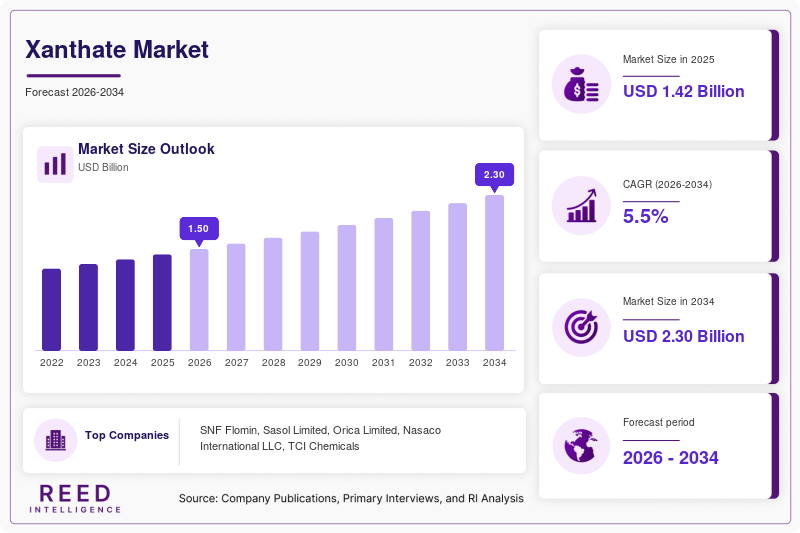
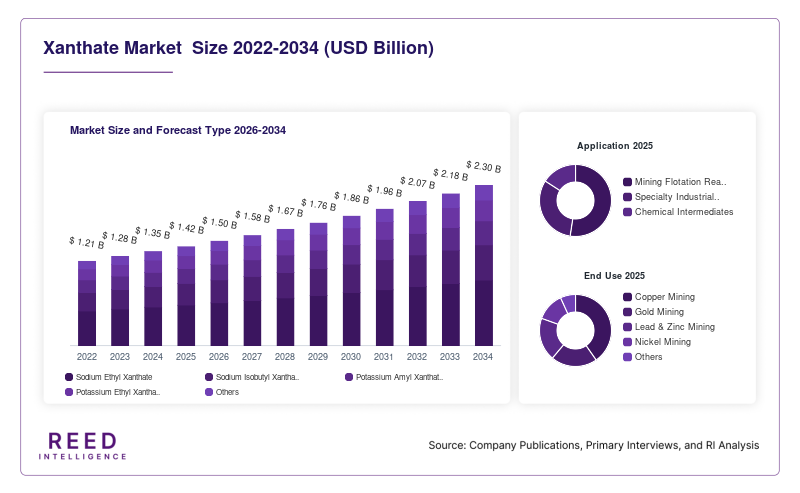
The Xanthate Market size was valued at USD 1.42 billion in 2026 and is projected to reach USD 2.18 billion by 2034, expanding at a CAGR of 5.5% during 2026–2034. Xanthates are sulfur-based chemical collectors widely used in mineral flotation processes, particularly in copper, gold, zinc, nickel, and lead mining operations. They also serve niche functions in rubber processing, agrochemicals, and cellulose applications. The market size is closely linked to global mining investment cycles, ore grade decline, and the need for higher mineral recovery efficiency. As miners process lower-grade ores, chemical reagents such as xanthates become essential for improving flotation yield and reducing waste rock losses.
A major global factor supporting market growth has been the continued demand for base metals used in electrification, renewable energy systems, construction, and industrial manufacturing. Copper demand from grid expansion, battery storage, and electric vehicles has increased mining throughput in several regions. This has directly supported higher consumption of xanthate reagents across concentrators and beneficiation plants. In parallel, modernization of mineral processing plants and automation of dosing systems has improved reagent optimization, encouraging premium xanthate blends with stronger selectivity and lower operating cost per ton of ore processed.
Key Highlights
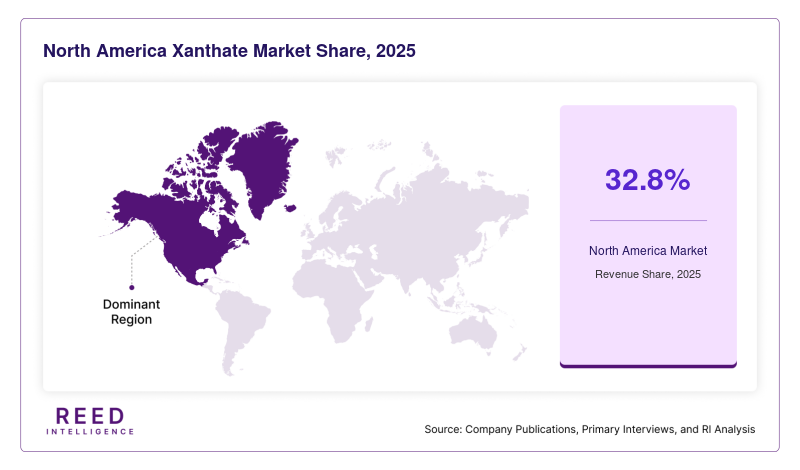
- North America dominated the market with a 32.8% share in 2025.
- Asia Pacific is expected to grow at the fastest CAGR of 6.8% during 2026–2034.
- By type, Sodium Ethyl Xanthate accounted for the largest share of 36.9%.
- while Potassium Amyl Xanthate is projected to grow at a 6.9% CAGR.
- By application, Mining Flotation Reagents led with a 74.4% share, whereas Specialty Industrial Applications are expected to expand at a 6.4% CAGR.
- By end use, Copper Mining remained the leading segment with a 31.6% share, while Gold Mining is forecast to grow at 6.7% CAGR.
- The United States remained the dominant country, with market values of USD 214 million in 2024 and USD 226 million in 2025.
Market Trends
Shift Toward High-Selectivity Reagent Formulations
Mining operators are increasingly adopting tailored xanthate blends that improve selectivity between valuable sulfide minerals and gangue material. Standard reagents remain widely used, but concentrators processing complex ores now prefer mixed xanthates and customized formulations. These products help improve recovery rates while reducing downstream smelting penalties caused by impurities. Demand is particularly visible in copper and polymetallic operations where ore bodies have become more variable. Producers are investing in formulation expertise, technical support, and on-site testing services. This trend is reshaping competition from price-led supply toward performance-led contracts and longer customer relationships.
Rising Manufacturing Presence in Emerging Mining Economies
Xanthate production capacity is gradually shifting closer to mining hubs in Asia Pacific, Latin America, and parts of Africa. Buyers seek shorter lead times, reduced freight costs, and stronger supply security after recent logistics disruptions. Regional plants also help suppliers meet country-specific packaging, safety, and customs requirements. Nations with expanding copper and gold production are encouraging local chemical manufacturing through industrial incentives. As a result, new mid-scale plants and storage terminals are being commissioned near ports and mining corridors. This trend is expected to reduce dependence on imported reagents and improve market responsiveness.
Market Drivers
Expansion of Copper and Base Metal Mining Activities
Global copper, zinc, nickel, and lead production growth remains a central driver for the Xanthate Market. These metals are essential for electrical infrastructure, batteries, transportation equipment, and industrial machinery. New mine development and brownfield expansions require larger flotation reagent volumes as processing plants raise throughput. Many deposits being mined today have lower ore grades than historical averages, which increases chemical intensity per ton of concentrate produced. Xanthates remain cost-effective collectors in sulfide ore flotation, making them difficult to replace at scale. Sustained investment in base metals therefore creates recurring demand across established and emerging mining regions.
Need for Higher Recovery Efficiency and Cost Control
Mining companies continue to focus on maximizing metal recovery while controlling unit operating costs. Even small improvements in flotation performance can create meaningful revenue gains for large concentrators. Xanthates help improve attachment of mineral particles to air bubbles, supporting stronger recovery rates and more stable plant output. Advanced dosing systems now allow operators to optimize reagent consumption based on ore variability and real-time plant conditions. This has increased confidence in using higher-value xanthate grades where economics justify adoption. The combination of productivity improvement and cost discipline strongly supports long-term market growth.
Market Restraint
Environmental and Handling Challenges
The Xanthate Market faces restraint from environmental scrutiny, worker safety requirements, and stricter chemical handling regulations. Xanthates can decompose under certain conditions and require controlled storage, careful transport, and disciplined usage procedures. Mines operating in environmentally sensitive jurisdictions may face tighter discharge limits, higher compliance costs, and increased monitoring of reagent residues. Smaller operators can delay purchases or seek lower-dose alternatives when compliance budgets are limited. In some countries, import approvals and hazardous chemical documentation can lengthen procurement cycles. These factors do not eliminate demand, but they can slow adoption of new products, raise operational complexity, and pressure supplier margins through added safety investments, training programs, and packaging upgrades.
Market Opportunities
Growth in Gold Projects and Refractory Ore Processing
Gold exploration and mine restarts create meaningful opportunity for xanthate suppliers, especially where sulfide-associated gold ores require flotation before further recovery stages. Many new projects involve complex mineralogy or refractory ores that need stronger collector performance and customized reagent schemes. Potassium-based xanthates and blended collectors can improve selectivity in these circuits. Rising gold prices often stimulate investment in marginal deposits that were previously uneconomic, expanding the customer base for specialty flotation chemicals. Suppliers offering metallurgical testing support and rapid site commissioning services are positioned to benefit most from this opportunity.
Development of Eco-Efficient and Digital Service Models
Another opportunity lies in combining reagent supply with digital process optimization and lower-impact chemistries. Mining customers increasingly prefer suppliers that deliver performance guarantees, automated dosing analytics, and technical audits rather than only commodity products. Producers can differentiate through lower-odor grades, safer packaging formats, and formulations that reduce total reagent consumption. Subscription-style service contracts tied to recovery improvements are gaining traction. As mines digitize plant operations, suppliers that integrate data monitoring with xanthate recommendations can secure premium pricing and stronger retention. This service-led model offers margin expansion beyond conventional volume sales.
Segmental Analysis
By Type
Sodium Ethyl Xanthate held the dominant share of 36.9% in 2024. It is widely used because of its balanced collecting power, cost efficiency, and compatibility across copper, lead, and zinc sulfide flotation circuits. Many operators prefer it as a standard reagent for routine plant conditions. Large-volume procurement and broad supplier availability also support its leadership position. Mines with established dosing programs often continue using sodium ethyl xanthate due to predictable performance, simpler inventory planning, and operator familiarity. Its versatility keeps demand resilient across multiple ore types.
Potassium Amyl Xanthate is the fastest-growing type and is projected to expand at a 6.9% CAGR through 2034. This grade offers stronger collecting power and is increasingly selected for difficult-to-float minerals, coarse particles, and certain gold-associated sulfides. As ore complexity rises, concentrators are willing to adopt higher-value reagents that improve recovery economics. Growth is further supported by new gold and copper projects requiring custom reagent suites. Suppliers are also promoting potassium amyl xanthate in blended solutions where selective recovery and throughput stability are priorities.
By Application
Mining Flotation Reagents dominated the market with a 74.4% share in 2024. Xanthates remain core collectors in sulfide ore beneficiation and are used daily in large processing volumes. Copper concentrators, lead-zinc plants, nickel operations, and gold pre-concentration circuits all contribute to recurring demand. Since reagent cost is relatively small compared with recovered metal value, mines prioritize performance consistency and supply reliability. This application segment benefits from long production lives of existing mines and the continuous need for metallurgical optimization as ore characteristics change over time.
Specialty Industrial Applications are the fastest-growing segment, forecast at a 6.4% CAGR through 2034. These uses include rubber additives, cellulose processing, specialty synthesis, and niche chemical intermediates. Although volumes are lower than mining, margins can be higher due to specification requirements and customized supply agreements. Industrial buyers increasingly seek sulfur-based intermediates with controlled purity and dependable batch consistency. As manufacturers diversify away from single end markets, this segment offers suppliers revenue balance and resilience during cyclical mining slowdowns.
By End Use
Copper Mining accounted for the largest share of 31.6% in 2024. Copper flotation circuits consume significant reagent volumes because of massive ore throughput and the importance of maintaining concentrate grade. Global electrification trends, grid upgrades, and electric vehicle production continue to support copper demand, indirectly benefiting xanthate consumption. Many copper deposits also face declining grades, which raises the need for efficient collector systems. Long-life mines and expansion projects make this segment the most stable revenue contributor for suppliers.
Gold Mining is the fastest-growing end-use segment and is anticipated to record a 6.7% CAGR through 2034. Rising gold prices often stimulate investment in new projects, tailings retreatment, and underground mine extensions. Many sulfide-hosted gold ores require flotation before leaching or pressure oxidation, increasing collector demand. Producers also seek specialized reagent programs to recover fine particles and manage arsenic or pyrite-rich feeds. These technical needs create room for premium xanthate grades and ongoing plant support services.
Regional Analysis
North America
North America held 32.8% of the Xanthate Market in 2025 and is forecast to expand at a 4.8% CAGR through 2034. The region benefits from mature mining infrastructure, high adoption of process automation, and steady production of copper, gold, and zinc concentrates. Demand is supported by replacement reagent contracts and modernization of older concentrators seeking improved recovery rates.
The United States remains the dominant country in the region. A unique growth factor is increasing investment in domestic critical minerals supply chains, including copper and nickel projects linked to energy transition policies. This encourages higher flotation chemical demand, especially in western mining states and integrated processing hubs.
Europe
Europe accounted for 18.6% market share in 2025 and is projected to grow at a 4.3% CAGR through 2034. Regional demand is smaller than mining-heavy areas, yet it remains stable due to specialty mineral processing, imported concentrate treatment, and chemical distribution networks. Sustainability standards are also driving premium reagent adoption.
Russia remains the largest country market within the broader European region due to its sizeable base metals sector. A unique growth factor is continued operation of large polymetallic ore bodies requiring consistent collector usage in harsh climatic conditions, favoring reliable year-round reagent supply arrangements.
Asia Pacific
Asia Pacific represented 27.4% of the market in 2025 and is expected to register the fastest 6.8% CAGR to 2034. Strong mining output, growing domestic chemical production, and lower manufacturing costs support regional expansion. Several countries are adding copper, gold, and zinc capacity, increasing flotation reagent consumption.
China is the dominant country market. A unique growth factor is its integrated ecosystem of mining, smelting, and chemical manufacturing that enables large-scale xanthate production with efficient logistics. Domestic supply depth helps stabilize pricing and supports export growth to neighboring mining economies.
Middle East & Africa
Middle East & Africa captured 11.2% share in 2025 and is forecast to grow at a 5.7% CAGR through 2034. Growth is linked to expanding gold and copper mining investments, especially in frontier jurisdictions seeking export revenue. New project development creates fresh demand rather than replacement demand.
South Africa remains the leading country market. A unique growth factor is its established mining services base, which supports reagent storage, technical testing, and contract supply for gold and polymetallic operations across southern Africa. This creates a regional distribution advantage.
Latin America
Latin America held 10.0% of the Xanthate Market in 2025 and is expected to grow at a 6.1% CAGR through 2034. The region is strategically important because of large copper and precious metal reserves. Expansion projects in the Andes are raising flotation plant capacity and reagent procurement volumes.
Chile is the dominant country market. A unique growth factor is ongoing processing of lower-grade copper ores that require higher reagent efficiency to maintain concentrate output. This supports steady demand for advanced xanthate blends and technical process optimization services.
Competitive Landscape
The Xanthate Market is moderately consolidated, with global chemical manufacturers competing alongside regional suppliers near mining clusters. Competition is shaped by pricing, product consistency, logistics reliability, technical service, and ability to customize formulations. Long-term contracts with major mining companies are common, especially where uninterrupted supply is critical.
SNF Flomin remains a leading participant due to its broad mining reagent portfolio and strong technical presence across flotation sites. A recent development in the market has been expanded regional warehousing and on-site reagent management programs to shorten delivery cycles. Other active companies include Sasol, Orica, Nasaco, and TCI Chemicals, each focusing on specialty collectors, blending capability, or mining customer support. Several Asian producers are also increasing export reach through competitive pricing and flexible packaging solutions. Future competition is expected to center on eco-efficient chemistries, data-enabled dosing systems, and local manufacturing partnerships.
Key Players List
- SNF Flomin
- Sasol
- Orica
- Nasaco
- TCI Chemicals
- Charles Tennant & Company
- Cytec Mining Chemicals
- Y&X Beijing Technology
- Senmin
- Qixia Tongda Flotation Reagent
- Coogee Chemicals
- Cheminova Mining Solutions
- Vizag Chemical
- AERO Reagents Group
- Hunan Province Chemical Industry
Recent Developments
- Several reagent suppliers expanded storage terminals in Chile and Peru to improve delivery efficiency for copper mines.
- Asian manufacturers introduced low-odor xanthate grades designed to improve handling conditions and workplace safety.
- Multiple mining companies signed performance-linked reagent contracts that combine chemical supply with flotation optimization services.
Xanthate Market Segments
Type
- Sodium Ethyl Xanthate
- Sodium Isobutyl Xanthate
- Potassium Amyl Xanthate
- Potassium Ethyl Xanthate
- Others
Application
- Mining Flotation Reagents
- Specialty Industrial Applications
- Chemical Intermediates
End Use
- Copper Mining
- Gold Mining
- Lead & Zinc Mining
- Nickel Mining
- Others
Region
- North America
- Europe
- Asia Pacific
- Middle East & Africa
- Latin America
By Region
- North America
- Europe
- APAC
- Middle East and Africa
- LATAM