XPLE Cable Market Size, Share & Demand Report By Voltage Type (Low Voltage XPLE Cables, Medium Voltage XPLE Cables, High Voltage XPLE Cables, Extra High Voltage XPLE Cables), By Installation Type (Overhead Installation, Submarine Installation), By End-Use Industry (Utilities, Renewable Energy, Industrial, Commercial, Transportation), By Region & Segment Forecasts, 2026–2034
USD 3950
Market Overview
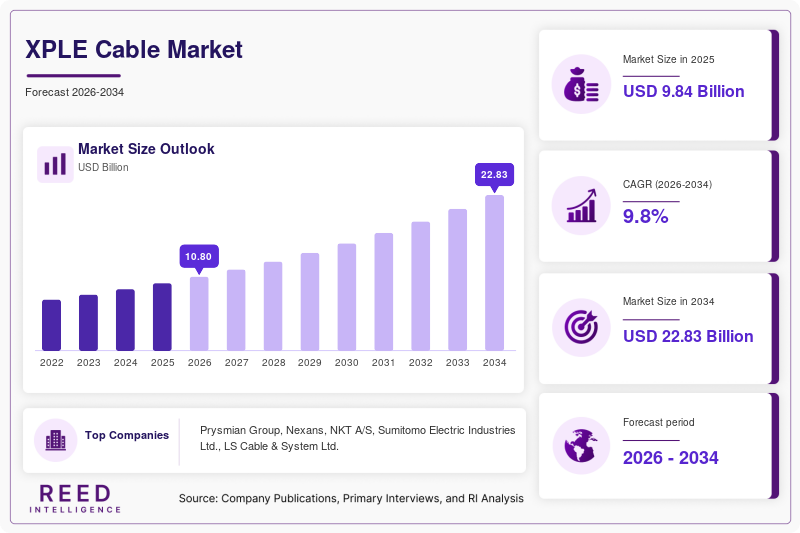
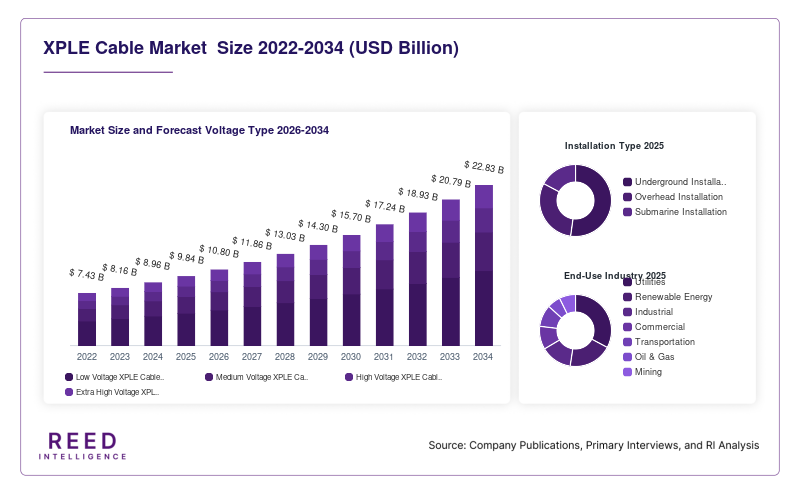
The global XPLE Cable Market size was valued at USD 9.84 billion in 2026 and is projected to reach USD 20.76 billion by 2034, expanding at a CAGR of 9.8% during 2026–2034. The market continues to gain momentum as utilities, industrial facilities, and infrastructure developers increasingly adopt high-performance power transmission solutions capable of supporting rising electricity demand and grid modernization initiatives. Cross-linked polyethylene (XPLE) cables are widely preferred for their thermal stability, high dielectric strength, moisture resistance, and extended operational lifespan, making them suitable for medium-voltage and high-voltage power distribution applications.
Growing investments in renewable energy integration, urban infrastructure expansion, and industrial electrification have accelerated the deployment of advanced cable systems across developed and emerging economies. Governments worldwide are allocating significant capital toward transmission and distribution network upgrades to accommodate increasing power consumption and renewable energy capacity additions. These developments are creating sustained demand for durable and efficient cable technologies.
Key Highlights
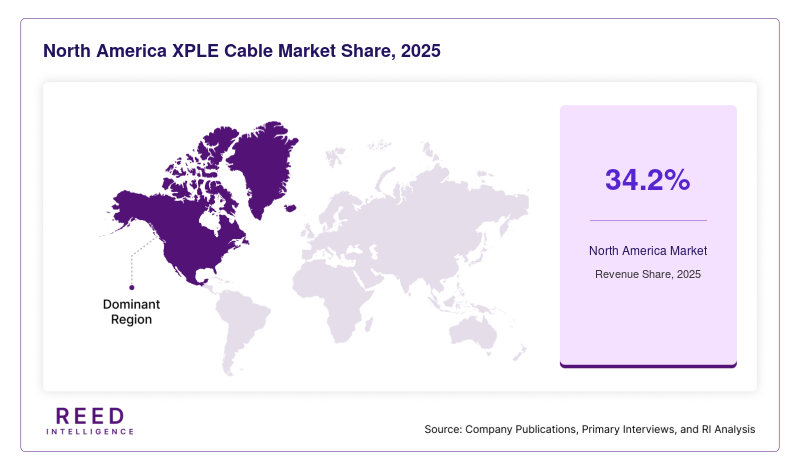
- North America dominated the market with a 34.2% share in 2025.
- while Asia Pacific is expected to grow at the fastest CAGR of 11.4% during 2026–2034.
- By voltage type, Medium Voltage XPLE Cables accounted for the largest share of 46.8%.
- while High Voltage XPLE Cables are projected to grow at a CAGR of 11.7%.
- By installation type, Underground Installation held the largest share of 58.3%.
- whereas Submarine Installation is anticipated to expand at a CAGR of 12.1%.
- By end-use industry, Utilities led with a 42.6% share.
- while Renewable Energy is expected to grow at a CAGR of 12.5%.
- The United States remained the dominant country, with market values of USD 2.88 billion in 2024 and USD 3.12 billion in 2025.
Market Trends
Expansion of Underground Power Transmission Networks
The increasing shift toward underground electricity distribution systems has become a significant trend in the XPLE Cable Market. Urbanization, grid reliability concerns, and land-use limitations are encouraging governments and utilities to replace overhead transmission lines with underground cable infrastructure. XPLE cables are widely utilized in these projects because they offer superior insulation performance, improved durability, and lower maintenance requirements compared with conventional alternatives. Major metropolitan regions are investing in underground transmission corridors to improve power reliability and minimize weather-related outages. The trend is particularly visible in densely populated cities where visual aesthetics, safety, and infrastructure resilience have become important planning considerations. As urban development projects continue to expand globally, demand for advanced underground cable systems is expected to rise steadily throughout the forecast period.
Rising Adoption of Renewable Energy Infrastructure
Renewable energy expansion is creating substantial demand for XPLE cable solutions across solar, wind, hydroelectric, and energy storage projects. Power generated from renewable facilities often requires efficient transmission systems capable of handling varying load conditions and long-distance connectivity. XPLE cables provide the thermal and electrical performance necessary for these demanding applications. Offshore wind developments are especially contributing to market growth due to increasing requirements for submarine and high-voltage cable installations. Governments across multiple regions continue to introduce clean energy targets and carbon reduction policies, encouraging large-scale renewable power investments. As renewable electricity generation becomes a larger component of global energy systems, XPLE cable deployment is expected to increase significantly across both transmission and distribution infrastructure projects.
Market Drivers
Growth in Grid Modernization Investments
Large-scale investments in power grid modernization are driving substantial growth within the XPLE Cable Market. Aging transmission and distribution infrastructure across many countries requires replacement to support increasing electricity demand and improved network efficiency. Utilities are adopting advanced cable technologies capable of handling higher power loads while reducing operational risks and maintenance expenses. XPLE cables offer excellent electrical performance and long service life, making them a preferred solution for modernization projects. The integration of digital monitoring systems, smart substations, and distributed energy resources is further increasing demand for upgraded cable infrastructure. As governments prioritize energy security and grid reliability, investments in modern transmission networks are expected to remain a major growth catalyst throughout the forecast period.
Increasing Industrial Electrification Across Sectors
Industrial electrification initiatives are generating strong demand for XPLE cable installations across manufacturing, mining, transportation, oil and gas, and processing industries. Organizations are increasingly adopting electric equipment and automated systems to improve operational efficiency and reduce carbon emissions. These facilities require reliable power transmission infrastructure capable of supporting continuous operations under demanding environmental conditions. XPLE cables provide superior thermal resistance, mechanical strength, and electrical insulation, making them suitable for industrial applications. Growing investments in industrial expansion projects, production facility upgrades, and digital manufacturing technologies are creating additional opportunities for cable manufacturers. The ongoing transition toward electrified industrial operations is expected to sustain market growth over the coming years.
Market Restraint
High Installation and Project Costs
Despite favorable long-term performance characteristics, high installation and project costs remain a notable challenge for the XPLE Cable Market. Underground and submarine cable deployments require substantial capital investment, specialized equipment, skilled labor, and extensive planning processes. These requirements often increase project timelines and budget constraints, particularly in developing economies with limited infrastructure funding. In addition, cable replacement and maintenance activities can involve significant excavation, permitting, and restoration expenses. Utilities and project developers may postpone infrastructure upgrades when faced with financial limitations or uncertain economic conditions. For example, large-scale underground transmission projects frequently encounter budget overruns due to complex terrain conditions and regulatory requirements. Although XPLE cables deliver long-term reliability benefits, their higher upfront costs can limit adoption among cost-sensitive end users and smaller infrastructure projects.
Market Opportunities
Expansion of Offshore Wind Energy Projects
The rapid development of offshore wind farms presents significant opportunities for the XPLE Cable Market. Offshore renewable energy projects require advanced cable systems capable of transmitting electricity over long distances while operating in challenging marine environments. XPLE cables offer excellent moisture resistance, thermal performance, and mechanical durability, making them suitable for submarine power transmission applications. Governments across Europe, Asia Pacific, and North America are increasing investments in offshore wind capacity to achieve renewable energy targets and strengthen energy security. These projects require extensive networks of inter-array and export cables, creating sustained demand for advanced cable technologies. As offshore wind installations continue to expand globally, cable manufacturers are expected to benefit from increasing procurement activity and infrastructure development programs.
Development of Smart Cities and Urban Infrastructure
The growing implementation of smart city initiatives is creating substantial opportunities for XPLE cable suppliers. Modern urban infrastructure projects require reliable power distribution systems capable of supporting digital technologies, electric transportation networks, intelligent lighting systems, and connected public services. XPLE cables are increasingly selected for these applications due to their efficiency, durability, and safety performance. Governments and municipal authorities are investing heavily in urban modernization programs aimed at improving energy management and infrastructure resilience. Rising construction activity, metro rail expansion, electric vehicle charging networks, and smart grid deployment are generating additional demand for advanced cable solutions. As smart city investments accelerate worldwide, the market is expected to experience consistent growth across multiple application areas.
Segmental Analysis
By Voltage Type
Medium Voltage XPLE Cables represented the dominant subsegment and accounted for approximately 46.8% of global revenue in 2024. Their widespread adoption across utility distribution networks, commercial facilities, industrial operations, and urban infrastructure projects contributed significantly to market leadership. These cables provide an effective balance between performance, durability, and cost efficiency, making them suitable for diverse applications. Growing urbanization and infrastructure modernization initiatives have further increased deployment across transmission and distribution networks. Utility operators frequently select medium-voltage cables for grid expansion projects because they offer reliable electrical performance while supporting evolving energy requirements.
High Voltage XPLE Cables are expected to record the fastest growth, expanding at a CAGR of 11.7% during the forecast period. Increasing investments in long-distance power transmission infrastructure and renewable energy integration projects are driving demand. High-voltage systems are essential for transporting electricity efficiently across large geographic areas while minimizing transmission losses. The expansion of offshore wind facilities, interregional transmission corridors, and smart grid projects is generating strong growth opportunities. Governments and utilities seeking improved energy efficiency and grid reliability are increasingly investing in advanced high-voltage cable solutions, supporting sustained market expansion.
By Installation Type
Underground Installation emerged as the largest subsegment and captured approximately 58.3% of market revenue in 2024. Increasing urban development and the need for reliable power infrastructure have accelerated underground cable deployment across residential, commercial, and industrial applications. Underground systems offer protection from weather-related disruptions and reduce visual impacts in densely populated areas. Municipal authorities and utility providers continue to prioritize underground transmission projects to improve service reliability and support urban expansion. The superior insulation and durability characteristics of XPLE cables make them particularly suitable for underground environments.
Submarine Installation is anticipated to be the fastest-growing subsegment, registering a CAGR of 12.1% through 2034. Rising investments in offshore renewable energy projects and cross-border electricity transmission systems are contributing to strong demand. Offshore wind farms require extensive submarine cable networks to transport generated power to mainland grids. Governments are increasingly supporting marine energy infrastructure as part of broader sustainability and energy security objectives. Technological advancements in cable design and installation methods are improving operational performance, further encouraging adoption across offshore transmission projects.
By End-Use Industry
Utilities accounted for the largest market share, representing approximately 42.6% of global revenue in 2024. Utility companies remain the primary consumers of XPLE cables due to ongoing investments in transmission and distribution infrastructure. Grid modernization initiatives, rising electricity demand, and replacement of aging cable networks continue to drive procurement activity. Utilities require durable and efficient cable systems capable of supporting long operational lifecycles and reliable power delivery. Increasing renewable energy integration has further elevated demand for advanced cable technologies across utility networks.
Renewable Energy is projected to be the fastest-growing end-use industry, expanding at a CAGR of 12.5% during the forecast period. Global efforts to reduce carbon emissions and increase clean energy generation are supporting substantial investments in wind, solar, and hydroelectric projects. These facilities require reliable cable infrastructure for electricity transmission and distribution. Offshore wind developments, utility-scale solar installations, and energy storage projects are generating significant opportunities for manufacturers. As governments continue implementing renewable energy targets, demand for XPLE cable systems within this segment is expected to grow considerably.
Regional Analysis
North America
North America accounted for approximately 34.2% of the global XPLE Cable Market in 2025 and maintained its position as the largest regional market. The region is projected to expand at a CAGR of 8.7% through 2034. Growth is supported by significant investments in power transmission upgrades, renewable energy integration, and aging grid replacement projects. Utility companies continue to modernize infrastructure to improve reliability and accommodate increasing electricity consumption from residential, commercial, and industrial sectors.
The United States represents the dominant country within the regional market. A major growth factor is the ongoing expansion of smart grid initiatives and transmission modernization programs. Federal and state-level investments in energy infrastructure have accelerated demand for advanced cable systems capable of supporting renewable power integration and grid resilience objectives. Increasing electrification across transportation and industrial sectors is further strengthening market demand.
Europe
Europe captured approximately 27.8% of global market revenue in 2025 and is anticipated to grow at a CAGR of 9.1% during the forecast period. The region benefits from extensive renewable energy deployment and ambitious carbon reduction strategies. Countries throughout Europe are investing in transmission infrastructure upgrades to support clean energy integration and cross-border electricity connectivity. Demand for underground and submarine cable installations continues to rise across multiple infrastructure projects.
Germany remains the leading national market within Europe. One unique growth factor is the country’s continued transition toward renewable electricity generation. Large-scale offshore wind developments and transmission corridor expansions require advanced cable technologies capable of supporting long-distance power delivery. Ongoing industrial electrification initiatives also contribute to growing cable demand across the country.
Asia Pacific
Asia Pacific represented approximately 24.6% of global revenue in 2025 and is forecast to register the fastest CAGR of 11.4% through 2034. Rapid urbanization, industrial development, and electricity consumption growth are supporting strong market expansion across the region. Governments are investing heavily in transmission and distribution infrastructure to meet increasing energy requirements and improve network efficiency. These investments are creating significant opportunities for cable manufacturers.
China dominates the regional market due to its large-scale infrastructure development activities. A key growth factor is the country's extensive investment in ultra-high-voltage transmission networks designed to transport electricity from renewable generation centers to urban demand hubs. Rising renewable energy capacity additions and industrial expansion continue to strengthen demand for XPLE cable installations.
Middle East & Africa
The Middle East & Africa accounted for nearly 7.4% of the global market in 2025 and is expected to grow at a CAGR of 8.9% during the forecast period. Infrastructure modernization, population growth, and rising electricity demand are supporting regional market development. Governments are investing in transmission and distribution projects to improve energy access and strengthen grid reliability. Renewable energy projects are also contributing to increasing cable deployment.
Saudi Arabia leads the regional market owing to large-scale energy and infrastructure investments. A distinctive growth factor is the country's economic diversification strategy, which includes substantial spending on smart cities, industrial zones, and renewable energy projects. These initiatives require reliable power transmission systems, creating sustained demand for advanced XPLE cable solutions.
Latin America
Latin America held approximately 6.0% of global market revenue in 2025 and is projected to expand at a CAGR of 8.5% through 2034. Growing investments in power infrastructure, urban development, and industrial expansion are supporting regional demand. Several countries are modernizing transmission networks to improve energy reliability and reduce distribution losses. Renewable energy deployment is also creating opportunities for cable manufacturers operating in the region.
Brazil represents the largest country market in Latin America. One significant growth factor is the country's ongoing investment in renewable power generation and long-distance transmission projects. Expanding wind and solar capacity requires efficient power delivery infrastructure, driving demand for advanced cable technologies. Industrial development and urban expansion further support market growth prospects.
Competitive Landscape
The XPLE Cable Market remains moderately consolidated, with established manufacturers focusing on capacity expansion, product innovation, and strategic partnerships to strengthen market positions. Leading companies are investing in advanced insulation technologies, sustainable manufacturing practices, and high-voltage cable development to address evolving customer requirements.
Among major participants, Prysmian Group continues to maintain a leading position due to its extensive product portfolio, global manufacturing footprint, and strong presence in transmission infrastructure projects. The company recently expanded production capabilities for high-voltage and submarine cable systems to support growing renewable energy demand.
Other notable market participants include Nexans, NKT A/S, Sumitomo Electric Industries, and LS Cable & System. These companies continue to pursue long-term supply agreements, infrastructure project contracts, and research initiatives aimed at improving cable efficiency and performance. Increasing competition is encouraging manufacturers to focus on technological advancements, regional expansion, and customized solutions for utility, industrial, and renewable energy applications.
Key Players
- Prysmian Group
- Nexans
- NKT A/S
- Sumitomo Electric Industries Ltd.
- LS Cable & System Ltd.
- Furukawa Electric Co., Ltd.
- Southwire Company LLC
- General Cable Corporation
- KEI Industries Limited
- Finolex Cables Ltd.
- Riyadh Cables Group
- Hengtong Group Co., Ltd.
- TBEA Co., Ltd.
- Jiangnan Group Limited
- Polycab India Limited
Recent Developments
- Prysmian Group expanded its high-voltage cable manufacturing capacity in 2025 to address increasing demand from offshore wind and transmission infrastructure projects.
- Nexans launched an enhanced XPLE cable portfolio designed for smart grid and renewable energy applications, improving thermal efficiency and operational reliability.
- NKT A/S secured multiple long-term transmission infrastructure contracts across Europe, strengthening its position in high-voltage cable deployment projects.
- LS Cable & System invested in advanced submarine cable production facilities to support growing offshore renewable energy developments.
- Sumitomo Electric Industries introduced next-generation insulation technologies aimed at improving cable lifespan and performance under demanding operating conditions.
XPLE Cable Market Segments
Voltage Type
- Low Voltage XPLE Cables
- Medium Voltage XPLE Cables
- High Voltage XPLE Cables
- Extra High Voltage XPLE Cables
Installation Type
- Underground Installation
- Overhead Installation
- Submarine Installation
End-Use Industry
- Utilities
- Renewable Energy
- Industrial
- Commercial
- Transportation
- Oil & Gas
- Mining
By Region
- North America
- Europe
- APAC
- Middle East and Africa
- LATAM