Yarn Lubricant Market Size, Share, Demand & Growth Analysis Report By Product Type (Synthetic Yarn Lubricants, Mineral Oil-Based Lubricants, Bio-Based Yarn Lubricants, Silicone-Based Lubricants), By Application (Spinning, Weaving, Knitting, Texturizing, Finishing), By End-Use Industry (Apparel Textiles, Home Furnishing, Industrial Textiles, Technical Textiles, Automotive Textiles) & By Region – Global Industry Forecast 2026–2034
USD 3950
Market Overview
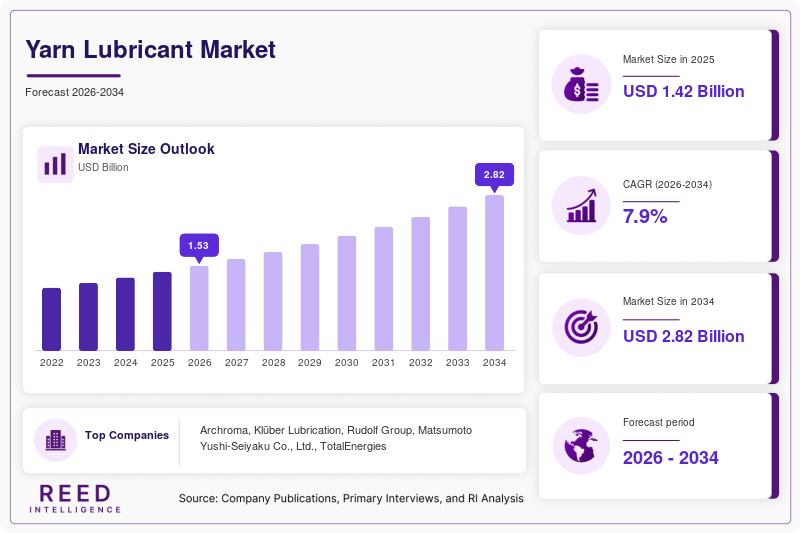
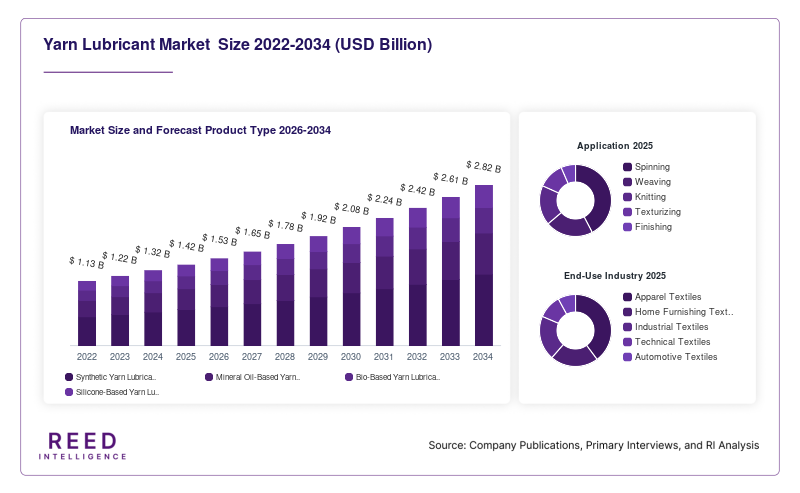
The global Yarn Lubricant Market size was valued at USD 1.42 billion in 2026 and is projected to reach USD 2.61 billion by 2034, expanding at a CAGR of 7.9% during the forecast period from 2026 to 2034. The market continues to witness stable growth due to increasing textile manufacturing activities across emerging economies and the rising demand for high-performance synthetic and blended yarns in apparel, industrial textiles, automotive fabrics, and technical textile applications. Yarn lubricants are widely used during spinning, weaving, knitting, and texturizing operations to reduce yarn friction, improve fiber cohesion, minimize machine wear, and enhance production efficiency. Manufacturers are increasingly adopting advanced lubricant formulations that provide better thermal stability, anti-static performance, and lower residue formation.
A major global factor supporting market growth is the expansion of the textile export industry in Asia Pacific and Latin America. Countries with large-scale textile production facilities are investing in automated spinning and weaving technologies that require precision lubrication systems to maintain operational efficiency. Growing awareness regarding sustainable textile processing has also accelerated the demand for biodegradable and water-based yarn lubricants that comply with environmental regulations. In addition, the rapid expansion of sportswear, home furnishing textiles, and industrial fabric applications has created consistent demand for specialty lubricants capable of supporting high-speed textile machinery.
Key Highlights
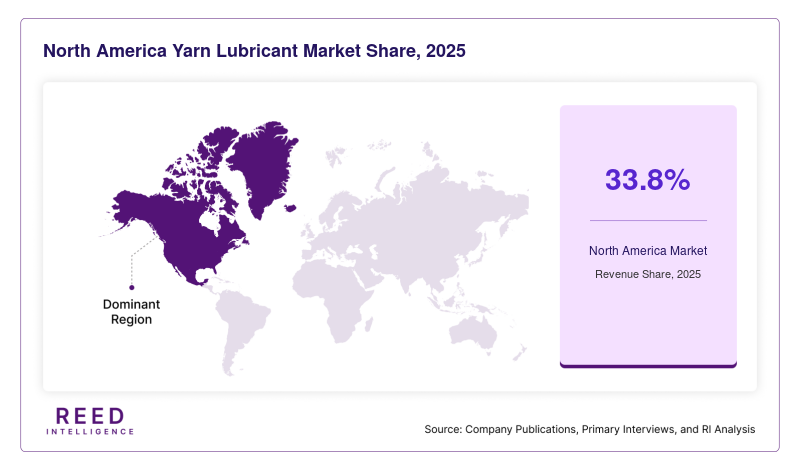
- North America dominated the Yarn Lubricant Market with a 33.8% share in 2025, while Asia Pacific is expected to grow at the fastest CAGR of 10.8% during 2026–2034.
- By product type, synthetic yarn lubricants accounted for the largest share of 44.6%, while bio-based yarn lubricants are projected to grow at a CAGR of 11.9%.
- By application, spinning operations led with a 39.4% share, whereas texturizing applications are expected to expand at a CAGR of 10.7%.
- By end-use industry, apparel textiles held the dominant share of 46.1%, while technical textiles are projected to grow at a CAGR of 10.5%.
- The United States remained the dominant country, with market values of USD 318 million in 2024 and USD 346 million in 2025.
Market Trends
Growing Preference for Bio-Based and Low-Residue Lubricants
The Yarn Lubricant Market is witnessing increased demand for bio-based and low-residue lubricant formulations due to tightening environmental standards and sustainability goals across the textile industry. Textile manufacturers are focusing on reducing wastewater contamination and chemical residue generated during spinning and weaving operations. As a result, lubricant producers are introducing formulations derived from vegetable oils, ester compounds, and biodegradable additives that improve yarn quality while reducing environmental impact. These lubricants also help textile facilities comply with export regulations in North America and Europe where sustainable textile processing standards are becoming stricter. The trend is particularly visible among manufacturers supplying premium apparel and sportswear brands that prioritize environmentally responsible production processes.
In addition, low-residue lubricants are gaining popularity because they reduce machine cleaning frequency and improve operational efficiency in high-speed textile manufacturing plants. Yarn producers are increasingly investing in advanced lubricants that minimize deposits on rollers, guides, and spinning equipment. Improved lubrication performance supports longer machinery lifespan and lower maintenance costs, which is becoming an important purchasing factor for large textile processors. Several lubricant manufacturers are also expanding research activities focused on water-soluble and silicone-free formulations that provide better thermal stability and lower fiber breakage during intensive production cycles.
Integration of Automation in Textile Manufacturing Facilities
The increasing integration of automated spinning, knitting, and weaving systems is significantly influencing product innovation in the Yarn Lubricant Market. Modern textile machinery operates at much higher speeds than conventional equipment, creating a strong requirement for precision lubrication systems that can maintain yarn consistency and reduce friction-related defects. Lubricants designed for automated machinery are formulated to provide uniform coating distribution, improved anti-static properties, and enhanced temperature resistance. Textile manufacturers are increasingly prioritizing lubricants capable of supporting continuous production processes without compromising fiber strength or product quality.
Automation trends are also encouraging lubricant suppliers to develop customized solutions for synthetic fibers such as polyester, nylon, and acrylic yarns that dominate global textile exports. High-speed manufacturing environments require lubricants with stable viscosity and low volatility to avoid interruptions in production lines. Smart textile factories are further contributing to demand for specialized lubricants compatible with digital monitoring systems and automated dispensing technologies. The growing adoption of Industry 4.0 practices within textile manufacturing facilities is expected to create long-term opportunities for advanced lubricant suppliers focused on operational efficiency and process optimization.
Market Drivers
Expansion of Global Textile Manufacturing Capacity
The rapid expansion of textile manufacturing capacity across developing economies is a major factor driving the Yarn Lubricant Market. Countries including India, Vietnam, Bangladesh, Indonesia, and Turkey are witnessing increased investments in spinning mills, weaving facilities, and textile export infrastructure. Growing apparel exports and rising domestic textile consumption have encouraged manufacturers to upgrade production lines with advanced machinery that requires high-performance lubrication systems. Yarn lubricants play a critical role in minimizing friction, preventing yarn breakage, and improving machine productivity during large-scale manufacturing operations.
The increasing use of synthetic fibers in clothing, home furnishing products, automotive fabrics, and industrial textiles is also supporting lubricant demand. Polyester and nylon yarns require effective lubrication to maintain smooth processing during spinning and texturizing activities. Textile manufacturers are prioritizing lubricants that improve yarn flexibility and reduce static electricity in high-speed processing environments. Furthermore, government initiatives supporting textile industry expansion in Asia Pacific and the Middle East are expected to increase the number of textile production facilities, thereby strengthening long-term demand for yarn lubricants.
Rising Demand for High-Performance Technical Textiles
The growing adoption of technical textiles in industrial, automotive, healthcare, and construction applications is contributing significantly to market growth. Technical textile products require high-strength fibers and precision manufacturing processes that depend heavily on advanced yarn lubrication systems. Lubricants help maintain fiber integrity during production and support uniform yarn performance under demanding industrial conditions. Manufacturers producing geotextiles, filtration fabrics, protective clothing, and automotive interior materials are increasingly adopting specialized lubricants with anti-static and heat-resistant properties.
The healthcare and automotive sectors are particularly contributing to demand for high-quality yarn lubricants because these industries require textiles with consistent durability and performance characteristics. In automotive manufacturing, lubricated yarns are widely used in seat fabrics, airbags, and reinforcement materials where friction reduction is essential during processing. Similarly, medical textiles require contamination-free and low-residue lubricants to maintain product safety and manufacturing precision. The expansion of industrial textile applications across both developed and emerging economies is expected to create sustained growth opportunities for lubricant manufacturers over the forecast period.
Market Restraint
Volatility in Raw Material Prices and Regulatory Compliance Costs
Fluctuating raw material prices remain a significant challenge for companies operating in the Yarn Lubricant Market. Most yarn lubricants are produced using petroleum-derived oils, synthetic esters, surfactants, emulsifiers, and specialty chemical additives whose prices are heavily influenced by global crude oil fluctuations and supply chain disruptions. Sudden increases in raw material costs can reduce manufacturer profit margins and create pricing pressure across the textile supply chain. Smaller lubricant manufacturers often face difficulties in maintaining consistent production costs, especially during periods of geopolitical instability or transportation disruptions affecting chemical imports.
In addition to raw material volatility, regulatory compliance requirements related to chemical safety and environmental sustainability are increasing operational expenses for lubricant producers. Textile processing industries in North America and Europe are subject to stringent restrictions regarding hazardous chemical content, wastewater discharge, and volatile organic compound emissions. Compliance with these standards requires ongoing investments in research, product reformulation, testing procedures, and certification processes. For example, several conventional lubricant formulations containing mineral oil derivatives have faced reduced demand due to stricter environmental regulations. These factors may slow product adoption among cost-sensitive textile manufacturers and create barriers for smaller suppliers attempting to compete with established multinational lubricant companies.
Market Opportunities
Increasing Adoption of Sustainable Textile Processing Solutions
The transition toward sustainable textile manufacturing presents significant opportunities for companies operating in the Yarn Lubricant Market. Global apparel brands and textile exporters are increasingly demanding eco-friendly production methods that reduce environmental impact while maintaining product quality. This shift is encouraging lubricant manufacturers to introduce biodegradable, low-toxicity, and water-soluble formulations suitable for sustainable textile operations. Producers capable of developing environmentally compliant lubricants with high processing efficiency are expected to gain competitive advantages in international markets.
Sustainable textile initiatives are particularly strong in Europe and North America, where regulatory authorities and consumer groups are encouraging responsible chemical usage throughout the textile supply chain. Textile manufacturers are actively replacing conventional mineral oil lubricants with renewable alternatives that generate lower emissions and reduced wastewater contamination. Growing investments in recycled fiber production are also creating demand for lubricants specifically designed for recycled polyester and blended yarn processing. Companies focusing on sustainable product innovation and green manufacturing technologies are likely to benefit from rising procurement preferences among global textile exporters and fashion brands.
Growth of Smart and Functional Textile Applications
The increasing popularity of smart textiles and functional fabrics is creating new opportunities for specialized yarn lubricant manufacturers. Smart textiles used in wearable electronics, healthcare monitoring systems, military clothing, and industrial safety equipment require advanced yarn processing techniques to maintain conductivity, flexibility, and durability. Lubricants developed for these applications must provide consistent performance without interfering with electronic or functional textile properties. This requirement is encouraging research into advanced synthetic and silicone-based lubricant technologies.
Functional textiles with moisture management, antimicrobial protection, thermal insulation, and flame-resistant characteristics are also driving demand for customized lubrication systems. Manufacturers producing these textiles require lubricants that improve yarn movement and processing stability while maintaining fabric functionality. The increasing use of conductive fibers and specialty yarns in wearable devices and industrial monitoring systems is expected to support long-term demand for high-performance lubricants. As textile innovation expands across healthcare, sportswear, aerospace, and defense industries, lubricant suppliers with advanced formulation capabilities are likely to experience strong commercial opportunities.
Segmental Analysis
By Product Type
Synthetic yarn lubricants accounted for the largest share of the Yarn Lubricant Market in 2024, representing 44.6% of total revenue. These lubricants are widely used because they provide excellent thermal stability, oxidation resistance, and lubrication performance during high-speed textile manufacturing operations. Synthetic formulations are particularly effective in processing polyester, nylon, and acrylic fibers commonly used in apparel, industrial fabrics, and technical textiles. Textile manufacturers prefer synthetic lubricants because they improve yarn smoothness, reduce friction during spinning, and minimize machine wear in automated production environments. In addition, synthetic lubricants help maintain consistent yarn quality while supporting higher production speeds in large textile facilities.
The bio-based yarn lubricant segment is projected to witness the fastest CAGR of 11.9% during the forecast period. Growing environmental concerns and sustainability initiatives across the textile industry are encouraging manufacturers to adopt biodegradable and renewable lubricant formulations. Bio-based lubricants derived from vegetable oils and ester compounds are gaining popularity because they reduce wastewater contamination and comply with environmental regulations in export-oriented markets. Textile producers supplying premium fashion brands and sustainable apparel manufacturers are increasingly prioritizing eco-friendly processing chemicals. Rising investments in green textile manufacturing and the growing adoption of recycled fibers are expected to further strengthen demand for bio-based yarn lubricant products.
By Application
Spinning operations held the dominant share of the Yarn Lubricant Market in 2024, accounting for 39.4% of overall revenue. Spinning processes require efficient lubrication systems to reduce fiber-to-metal friction, prevent yarn breakage, and improve yarn cohesion during high-speed production cycles. Lubricants used in spinning applications help maintain consistent yarn tension and minimize static electricity, which is particularly important in synthetic fiber processing. The increasing use of automated spinning machinery across textile manufacturing facilities has significantly increased demand for high-performance lubricants capable of supporting continuous industrial production. In addition, spinning applications consume large volumes of lubricants due to their central role in textile manufacturing operations.
Texturizing applications are expected to register the fastest CAGR of 10.7% during the forecast period. Texturizing processes involve modifying synthetic yarn structures to improve elasticity, softness, and appearance in finished textile products. These operations generate substantial heat and friction, creating strong demand for lubricants with superior thermal stability and anti-static performance. The rising popularity of stretch fabrics, sportswear, and performance apparel is increasing demand for textured synthetic yarns globally. Manufacturers are investing in advanced texturizing technologies that require specialized lubricant formulations capable of improving yarn flexibility and reducing machine deposits. The growth of premium activewear and functional textile applications is expected to support long-term expansion of this segment.
By End-Use Industry
Apparel textiles represented the largest end-use segment in the Yarn Lubricant Market in 2024, contributing 46.1% of total market revenue. The apparel industry remains the largest consumer of yarn lubricants due to extensive production of cotton, polyester, blended, and synthetic fabrics used in clothing manufacturing. Lubricants are essential for maintaining yarn quality during spinning, weaving, knitting, and finishing processes within apparel production facilities. Growing global demand for fast fashion, sportswear, and casual clothing continues to increase textile manufacturing volumes, particularly in Asia Pacific and Latin America. In addition, apparel producers are increasingly investing in automated machinery that depends on precision lubrication systems to improve efficiency and reduce production defects.
Technical textiles are projected to grow at the fastest CAGR of 10.5% during the forecast period. The expanding use of technical textiles in automotive, healthcare, industrial, aerospace, and construction applications is driving demand for high-performance yarn lubricants capable of supporting specialty fiber processing. Technical textile manufacturing often involves high-strength fibers and precision production methods that require advanced lubrication technologies to maintain yarn integrity and processing consistency. Increasing investments in protective clothing, filtration fabrics, medical textiles, and geotextiles are contributing to rapid segment growth. Furthermore, the development of smart textiles and wearable technologies is encouraging manufacturers to adopt specialized lubricants designed for conductive and functional yarn processing applications.
Regional Analysis
North America
North America accounted for 33.8% of the global Yarn Lubricant Market share in 2025 and is projected to expand at a CAGR of 6.9% during the forecast period. The region maintains a strong position due to advanced textile manufacturing infrastructure, high adoption of automated spinning systems, and increasing demand for technical textiles. Textile producers across the United States and Canada are investing in precision manufacturing technologies that require efficient lubrication systems to reduce yarn breakage and improve production consistency. The region also benefits from strong demand for industrial fabrics used in automotive, healthcare, and defense applications.
The United States remained the dominant country within North America due to its large industrial textile sector and continuous investments in sustainable manufacturing technologies. A major growth factor supporting the market is the increasing adoption of eco-friendly lubricants among textile processors supplying global apparel brands. Manufacturers are replacing traditional mineral oil lubricants with biodegradable formulations to comply with environmental standards and improve export competitiveness. In addition, the expansion of technical textile production for medical and automotive applications continues to strengthen lubricant consumption across the country.
Europe
Europe represented 27.1% of the global Yarn Lubricant Market in 2025 and is anticipated to register a CAGR of 6.5% through 2034. The regional market is driven by stringent environmental regulations, strong textile innovation capabilities, and growing demand for premium-quality fabrics. Textile manufacturers across Germany, Italy, France, and Spain are increasingly adopting high-performance lubricants designed for automated weaving and knitting systems. The market also benefits from rising investments in sustainable textile production and recycling technologies.
Germany dominated the European market due to its strong industrial textile manufacturing sector and advanced machinery production capabilities. A key factor supporting market growth in the country is the increasing demand for specialty lubricants used in technical textile applications such as filtration materials, automotive fabrics, and protective clothing. German textile companies are actively investing in research focused on low-emission production technologies and sustainable fiber processing methods. This trend continues to create opportunities for lubricant suppliers offering advanced biodegradable and low-residue formulations.
Asia Pacific
Asia Pacific held 24.9% of the global Yarn Lubricant Market share in 2025 and is projected to witness the fastest CAGR of 10.8% during the forecast period. The region benefits from large-scale textile manufacturing operations, expanding export activities, and rising domestic apparel consumption. Countries including China, India, Bangladesh, Vietnam, and Indonesia are investing heavily in textile production capacity to meet growing international demand. High-volume spinning and weaving operations across these countries are generating strong demand for efficient yarn lubrication systems capable of supporting continuous industrial production.
China remained the leading country in the Asia Pacific market due to its extensive textile export industry and large synthetic fiber manufacturing base. One major growth factor driving the Chinese market is the rapid modernization of textile factories with automated spinning and knitting technologies. Manufacturers are increasingly adopting advanced lubricants that improve machine productivity and reduce operational downtime. The expansion of sportswear, home furnishing textiles, and industrial fabric production within China is further contributing to long-term market growth across the region.
Middle East & Africa
The Middle East & Africa accounted for 7.6% of the global Yarn Lubricant Market in 2025 and is expected to grow at a CAGR of 7.2% during the forecast period. The market is gradually expanding due to rising textile manufacturing investments, favorable industrial policies, and increasing demand for apparel production in Gulf countries and parts of Africa. Several governments are encouraging textile sector development to diversify industrial output and create employment opportunities. As new textile facilities become operational, demand for industrial lubricants used in spinning and weaving activities is expected to increase steadily.
Turkey dominated the regional market because of its well-established textile export industry and strategic position connecting European and Asian markets. A significant growth factor supporting the Turkish market is the expansion of textile exports to Europe and the Middle East, which has encouraged manufacturers to upgrade production efficiency and adopt advanced processing technologies. Turkish textile companies are increasingly focusing on premium-quality yarn processing methods that require high-performance lubrication systems capable of supporting high-speed textile machinery and export-grade fabric production.
Latin America
Latin America captured 6.6% of the global Yarn Lubricant Market share in 2025 and is anticipated to expand at a CAGR of 7.5% during the forecast period. The market is benefiting from improving textile manufacturing capabilities and rising investments in domestic apparel production across Brazil, Mexico, and Colombia. Growing consumer demand for affordable clothing and home textiles has encouraged regional manufacturers to modernize spinning and weaving operations. Increasing industrialization and expanding textile exports are further supporting lubricant consumption within the region.
Brazil remained the dominant country in Latin America due to its large domestic textile industry and strong apparel manufacturing network. One unique growth factor driving the Brazilian market is the increasing use of blended and synthetic yarns in sportswear and casual clothing production. Textile manufacturers are investing in lubricant solutions that improve yarn flexibility and reduce production defects during high-speed processing. In addition, government support for domestic manufacturing and industrial modernization initiatives continues to create favorable conditions for yarn lubricant suppliers operating in the country.
Competitive Landscape
The Yarn Lubricant Market is moderately fragmented, with global and regional manufacturers competing through product innovation, sustainability initiatives, and customized formulation capabilities. Leading companies are focusing on developing high-performance lubricants compatible with automated textile machinery and environmentally responsible manufacturing practices. Strategic partnerships with textile producers and machinery manufacturers remain important growth strategies across the industry.
Archroma emerged as one of the leading companies in the market due to its broad portfolio of sustainable textile processing chemicals and strong global distribution network. The company has expanded its focus on biodegradable lubricant technologies designed for synthetic and blended yarn applications. Other major participants including Klüber Lubrication, Rudolf Group, TotalEnergies, and Matsumoto Yushi-Seiyaku are investing in research and development activities aimed at improving anti-static properties, thermal resistance, and low-residue performance.
Key Players
- Archroma
- Klüber Lubrication
- Rudolf Group
- Matsumoto Yushi-Seiyaku Co., Ltd.
- TotalEnergies
- Schill+Seilacher GmbH
- Takemoto Oil & Fat Co., Ltd.
- Clearco Products Co., Inc.
- Zschimmer & Schwarz
- Pulcra Chemicals
- Bozzetto Group
- CHT Germany GmbH
- Goulston Technologies
- Sarex Chemicals
- Fineotex Chemical Limited
Recent Developments
- In February 2026, Archroma introduced a new biodegradable yarn lubricant series designed for recycled polyester processing applications in textile manufacturing facilities.
- In August 2025, Klüber Lubrication expanded its textile lubricant production capacity in Asia Pacific to address increasing demand from automated spinning mills.
- In November 2025, Rudolf Group launched a low-residue lubricant formulation developed specifically for high-speed synthetic yarn texturizing operations.
- In March 2026, Matsumoto Yushi-Seiyaku Co., Ltd. announced research collaboration initiatives focused on advanced anti-static lubricant technologies for technical textile manufacturing.
- In January 2026, TotalEnergies introduced water-soluble textile lubricant solutions aimed at reducing wastewater generation in large-scale textile processing plants.
Yarn Lubricant Market Segments
Product Type
- Synthetic Yarn Lubricants
- Mineral Oil-Based Yarn Lubricants
- Bio-Based Yarn Lubricants
- Silicone-Based Yarn Lubricants
Application
- Spinning
- Weaving
- Knitting
- Texturizing
- Finishing
End-Use Industry
- Apparel Textiles
- Home Furnishing Textiles
- Industrial Textiles
- Technical Textiles
- Automotive Textiles
By Region
- North America
- Europe
- APAC
- Middle East and Africa
- LATAM