Yttria Stabilized Zirconia Market Size, Share & Demand Report By Type (Fully Stabilized Zirconia, Partially Stabilized Zirconia, Tetragonal Zirconia Polycrystal), By Application (Thermal Barrier Coatings, Dental Ceramics, Fuel Cells, Oxygen Sensors, Industrial Wear Components, Biomedical Implants), By End-Use Industry (Aerospace and Defense, Healthcare, Electronics and Semiconductor, Energy and Power, Automotive, Industrial Manufacturing), By Region & Segment Forecasts, 2026–2034
USD 3950
Market Overview
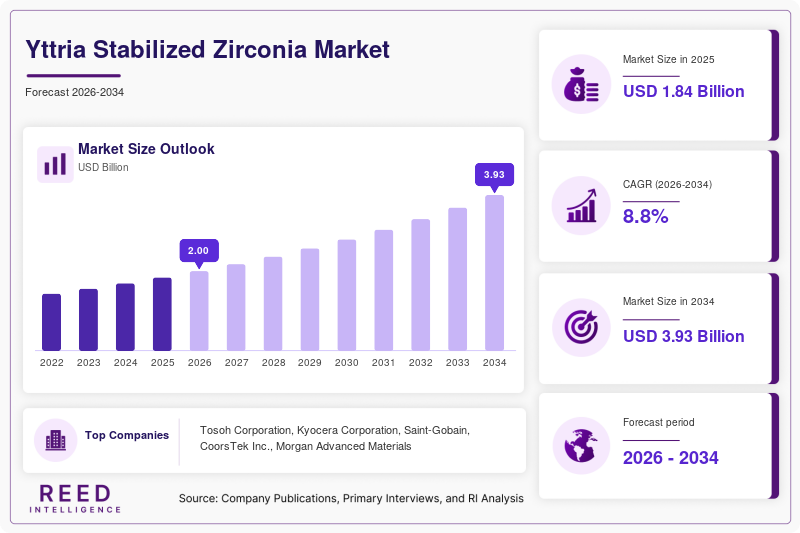
The global Yttria Stabilized Zirconia Market size was valued at USD 1.84 billion in 2026 and is projected to reach USD 3.62 billion by 2034, expanding at a CAGR of 8.8% during the forecast period from 2026 to 2034. The market continues to witness stable expansion due to the increasing use of advanced ceramic materials across electronics, medical implants, thermal barrier coatings, energy systems, and industrial manufacturing. Yttria stabilized zirconia, commonly known as YSZ, offers high fracture toughness, thermal resistance, corrosion stability, and ionic conductivity, making it suitable for demanding industrial applications. Growing investments in precision engineering and advanced manufacturing technologies have also supported product adoption across multiple sectors.
One of the major global factors supporting market growth is the rising deployment of fuel cells and energy-efficient systems. Governments and private manufacturers are investing in clean energy technologies to reduce industrial emissions and improve energy efficiency. YSZ materials are widely used in solid oxide fuel cells due to their oxygen ion conductivity and thermal durability. At the same time, demand from dental ceramics and biomedical implants continues to rise because of increasing healthcare expenditure and the growing preference for durable ceramic-based restorative materials. The aerospace industry is also creating additional demand for thermal barrier coatings manufactured using yttria stabilized zirconia.
Key Highlights
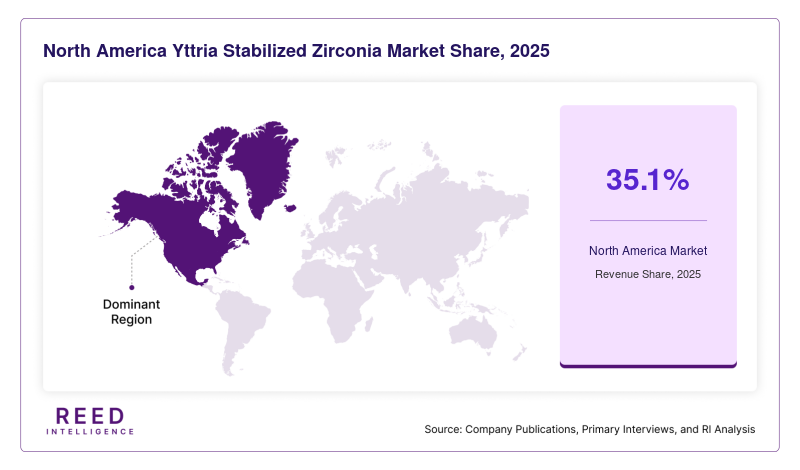
- North America dominated the market with a 35.1% share in 2025, while Asia Pacific is expected to grow at the fastest CAGR of 10.9% during 2026–2034.
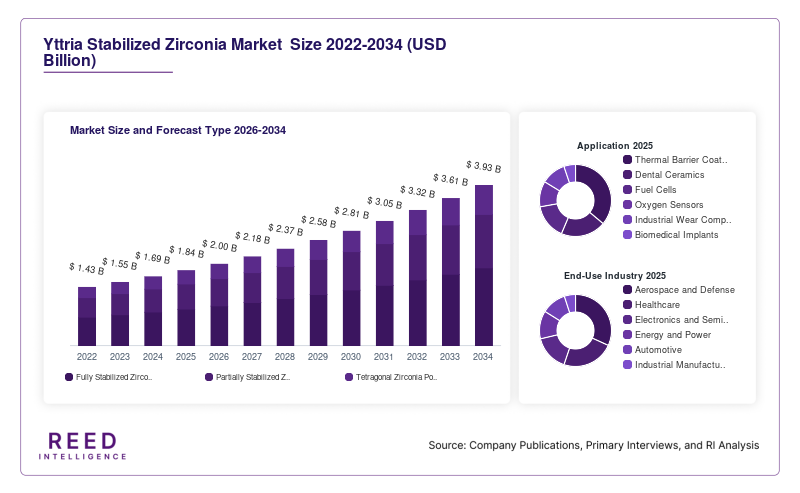
- By type, partially stabilized zirconia accounted for the largest share of 42.8%, while tetragonal zirconia polycrystal is projected to grow at a CAGR of 10.7%.
- By application, thermal barrier coatings led with a 39.4% share, whereas dental ceramics are expected to expand at a CAGR of 11.3%.
- By end-use industry, aerospace and defense accounted for the largest market share of 33.6%, while healthcare is projected to grow at a CAGR of 10.8%.
- The United States remained the dominant country, with market values of USD 472 million in 2024 and USD 518 million in 2025.
Market Trends
Expansion of Advanced Dental Ceramic Applications
The increasing use of yttria stabilized zirconia in dental restoration procedures is emerging as a major trend across the global market. Dental laboratories and healthcare providers are shifting toward zirconia-based crowns, bridges, and implants because of their durability, biocompatibility, and natural appearance. Rising awareness regarding cosmetic dentistry and the growing aging population are supporting product demand in developed and developing economies. Manufacturers are also introducing multilayer zirconia materials with enhanced translucency and mechanical strength to improve patient outcomes. Digital dentistry technologies, including CAD/CAM systems, are further increasing the adoption of yttria stabilized zirconia materials in precision dental manufacturing.
Rising Integration in Clean Energy and Fuel Cell Technologies
The market is also witnessing strong momentum from the expanding use of solid oxide fuel cells and other clean energy systems. Yttria stabilized zirconia acts as an effective electrolyte material because of its high ionic conductivity at elevated temperatures. Energy companies and industrial equipment manufacturers are increasing investments in efficient fuel cell technologies to support low-emission energy generation. This trend is particularly visible in Europe and Asia Pacific, where governments are promoting hydrogen infrastructure and industrial decarbonization initiatives. In addition, research institutions are developing improved YSZ formulations for energy storage systems, oxygen sensors, and electrochemical devices, creating long-term growth potential for advanced ceramic suppliers.
Market Drivers
Increasing Demand from Aerospace Thermal Barrier Coatings
The growing need for high-performance thermal protection systems in aerospace engines is a major factor driving the Yttria Stabilized Zirconia Market. Aircraft engine manufacturers use yttria stabilized zirconia coatings to protect turbine blades and engine components from extreme temperatures and oxidation. These coatings improve fuel efficiency, extend component lifespan, and support engine reliability in demanding operational environments. Rising air passenger traffic and increasing aircraft production are creating sustained demand for advanced ceramic coatings. Defense modernization programs and investments in next-generation military aircraft are also contributing to market expansion. Continuous advancements in plasma spray coating technologies are improving coating efficiency and supporting wider industrial adoption.
Growth of Medical Implant and Bioceramic Applications
The expanding healthcare sector is another important driver supporting the global market. Yttria stabilized zirconia materials are increasingly used in orthopedic implants, dental prosthetics, and surgical devices because of their strength, wear resistance, and biocompatibility. Growing healthcare spending and rising demand for minimally invasive procedures are encouraging the use of advanced ceramic biomaterials. The aging population in several countries is increasing the number of joint replacement and dental restoration procedures, creating stable product demand. In addition, healthcare manufacturers are investing in precision ceramic manufacturing processes to improve implant quality and patient safety, further accelerating market growth across medical applications.
Market Restraint
High Production Costs and Complex Manufacturing Processes
The high cost associated with the production and processing of yttria stabilized zirconia remains a significant restraint for market expansion. Manufacturing YSZ materials requires advanced sintering technologies, controlled processing conditions, and high-purity raw materials, which increase operational expenses for producers. Small and medium-sized manufacturers often face difficulties in scaling production because of the substantial capital investment required for ceramic processing equipment. In addition, fluctuations in the prices of zirconium compounds and yttrium oxide can affect profit margins and create supply chain challenges. Complex machining and finishing requirements also increase overall manufacturing costs for end-use industries such as aerospace and medical devices. These cost-related challenges may limit adoption in price-sensitive markets and reduce penetration among small industrial users. The availability of alternative ceramic materials with lower production costs further intensifies competitive pressure across several application segments.
Market Opportunities
Increasing Investments in Semiconductor Manufacturing
The rapid expansion of semiconductor manufacturing facilities presents a strong opportunity for the Yttria Stabilized Zirconia Market. Semiconductor fabrication processes require advanced ceramic materials that can withstand corrosive chemicals, plasma exposure, and high operating temperatures. YSZ components are increasingly used in wafer handling systems, deposition equipment, and insulating applications because of their mechanical stability and chemical resistance. Countries across Asia Pacific and North America are investing heavily in domestic semiconductor production to strengthen supply chains and support technology industries. As chip manufacturing becomes more advanced, the demand for precision ceramic components is expected to increase steadily. This trend is creating opportunities for ceramic manufacturers to develop customized YSZ solutions for electronics and semiconductor applications.
Expansion of Hydrogen Economy Infrastructure
The growing global focus on hydrogen energy systems is creating additional opportunities for market participants. Governments and private organizations are increasing investments in hydrogen production, storage, and fuel cell technologies to reduce carbon emissions and improve energy security. Yttria stabilized zirconia plays a key role in solid oxide fuel cells and electrochemical devices used within hydrogen infrastructure. Rising industrial interest in green hydrogen projects is expected to support long-term demand for high-performance ceramic electrolytes. Research activities aimed at improving fuel cell efficiency and durability are also expanding the application scope of YSZ materials. As hydrogen-powered transportation and industrial energy systems gain commercial acceptance, manufacturers are expected to benefit from increasing demand for advanced zirconia-based components.
Segmental Analysis
By Type
Partially stabilized zirconia accounted for the largest share of the global Yttria Stabilized Zirconia Market in 2024, representing approximately 42.8% of total revenue. The segment remains dominant because it offers a balanced combination of toughness, thermal resistance, and cost efficiency across multiple industrial applications. Partially stabilized zirconia is widely used in thermal barrier coatings, oxygen sensors, grinding media, and industrial ceramics where mechanical reliability is essential. Aerospace manufacturers continue to prefer this material for turbine coating systems due to its thermal shock resistance and operational stability at elevated temperatures. Industrial equipment manufacturers are also increasing usage because partially stabilized zirconia provides long service life and improved performance in harsh operating environments. Growing adoption across automotive exhaust systems and industrial wear-resistant components further supports segment expansion globally.
Tetragonal zirconia polycrystal is expected to register the fastest CAGR of 10.7% during the forecast period because of its increasing use in medical and dental applications. This material provides high flexural strength, enhanced fracture toughness, and excellent aesthetic properties, making it suitable for dental crowns, bridges, and orthopedic implants. Rising healthcare expenditure and increasing cosmetic dentistry procedures are driving product demand across developed and emerging economies. Manufacturers are also improving processing technologies to enhance translucency and durability, which supports wider adoption in premium dental restoration products. The segment is additionally benefiting from growing research activities focused on biocompatible ceramic materials for surgical and implantable devices. Expanding healthcare infrastructure in Asia Pacific and Latin America is expected to create long-term growth opportunities for this subsegment.
By Application
Thermal barrier coatings held the largest market share in 2024, accounting for nearly 39.4% of global revenue. The segment continues to dominate because yttria stabilized zirconia provides superior insulation against extreme temperatures in turbine engines and industrial machinery. Aerospace manufacturers rely heavily on YSZ coatings to improve engine efficiency and reduce thermal degradation in aircraft turbines. Industrial gas turbines used in power generation also require advanced ceramic coatings to improve operational lifespan and fuel efficiency. Rising aircraft production, growing energy demand, and increasing industrial automation are contributing to strong demand across this application segment. The ability of yttria stabilized zirconia coatings to reduce maintenance costs and improve system durability remains a major factor supporting widespread industrial adoption across both commercial and defense sectors.
Dental ceramics are projected to witness the fastest CAGR of 11.3% through 2034 due to increasing consumer preference for durable and aesthetically appealing dental restoration materials. Dental laboratories and clinics are increasingly shifting toward zirconia-based prosthetics because of their strength, biocompatibility, and natural appearance. The expansion of digital dentistry technologies, including CAD/CAM milling systems, is simplifying the production of precision zirconia restorations and increasing treatment efficiency. Rising disposable incomes and growing awareness regarding cosmetic dental procedures are also supporting demand in developing economies. In addition, the increasing elderly population worldwide is contributing to higher volumes of dental implant and crown procedures. Continuous innovation in multilayer zirconia products with improved translucency is expected to further accelerate growth across this application segment during the forecast period.
By End-Use Industry
Aerospace and defense accounted for the largest share of the Yttria Stabilized Zirconia Market in 2024, contributing approximately 33.6% of total revenue. The dominance of this segment is linked to the extensive use of YSZ coatings in aircraft engines, turbine systems, and defense equipment operating under extreme thermal conditions. Advanced ceramic coatings help improve fuel efficiency, reduce heat-related wear, and extend component life in aerospace systems. Increasing global air travel demand and rising defense modernization programs are creating stable opportunities for zirconia coating manufacturers. Governments across major economies are also investing in next-generation aircraft and propulsion technologies that require high-performance thermal barrier materials. The continued development of energy-efficient aviation technologies is expected to maintain strong demand for yttria stabilized zirconia products within this industry segment.
Healthcare is anticipated to grow at the fastest CAGR of 10.8% between 2026 and 2034 because of increasing adoption of zirconia materials in dental and orthopedic applications. YSZ-based implants and restorative products are gaining popularity due to their biocompatibility, corrosion resistance, and long-term durability. Rising global healthcare expenditure and increasing awareness regarding advanced treatment options are contributing to market growth. Healthcare providers are also emphasizing minimally invasive procedures and durable implant materials to improve patient outcomes. Growing investments in dental tourism and cosmetic dentistry are supporting higher demand for zirconia crowns and implants, particularly in Asia Pacific and Latin America. In addition, ongoing technological advancements in medical ceramics manufacturing are helping producers develop customized and precision-engineered zirconia solutions for healthcare applications.
Regional Analysis
North America
North America accounted for 35.1% of the global Yttria Stabilized Zirconia Market share in 2025 and is expected to maintain stable growth during the forecast period at a CAGR of 8.1%. The region benefits from strong demand across aerospace, defense, healthcare, and energy industries. Growing investments in advanced manufacturing technologies and ceramic research facilities continue to support market development. The presence of major aircraft manufacturers and medical device companies also contributes to consistent product demand. Increasing adoption of thermal barrier coatings and precision ceramic components is further strengthening regional market expansion.
The United States remained the dominant country within North America due to its strong industrial base and extensive aerospace manufacturing activities. The country is witnessing rising demand for zirconia coatings in jet engines, industrial turbines, and military applications. Healthcare infrastructure expansion and the growing use of zirconia dental implants are also supporting market growth. In addition, government funding for clean energy technologies and fuel cell research is encouraging the adoption of yttria stabilized zirconia materials in energy storage and hydrogen-related applications across the country.
Europe
Europe represented a considerable share of the global market in 2025 and is projected to expand at a CAGR of 8.4% through 2034. The region continues to benefit from strong automotive engineering capabilities and increasing adoption of advanced ceramic technologies in industrial equipment manufacturing. European industries are emphasizing energy efficiency and low-emission technologies, which supports demand for YSZ-based fuel cells and thermal insulation systems. The growing use of ceramic coatings in turbine systems and industrial machinery is also contributing to regional market expansion. Stable research investments are helping manufacturers improve ceramic material performance and production efficiency.
Germany dominated the European market due to its advanced industrial manufacturing ecosystem and strong engineering sector. The country has a well-established automotive and industrial machinery industry that increasingly relies on advanced ceramic materials for precision applications. Demand for yttria stabilized zirconia is also supported by expanding investments in hydrogen energy systems and clean industrial technologies. German healthcare manufacturers are further increasing the use of zirconia materials in medical implants and dental restoration products, creating additional growth opportunities for regional suppliers.
Asia Pacific
Asia Pacific is projected to register the fastest CAGR of 10.9% during the forecast period owing to rapid industrialization and expanding electronics manufacturing activities. The region is experiencing increasing demand for advanced ceramics across energy, electronics, automotive, and healthcare sectors. Governments in countries such as China, Japan, South Korea, and India are supporting domestic manufacturing capabilities and clean energy infrastructure development. Rising semiconductor manufacturing investments and increasing production of consumer electronics are creating strong demand for durable ceramic materials. The availability of low-cost manufacturing facilities is also encouraging international companies to expand regional operations.
China remained the leading country in Asia Pacific because of its extensive industrial production capabilities and expanding clean energy investments. The country is witnessing strong demand for yttria stabilized zirconia in fuel cells, industrial coatings, and electronics manufacturing applications. China’s growing healthcare infrastructure and rising dental care awareness are further increasing the adoption of zirconia-based restorative materials. In addition, government support for advanced materials research and semiconductor manufacturing expansion continues to create favorable conditions for regional market growth.
Middle East & Africa
The Middle East & Africa market is developing steadily and is expected to grow at a CAGR of 7.3% between 2026 and 2034. Industrial diversification programs and increasing investments in energy infrastructure are contributing to market development across the region. Countries are focusing on expanding manufacturing activities and reducing dependence on oil-based revenue sources, which is supporting demand for advanced industrial materials. Growing adoption of thermal coatings in industrial gas turbines and energy systems is also encouraging market expansion. The region is additionally witnessing gradual growth in healthcare infrastructure and medical device imports.
Saudi Arabia emerged as the dominant country in the regional market because of its expanding industrial modernization initiatives and energy sector investments. The country is increasingly adopting advanced ceramic materials for industrial processing equipment and power generation systems. Demand for yttria stabilized zirconia is also supported by infrastructure development projects and growing industrial manufacturing capabilities. Investments in healthcare modernization and dental treatment facilities are creating additional opportunities for zirconia-based medical and dental applications within the country.
Latin America
Latin America accounted for a moderate share of the global market in 2025 and is projected to grow at a CAGR of 7.6% during the forecast period. The market is benefiting from rising industrial automation activities and increasing investments in manufacturing industries. Demand for yttria stabilized zirconia materials is gradually increasing across energy systems, medical devices, and industrial coatings applications. Governments across the region are encouraging industrial modernization and technology adoption, which is supporting the use of advanced ceramic materials. Growth in automotive component manufacturing is also contributing to regional market expansion.
Brazil dominated the Latin American market due to its relatively large industrial sector and growing healthcare infrastructure. The country is witnessing rising demand for zirconia materials in dental restoration and medical implant applications. Increasing industrial activity in mining, manufacturing, and energy generation is also supporting the use of ceramic coatings and high-performance industrial components. Furthermore, the expansion of private healthcare facilities and dental laboratories is creating favorable conditions for the adoption of yttria stabilized zirconia products across Brazil.
Competitive Landscape
The global Yttria Stabilized Zirconia Market is moderately consolidated, with leading manufacturers focusing on product innovation, strategic partnerships, and regional expansion to strengthen market presence. Companies are investing in advanced ceramic processing technologies to improve product purity, mechanical performance, and thermal stability. Market participants are also increasing research activities related to fuel cells, medical ceramics, and aerospace coatings to diversify application areas and enhance long-term revenue opportunities.
Tosoh Corporation remained one of the leading companies in the market due to its extensive zirconia powder production capabilities and broad global distribution network. The company continues to expand its advanced ceramic portfolio to support growing demand from healthcare and industrial sectors. Other major players are focusing on acquisitions and collaborative agreements with aerospace and electronics manufacturers to improve technological capabilities and strengthen supply chain efficiency.
Key Players
- Tosoh Corporation
- Kyocera Corporation
- Saint-Gobain
- CoorsTek Inc.
- Morgan Advanced Materials
- CeramTec GmbH
- Showa Denko K.K.
- Zircoa Inc.
- 3M Company
- HC Starck Solutions
- Rauschert GmbH
- Innovnano
- Vesuvius plc
- MEL Chemicals
- Nanoe
Recent Developments
- In February 2026, Tosoh Corporation expanded its zirconia powder production capacity to support rising demand from dental and fuel cell manufacturers.
- In September 2025, CeramTec GmbH introduced a new yttria stabilized zirconia material designed for high-strength medical implant applications.
- In June 2025, Saint-Gobain announced investments in advanced thermal barrier coating technologies for aerospace turbine systems.
Yttria Stabilized Zirconia Market Segments
Type
- Fully Stabilized Zirconia
- Partially Stabilized Zirconia
- Tetragonal Zirconia Polycrystal
Application
- Thermal Barrier Coatings
- Dental Ceramics
- Fuel Cells
- Oxygen Sensors
- Industrial Wear Components
- Biomedical Implants
End-Use Industry
- Aerospace and Defense
- Healthcare
- Electronics and Semiconductor
- Energy and Power
- Automotive
- Industrial Manufacturing
By Region
- North America
- Europe
- APAC
- Middle East and Africa
- LATAM