Zero Trust Network Access (ZTNA) Solution Market Size, Share & Trends Analysis Report By Deployment (Cloud, On-Premise), By Enterprise Type (Large Enterprises, Small & Medium Enterprises), By Authentication Type (Single, Multi ), By Application (Remote Access Security, Data Center & Cloud Access Security), By End User (BFSI, IT & Telecommunications, Healthcare, Retail & E-Commerce, Government & Defense, Manufacturing, Energy & Utilities) Forecasts 2026–2034
USD 3950
Zero Trust Network Access (ZTNA) Solution Market Size
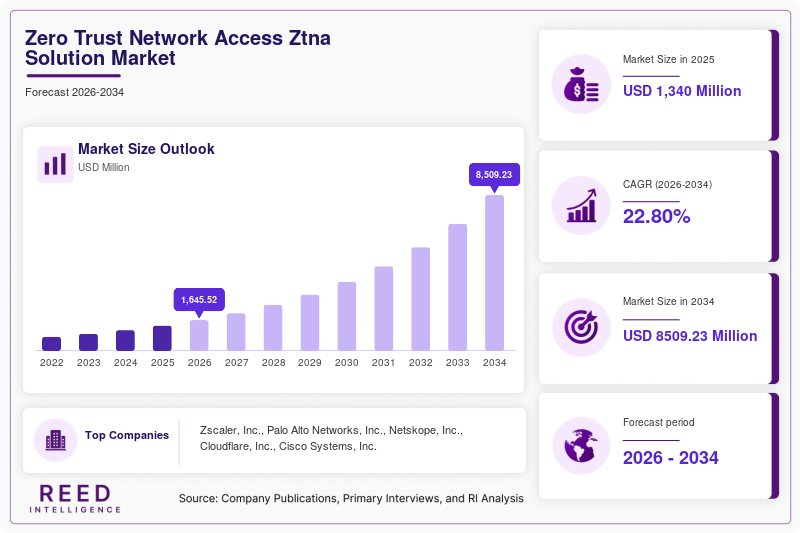
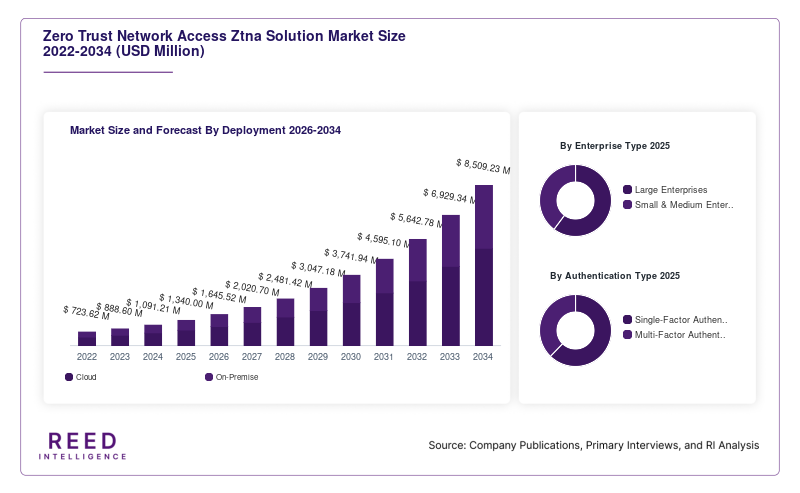
The global Zero Trust Network Access (ZTNA) Solution Market size was valued at USD 1,340 million in 2025 and is projected to grow from USD 1,620 million in 2026 to USD 8,509.23 million by 2034, registering a CAGR of 22.80% during the forecast period from 2026 to 2034.
Zero Trust Network Access solutions provide identity-based, least-privilege access to private applications and enterprise resources without granting users unrestricted visibility into the underlying network. The architecture evaluates identity, device posture and contextual signals before establishing access. NIST's implementation guidance demonstrates how zero-trust architectures can support employees, contractors and partners accessing resources distributed across on-premises and multiple cloud environments.
The ZTNA market has developed partly as an alternative to conventional VPN-based remote access. VPN architectures traditionally connect users to a broader network, whereas ZTNA establishes access at the application level. This distinction reduces unnecessary network exposure and supports segmentation of private applications. Zscaler, Netskope, Palo Alto Networks and other vendors have consequently positioned ZTNA as a component of broader SASE or SSE architectures rather than simply as a replacement VPN product.
Zero Trust Network Access (ZTNA) Solution Market Drivers
Replacement of Legacy VPN-Based Remote Access
The migration away from broad network-level remote access is a fundamental demand driver for ZTNA. Traditional VPNs can expose larger portions of enterprise networks once authentication is completed, whereas ZTNA is designed to authorize access to individual applications based on defined policies. This application-centric model aligns more closely with least-privilege security requirements.
The shift is particularly relevant for organizations operating hybrid workforces and distributed applications. ZTNA can authenticate users and devices before providing access to specific private applications, reducing unnecessary network visibility. Vendors are consequently positioning ZTNA as a mechanism for reducing VPN dependency while supporting remote, third-party and internal access use cases.
Expansion of Cloud and Hybrid IT Environments
Enterprise applications are increasingly distributed across public clouds, private data centers and SaaS platforms. This fragmentation weakens the effectiveness of security architectures built around a single enterprise network perimeter. ZTNA addresses this structural change by applying identity and policy controls irrespective of where an application is hosted.
NIST's zero-trust implementation work specifically addresses enterprise resources distributed across on-premises and multiple cloud environments. This creates demand for access platforms capable of maintaining consistent authorization and security policies across heterogeneous infrastructure.
Increasing Identity and Access Security Requirements
Credential compromise, unmanaged devices and third-party access increase the importance of continuously evaluating access conditions. Modern ZTNA architectures combine identity verification with device posture and contextual controls rather than relying solely on successful password authentication.
Multi-factor authentication, device intelligence and continuous policy evaluation therefore become increasingly integrated into ZTNA deployments. Netskope's Universal ZTNA architecture, for example, combines device intelligence with posture, risk and role information to extend policy enforcement across users and connected devices.
Zero Trust Network Access (ZTNA) Solution Market Restraints
Integration Complexity Across Existing Infrastructure
ZTNA implementation can require integration with identity providers, endpoint-management platforms, applications, network infrastructure and security tools. Organizations with large estates of legacy applications may need application connectors, policy redesign and identity mapping before access controls can be consistently implemented.
The operational challenge becomes more pronounced where enterprises operate multiple cloud environments and legacy applications simultaneously. Palo Alto Networks highlights application onboarding, tunnel management and private-application connectivity as important components of modern ZTNA deployments, illustrating the infrastructure-management requirements associated with large-scale implementations.
Skills, Policy Management and Migration Costs
ZTNA changes how organizations define access policies, meaning security teams must transition from network-oriented rules toward identity, application and contextual policies. Incorrect policy design can create either excessive access or unnecessary restrictions that affect productivity.
SMEs may face particular implementation constraints because they often have smaller security teams and limited resources for complex security architectures. Cloud-delivered ZTNA and managed security services can reduce infrastructure requirements, but subscription costs, integration work and migration from legacy VPNs can remain barriers during the initial deployment phase.
Zero Trust Network Access (ZTNA) Solution Market Opportunities
Universal ZTNA for IoT, OT and Unmanaged Devices
A major opportunity is extending ZTNA beyond conventional employee laptops and managed endpoints. Industrial equipment, IoT devices and operational technology frequently cannot run traditional security agents, creating a requirement for identity and context-aware access mechanisms that operate without conventional endpoint software.
Netskope's 2025 Universal ZTNA enhancements incorporated device intelligence for IoT and OT environments, including devices that cannot run agents. This expands the addressable market from employee remote access toward broader enterprise connectivity involving machines, operational systems and connected devices.
ZTNA for AI Agents and Machine Identities
The emergence of autonomous AI agents creates a new access-control requirement because software agents can access applications, APIs and enterprise data without behaving like conventional human users. Their identities may be temporary, permissions can change dynamically and automated actions can occur at machine speed.
Zscaler announced in June 2026 an expansion of its Zero Trust Exchange platform specifically for agentic AI, covering how AI agents connect to resources, access data and operate across enterprise environments. This creates a new opportunity for ZTNA platforms to extend identity-centric access controls from human users to autonomous software entities.
Zero Trust Network Access (ZTNA) Solution Market Segmental Analysis
By Deployment
Cloud deployment represents the dominant deployment segment and is projected to record a 25.0% CAGR during 2026–2034. Cloud ZTNA is well suited to distributed enterprises because policy enforcement can be delivered centrally while supporting users, applications and devices across multiple locations. Subscription-based deployment also reduces the need for organizations to maintain extensive access infrastructure internally.
On-premise ZTNA remains relevant for organizations requiring direct control over access infrastructure, particularly government, defense, financial services and highly regulated environments. Legacy application dependencies and data-residency requirements can sustain demand for locally deployed components even as cloud architectures gain broader adoption.
By Enterprise Type
Large enterprises hold the dominant position, supported by larger cybersecurity budgets, complex application environments, extensive user populations and greater requirements for remote, privileged and third-party access. These organizations also have more complex network architectures, making application-level access control increasingly relevant.
SMEs are the fastest-growing enterprise category, with a projected 26.1% CAGR. Cloud-delivered ZTNA lowers the infrastructure and administration requirements associated with deployment, enabling smaller organizations to adopt capabilities that historically required larger security teams. Managed security providers further reduce the technical burden associated with implementation.
By Authentication Type
Multi-factor authentication (MFA) is the dominant authentication segment and is projected to grow at a 25.3% CAGR. ZTNA deployments increasingly require stronger identity verification because access decisions depend on confidence in both the user's identity and the security context surrounding the connection.
Single-factor authentication remains present in legacy environments and lower-risk applications but faces structural pressure as organizations strengthen identity controls. MFA integration is increasingly connected with conditional access, device posture and risk-based authorization, making authentication an integral component of broader zero-trust policy enforcement.
By Application
Remote Access Security is the dominant application, accounting for 38.6% of market share in 2025. The segment benefits from continued demand for secure access by remote employees, contractors and distributed users without exposing broader enterprise networks.
Data Center & Cloud Access Security is the fastest-growing application, with a projected 26.3% CAGR. As applications and sensitive information move across hybrid and multi-cloud environments, enterprises require controls that connect users to specific resources without extending network-level access. This makes application-level authorization increasingly important for cloud and data-center environments.
By End User
BFSI is the dominant end-user segment, accounting for 24.5% of market share in 2025. Banks, insurers and financial technology organizations manage sensitive financial information and operate highly distributed digital infrastructures, making identity-centric access controls relevant for employees, privileged users, applications and third-party connections.
Healthcare is the fastest-growing end-user segment, with a projected 25.1% CAGR. Hospitals, insurers and healthcare platforms are expanding their use of cloud applications, electronic health records and connected digital services while facing persistent cybersecurity and data-protection requirements. ZTNA provides an access-control framework for connecting distributed users to specific healthcare applications and resources.
Zero Trust Network Access (ZTNA) Solution Market Regional Analysis
North America Zero Trust Network Access (ZTNA) Solution Market
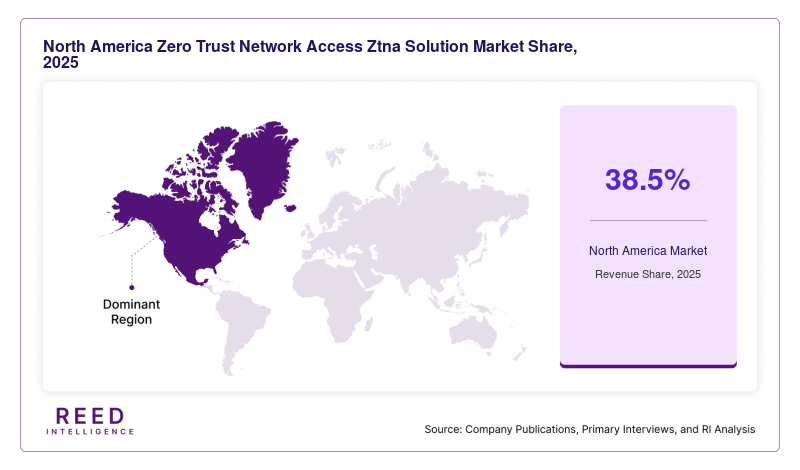
North America is the dominant regional market, accounting for 38.05% of global ZTNA market share in 2025. The region benefits from early enterprise adoption of zero-trust architectures, high cybersecurity expenditure and the presence of major ZTNA vendors. The U.S. market also has substantial demand from cloud-first enterprises, government organizations and regulated industries.
The United States is the principal regional market, supported by widespread cloud adoption, hybrid work environments and federal zero-trust initiatives. NIST's implementation guidance has also provided practical models for organizations transitioning toward zero-trust architectures across on-premises and cloud resources.
Europe Zero Trust Network Access (ZTNA) Solution Market
Europe represents a substantial ZTNA market supported by data-protection requirements, cloud adoption and increasing enterprise emphasis on identity-based security. The United Kingdom, Germany, France and other major economies have established enterprise cybersecurity ecosystems that support adoption of cloud-delivered access technologies.
European enterprises are also balancing security modernization with data sovereignty, regulatory requirements and legacy infrastructure. This creates demand for ZTNA platforms that can maintain consistent access policies across cloud and on-premise applications while providing stronger control over user and device access.
Asia Pacific Zero Trust Network Access (ZTNA) Solution Market
Asia Pacific is the fastest-growing regional market during the forecast period. Rapid cloud migration, digital transformation and increasing cybersecurity investments across China, India, Japan, South Korea and Southeast Asia are expanding the addressable market. The region's large SME population also supports adoption of cloud-based security platforms.
China, India and Japan are important regional markets, while South Korea, ASEAN and Oceania contribute through expanding digital infrastructure. Adoption is particularly relevant across BFSI, telecommunications, manufacturing and healthcare, where organizations are connecting increasingly distributed users, applications and devices to cloud and private resources.
Latin America Zero Trust Network Access (ZTNA) Solution Market
Latin America is developing as enterprises modernize remote-access infrastructure and expand cloud applications. Brazil and Mexico represent important markets because of their large enterprise bases, growing digital ecosystems and increasing cybersecurity requirements.
ZTNA adoption is influenced by the availability of cloud-delivered security services and managed security providers. These models can reduce the infrastructure and specialized staffing requirements associated with implementing zero-trust access, supporting adoption among organizations that may not maintain large internal cybersecurity teams.
Middle East & Africa Zero Trust Network Access (ZTNA) Solution Market
The Middle East & Africa market is supported by digital transformation programs, cloud adoption and modernization of cybersecurity infrastructure. Financial services, government, telecommunications and large enterprises represent important adoption environments where secure access to distributed applications is becoming increasingly relevant.
Gulf economies are investing in cloud infrastructure and cybersecurity modernization, while African enterprises increasingly use cloud-delivered security services to overcome infrastructure limitations. ZTNA can provide consistent access policies across distributed environments without requiring every organization to build extensive perimeter-based security infrastructure.
Zero Trust Network Access (ZTNA) Solution Market Competitive Landscape
The ZTNA market is characterized by competition between specialized zero-trust vendors and broader cybersecurity companies integrating ZTNA into SASE, SSE, firewall and security-platform portfolios. Zscaler has built a cloud-native secure-access ecosystem around its Zero Trust Exchange and Zscaler Private Access, with emphasis on private application access, identity-based controls and distributed users. Its 2026 product expansion into agentic AI extends the zero-trust proposition beyond conventional human access.
Palo Alto Networks competes through Prisma Access and its ZTNA 2.0 architecture, combining least-privilege application access with continuous trust verification and security inspection. Its approach integrates ZTNA with broader SASE capabilities, enabling organizations to consolidate secure access and network-security controls within a common platform.
Key Market Players
- Zscaler, Inc.
- Palo Alto Networks, Inc.
- Netskope, Inc.
- Cloudflare, Inc.
- Cisco Systems, Inc.
- Fortinet, Inc.
- Okta, Inc.
- IBM Corporation
- Broadcom Inc.
- Check Point Software Technologies Ltd.
- Forcepoint LLC
- CyberArk Software Ltd.
- SonicWall Inc.
Zero Trust Network Access (ZTNA) Solution Market Recent Developments
-
June 2026- Zscaler: Zscaler announced new Zero Trust Exchange capabilities designed to secure agentic AI, covering AI-agent connectivity, data access and autonomous operations within enterprise environments.
-
March 2026- Palo Alto Networks: Prisma Access introduced new ZTNA Connector capabilities, including automated private-application access and rolling upgrades for ZTNA Connector Groups, improving application onboarding and service continuity.
Zero Trust Network Access Ztna Solution Market Segments
By Deployment
- Cloud
- On-Premise
By Enterprise Type
- Large Enterprises
- Small & Medium Enterprises (SMEs)
By Authentication Type
- Single-Factor Authentication
- Multi-Factor Authentication
By Application
- Remote Access Security
- Data Center & Cloud Access Security
- Privileged Access Security
- Third-Party/Partner Access Security
- Others
By End User
- BFSI
- IT & Telecommunications
- Healthcare
- Retail & E-Commerce
- Government & Defense
- Manufacturing
- Energy & Utilities
- Others
By Region
- North America
- Europe
- APAC
- Middle East and Africa
- LATAM