Zinc Borate Market Size, Share & Demand Report By Type (High Zinc Content Zinc Borate, Low Zinc Content Zinc Borate, Ultra-Fine Zinc Borate), By Application (Construction, Electronics, Textiles, Paints & Coatings, Rubber & Plastics), By End-Use Industry (Building & Construction, Automotive, Electrical & Electronics, Industrial Manufacturing), By Form (Powder, Dispersion), By Region & Segment Forecasts, 2026–2034
USD 3950
Market Overview
The global Zinc Borate Market was valued at approximately USD 1.35 billion in 2026 and is projected to reach USD 2.28 billion by 2034, expanding at a CAGR of 6.8% during the forecast period (2026–2034). The market has witnessed steady expansion due to its widespread use as a multifunctional additive in flame retardants, smoke suppressants, and corrosion inhibitors across diverse industries such as construction, electronics, textiles, and polymers.
A key global factor supporting market growth has been the increasing emphasis on fire safety regulations across developed and emerging economies. Governments and regulatory bodies have mandated the use of non-halogenated flame retardants in materials used in construction and electrical applications. Zinc borate, being an environmentally stable and low-toxicity compound, has gained significant traction as a preferred alternative to traditional halogen-based flame retardants.
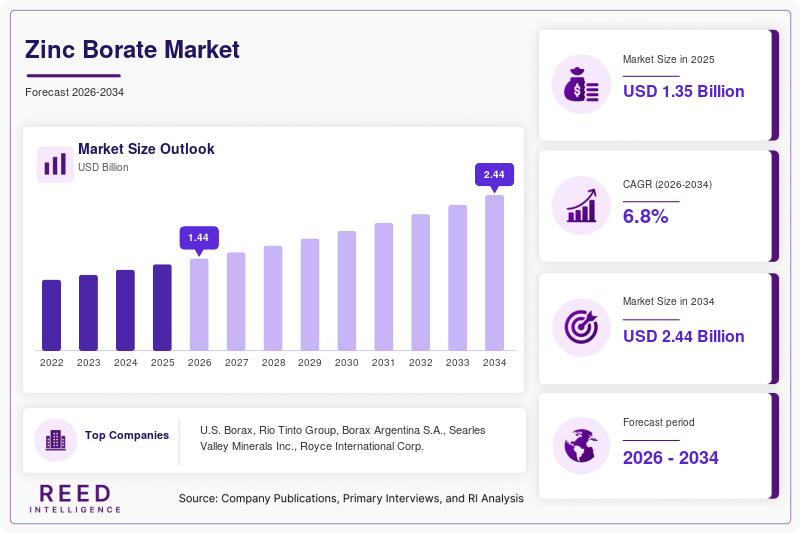
Key Highlights:
- Asia Pacific dominated the market with a share of 41% in 2025 and is expected to register the fastest CAGR of 7.5% during the forecast period.
- The high-zinc borate content segment led by type with a 48% share, while ultra-fine particle zinc borate is projected to grow fastest at a CAGR of 7.9%.
- The construction application segment dominated with a 36% share, whereas electronics applications are expected to grow at a CAGR of 7.6%.
- China remained the dominant country, with market values of USD 310 million in 2024 and USD 330 million in 2025.
Market Trends
Shift Toward Halogen-Free Flame Retardants
One of the most notable trends in the Zinc Borate Market is the increasing shift toward halogen-free flame retardant solutions. Industries are moving away from brominated and chlorinated compounds due to environmental and health concerns. Zinc borate has emerged as a suitable alternative due to its smoke suppression capabilities and compatibility with other flame retardants. This transition is particularly evident in construction materials, electrical cables, and consumer electronics, where safety standards are becoming more stringent. Manufacturers are increasingly integrating zinc borate into polymer formulations to meet compliance requirements while maintaining product performance.
Growing Demand for Multifunctional Additives
Another key trend shaping the Zinc Borate Market is the rising demand for multifunctional additives that offer more than one benefit. Zinc borate acts not only as a flame retardant but also as a corrosion inhibitor, anti-arcing agent, and biocide. This multifunctionality reduces the need for multiple additives, thereby lowering production costs and simplifying formulations. Industries such as paints and coatings, rubber, and plastics are increasingly adopting zinc borate for its versatility. The trend is further supported by ongoing research and development aimed at enhancing the efficiency of zinc borate formulations, particularly in high-performance applications.
Market Drivers
Increasing Fire Safety Regulations Across Industries
The growing enforcement of fire safety regulations globally is a primary driver for the Zinc Borate Market. Regulatory authorities have mandated stringent safety standards in sectors such as construction, transportation, and electronics. Zinc borate is widely used as a flame retardant additive in polymers, coatings, and textiles to improve fire resistance. Its ability to suppress smoke and reduce toxic emissions during combustion makes it highly desirable. As governments continue to prioritize public safety and infrastructure resilience, the demand for zinc borate is expected to increase steadily.
Rising Demand from Polymer and Plastics Industry
The expansion of the global polymer and plastics industry has significantly contributed to the growth of the Zinc Borate Market. Zinc borate is extensively used in PVC, polyolefins, and engineering plastics to enhance thermal stability and flame retardancy. With increasing demand for lightweight and durable materials in automotive, construction, and electronics industries, the use of advanced polymer composites is rising. Zinc borate plays a crucial role in improving the performance characteristics of these materials, thereby driving its adoption. Additionally, the growth of the packaging industry has further boosted demand for polymer-based materials, indirectly supporting market expansion.
Market Restraint
Availability of Alternative Flame Retardants
One of the major restraints impacting the Zinc Borate Market is the availability of alternative flame retardant materials. Compounds such as aluminum trihydrate, magnesium hydroxide, and phosphorus-based flame retardants are widely used in similar applications. These alternatives often offer cost advantages or specific performance benefits, which can limit the adoption of zinc borate in certain use cases.
In addition, fluctuations in raw material prices and supply chain disruptions can impact the production cost of zinc borate, making it less competitive compared to other additives. Some industries may prefer alternative solutions that are more readily available or require lower loading levels.
Moreover, the need for precise formulation and compatibility with specific polymers can pose challenges for manufacturers. While zinc borate offers multiple benefits, its effectiveness depends on proper integration into product formulations. This complexity may discourage smaller manufacturers from adopting it.
Despite these challenges, ongoing research and product innovations are expected to address some of these limitations, enabling broader adoption in the long term.
Market Opportunities
Expansion in Emerging Economies
Emerging economies present significant growth opportunities for the Zinc Borate Market. Rapid industrialization, urban development, and infrastructure expansion in countries such as India, Indonesia, and Brazil are driving demand for fire-resistant materials. Governments in these regions are increasingly implementing safety regulations, creating a favorable environment for zinc borate adoption. Additionally, the growth of local manufacturing industries is expected to boost demand for polymer additives, further supporting market expansion.
Advancements in Nanotechnology and Material Science
Technological advancements in nanotechnology and material science offer new avenues for the Zinc Borate Market. Researchers are developing nano-sized zinc borate particles with enhanced dispersion and performance characteristics. These innovations are expected to improve the efficiency of zinc borate in flame retardant applications while reducing the required dosage. The development of advanced composites and high-performance materials in aerospace, automotive, and electronics sectors is likely to create new demand for specialized zinc borate formulations. This opportunity is expected to drive innovation and open up new application areas in the coming years.
Segmental Analysis
By Type
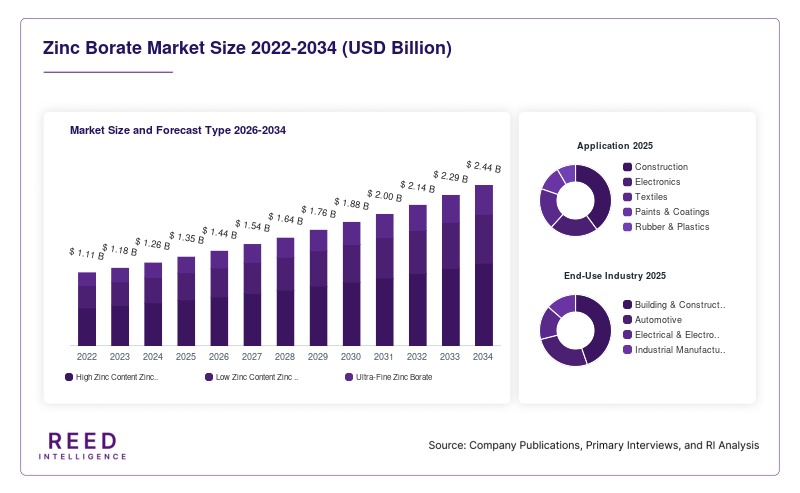
The high-zinc content borate segment dominated the Zinc Borate Market in 2025, accounting for approximately 48% of the total share. This segment gained prominence due to its superior flame retardant efficiency and compatibility with a wide range of polymers. Industries such as construction and electronics have extensively adopted high-zinc content borate for its ability to enhance fire resistance while maintaining material integrity.
The ultra-fine particle zinc borate segment is expected to grow at the fastest CAGR of 7.9% during the forecast period. This growth will be driven by its improved dispersion properties and higher surface area, which enhance performance in advanced applications. The increasing demand for high-performance materials in electronics and automotive industries will further support this segment’s expansion.
By Application
The construction segment held the largest share of 36% in 2025. Zinc borate is widely used in building materials such as insulation, coatings, and plastics to improve fire resistance. The growth of the construction industry, particularly in emerging economies, has significantly contributed to this segment’s dominance.
The electronics application segment is projected to grow at a CAGR of 7.6%. This growth will be fueled by the increasing demand for flame-retardant components in electronic devices. As consumer electronics become more advanced, the need for reliable and safe materials will drive the adoption of zinc borate.
By End-Use Industry
The building and construction industry dominated the Zinc Borate Market in 2025 with a share of 34%. The widespread use of zinc borate in construction materials for fire protection and durability has supported this segment’s growth.
The automotive industry is expected to witness the fastest growth, with a CAGR of 7.2%. The increasing use of lightweight and flame-retardant materials in vehicles will drive demand for zinc borate. Additionally, the shift toward electric vehicles will create new opportunities for advanced material applications.
By Form
The powder form segment accounted for the largest share of 52% in 2025. Powdered zinc borate is widely used due to its ease of handling and compatibility with various formulations. It is commonly used in plastics, coatings, and rubber applications.
The dispersion form segment is projected to grow at a CAGR of 7.4%. This growth will be driven by its improved application efficiency and uniform distribution in complex formulations. Industries requiring high precision and consistency are expected to adopt dispersion-based zinc borate.
Regional Analysis
North America
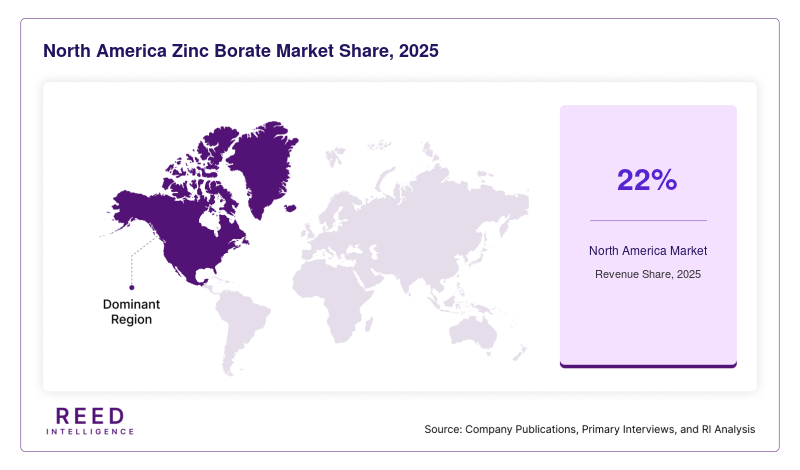
North America accounted for approximately 22% of the Zinc Borate Market share in 2025 and is projected to grow at a CAGR of 6.2% during the forecast period. The region has a mature industrial base and strong regulatory framework supporting fire safety standards. The demand for zinc borate is driven by its use in construction materials, electrical components, and coatings.
The United States dominated the regional market due to its advanced manufacturing sector and strict compliance requirements. The presence of established industries and ongoing investments in infrastructure modernization have contributed to steady demand. Increasing adoption of environmentally friendly flame retardants has further supported market growth.
Europe
Europe held a market share of 19% in 2025 and is expected to expand at a CAGR of 6.0% from 2026 to 2034. The region has been at the forefront of environmental regulations, promoting the use of non-toxic and sustainable materials.
Germany emerged as the leading country, driven by its strong automotive and construction industries. The emphasis on green building practices and sustainable manufacturing has encouraged the use of zinc borate. Additionally, stringent regulations on hazardous substances have accelerated the transition toward halogen-free flame retardants.
Asia Pacific
Asia Pacific dominated the Zinc Borate Market with a 41% share in 2025 and is anticipated to grow at the fastest CAGR of 7.5% during the forecast period. Rapid industrialization, urbanization, and infrastructure development have been key growth drivers in the region.
China led the market due to its large-scale manufacturing capabilities and extensive construction activities. The country’s focus on industrial growth and export-oriented production has increased demand for polymer additives. Additionally, rising awareness of fire safety standards has contributed to higher adoption of zinc borate across various industries.
Middle East & Africa
The Middle East & Africa region accounted for 9% of the market share in 2025 and is projected to grow at a CAGR of 6.5%. The region’s growth is primarily driven by increasing construction activities and infrastructure development.
Saudi Arabia dominated the market due to its ongoing investments in large-scale construction projects and urban development initiatives. The demand for fire-resistant materials in commercial and residential buildings has supported the adoption of zinc borate.
Latin America
Latin America held a 9% share of the Zinc Borate Market in 2025 and is expected to grow at a CAGR of 6.3% during the forecast period. The region has shown steady growth due to expanding industrial activities and infrastructure projects.
Brazil emerged as the leading country, driven by its growing construction and manufacturing sectors. The increasing use of polymer-based materials in various applications has contributed to the demand for zinc borate. Government initiatives aimed at improving building safety standards have further supported market growth.
Competitive Landscape
The Zinc Borate Market is moderately consolidated, with several global and regional players competing based on product quality, innovation, and pricing strategies. Key companies are focusing on expanding their production capacities and investing in research and development to enhance product performance.
U.S. Borax, a leading market player, has maintained a strong position through its extensive product portfolio and global distribution network. The company recently introduced advanced zinc borate formulations designed for high-performance polymer applications, strengthening its competitive edge.
Other prominent players are adopting strategies such as mergers, acquisitions, and partnerships to expand their market presence. Continuous innovation and focus on sustainable solutions are expected to shape the competitive landscape in the coming years.
Key Players List
- U.S. Borax
- Rio Tinto Group
- Borax Argentina S.A.
- Searles Valley Minerals Inc.
- Royce International Corp.
- American Elements
- Chemtura Corporation
- Akdeniz Chemson
- Valtris Specialty Chemicals
- Shandong Zibo Shuanglian Chemical Industry
- Qingdao Hongjia Chemical
- Henan Kingway Chemicals
- Weifang Yongde Chemical
- Liaoning Xinhe Chemical
- Jiangsu Yuyuan Chemical
Recent Developments
- In 2025, leading manufacturers introduced advanced ultra-fine zinc borate products for improved flame retardancy.
- In 2024, key players expanded production facilities in Asia Pacific to meet growing demand.
- In 2025, companies focused on developing environmentally sustainable zinc borate formulations.
- Strategic collaborations between chemical companies and polymer manufacturers increased.
- Investments in R&D for nanotechnology-based zinc borate solutions gained momentum.
Zinc Borate Market Segments
Type
- High Zinc Content Zinc Borate
- Low Zinc Content Zinc Borate
- Ultra-Fine Zinc Borate
Application
- Construction
- Electronics
- Textiles
- Paints & Coatings
- Rubber & Plastics
End-Use Industry
- Building & Construction
- Automotive
- Electrical & Electronics
- Industrial Manufacturing
Form
- Powder
- Dispersion
By Region
- North America
- Europe
- APAC
- Middle East and Africa
- LATAM