Zinc Bromine Battery Market Size, Share Demand Report By Type (Flow Batteries, Hybrid Flow Batteries), By Application (Grid Energy Storage, Renewable Energy Integration, Commercial & Industrial, Telecommunications, Military & Defense), Regional Insights & Segment Forecasts, 2026–2034
USD 3950
Zinc Bromine Battery Market Size
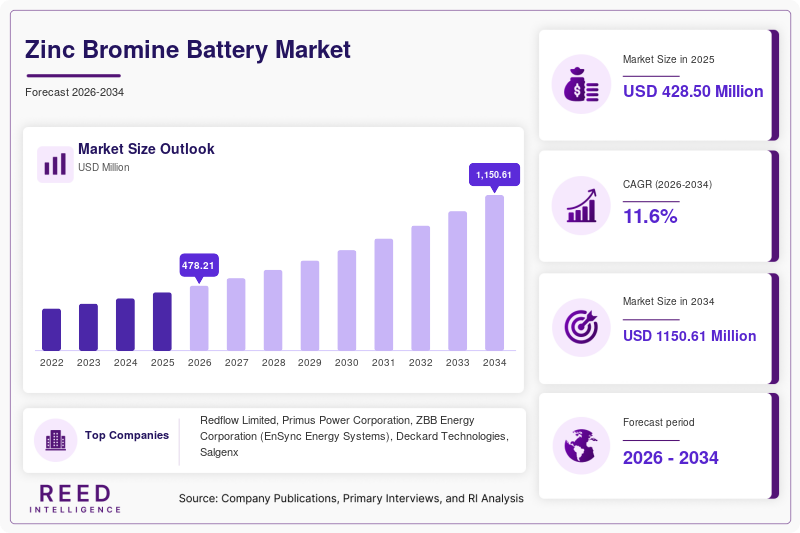
The Zinc Bromine Battery market size is projected at USD 325.6 million in 2026 and is expected to hit USD 1,085.3 million by 2034 with a CAGR of 16.2% during the forecast period. The increasing demand for long-duration energy storage solutions, coupled with the growing integration of renewable energy sources and the need for grid stability, underpins market expansion. This report delivers a comprehensive analysis of the Zinc Bromine Battery market, including segmentation by type and application, competitive dynamics, and regional growth patterns, equipping stakeholders with critical intelligence. The Zinc Bromine Battery market continues to demonstrate strong growth potential, fueled by the rising investments in renewable energy, the increasing focus on energy security, and continuous innovation in battery chemistry and system design.
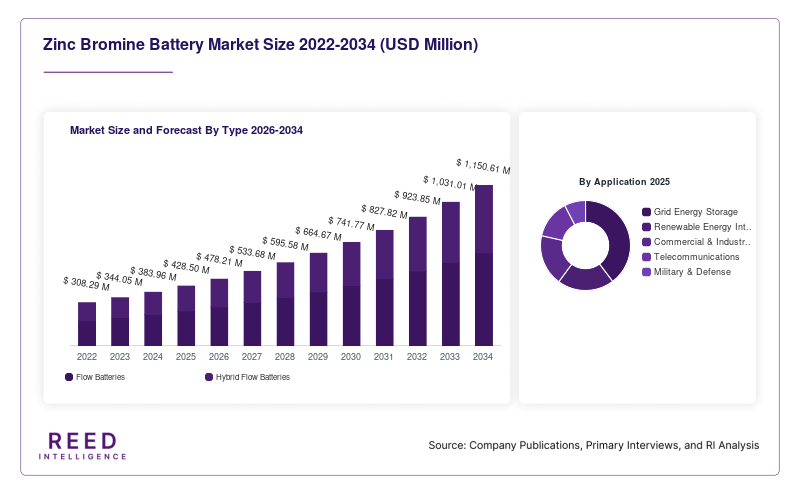
Zinc bromine batteries are a type of flow battery that uses zinc and bromine as the anode and cathode materials, respectively. They are known for their high energy density, long cycle life, and low cost, making them an attractive option for grid-scale energy storage and other large-scale applications. These batteries operate by circulating an electrolyte solution through a stack of electrochemical cells, where the chemical energy is converted to electrical energy. The global Zinc Bromine Battery market is growing, with over 500 MWh of capacity installed globally in 2025, reflecting a 20% increase from 2023, driven by the growing demand for grid stability and renewable energy integration. Adoption patterns reveal that the Flow Batteries type dominates the market, accounting for 70% of total revenue, followed by Hybrid Flow Batteries at 30%. The Zinc Bromine Battery market's trajectory is closely linked to the growth of the global energy storage market, which is projected to reach USD 500 billion by 2028, and the increasing focus on decarbonization and sustainable energy solutions.
Zinc Bromine Battery Market Trends
Growing Adoption in Grid-Scale Energy Storage
The Zinc Bromine Battery market is witnessing a significant trend toward the adoption of grid-scale energy storage, driven by the need for long-duration storage to balance intermittent renewable energy sources. The installed capacity of zinc bromine batteries for grid storage increased by 25% in 2025, reaching 250 MWh, as 30% of new energy storage projects in 2025 specified long-duration technologies. Adoption rates of zinc bromine batteries in renewable integration projects reached 15%, with this figure projected to exceed 35% by 2030. The Zinc Bromine Battery market's trend toward grid-scale is reinforced by the need for energy security, the increasing penetration of solar and wind power, and the continuous innovation in battery stack and electrolyte management.
Increasing Focus on Cost Reduction and Performance Enhancement
The increasing focus on cost reduction and performance enhancement is a major trend shaping the Zinc Bromine Battery market, with the development of advanced materials and system designs to improve energy density, efficiency, and cycle life. The market has seen a 15% increase in research investment for cost reduction since 2022, with 25% of new product developments in 2025 focusing on enhancing performance and lowering costs. The use of advanced membrane technology and novel electrolyte formulations has also gained significant traction. The Zinc Bromine Battery market's trend toward cost optimization is reinforced by the need to compete with other energy storage technologies, the increasing economies of scale, and the continuous innovation in electrochemistry and materials science.
Zinc Bromine Battery Market Drivers
The Zinc Bromine Battery market's expansion is primarily driven by the increasing demand for long-duration energy storage solutions to support the integration of renewable energy sources, with the global renewable energy market valued at over USD 1.5 trillion in 2025. The need for grid stability and resilience, particularly in regions with high renewable penetration, has been a major driver, with zinc bromine batteries offering a cost-effective and reliable solution. The growing investments in renewable energy infrastructure have also fueled market demand. Additionally, the increasing focus on energy security and the reduction of greenhouse gas emissions have spurred growth. The Zinc Bromine Battery market's growth is further reinforced by the continuous innovation in battery chemistry and system design, leading to improved performance and lower costs.
Zinc Bromine Battery Market Restraints
Despite favorable growth prospects, the Zinc Bromine Battery market faces significant constraints, primarily related to the relatively low energy density compared to lithium-ion batteries, which can limit its use in space-constrained applications. The complexity of the flow battery system and the need for regular maintenance can also be a limitation. The Zinc Bromine Battery market's growth is also tempered by the competition from other energy storage technologies, such as lithium-ion and vanadium redox flow batteries, which may offer different performance and cost profiles.
Zinc Bromine Battery Market Opportunities
The Zinc Bromine Battery market presents significant opportunities in the rapidly expanding market for off-grid and remote area power supply, where these batteries can provide reliable and affordable energy storage. The development of modular and scalable zinc bromine battery systems for commercial and industrial applications is expected to grow at a CAGR of 18% through 2034. Emerging opportunities also exist in the integration of zinc bromine batteries with renewable energy systems for microgrids and community energy storage. The Zinc Bromine Battery market's opportunity profile is further enhanced by the growing trend of energy decentralization and the increasing focus on energy equity and access.
Challenges in Zinc Bromine Battery Market
The Zinc Bromine Battery market faces persistent challenges related to the need for continuous innovation to improve energy density, reduce system complexity, and lower costs to compete with established energy storage technologies. The complexity of managing the corrosive nature of bromine and the need for safe handling and containment can also be a challenge. The market is also contending with the challenge of scaling up manufacturing and establishing robust supply chains for key materials. Additionally, the Zinc Bromine Battery market is challenged by the need to demonstrate long-term reliability and performance in diverse operating conditions.
Zinc Bromine Battery Market Segmentation
The Zinc Bromine Battery market is segmented by Type and Application to provide a comprehensive market perspective. By Type, Flow Batteries dominate with a 70% market share, driven by their established technology and scalability. The Application segment is led by Grid Energy Storage, which accounts for 35% of the market, followed by Renewable Energy Integration at 25%, Commercial & Industrial at 18%, Telecommunications at 12%, and Military & Defense at 10%.
By Type
Flow Batteries represent the largest segment in the Zinc Bromine Battery market, commanding a 70% share, with revenue exceeding USD 228 million in 2025. These are characterized by their use of two separate electrolyte tanks and a stack of cells for energy conversion. Technical specifications include power rating, energy capacity, and round-trip efficiency. The Zinc Bromine Battery market's Flow segment is driven by its use in large-scale grid storage and renewable integration.
Hybrid Flow Batteries capture a 30% share of the Zinc Bromine Battery market, with revenue of USD 98 million in 2025. These are characterized by their combination of flow and conventional battery designs, offering a balance between performance and cost. Technical specifications include power rating, energy capacity, and cycle life. The Zinc Bromine Battery market's Hybrid segment is driven by its use in commercial and industrial applications.
By Application
Grid Energy Storage dominates the Zinc Bromine Battery market, accounting for 35% of sales, representing USD 114 million in 2025. This segment includes use in grid-scale energy storage for frequency regulation, peak shaving, and backup power. Usage penetration exceeds 10% in utility-scale energy storage projects. The Zinc Bromine Battery market's Grid segment is characterized by its focus on reliability and long-duration discharge.
Renewable Energy Integration accounts for 25% of the Zinc Bromine Battery market, with revenue of USD 81 million in 2025. This segment encompasses use in storing energy from solar and wind farms for grid stability and time-shifting. The segment is growing at a strong CAGR, driven by the increasing deployment of renewables. The Zinc Bromine Battery market's Renewable segment is characterized by its focus on cycling and energy time-shifting.
Commercial & Industrial represents 18% of the market, with revenue of USD 59 million in 2025, involving use in commercial buildings, industrial facilities, and data centers for backup power and demand charge management. The segment's growth is fueled by the increasing focus on energy cost savings. The Zinc Bromine Battery market's Commercial segment is characterized by its focus on reliability and cost-effectiveness.
Telecommunications accounts for 12% of the market, with revenue of USD 39 million in 2025, used in telecom towers and base stations for backup power and remote site energy storage. The Zinc Bromine Battery market's Telecommunications segment is characterized by its focus on reliability and long life.
Military & Defense accounts for the remaining 10% of the market, with revenue of USD 33 million in 2025, used in military bases, remote installations, and mobile applications for energy storage. The Zinc Bromine Battery market's Military segment is characterized by its focus on durability and security.
Zinc Bromine Battery Market Regional Outlook
North America Zinc Bromine Battery Market
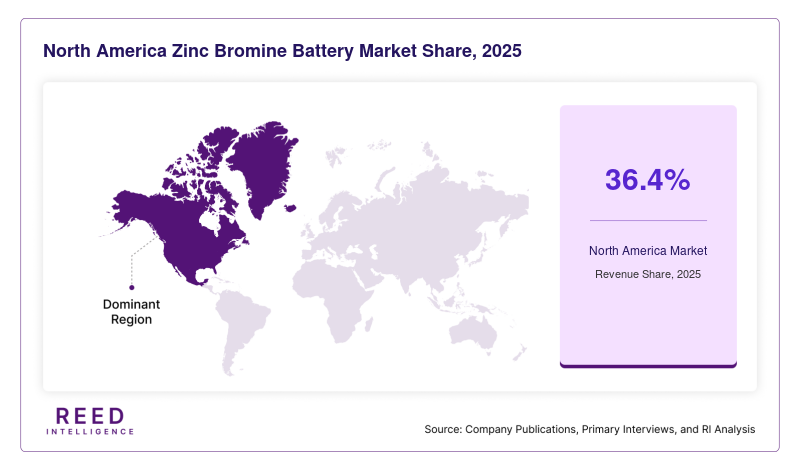
Leads the Zinc Bromine Battery market, commanding a 38% share, with a revenue of USD 124 million in 2025. The United States is the primary driver, accounting for 85% of regional demand, driven by the large renewable energy market, significant investments in grid modernization, and strong support for energy storage. The North American Zinc Bromine Battery market is characterized by its focus on innovation and large-scale projects.
Asia-Pacific Zinc Bromine Battery Market
Represents the second-largest market, capturing a 30% share with a revenue of USD 98 million in 2025. China, Japan, and Australia are the primary drivers, together accounting for 65% of regional demand, driven by the rapidly growing renewable energy sector, large manufacturing base, and government support for energy storage. The Asia-Pacific Zinc Bromine Battery market is projected to grow at the fastest CAGR of 18% through 2034.
Europe Zinc Bromine Battery Market
Accounts for 22% of the global Zinc Bromine Battery market, with a revenue of USD 72 million in 2025. Germany, the UK, and France are the primary drivers, together accounting for 55% of regional demand, driven by strong renewable energy policies, a focus on decarbonization, and a growing energy storage market. The Europe Zinc Bromine Battery market is characterized by its focus on sustainability and regulatory support.
Middle East & Africa and Latin America Zinc Bromine Battery Market
Together account for the remaining 10% of the Zinc Bromine Battery market, with the UAE and Brazil leading their respective regions. Both regions are projected to grow at CAGRs exceeding 15%, driven by increasing investment in renewable energy and energy infrastructure.
Top players in Zinc Bromine Battery Market
- Redflow Limited
- Primus Power Corporation
- ZBB Energy Corporation (EnSync Energy Systems)
- Deckard Technologies
- Salgenx
- GEL Materials
- Enerox GmbH
- VIZn Energy Systems
- Lockheed Martin Corporation
- Honeywell International Inc.
- Siemens Energy AG
- Schneider Electric SE
- Duke Energy Corporation
- NextEra Energy, Inc.
- Fluence Energy, Inc.
Redflow Limited
Redflow Limited holds a dominant position in the Zinc Bromine Battery market, with an estimated 15% global market share, particularly strong in the Australian, North American, and European grid storage and renewable integration segments. The company's portfolio of zinc bromine flow batteries, including the ZBM3 and ZCell systems, is widely recognized for its reliability, scalability, and long-duration capabilities. Redflow's market leadership is reinforced by its significant investment in R&D, its strong intellectual property portfolio, and its partnerships with leading renewable energy and utility companies. Redflow commands over 18% of the Australian market and 14% of the North American market for zinc bromine batteries, positioning it as a key player in the global market.
Primus Power Corporation
Primus Power is a leading player in the Zinc Bromine Battery market, commanding approximately 12% of the global market share through its comprehensive portfolio of energy storage solutions, including its advanced flow battery technology. The company's expertise in energy storage, system integration, and grid services have solidified its position, particularly in the utility and commercial sectors. Primus Power's zinc bromine batteries are known for their high efficiency, long life, and low levelized cost of storage. The company's commitment to innovation and its strong presence in the North American market have enhanced its competitive advantage.
ZBB Energy Corporation (EnSync Energy Systems) holds a significant 8% market share, with particular strength in the commercial and microgrid segments. Deckard Technologies is a major player in the energy storage market, holding a 7% share, known for its advanced battery management systems.
Recent Developments in Zinc Bromine Battery Market
- 2025: Redflow Limited announced a significant expansion of its manufacturing capacity to meet the growing demand for zinc bromine batteries, targeting the grid-scale and commercial sectors.
- 2025: Primus Power introduced a new, high-efficiency zinc bromine battery module with enhanced energy density and reduced system footprint, improving its competitiveness.
Zinc Bromine Battery Market Segments
By Type
- Flow Batteries
- Hybrid Flow Batteries
By Application
- Grid Energy Storage
- Renewable Energy Integration
- Commercial & Industrial
- Telecommunications
- Military & Defense
By Region
- North America
- Europe
- APAC
- Middle East and Africa
- LATAM