Zinc Citrate Market Size, Share, Demand Report By Type (Powder Grade, Granular Grade, Liquid Dispersion Grade), By Application (Dietary Supplements, Oral Care Products, Functional Foods & Beverages, Pharmaceuticals, Animal Nutrition), By End Use (Nutraceutical Manufacturers, Pharmaceutical Companies, Personal Care Manufacturers, Contract Manufacturing Organizations, Feed Producers) By Region & Segment Forecasts, 2026–2034
USD 3950
Market Overview
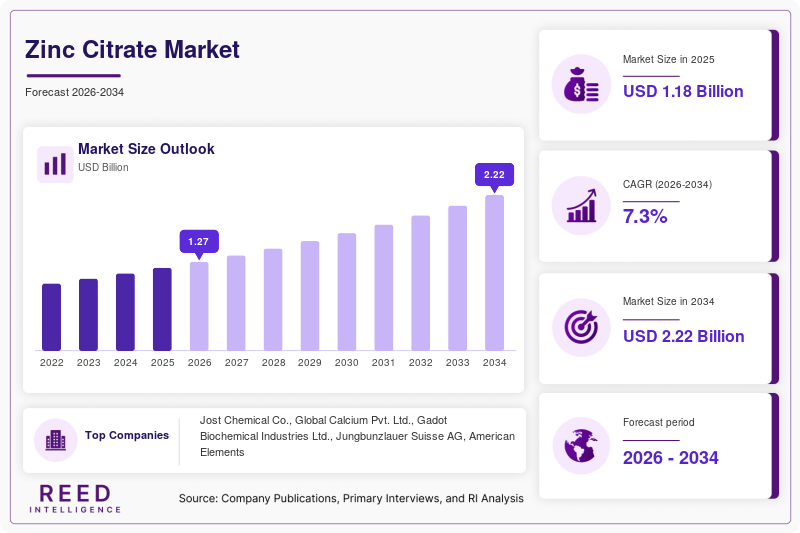
The Zinc Citrate Market size was valued at USD 1.18 billion in 2026 and is projected to reach USD 2.07 billion by 2034, expanding at a CAGR of 7.3% during 2026–2034. Zinc citrate is a widely used zinc salt known for high bioavailability, mild taste profile, and compatibility with tablets, powders, capsules, and oral care formulations. It is used across dietary supplements, pharmaceutical products, functional foods, personal care products, and animal nutrition applications. Demand has remained supported by rising consumer awareness regarding immunity, metabolic wellness, and micronutrient deficiencies.
A major global factor supporting market expansion is the growing preventive healthcare movement. Consumers across developed and emerging economies are increasingly purchasing vitamins and mineral supplements to support immune health, skin wellness, and overall nutrition. Zinc citrate benefits from this shift because it is often preferred over some alternative zinc forms due to better absorption and lower gastric irritation. Manufacturers are also integrating zinc citrate into gummies, drink mixes, fortified foods, and clean-label oral care products, broadening addressable demand.
Key Highlights
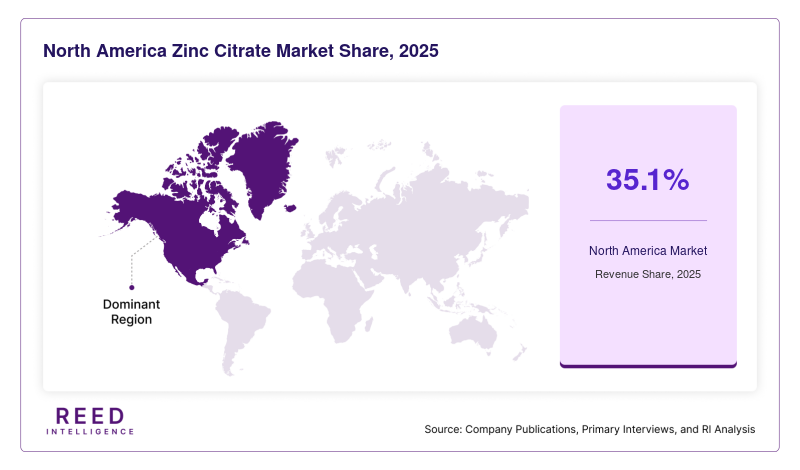
- North America dominated the market with a 35.1% share in 2025.
- Asia Pacific is expected to grow at the fastest CAGR of 8.9% during 2026–2034.
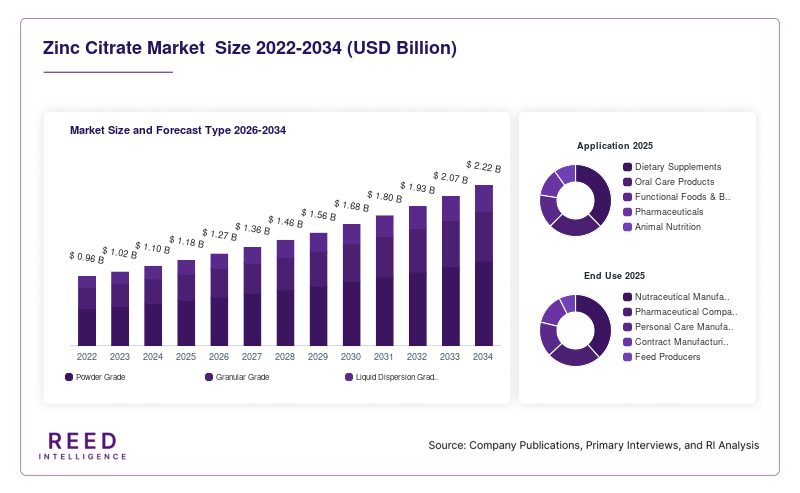
- By type, powder grade accounted for the largest share of 46.4%, while granular grade is projected to grow at a CAGR of 8.1%.
- By application, dietary supplements led with a 42.8% share, whereas oral care products are expected to expand at a CAGR of 8.4%.
- By end use, nutraceutical manufacturers held the largest share of 39.6%, while contract manufacturing organizations are forecast to grow at a CAGR of 8.7%.
- The United States remained the dominant country, with market values of USD 356 million in 2024 and USD 384 million in 2025.
Market Trends
Clean-label mineral supplementation formats
Consumers are shifting from conventional tablets toward gummies, stick packs, chewables, and flavored powders that fit daily wellness routines. This has encouraged supplement brands to adopt zinc citrate because of its favorable taste masking potential and compatibility with modern delivery formats. Brands targeting younger consumers and family nutrition segments increasingly promote zinc citrate in sugar-reduced gummies and convenient single-dose sachets. Private-label retailers are also adding zinc citrate products to affordable wellness portfolios. This trend is improving volume demand while increasing product differentiation opportunities for ingredient suppliers focused on texture, solubility, and flavor performance.
Expansion of multifunctional oral care formulations
Zinc citrate continues gaining traction in toothpaste, mouthwash, and breath-freshening products designed to address plaque, odor control, and gum wellness. Personal care companies are combining zinc citrate with fluoride, herbal extracts, and whitening agents to create multifunctional premium products. Growth in online beauty and personal care channels has accelerated launches of niche oral wellness brands using zinc-based active ingredients. Consumers seeking dentist-recommended daily care products are supporting recurring purchases. This trend is especially visible in urban markets where preventive dental care spending is rising and consumers are willing to pay for enhanced formulations.
Market Drivers
Rising awareness of immune and nutritional health
Consumers increasingly recognize the importance of trace minerals in immune support, cellular repair, and metabolic function. Zinc supplementation demand often rises during seasonal illness periods and wellness campaigns, supporting steady purchases of zinc citrate capsules, tablets, and powders. Healthcare professionals in many markets also recommend zinc as part of balanced nutritional intake strategies. Zinc citrate benefits because it is commonly perceived as a well-tolerated form with reliable absorption. This driver has expanded demand across pharmacies, supermarkets, online marketplaces, and practitioner-led supplement channels, creating stable multi-channel revenue opportunities for manufacturers.
Growth of fortified foods and beverage innovation
Food and beverage companies are expanding micronutrient fortification strategies to address health-conscious consumers and nutritional gaps. Zinc citrate is increasingly used in meal replacements, protein powders, fortified cereals, hydration drinks, and children's nutrition products. Its relatively neutral sensory profile makes it suitable for multiple formulations. Demand is also supported by busy lifestyles that encourage convenient nutrition purchases. As functional food categories grow across Asia Pacific and Latin America, ingredient suppliers are receiving larger formulation inquiries from regional brands. This driver strengthens long-term industrial demand beyond traditional supplement applications.
Market Restraint
Price volatility and formulation substitution risks
The Zinc Citrate Market faces pressure from fluctuations in zinc raw material prices, energy costs, and transportation expenses. When production costs rise, manufacturers of supplements and personal care goods may reformulate using lower-cost zinc alternatives such as zinc sulfate or zinc oxide, particularly in price-sensitive mass-market categories. This creates margin pressure for ingredient suppliers and may slow contract renewals. Smaller producers are more vulnerable because they often lack scale purchasing power or integrated sourcing networks. In addition, stricter quality standards for heavy metals and purity testing can increase compliance costs. For example, a mid-sized nutraceutical brand launching value-priced immunity tablets may shift suppliers or reduce zinc citrate inclusion rates if input costs rise sharply, delaying market expansion in cost-sensitive regions.
Market Opportunities
Personalized nutrition and premium wellness subscriptions
Digital health platforms and subscription supplement brands are creating demand for customized micronutrient blends tailored to age, gender, lifestyle, and dietary habits. Zinc citrate is well positioned for these personalized formulations because it is frequently included in immune, skin, men's health, and sports recovery packs. Premium direct-to-consumer brands value consistent purity and traceability, encouraging long-term sourcing partnerships. As personalized wellness gains traction in North America, Europe, and affluent Asian cities, suppliers offering small-batch blending support and branded ingredient documentation can capture higher-margin opportunities.
Expansion in animal nutrition and veterinary products
Zinc citrate has emerging potential in companion animal supplements and specialty feed additives aimed at skin health, coat quality, immunity, and growth support. Pet owners increasingly purchase wellness products mirroring human supplement trends, including chewables and powdered toppers containing bioavailable minerals. Livestock producers are also evaluating efficient trace mineral sources that support productivity and health management. As regulatory focus increases on optimized nutrition and responsible animal care, zinc citrate suppliers can diversify revenue beyond human consumption markets and reduce exposure to cyclical retail demand patterns.
Segmental Analysis
By Type
Powder grade was the dominant subsegment in 2024, accounting for 46.4% of the global market. Its leadership is linked to versatility across tablets, capsules, sachets, dry beverage mixes, and food fortification systems. Powder zinc citrate is preferred by manufacturers because it supports accurate dosing, scalable blending, and broad compatibility with excipients. Nutraceutical companies use powder grade extensively for private-label production because it fits multiple pack sizes and dosage formats. Demand is especially strong in contract manufacturing environments where flexible ingredient handling and standardized particle profiles are required for high-volume production runs.
Granular grade is the fastest-growing subsegment and is forecast to expand at a 8.1% CAGR through 2034. Growth is supported by better flow properties, reduced dust generation, and improved processing efficiency in automated production lines. Granular forms are increasingly selected for direct compression tablets and flavored effervescent applications where uniformity matters. Manufacturers investing in faster throughput and cleaner factory environments prefer granular inputs that reduce handling losses. As supplement production scales globally, demand for operationally efficient ingredient formats is expected to rise steadily.
By Application
Dietary supplements held the leading share in 2024 at 42.8%. This segment benefits from consumer familiarity with zinc for immunity, skin wellness, reproductive health, and general nutrition support. Zinc citrate is widely used in stand-alone zinc tablets and multi-ingredient formulas containing vitamin C, magnesium, or herbal extracts. Pharmacies, online channels, and wellness retailers continue to broaden access to such products. The segment also gains from recurring purchase behavior, as consumers often repurchase mineral supplements monthly or seasonally, supporting stable market demand.
Oral care products are projected to be the fastest-growing subsegment, advancing at a 8.4% CAGR through 2034. Zinc citrate is used in toothpaste and mouthwash products focused on breath freshness, plaque management, and gum hygiene. Consumers increasingly prefer multifunctional oral care solutions that combine cosmetic and therapeutic benefits. Premiumization within toothpaste categories, along with dentist-recommended formulations, is lifting ingredient demand. Emerging markets are also seeing higher oral care awareness, creating new opportunities for zinc citrate inclusion in mainstream and premium products.
By End Use
Nutraceutical manufacturers dominated the market in 2024 with a 39.6% share. These companies purchase zinc citrate for branded supplements, private-label contracts, and condition-specific wellness formulas. Large nutraceutical firms value traceability, consistent assay standards, and dependable global supply contracts. Their scale enables multi-format launches across tablets, gummies, powders, and capsules. As consumer demand shifts toward preventive health, nutraceutical manufacturers remain the largest industrial buyers of zinc citrate, anchoring baseline market volumes across major regions.
Contract manufacturing organizations are the fastest-growing end-use segment and are expected to register a 8.7% CAGR through 2034. Many brands outsource formulation, packaging, and compliance operations to specialized partners to reduce capital expenditure and accelerate time to market. CMOs purchase zinc citrate in bulk and serve multiple brands simultaneously, amplifying ingredient demand. Growth is further supported by start-up supplement brands that rely on outsourced production rather than building internal factories. This structural outsourcing trend creates scalable opportunities for ingredient suppliers.
Regional Analysis
North America
North America accounted for 35.1% of the Zinc Citrate Market in 2025 and is expected to expand at a 6.8% CAGR through 2034. The region benefits from mature supplement consumption habits, strong pharmacy distribution, and premium wellness spending. Demand remains high across tablets, gummies, and immunity blends. Stable regulatory pathways for nutraceutical labeling and extensive contract manufacturing capacity support regular product launches and private-label expansion.
The United States leads regional demand due to its large consumer supplement base and developed e-commerce ecosystem. A unique growth factor is the rapid rise of subscription wellness brands that sell monthly personalized nutrient packs. These platforms frequently include zinc citrate in formulations for immunity, skin health, and men's wellness, supporting repeat purchase cycles and consistent industrial procurement volumes.
Europe
Europe represented 26.4% of the global market in 2025 and is forecast to grow at a 6.5% CAGR during the study period. Demand is supported by preventive healthcare culture, aging populations, and rising interest in clean-label mineral products. Western European countries continue to favor premium supplements with traceability and quality certifications. Oral care manufacturers also contribute meaningful regional consumption of zinc citrate.
Germany remains the dominant country market because of strong pharmacy retail networks and high consumer trust in scientifically positioned supplements. A unique growth factor is the expansion of vegan and vegetarian nutrition brands that use zinc citrate in plant-based wellness formulas. These brands market mineral replenishment solutions to consumers seeking balanced micronutrient intake without animal-derived ingredients.
Asia Pacific
Asia Pacific held 22.7% share in 2025 and is projected to record the fastest 8.9% CAGR through 2034. The region benefits from rising disposable incomes, growing middle-class health awareness, and rapid digital commerce adoption. Consumers increasingly purchase vitamins, beauty supplements, and fortified beverages. Local manufacturers are also scaling production capacity to meet domestic and export demand for mineral ingredients.
China is the leading country market, supported by large-scale supplement manufacturing and expanding wellness consumption. A unique growth factor is the rapid growth of live-commerce channels that promote nutritional products through influencers and health educators. These sales models accelerate product discovery and enable zinc citrate brands to reach younger consumers in lower-tier cities.
Middle East & Africa
Middle East & Africa captured 8.1% of the market in 2025 and is anticipated to grow at a 7.1% CAGR over the forecast period. Demand is rising from increasing healthcare awareness, pharmacy modernization, and higher spending on imported supplements. Urban populations are adopting preventive wellness routines, while premium personal care and oral hygiene categories are expanding across major metropolitan markets.
Saudi Arabia leads regional demand due to strong retail infrastructure and rising consumer spending on wellness products. A unique growth factor is the government-backed expansion of modern healthcare and nutrition awareness campaigns encouraging healthier lifestyles. This has supported stronger sales of vitamins and mineral supplements through pharmacies, clinics, and organized retail channels.
Latin America
Latin America accounted for 7.7% share in 2025 and is expected to grow at a 7.4% CAGR through 2034. The region shows improving demand for affordable daily supplements, fortified foods, and family nutrition products. Expanding supermarket health aisles and online marketplaces are increasing product accessibility. Local brands are launching combination formulas containing zinc with vitamin C and other essential nutrients.
Brazil remains the largest country market because of its scale, retail reach, and growing wellness consumer base. A unique growth factor is the popularity of sports nutrition and active lifestyle products. Zinc citrate is increasingly incorporated into recovery powders and daily wellness packs marketed to gym users and amateur athletes seeking balanced micronutrient intake.
Competitive Landscape
The Zinc Citrate Market is moderately fragmented, with global mineral ingredient suppliers competing alongside regional specialty manufacturers. Key competition factors include purity standards, regulatory documentation, pricing consistency, formulation support, and supply reliability. Companies are expanding production footprints and offering customized particle sizes or branded premixes to strengthen customer retention.
Jost Chemical Co. is viewed as a market leader due to its broad mineral salt portfolio and strong presence in pharmaceutical-grade ingredients. A recent development in the market includes capacity additions by several Asian producers to support growing nutraceutical exports and shorten lead times for Western buyers.Other notable participants are leveraging mergers, distributor partnerships, and e-commerce ingredient channels to reach mid-sized supplement brands. Companies with integrated sourcing and advanced quality testing are better positioned to serve premium customers. The competitive environment is expected to intensify as demand rises in personalized nutrition, oral care, and functional foods.
Key Players List
- Jost Chemical Co.
- Global Calcium Pvt. Ltd.
- Gadot Biochemical Industries Ltd.
- Jungbunzlauer Suisse AG
- American Elements
- Noah Chemicals
- Dr. Paul Lohmann GmbH & Co. KGaA
- Balchem Corporation
- Lemonflex Company Limited
- NutriScience Innovations LLC
- Panvo Organics Pvt. Ltd.
- SternVitamin GmbH
- Triveni Chemicals
- West Bengal Chemical Industries Ltd.
- Foodchem International Corporation
Recent Developments
- Several supplement brands launched zinc citrate gummies and chewables targeted at family immunity and daily wellness segments in 2025.
- A European oral care manufacturer introduced a premium toothpaste line containing zinc citrate for odor control and gum care in 2025.
- Multiple Asian ingredient producers expanded micronutrient blending and packaging capacity during 2024–2025 to support export demand for mineral premixes.
Zinc Citrate Market Segments
Type
- Powder Grade
- Granular Grade
- Liquid Dispersion Grade
Application
- Dietary Supplements
- Oral Care Products
- Functional Foods & Beverages
- Pharmaceuticals
- Animal Nutrition
End Use
- Nutraceutical Manufacturers
- Pharmaceutical Companies
- Personal Care Manufacturers
- Contract Manufacturing Organizations
- Feed Producers
By Region
- North America
- Europe
- APAC
- Middle East and Africa
- LATAM