Zinc Dust Powders Flakes Market Size, Share & Demand Report By Product Type (Zinc Dust Powders, Zinc Flakes), By Application (Anti-Corrosion Coatings, Batteries, Chemicals, Metallurgy, Others), By End Use (Industrial Manufacturing, Construction, Automotive, Energy & Utilities, Renewable Energy Infrastructure, Others), By Region & Segment Forecasts, 2026–2034
USD 3950
Market Overview
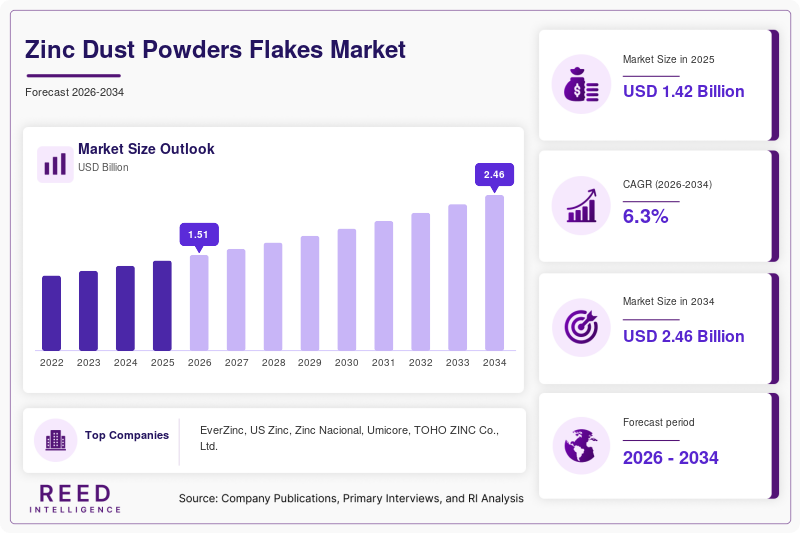
The global Zinc Dust Powders Flakes Market size was valued at USD 1.42 billion in 2026 and is projected to reach USD 2.31 billion by 2034, expanding at a CAGR of 6.3% during the forecast period from 2026 to 2034. The market continues to witness stable expansion due to rising industrial consumption across coatings, chemicals, batteries, metallurgy, and corrosion protection applications. Zinc dust powders and flakes are widely used in anti-corrosion paints, galvanizing compounds, alkaline batteries, and specialty chemical formulations because of their conductivity, chemical stability, and protective properties. The increasing requirement for infrastructure maintenance and industrial asset protection across developed and emerging economies has created favorable growth conditions for manufacturers.
A major global factor supporting market growth is the steady increase in infrastructure modernization and industrial construction activities. Governments and private industries are investing in bridges, railways, marine facilities, pipelines, and renewable energy infrastructure that require long-term corrosion protection systems. Zinc-rich coatings containing zinc dust powders and flakes have become important in extending the service life of industrial structures. In addition, growth in automotive manufacturing and energy storage applications is contributing to higher product demand. Manufacturers are also improving particle uniformity, purity levels, and production efficiency to meet evolving performance standards across industrial sectors.
Key Highlights
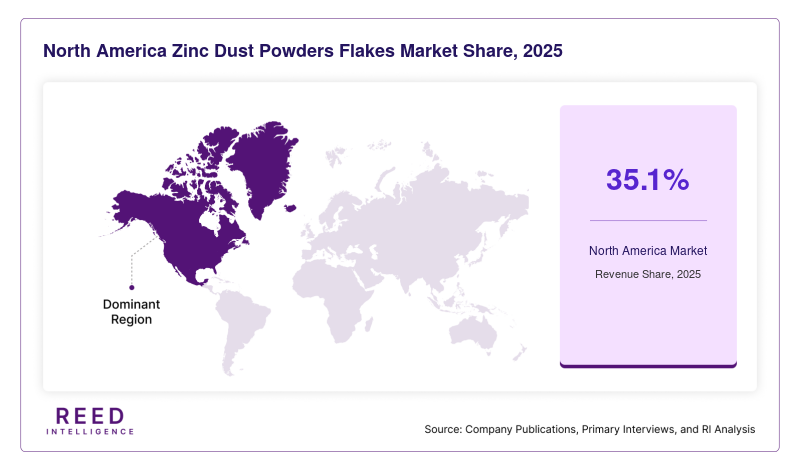
- North America dominated the market with a 35.1% share in 2025.
- Asia Pacific is expected to grow at the fastest CAGR of 7.4% during 2026–2034.
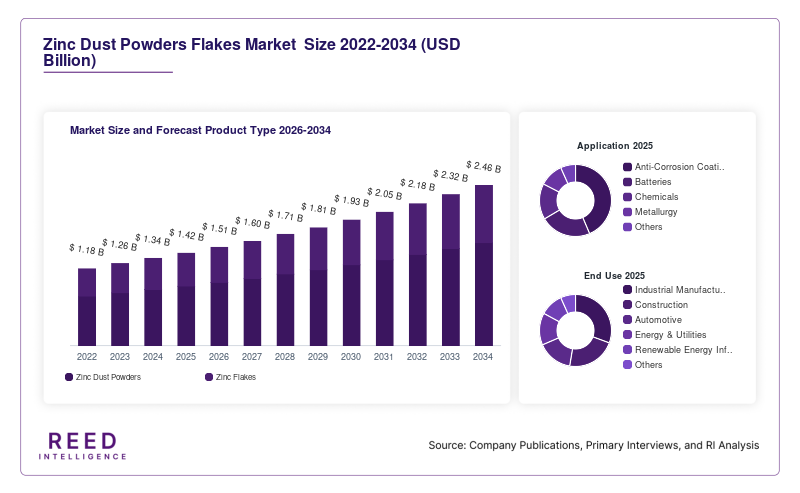
- By product type, zinc dust powders accounted for the largest share of 61.8%.
- while zinc flakes are projected to grow at a CAGR of 7.1%.
- By application, anti-corrosion coatings led with a 44.3% share.
- whereas battery applications are expected to expand at a CAGR of 7.8%.
- By end use, industrial manufacturing held the dominant share of 39.6%, while renewable energy infrastructure is projected to grow at a CAGR of 8.2%.
- The United States remained the dominant country, with market values of USD 372 million in 2024 and USD 396 million in 2025.
Market Trends
Expansion of High-Performance Protective Coating Applications
The use of zinc dust powders and flakes in high-performance protective coatings has increased significantly across industrial sectors. Manufacturers are developing advanced zinc-rich primers and coatings that provide longer protection cycles for steel structures exposed to harsh environmental conditions. Industries including marine transportation, oil and gas, construction, and heavy engineering are adopting these coatings to reduce maintenance costs and improve structural durability. Zinc flakes are gaining preference in premium coating systems because of their improved barrier performance and uniform surface coverage. Demand is also rising from renewable energy projects such as wind towers and solar infrastructure, where corrosion resistance is essential for operational efficiency. Coating formulators are increasingly focusing on low-VOC and environmentally compatible products, which is encouraging innovation in zinc particle processing technologies.
Rising Adoption in Energy Storage and Battery Manufacturing
The growing demand for energy storage systems has emerged as a notable trend in the Zinc Dust Powders Flakes Market. Zinc-based materials are increasingly used in alkaline batteries and next-generation zinc-air battery technologies because of their conductivity, energy efficiency, and comparatively lower environmental impact. Battery manufacturers are investing in high-purity zinc powders to improve charging cycles and performance stability. The expansion of electric mobility infrastructure and portable energy storage devices has further strengthened product demand. Research institutions and battery developers are also exploring advanced zinc chemistries for large-scale energy storage applications. This trend is expected to support long-term market growth, particularly in Asia Pacific and North America, where battery manufacturing capacity expansion remains a strategic industrial priority.
Market Drivers
Increasing Infrastructure Rehabilitation and Corrosion Protection Demand
The increasing focus on infrastructure rehabilitation and corrosion prevention is driving demand for zinc dust powders and flakes across global markets. Aging bridges, pipelines, ports, railways, and industrial facilities require protective coating systems to maintain operational safety and reduce replacement costs. Zinc-rich coatings are widely preferred because they provide sacrificial protection to steel structures and improve product lifespan under challenging weather conditions. Governments in developed economies are allocating large infrastructure budgets for transportation modernization and industrial maintenance programs. This trend has encouraged coating manufacturers to increase procurement of zinc dust materials for industrial primers and paints. Emerging economies are also investing heavily in smart cities, industrial corridors, and urban development projects, further supporting long-term product consumption.
Growth of Automotive, Chemical, and Electronics Manufacturing
The continued growth of automotive, electronics, and chemical manufacturing industries is contributing to higher consumption of zinc dust powders and flakes. Automotive manufacturers use zinc-based coatings and chemical compounds to improve corrosion resistance and component durability. In the electronics sector, zinc powders are used in specialty formulations and conductive applications. Chemical producers also rely on zinc materials in reducing agents, pigments, and catalyst formulations. The rising production of industrial equipment and consumer electronics in countries such as China, India, South Korea, and Mexico has strengthened regional demand. In addition, manufacturers are adopting advanced atomization and particle refinement technologies to supply customized zinc products for precision industrial applications, creating additional growth opportunities within the market.
Market Restraint
Volatility in Raw Material Prices and Environmental Compliance Costs
Fluctuations in zinc metal prices and rising environmental compliance costs continue to restrain the growth of the Zinc Dust Powders Flakes Market. Zinc production is highly dependent on mining output, energy prices, transportation expenses, and international trade conditions, which can create unpredictable cost variations for manufacturers. Sudden changes in raw material pricing affect profitability and make long-term supply agreements more difficult for coating producers and industrial buyers. Environmental regulations related to emissions, waste disposal, and worker safety standards are also increasing operational expenses for processing facilities. Small and medium-scale manufacturers often face challenges in upgrading production equipment to comply with stricter sustainability requirements. For example, companies operating older atomization plants may require significant capital investment to reduce emissions and improve material recovery systems. These financial pressures can slow expansion strategies and limit production capacity growth in price-sensitive markets.
Market Opportunities
Development of Zinc-Air Batteries and Sustainable Energy Technologies
The development of zinc-air batteries and sustainable energy technologies presents a significant opportunity for the Zinc Dust Powders Flakes Market. Zinc-air batteries are gaining attention because they offer high energy density, stable performance, and lower environmental impact compared to several conventional battery chemistries. Manufacturers and research organizations are increasing investments in advanced zinc powder formulations that enhance conductivity and battery cycle life. Demand for stationary energy storage systems in renewable energy projects is expected to support commercial adoption over the coming years. Governments promoting cleaner energy infrastructure are also supporting battery innovation through funding and policy incentives. As energy storage technologies expand across residential, industrial, and utility-scale applications, high-purity zinc powders are expected to witness increasing commercial demand.
Expansion of Industrial Coating Production in Emerging Economies
Rapid industrialization in emerging economies offers strong opportunities for zinc dust powder and flake manufacturers. Countries across Asia Pacific, Latin America, and the Middle East are increasing investments in industrial infrastructure, petrochemical facilities, transportation networks, and urban construction projects. These developments require large volumes of anti-corrosion coatings and galvanizing products, which directly support market demand. Local coating manufacturers are expanding production capacities to meet rising domestic consumption and export requirements. In addition, international companies are establishing regional manufacturing facilities to improve supply chain efficiency and reduce transportation costs. The expansion of offshore energy projects and industrial machinery manufacturing in developing regions is also expected to create sustained demand for zinc-based protective materials during the forecast period.
Segmental Analysis
By Product Type
Zinc dust powders accounted for the dominant share of 61.8% in 2024 due to their extensive use in anti-corrosion coatings, chemical processing, galvanizing compounds, and battery manufacturing applications. These powders are widely preferred because they provide effective sacrificial protection and maintain strong conductivity characteristics across industrial environments. Manufacturers use atomized zinc powders in primers, marine coatings, and industrial paints designed for bridges, pipelines, and structural steel. The increasing requirement for industrial maintenance and corrosion prevention in transportation and energy infrastructure has supported strong product demand. In addition, improvements in particle uniformity and purity levels have enabled suppliers to serve specialized applications in electronics, catalysts, and advanced chemical formulations.
Zinc flakes are projected to witness the fastest CAGR of 7.1% during the forecast period because of their enhanced surface coverage and improved barrier protection capabilities. These flakes are increasingly used in premium protective coatings for automotive, aerospace, and renewable energy infrastructure applications. Their layered structure improves coating density and corrosion resistance, making them suitable for demanding environmental conditions. Manufacturers are also developing ultrafine zinc flakes for advanced coating systems that require higher durability and reduced material consumption. Growth in offshore wind installations, industrial machinery exports, and infrastructure modernization projects is expected to further increase demand. The rising preference for environmentally compatible coating formulations is also supporting adoption of zinc flakes in low-VOC industrial paints.
By Application
Anti-corrosion coatings held the largest market share of 44.3% in 2024 due to widespread utilization across industrial infrastructure, marine equipment, transportation systems, and energy facilities. Zinc dust powders and flakes are extensively incorporated into primers and protective paints to safeguard steel structures from rust and environmental degradation. Industries including oil and gas, construction, power generation, and shipbuilding rely on zinc-rich coatings to reduce maintenance costs and improve operational lifespan. Government spending on infrastructure rehabilitation in developed countries has significantly contributed to demand growth. Coating manufacturers are also introducing advanced formulations that improve adhesion, weather resistance, and durability, further increasing product adoption in commercial and industrial applications.
Battery applications are anticipated to expand at the fastest CAGR of 7.8% from 2026 to 2034 due to increasing investments in energy storage technologies and portable power systems. Zinc powders are gaining importance in alkaline batteries and emerging zinc-air battery technologies because of their stable electrochemical properties and lower environmental impact. Battery manufacturers are investing in high-purity zinc materials to improve charging efficiency and battery life cycles. The rapid growth of renewable energy systems, electric mobility infrastructure, and backup power installations is expected to accelerate demand. Research institutions and technology companies are also developing advanced zinc battery chemistries aimed at improving safety, scalability, and long-term energy storage performance.
By End Use
Industrial manufacturing represented the dominant end-use segment with a 39.6% share in 2024 due to strong consumption across machinery production, fabricated metal products, automotive components, and heavy engineering industries. Zinc dust powders and flakes are widely used in protective coatings, metal treatment compounds, and specialty chemical processes within industrial manufacturing operations. The need to improve product durability and corrosion resistance has encouraged manufacturers to integrate zinc-based materials into production systems. Industrial expansion in Asia Pacific and North America has further supported segment growth. In addition, technological improvements in coating application methods and material processing are helping manufacturers optimize zinc consumption while maintaining product performance and operational efficiency.
Renewable energy infrastructure is expected to register the fastest CAGR of 8.2% during the forecast period due to increasing global investment in wind, solar, and energy storage projects. Wind towers, transmission systems, solar mounting structures, and battery storage facilities require durable anti-corrosion coatings to maintain operational reliability in outdoor environments. Zinc flakes and powders are increasingly used in protective systems designed for renewable energy infrastructure because of their strong resistance to moisture and atmospheric exposure. Governments promoting clean energy transition strategies are encouraging large-scale deployment of renewable installations across developed and emerging economies. This trend is expected to create sustained demand for advanced zinc coating materials over the coming years.
Regional Analysis
North America
North America accounted for 35.1% of the global Zinc Dust Powders Flakes Market in 2025 and is expected to maintain steady growth at a CAGR of 5.8% through 2034. The region benefits from extensive demand across industrial coatings, automotive manufacturing, energy infrastructure, and specialty chemicals. Infrastructure rehabilitation programs in the United States and Canada are increasing the use of zinc-rich protective coatings for bridges, pipelines, and transportation facilities. Market participants are also investing in advanced zinc processing technologies to improve product quality and production efficiency. The presence of established coating manufacturers and industrial chemical suppliers further supports regional market expansion.
The United States remained the dominant country in North America due to strong industrial production and infrastructure investment activity. A key growth factor in the country is the modernization of transportation and utility infrastructure requiring long-term corrosion protection systems. Federal funding programs supporting bridge restoration, renewable energy installations, and industrial facility upgrades have strengthened demand for zinc dust powders and flakes. In addition, domestic battery manufacturers are increasing research into zinc-based energy storage technologies, creating new opportunities for high-purity zinc powder suppliers.
Europe
Europe represented a significant share of the Zinc Dust Powders Flakes Market in 2025 and is forecast to grow at a CAGR of 5.6% during the assessment period. The region maintains stable demand due to its strong industrial manufacturing base and established automotive sector. Zinc-rich coatings are widely used in marine infrastructure, rail transportation, industrial equipment, and construction applications. Environmental regulations promoting sustainable coatings and improved corrosion management strategies are encouraging manufacturers to adopt refined zinc materials with enhanced performance characteristics. Several European producers are also focusing on recycling technologies and low-emission production systems to align with regional sustainability goals.
Germany dominated the European market owing to its advanced manufacturing sector and strong engineering industries. A unique growth factor supporting the German market is the expansion of renewable energy infrastructure, particularly offshore wind energy projects. Wind towers and related steel components require durable anti-corrosion coatings to withstand marine environments, increasing demand for zinc flakes and powders. The country’s automotive suppliers and industrial machinery manufacturers are also contributing to steady market consumption through the use of zinc-based coating systems and specialty chemical formulations.
Asia Pacific
Asia Pacific is projected to register the fastest CAGR of 7.4% in the Zinc Dust Powders Flakes Market during 2026–2034. The region is experiencing rapid industrialization, urban development, and manufacturing expansion across several countries. Demand for anti-corrosion coatings, galvanizing compounds, and battery materials continues to increase due to growing infrastructure investment and rising industrial output. China, India, Japan, and South Korea are major manufacturing hubs for automotive, electronics, and industrial equipment production, creating consistent demand for zinc materials. The region also benefits from comparatively lower manufacturing costs and expanding export-oriented industrial activity.
China remained the dominant country in Asia Pacific because of its extensive industrial production capabilities and large-scale infrastructure projects. A key growth factor supporting the Chinese market is the rapid expansion of domestic battery manufacturing and renewable energy systems. The country is increasing investments in energy storage technologies and electric mobility infrastructure, creating higher demand for high-purity zinc powders. Additionally, continued investments in railways, industrial parks, ports, and urban construction projects are supporting sustained consumption of zinc-rich protective coatings across multiple industries.
Middle East & Africa
The Middle East & Africa region is expected to witness moderate growth in the Zinc Dust Powders Flakes Market with a CAGR of 5.1% during the forecast period. Demand is primarily supported by investments in oil and gas infrastructure, petrochemical facilities, marine construction, and industrial development projects. Zinc-rich coatings are widely utilized to protect steel structures exposed to extreme temperatures and corrosive environments. Governments across the Gulf countries are increasing industrial diversification efforts, which is encouraging investment in manufacturing and infrastructure modernization. The region’s growing construction activity is also supporting consumption of zinc-based materials.
Saudi Arabia emerged as the dominant country within the regional market due to its large industrial infrastructure and energy sector investments. A unique growth factor for the country is the expansion of industrial diversification initiatives under long-term economic development programs. New industrial cities, petrochemical plants, and transportation projects require durable corrosion protection systems for steel equipment and structural assets. This has increased the adoption of zinc dust powders in industrial coatings and maintenance applications. In addition, the development of renewable energy projects is creating new demand for protective coating solutions.
Latin America
Latin America accounted for a moderate share of the Zinc Dust Powders Flakes Market in 2025 and is expected to expand at a CAGR of 5.3% through 2034. Infrastructure development, mining activities, and industrial manufacturing are major contributors to market growth in the region. Countries across Latin America are increasing investments in transportation networks, ports, and energy facilities, which require long-term anti-corrosion protection systems. Zinc-rich coatings and galvanizing products are increasingly used in industrial maintenance operations to improve structural durability and reduce operational costs. Regional manufacturers are also focusing on expanding coating production capacity.
Brazil dominated the Latin American market due to its large industrial base and expanding construction sector. A significant growth factor in Brazil is the increasing investment in mining infrastructure and energy transmission projects. Mining operations require durable protective coatings for heavy equipment, pipelines, and steel structures exposed to demanding environmental conditions. The country’s automotive production sector also contributes to zinc material consumption through coating and component manufacturing applications. Government infrastructure programs aimed at improving transportation and industrial connectivity are expected to support additional market demand over the forecast period.
Competitive Landscape
The Zinc Dust Powders Flakes Market is moderately consolidated, with major players focusing on production expansion, advanced particle processing technologies, and strategic partnerships with coating and battery manufacturers. Companies are investing in product innovation to improve purity levels, corrosion resistance performance, and environmental compatibility. Market competition is influenced by pricing strategies, raw material sourcing capabilities, regional distribution networks, and technical support services for industrial customers.
US Zinc remained one of the leading companies in the market due to its broad zinc product portfolio and strong supply relationships across coatings and chemical industries. The company recently expanded its production optimization initiatives to improve processing efficiency and support demand from battery and infrastructure sectors. Other major companies including EverZinc, Zinc Nacional, Umicore, and TOHO ZINC are focusing on sustainable production technologies and expansion into high-growth regional markets. Several manufacturers are also strengthening recycling capabilities to improve raw material efficiency and reduce environmental impact. Partnerships with industrial coating producers and energy storage developers are expected to remain an important competitive strategy during the forecast period.
Key Players
- EverZinc
- US Zinc
- Zinc Nacional
- Umicore
- TOHO ZINC Co., Ltd.
- Rubamin Ltd.
- Votorantim Group
- HakusuiTech Co., Ltd.
- Jiangsu Tianyi Ultra-Fine Metal Powder Co., Ltd.
- Henan Yuguang Zinc Industry Co., Ltd.
- Nanografi Nano Technology
- SILOX Holding
- Grillo-Werke AG
- Norzinco Group
Recent Developments
- EverZinc announced an expansion of its specialty zinc powder production capacity in Europe to support rising demand from protective coating and battery manufacturers.
- US Zinc introduced upgraded zinc dust processing technology aimed at improving particle consistency and reducing production waste across industrial coating applications.
- TOHO ZINC Co., Ltd. increased investment in high-purity zinc materials for advanced battery applications and energy storage research programs.
- Zinc Nacional expanded its recycling and recovery operations to improve raw material sustainability and strengthen regional supply chain efficiency.
Zinc Dust Powders Flakes Market Segments
Product Type
- Zinc Dust Powders
- Zinc Flakes
Application
- Anti-Corrosion Coatings
- Batteries
- Chemicals
- Metallurgy
- Others
End Use
- Industrial Manufacturing
- Construction
- Automotive
- Energy & Utilities
- Renewable Energy Infrastructure
- Others
By Region
- North America
- Europe
- APAC
- Middle East and Africa
- LATAM