Zirconia Oxygen Sensor Market Size, Share & Demand Report By Type (Planar Zirconia Sensors, Thimble-Type Zirconia Sensors), By Application (Automotive Exhaust Systems, Industrial Combustion Monitoring, Environmental Monitoring), By End-Use Industry (Automotive, Industrial, Energy & Power), By Region & Segment Forecasts, 2026–2034
USD 3950
Market Overview
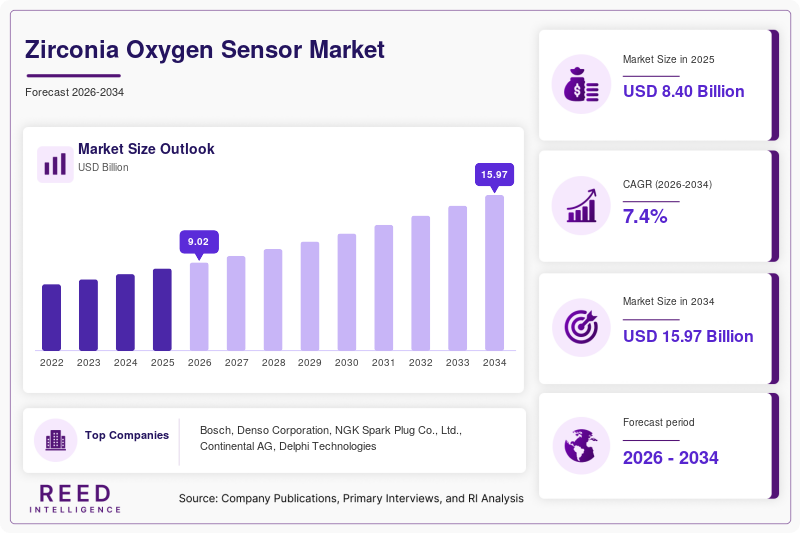
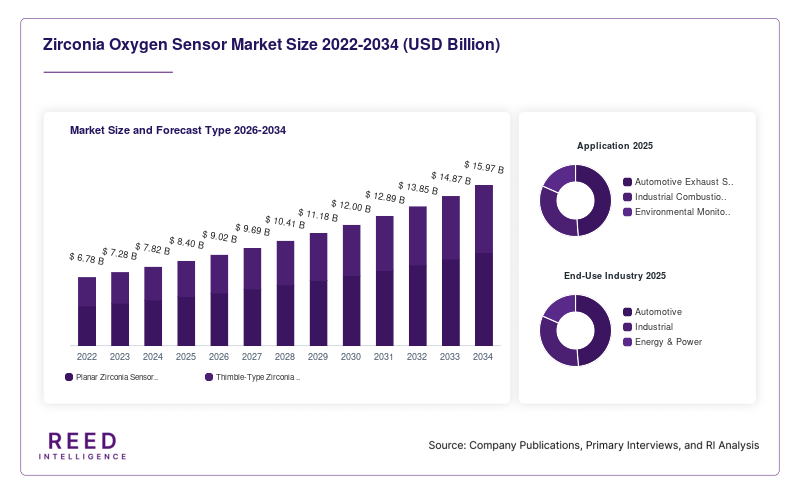
The global Zirconia Oxygen Sensor Market was valued at approximately USD 8.4 billion in 2026 and is projected to reach USD 14.9 billion by 2034, registering a compound annual growth rate (CAGR) of 7.4% during the forecast period. Zirconia oxygen sensors are widely used in automotive exhaust systems, industrial combustion processes, and environmental monitoring applications due to their high accuracy and thermal stability. The increasing emphasis on emission control regulations across major economies has played a crucial role in driving the demand for these sensors. Governments are mandating stricter standards for vehicle emissions and industrial pollution, which has led to widespread adoption of oxygen sensing technologies to optimize fuel efficiency and reduce harmful emissions.
Additionally, advancements in sensor miniaturization and integration with electronic control units (ECUs) are enhancing operational efficiency in modern vehicles. The growing production of internal combustion engine vehicles in emerging economies continues to sustain market demand, even as electrification trends gradually reshape the automotive landscape. Industrial sectors such as power generation and chemical processing are also adopting zirconia sensors to maintain combustion efficiency and safety standards.
Key Highlights
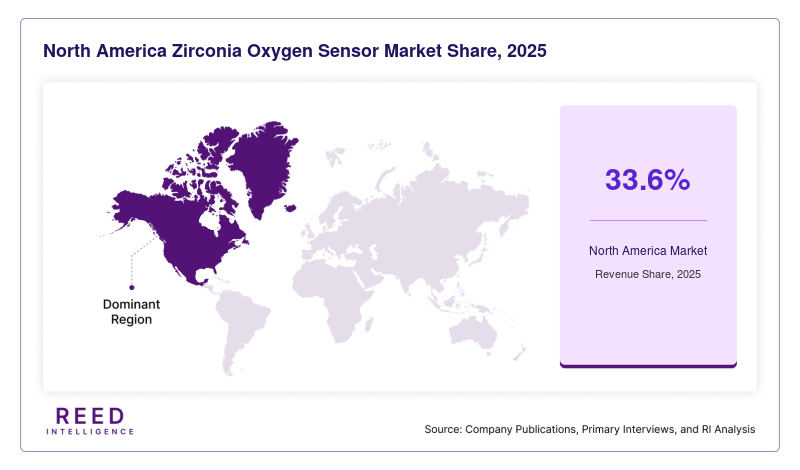
- North America dominated the market with a 33.6% share in 2025.
- Asia Pacific is expected to grow at the fastest CAGR of 9.1% during 2026–2034.
- By type, planar zirconia sensors accounted for the largest share of 42.3%, while thimble-type sensors are projected to grow at a CAGR of 8.2%.
- By application, automotive exhaust systems led with a 48.7% share, whereas industrial combustion monitoring is expected to expand at a CAGR of 8.6%.
- The United States remained the dominant country, with market values of USD 1.2 billion in 2024 and USD 1.3 billion in 2025.
Market Trends
Integration of Smart Sensor Technologies in Automotive Systems
The integration of smart sensor technologies into automotive systems is reshaping the Zirconia Oxygen Sensor Market. Modern vehicles increasingly rely on advanced electronic control systems to optimize fuel injection, improve combustion efficiency, and reduce emissions. Zirconia oxygen sensors are being upgraded with enhanced signal processing capabilities and connectivity features, allowing real-time data transmission to onboard diagnostic systems. This trend supports predictive maintenance and improves vehicle performance over time. Automakers are also focusing on developing sensors that can withstand higher temperatures and offer faster response times, ensuring compliance with evolving emission standards. The shift toward connected vehicles and digital diagnostics continues to support the adoption of advanced zirconia sensors across both passenger and commercial vehicle segments.
Rising Adoption in Industrial Emission Monitoring Applications
Industrial sectors are increasingly deploying zirconia oxygen sensors for emission monitoring and process optimization. Industries such as power generation, oil and gas, and manufacturing rely on accurate oxygen measurement to ensure efficient combustion and minimize environmental impact. Zirconia sensors provide high-temperature stability and long operational life, making them suitable for harsh industrial environments. Regulatory pressure to reduce carbon emissions and improve energy efficiency is encouraging companies to invest in advanced monitoring solutions. Additionally, the growing adoption of automation and Industry 4.0 technologies is driving the integration of sensors into centralized control systems. This trend is expected to expand the application scope of zirconia oxygen sensors beyond traditional automotive uses.
Market Drivers
Stringent Emission Regulations Across Global Markets
Stringent emission regulations imposed by governments worldwide are a primary driver for the Zirconia Oxygen Sensor Market. Regulatory bodies are enforcing strict standards to reduce pollutants such as nitrogen oxides and carbon monoxide from vehicles and industrial processes. Zirconia oxygen sensors play a critical role in maintaining optimal air-fuel ratios, which directly impacts emission levels. As countries implement tighter norms, automakers and industrial operators are required to integrate advanced sensing technologies to ensure compliance. This regulatory push is particularly strong in developed regions, but emerging economies are also adopting stricter environmental policies, thereby expanding the market scope.
Growth in Automotive Production and Aftermarket Demand
The steady growth in global automotive production, particularly in developing regions, is fueling demand for zirconia oxygen sensors. These sensors are essential components in internal combustion engine vehicles, contributing to fuel efficiency and emission control. In addition to original equipment manufacturer (OEM) demand, the aftermarket segment is experiencing growth due to sensor replacement needs. Oxygen sensors have a limited lifespan and require periodic replacement to maintain optimal vehicle performance. The expansion of vehicle fleets worldwide and increased awareness of maintenance practices are supporting aftermarket sales, further driving overall market growth.
Market Restraint
Increasing Shift Toward Electric Vehicles (EVs)
The transition toward electric vehicles presents a significant restraint for the Zirconia Oxygen Sensor Market. Unlike internal combustion engine vehicles, electric vehicles do not require oxygen sensors, as they do not rely on fuel combustion. As governments promote EV adoption through incentives and infrastructure development, the long-term demand for zirconia oxygen sensors may decline. This shift is particularly evident in developed regions where EV penetration is increasing rapidly.
The impact of this restraint is already visible in segments with high EV adoption rates, where demand growth for traditional sensors is slowing. For instance, automotive manufacturers are reallocating resources toward electric powertrain development, which reduces investment in combustion-related components. However, the effect is somewhat mitigated by the continued production of hybrid vehicles and the slow pace of EV adoption in certain emerging markets. Despite this, the long-term outlook suggests that the growing EV market could limit the expansion potential of zirconia oxygen sensors, prompting manufacturers to diversify into alternative applications.
Market Opportunities
Expansion in Industrial Automation and Process Optimization
The increasing adoption of industrial automation presents a significant opportunity for the Zirconia Oxygen Sensor Market. Industries are focusing on improving operational efficiency and reducing energy consumption through advanced monitoring systems. Zirconia oxygen sensors enable precise control of combustion processes, leading to optimized fuel usage and reduced emissions. As factories adopt automated control systems, the demand for reliable and high-performance sensors is expected to grow. The integration of sensors with digital platforms also allows real-time monitoring and predictive maintenance, enhancing overall productivity. This trend is particularly strong in sectors such as power generation and chemical processing.
Growth in Emerging Economies with Expanding Automotive Sector
Emerging economies offer substantial growth opportunities due to increasing vehicle production and rising environmental awareness. Countries in Asia Pacific and Latin America are witnessing rapid urbanization and industrialization, which is driving demand for automobiles. As governments in these regions implement stricter emission norms, the adoption of zirconia oxygen sensors is expected to increase. Additionally, the expansion of automotive manufacturing facilities and supply chains in these markets is supporting local production and reducing costs. This creates favorable conditions for market growth, particularly in the mid- to long-term forecast period.
Segmental Analysis
By Type
Planar zirconia sensors dominated the market in 2024, accounting for a share of 42.3%. These sensors are widely preferred due to their compact design, faster response time, and improved durability compared to traditional designs. They are extensively used in modern vehicles to meet stringent emission standards and ensure efficient fuel combustion. The growing demand for high-performance automotive components is supporting the adoption of planar sensors. Additionally, advancements in manufacturing processes have reduced production costs, making these sensors more accessible to a wider range of applications, including industrial monitoring systems.
Thimble-type zirconia sensors are expected to be the fastest-growing subsegment, with a CAGR of 8.2% during the forecast period. Their growth is driven by their reliability and cost-effectiveness in specific industrial applications. These sensors are particularly suitable for high-temperature environments, making them ideal for use in furnaces and power plants. The increasing demand for efficient combustion monitoring in industrial processes is supporting the adoption of thimble-type sensors. Furthermore, ongoing research and development efforts are improving their performance, which is expected to enhance their market penetration in the coming years.
By Application
Automotive exhaust systems held the largest market share of 48.7% in 2024. Zirconia oxygen sensors are critical components in these systems, as they help maintain optimal air-fuel ratios and reduce emissions. The increasing production of vehicles and the implementation of strict emission regulations are driving demand in this segment. Automakers are continuously integrating advanced sensors to improve fuel efficiency and comply with regulatory requirements. Additionally, the growing aftermarket demand for sensor replacement is further supporting the dominance of this segment.
Industrial combustion monitoring is the fastest-growing application segment, with a CAGR of 8.6%. This growth is driven by the need for efficient energy utilization and reduced emissions in industrial processes. Zirconia oxygen sensors are widely used in industries such as power generation and chemical processing to monitor oxygen levels and optimize combustion. The increasing adoption of automation and digital monitoring systems is further supporting the growth of this segment. These sensors enable real-time data analysis, which helps improve operational efficiency and reduce costs.
By End-Use Industry
The automotive industry dominated the market in 2024, accounting for a significant share due to the widespread use of zirconia oxygen sensors in vehicles. These sensors play a crucial role in maintaining engine performance and ensuring compliance with emission standards. The growth of the automotive sector, particularly in emerging economies, is driving demand for these sensors. Additionally, the increasing focus on fuel efficiency and environmental sustainability is encouraging the adoption of advanced sensing technologies.
The industrial sector is expected to be the fastest-growing end-use industry, with a CAGR of 8.4%. This growth is driven by the increasing need for efficient energy management and emission control in industrial processes. Zirconia oxygen sensors are widely used in various industries to monitor combustion and ensure operational efficiency. The adoption of automation and digital technologies is further supporting the growth of this segment. Industries are investing in advanced monitoring systems to improve productivity and reduce environmental impact.
Regional Analysis
North America
North America held a significant share of 33.6% in 2025 and is expected to grow at a CAGR of 6.8% during the forecast period. The region benefits from established automotive and industrial sectors, along with stringent emission regulations that mandate the use of advanced sensing technologies. The presence of major automotive manufacturers and technological advancements in sensor design contribute to steady market growth. Additionally, increasing investments in industrial automation further support demand for zirconia oxygen sensors across multiple applications.
The United States dominates the regional market due to its strong automotive industry and regulatory framework. A unique growth factor in this region is the widespread adoption of advanced diagnostic systems in vehicles, which rely on accurate sensor data. This trend supports the integration of high-performance zirconia sensors in both new vehicles and aftermarket applications, ensuring consistent demand.
Europe
Europe accounted for 27.4% of the market share in 2025 and is projected to grow at a CAGR of 7.0% through 2034. The region is characterized by strict environmental regulations and a strong focus on reducing carbon emissions. These factors drive the adoption of zirconia oxygen sensors in both automotive and industrial sectors. The presence of leading automotive manufacturers and technological innovation further contribute to market expansion.
Germany is the dominant country in this region, supported by its advanced automotive manufacturing capabilities. A unique growth factor is the emphasis on sustainable industrial practices, which encourages the use of sensors for efficient energy management. This focus on sustainability is expected to sustain demand for zirconia oxygen sensors.
Asia Pacific
Asia Pacific is expected to witness the fastest growth, with a CAGR of 9.1% during the forecast period, and held a 24.8% share in 2025. Rapid industrialization, increasing vehicle production, and expanding manufacturing activities are key factors driving market growth. Governments in the region are also implementing stricter emission standards, further supporting sensor adoption.
China leads the regional market due to its large automotive production base. A unique growth factor is the expansion of domestic manufacturing capabilities, which reduces dependency on imports and supports cost-effective production. This trend is expected to drive significant growth in the zirconia oxygen sensor market.
Middle East & Africa
The Middle East & Africa region held a 7.2% share in 2025 and is projected to grow at a CAGR of 6.5%. The market is driven by increasing industrial activities, particularly in the oil and gas sector. Zirconia oxygen sensors are used to monitor combustion processes and ensure operational efficiency. Growing awareness of environmental regulations is also contributing to market growth.
Saudi Arabia dominates the region due to its strong oil and gas industry. A unique growth factor is the modernization of industrial infrastructure, which includes the adoption of advanced monitoring technologies. This development is expected to boost demand for zirconia oxygen sensors in the region.
Latin America
Latin America accounted for 7.0% of the market share in 2025 and is expected to grow at a CAGR of 6.7%. The region is experiencing moderate growth due to increasing automotive production and industrial activities. Governments are gradually implementing emission standards, which is driving the adoption of oxygen sensors.
Brazil is the leading country in this region, supported by its automotive manufacturing sector. A unique growth factor is the expansion of local supply chains, which reduces costs and improves product availability. This trend is expected to support market growth in Latin America.
Competitive Landscape
The Zirconia Oxygen Sensor Market is moderately consolidated, with several key players focusing on innovation and strategic partnerships to strengthen their market position. Leading companies are investing in research and development to enhance sensor performance and expand application areas. The market is characterized by the presence of established automotive component manufacturers and specialized sensor companies.
Bosch is considered a market leader due to its extensive product portfolio and strong presence in the automotive sector. The company continues to invest in advanced sensor technologies and has recently introduced next-generation oxygen sensors with improved durability and response time. Other major players are also focusing on expanding their global footprint and improving manufacturing capabilities to meet growing demand. Strategic collaborations with automotive manufacturers and industrial clients are helping companies enhance their market presence and competitiveness.
Key Players
- Bosch
- Denso Corporation
- NGK Spark Plug Co., Ltd.
- Continental AG
- Delphi Technologies
- Sensata Technologies
- Honeywell International Inc.
- Ametek Inc.
- Figaro Engineering Inc.
- Mitsubishi Electric Corporation
- Yokogawa Electric Corporation
- Siemens AG
- ABB Ltd.
- TE Connectivity
- Fuji Electric Co., Ltd.
Recent Developments
- In 2025, Bosch introduced an advanced zirconia oxygen sensor with enhanced thermal resistance for high-performance vehicles.
- In 2024, Denso Corporation expanded its production facility to increase sensor manufacturing capacity in Asia Pacific.
- In 2025, NGK Spark Plug Co., Ltd. launched a new sensor series designed for industrial combustion monitoring applications.
Zirconia Oxygen Sensor Market Segments
Type
- Planar Zirconia Sensors
- Thimble-Type Zirconia Sensors
Application
- Automotive Exhaust Systems
- Industrial Combustion Monitoring
- Environmental Monitoring
End-Use Industry
- Automotive
- Industrial
- Energy & Power
By Region
- North America
- Europe
- APAC
- Middle East and Africa
- LATAM