United Arab Emirates Policosanol Market Size & Outlook, 2026-2034
United Arab Emirates Policosanol Market Insights
- As per Reed Intelligence insights, the United Arab Emirates Policosanol Market stood at USD 84.08 Million in 2025 and is anticipated to grow to USD 150.16 Million by 2034.
- The United Arab Emirates market is expected to advance at a CAGR of 6.59% from 2026 through 2034.
- In 2025, Tin Phosphor Bronze Wire accounted for the highest share of the Type market size.
- During the forecast period, Tin Phosphor Bronze Wire is set to register the highest growth, making it the most lucrative Type segment.
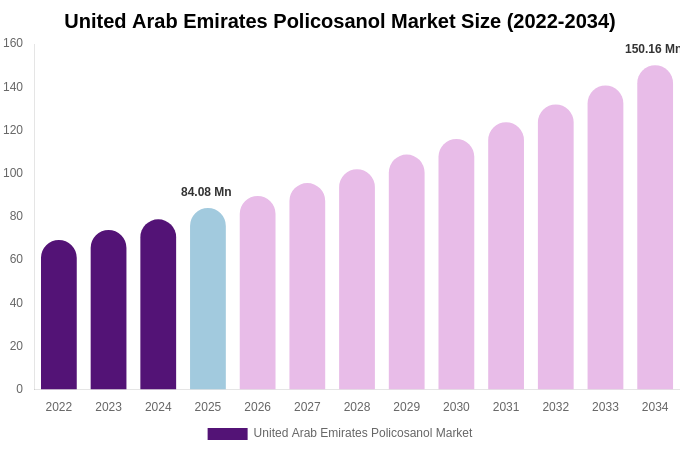
Source: RI Analysis Company Publications, Primary Interviews.

Other Key Findings
- In 2025, United Arab Emirates accounted for 4.57% of the global Policosanol Market size.
- By 2034, United States is expected to lead the global Policosanol Market in terms of market size.
- Within Middle East and Africa, United Arab Emirates is projected to dominate the regional Policosanol Market size by 2034.
- South Africa is identified as the fastest-growing market in Middle East and Africa, anticipated to reach USD 38.82 Million by 2034.
Report Summary
| Report Scope | Details |
|---|---|
| Base Year for Study | 2025 |
| Study Period | 2022-2034 |
| Historical Period | 2022-2024 |
| Forecast Period | 2026-2034 |
| Market Size In 2025 | USD 84.08 Million |
| Market Size In 2034 | USD 150.16 Million |
| Largest segment | Tin Phosphor Bronze Wire |
| Units | Revenue in USD Million |
| CAGR | 6.59% (2026-2034) |
| Segmnetation Covered | |
| Type |
|
| Application |
|
| End Use |
|
| Report Coverage | Revenue Forecast, Competitive Landscape, Growth Factors, Environment & Regulatory Landscape and Trends |
United Arab Emirates Policosanol Market Type 2026-2034 (USD Million)
| Type | 2022 | 2023 | 2024 | 2025 | 2026 | 2027 | 2028 | 2029 | 2030 | 2031 | 2032 | 2033 | 2034 |
|---|---|---|---|---|---|---|---|---|---|---|---|---|---|
| Tin Phosphor Bronze Wire | XX.x | XX.x | XX.x | 35.02 | XX.x | XX.x | XX.x | XX.x | XX.x | XX.x | XX.x | XX.x | XX.x |
| High-Conductivity Phosphor Bronze Wire | XX.x | XX.x | XX.x | XX.x | XX.x | XX.x | XX.x | XX.x | XX.x | XX.x | XX.x | XX.x | XX.x |
| Leaded Phosphor Bronze Wire | XX.x | XX.x | XX.x | XX.x | XX.x | XX.x | XX.x | XX.x | XX.x | XX.x | XX.x | XX.x | XX.x |
| Specialty Alloy Phosphor Bronze Wire | XX.x | XX.x | XX.x | XX.x | XX.x | XX.x | XX.x | XX.x | XX.x | XX.x | XX.x | XX.x | XX.x |
| Total | XX.x | XX.x | XX.x | XX.x | XX.x | XX.x | XX.x | XX.x | XX.x | XX.x | XX.x | XX.x | XX.x |
Source: RI Analysis Company Publications, Primary Interviews.
United Arab Emirates Policosanol Market Application 2026-2034 (USD Million)
| Application | 2022 | 2023 | 2024 | 2025 | 2026 | 2027 | 2028 | 2029 | 2030 | 2031 | 2032 | 2033 | 2034 |
|---|---|---|---|---|---|---|---|---|---|---|---|---|---|
| Electrical Connectors | XX.x | XX.x | XX.x | 25.29 | XX.x | XX.x | XX.x | XX.x | XX.x | XX.x | XX.x | XX.x | XX.x |
| Springs and Contacts | XX.x | XX.x | XX.x | XX.x | XX.x | XX.x | XX.x | XX.x | XX.x | XX.x | XX.x | XX.x | XX.x |
| Automotive Electronics | XX.x | XX.x | XX.x | XX.x | XX.x | XX.x | XX.x | XX.x | XX.x | XX.x | XX.x | XX.x | XX.x |
| Industrial Equipment | XX.x | XX.x | XX.x | XX.x | XX.x | XX.x | XX.x | XX.x | XX.x | XX.x | XX.x | XX.x | XX.x |
| Telecommunications Components | XX.x | XX.x | XX.x | XX.x | XX.x | XX.x | XX.x | XX.x | XX.x | XX.x | XX.x | XX.x | XX.x |
| Aerospace Systems | XX.x | XX.x | XX.x | XX.x | XX.x | XX.x | XX.x | XX.x | XX.x | XX.x | XX.x | XX.x | XX.x |
| Total | XX.x | XX.x | XX.x | XX.x | XX.x | XX.x | XX.x | XX.x | XX.x | XX.x | XX.x | XX.x | XX.x |
Source: RI Analysis Company Publications, Primary Interviews.
United Arab Emirates Policosanol Market End Use 2026-2034 (USD Million)
| End Use | 2022 | 2023 | 2024 | 2025 | 2026 | 2027 | 2028 | 2029 | 2030 | 2031 | 2032 | 2033 | 2034 |
|---|---|---|---|---|---|---|---|---|---|---|---|---|---|
| Electronics and Electrical Manufacturing | XX.x | XX.x | XX.x | 27.67 | XX.x | XX.x | XX.x | XX.x | XX.x | XX.x | XX.x | XX.x | XX.x |
| Automotive Industry | XX.x | XX.x | XX.x | XX.x | XX.x | XX.x | XX.x | XX.x | XX.x | XX.x | XX.x | XX.x | XX.x |
| Aerospace and Defense | XX.x | XX.x | XX.x | XX.x | XX.x | XX.x | XX.x | XX.x | XX.x | XX.x | XX.x | XX.x | XX.x |
| Industrial Manufacturing | XX.x | XX.x | XX.x | XX.x | XX.x | XX.x | XX.x | XX.x | XX.x | XX.x | XX.x | XX.x | XX.x |
| Energy and Utilities | XX.x | XX.x | XX.x | XX.x | XX.x | XX.x | XX.x | XX.x | XX.x | XX.x | XX.x | XX.x | XX.x |
| Telecommunications | XX.x | XX.x | XX.x | XX.x | XX.x | XX.x | XX.x | XX.x | XX.x | XX.x | XX.x | XX.x | XX.x |
| Total | XX.x | XX.x | XX.x | XX.x | XX.x | XX.x | XX.x | XX.x | XX.x | XX.x | XX.x | XX.x | XX.x |
Source: RI Analysis Company Publications, Primary Interviews.