United States Tooling Board Market Size & Outlook, 2026-2034
United States Tooling Board Market Insights
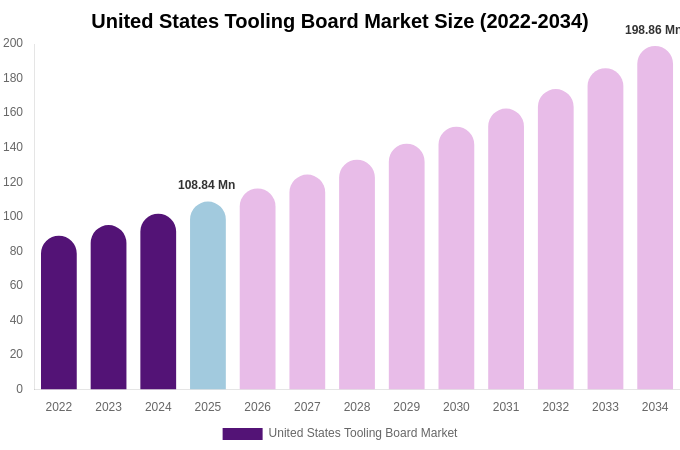
- Reed Intelligence analysis indicates that the United States Tooling Board Market size, valued at USD 108.84 Million in 2025, is expected to expand to USD 198.86 Million by 2034.
- The United States market is forecasted to expand at a CAGR of 6.9% spanning 2026–2034.
- Polyurethane Tooling Boards held the leading position among By Type segments in 2025, based on market size.
- Epoxy Tooling Boards is projected to post the fastest growth rate, sustaining its position as the most attractive By Type segment during the forecast horizon.
Source: RI Analysis Company Publications, Primary Interviews.

Other Key Findings
- United States accounted for 23.56% of the global Tooling Board Market size in 2025.
- By 2034, United States is expected to remain the top global market in terms of size.
- Within North America, United States is forecasted to dominate the regional Tooling Board Market size by 2034.
- United States will be the fastest-growing market in North America, projected to achieve USD 198.42 Million by 2034.
Report Summary
| Report Scope | Details |
|---|---|
| Base Year for Study | 2025 |
| Study Period | 2022-2034 |
| Historical Period | 2022-2024 |
| Forecast Period | 2026-2034 |
| Market Size In 2025 | USD 108.84 Million |
| Market Size In 2034 | USD 198.86 Million |
| Largest segment | Polyurethane Tooling Boards |
| Units | Revenue in USD Million |
| CAGR | 6.9% (2026-2034) |
| Segmnetation Covered | |
| By Type |
|
| By Application |
|
| By End-Use Industry |
|
| By Manufacturing Process |
|
| Report Coverage | Revenue Forecast, Competitive Landscape, Growth Factors, Environment & Regulatory Landscape and Trends |
United States Tooling Board Market By Type 2026-2034 (USD Million)
| By Type | 2022 | 2023 | 2024 | 2025 | 2026 | 2027 | 2028 | 2029 | 2030 | 2031 | 2032 | 2033 | 2034 |
|---|---|---|---|---|---|---|---|---|---|---|---|---|---|
| Polyurethane Tooling Boards | XX.x | XX.x | XX.x | 57.52 | XX.x | XX.x | XX.x | XX.x | XX.x | XX.x | XX.x | XX.x | XX.x |
| Epoxy Tooling Boards | XX.x | XX.x | XX.x | XX.x | XX.x | XX.x | XX.x | XX.x | XX.x | XX.x | XX.x | XX.x | XX.x |
| Other Specialty Tooling Boards | XX.x | XX.x | XX.x | XX.x | XX.x | XX.x | XX.x | XX.x | XX.x | XX.x | XX.x | XX.x | XX.x |
| Total | XX.x | XX.x | XX.x | XX.x | XX.x | XX.x | XX.x | XX.x | XX.x | XX.x | XX.x | XX.x | XX.x |
Source: RI Analysis Company Publications, Primary Interviews.
United States Tooling Board Market By Application 2026-2034 (USD Million)
| By Application | 2022 | 2023 | 2024 | 2025 | 2026 | 2027 | 2028 | 2029 | 2030 | 2031 | 2032 | 2033 | 2034 |
|---|---|---|---|---|---|---|---|---|---|---|---|---|---|
| Automotive Prototyping | XX.x | XX.x | XX.x | 44.49 | XX.x | XX.x | XX.x | XX.x | XX.x | XX.x | XX.x | XX.x | XX.x |
| Aerospace Tooling | XX.x | XX.x | XX.x | XX.x | XX.x | XX.x | XX.x | XX.x | XX.x | XX.x | XX.x | XX.x | XX.x |
| Marine Applications | XX.x | XX.x | XX.x | XX.x | XX.x | XX.x | XX.x | XX.x | XX.x | XX.x | XX.x | XX.x | XX.x |
| Wind Energy Components | XX.x | XX.x | XX.x | XX.x | XX.x | XX.x | XX.x | XX.x | XX.x | XX.x | XX.x | XX.x | XX.x |
| Industrial Design Modeling | XX.x | XX.x | XX.x | XX.x | XX.x | XX.x | XX.x | XX.x | XX.x | XX.x | XX.x | XX.x | XX.x |
| Total | XX.x | XX.x | XX.x | XX.x | XX.x | XX.x | XX.x | XX.x | XX.x | XX.x | XX.x | XX.x | XX.x |
Source: RI Analysis Company Publications, Primary Interviews.
United States Tooling Board Market By End-Use Industry 2026-2034 (USD Million)
| By End-Use Industry | 2022 | 2023 | 2024 | 2025 | 2026 | 2027 | 2028 | 2029 | 2030 | 2031 | 2032 | 2033 | 2034 |
|---|---|---|---|---|---|---|---|---|---|---|---|---|---|
| Automotive Industry | XX.x | XX.x | XX.x | 46.69 | XX.x | XX.x | XX.x | XX.x | XX.x | XX.x | XX.x | XX.x | XX.x |
| Aerospace Defense | XX.x | XX.x | XX.x | XX.x | XX.x | XX.x | XX.x | XX.x | XX.x | XX.x | XX.x | XX.x | XX.x |
| Marine Industry | XX.x | XX.x | XX.x | XX.x | XX.x | XX.x | XX.x | XX.x | XX.x | XX.x | XX.x | XX.x | XX.x |
| Renewable Energy (Wind Energy) | XX.x | XX.x | XX.x | XX.x | XX.x | XX.x | XX.x | XX.x | XX.x | XX.x | XX.x | XX.x | XX.x |
| Industrial Manufacturing | XX.x | XX.x | XX.x | XX.x | XX.x | XX.x | XX.x | XX.x | XX.x | XX.x | XX.x | XX.x | XX.x |
| Total | XX.x | XX.x | XX.x | XX.x | XX.x | XX.x | XX.x | XX.x | XX.x | XX.x | XX.x | XX.x | XX.x |
Source: RI Analysis Company Publications, Primary Interviews.
United States Tooling Board Market By Manufacturing Process 2026-2034 (USD Million)
| By Manufacturing Process | 2022 | 2023 | 2024 | 2025 | 2026 | 2027 | 2028 | 2029 | 2030 | 2031 | 2032 | 2033 | 2034 |
|---|---|---|---|---|---|---|---|---|---|---|---|---|---|
| CNC Machining Compatible Boards | XX.x | XX.x | XX.x | 58.15 | XX.x | XX.x | XX.x | XX.x | XX.x | XX.x | XX.x | XX.x | XX.x |
| Hand-Processed Tooling Boards | XX.x | XX.x | XX.x | XX.x | XX.x | XX.x | XX.x | XX.x | XX.x | XX.x | XX.x | XX.x | XX.x |
| Hybrid Processing Systems | XX.x | XX.x | XX.x | XX.x | XX.x | XX.x | XX.x | XX.x | XX.x | XX.x | XX.x | XX.x | XX.x |
| Total | XX.x | XX.x | XX.x | XX.x | XX.x | XX.x | XX.x | XX.x | XX.x | XX.x | XX.x | XX.x | XX.x |
Source: RI Analysis Company Publications, Primary Interviews.