A3 Multi-Function Printers (A3 MFP) Market Size, Share & Trends Analysis Report By Type (Color A3 MFP, Monochrome A3 MFP), By Application (Corporate Offices, Government & Public Sector, Education, Healthcare, Commercial & Others), By Distribution Channel (Direct Sales, Dealers & Distributors, Online Channels) and By Region (North America, Europe, Asia-Pacific, Latin America, Middle East & Africa) Forecasts, 2026–2034
USD 3950
A3 Multi-Function Printers (A3 MFP) Market Size
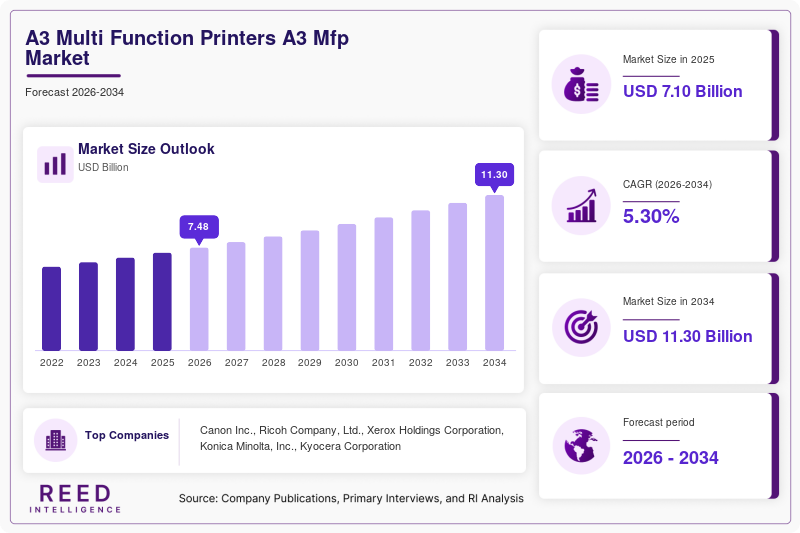
The global A3 multi-function printers (A3 MFP) market was valued at USD 7.10 billion in 2025 and is projected to grow from USD 7.48 billion in 2026 to USD 10.50 billion by 2034, registering a CAGR of 5.30% during the forecast period from 2026 to 2034.
A3 MFPs are shifting from standalone print-and-copy equipment toward connected workplace devices that combine printing, scanning, copying, document capture, security and cloud-enabled workflows. The commercial demand base remains concentrated in organizations with recurring document workloads, particularly corporate offices, government agencies, educational institutions, healthcare organizations and centralized print rooms.
The market is being reshaped by the transition from traditional hardware purchases toward managed print services, cloud connectivity and workflow automation. Industry dealer research shows that A3/A4 equipment and managed print services together represented 78.9% of dealer revenue in 2025, although the same research noted pressure on traditional print revenues and MPS pricing.
A3 Multi-Function Printers (A3 MFP) Market Drivers
Cloud-Connected MFPs Increase the Value of A3 Devices Beyond Printing
A3 MFP manufacturers are increasingly integrating cloud workflows, mobile connectivity and document-management functions into office devices. Canon's imageRUNNER ADVANCE DX portfolio, for example, combines A3 printing with cloud connectivity and workflow-management capabilities.
The mechanism is a shift in purchasing criteria: businesses can justify an MFP not only as a printer but as a device for capturing, routing and managing physical documents. This is particularly relevant for distributed and hybrid workplaces where employees need secure access to documents from multiple locations. The opportunity is strongest for vendors able to combine hardware with software and recurring services. However, organizations with low document volumes may increasingly favor A4 devices or digital-only workflows.
High-Volume Organizations Are Consolidating Printing Equipment
Businesses are increasingly seeking to consolidate several desktop printers and older large-format devices into centralized, high-capacity MFPs. Ricoh specifically identified demand for centralized color MFPs capable of replacing multiple smaller devices and launched the IM C7010 and IM C8010 for high-volume workplace and in-house print applications.
This creates a direct replacement mechanism for A3 equipment: one higher-capacity device can reduce the number of machines requiring maintenance, consumables and IT management. The effect is strongest in large offices, corporate print rooms and centralized reprographic departments. The constraint is that decentralization and hybrid work can reduce the utilization rate of large shared devices, limiting the economics of consolidation in smaller offices.
Security and Document Capture Are Increasing MFP Replacement Requirements
Network-connected MFPs increasingly function as endpoints within corporate information systems, making security and document capture important procurement considerations. Ricoh's 2025 A3 lineup, for example, introduced a straight-path scanner capable of handling different media formats and improving digital capture of documents such as identification cards.
The commercial mechanism is particularly relevant for organizations handling sensitive or diverse documents. Improved scanning, authentication, workflow integration and secure processing can provide a reason to replace older devices even when printing volumes are stable. This supports higher-value equipment and service contracts, although the cost of upgrading legacy fleets can delay replacement cycles.
A3 Multi-Function Printers (A3 MFP) Market Restraints
Digitalization Limits Underlying Print-Volume Expansion
The A3 MFP market faces a structural limitation because organizations continue moving routine documents into digital workflows. Dealer research published in 2025 noted that the market for traditional A3 and A4 print products is shrinking and that dealers face margin and renewal-price pressure.
This affects demand differently from conventional hardware markets. Even when organizations purchase newer MFPs, they may not increase page volumes. Vendors therefore need to monetize security, workflow software, cloud connectivity, maintenance and managed print services alongside hardware.
Capital Costs and Fleet-Management Complexity Can Delay Upgrades
A3 MFPs generally require greater upfront investment and infrastructure planning than desktop printers. Large organizations must also evaluate network integration, security, consumables, service agreements and fleet management before replacing equipment.
This makes purchasing cycles longer, particularly for smaller organizations. Subscription and managed-print models can reduce the initial capital burden, but they also expose vendors to greater competition over service pricing and contract renewals.
A3 Multi-Function Printers (A3 MFP) Market Opportunities
Managed Print Services Create Recurring Revenue Around A3 Hardware
Managed Print Services allow organizations to outsource equipment management, maintenance, consumables and print optimization rather than treating MFPs solely as capital equipment. Industry research shows that MPS is already a substantial revenue stream for office-technology dealers, while cloud print services are becoming an increasingly important component of the offering.
For A3 MFP manufacturers, the opportunity is to attach recurring software and service revenue to installed hardware. Fleet monitoring, automated consumables management, secure printing and workflow analytics can increase customer retention while making device replacement part of a longer-term service relationship. Adoption may be slower among organizations that prefer direct equipment ownership or have relatively simple printing requirements.
Intelligent Scanning Expands the Addressable Workflow Market
Advanced document capture creates an opportunity to position A3 MFPs as document-processing platforms. Ricoh's straight-path scanning technology, for example, is designed to process media that can be difficult for conventional document feeders, extending the types of physical documents that can be digitized directly through an MFP.
The opportunity is relevant to government, healthcare, financial services, education and other document-intensive organizations. Faster scanning and automated routing can reduce manual document handling and increase the utilization value of the device. The constraint is competition from dedicated scanners and increasingly paperless workflows.
Type Segment Analysis
Color A3 MFP Leads Because Organizations Increasingly Consolidate High-Value Workflows Into One Device
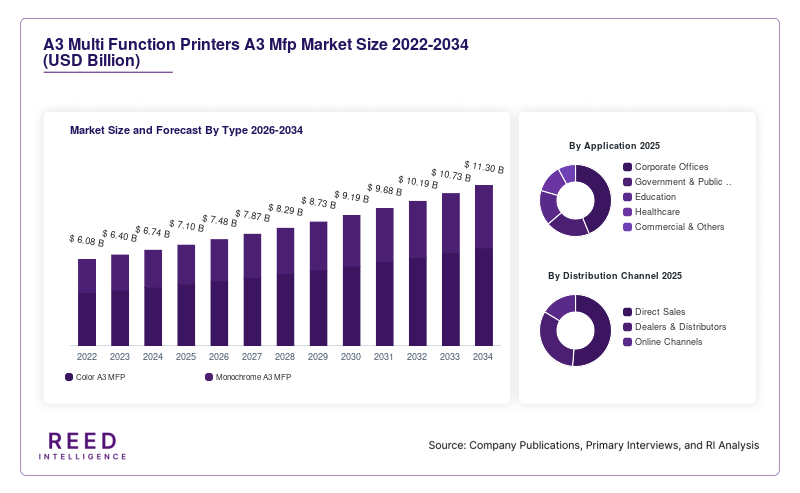
Color A3 MFPs accounted for approximately 61% of the global market in 2025, making them the largest product segment. Their position is supported by demand for presentation-quality documents, marketing materials, internal communications and color-sensitive business documents. Color systems also increasingly combine printing with scanning, cloud connectivity and workflow automation, allowing organizations to consolidate several document functions into a single device.
Ricoh's 2025 launches illustrate this transition, with new A3 color models targeting high-volume office users and central reprographic departments while incorporating security and cloud-based capabilities.
Monochrome A3 MFPs represented approximately 39% of the market and are projected to expand at a CAGR of approximately 4.7%. They remain relevant where document volumes are high but color output is not essential, including administrative, government and operational environments.
Application Segment Analysis
Corporate Offices Represent the Largest Application as MFPs Become Shared Workflow Hubs
Corporate offices accounted for approximately 44% of the market in 2025, supported by recurring document requirements, centralized printing and demand for network-connected devices.
Healthcare is the fastest-growing application, with approximately 11.6% CAGR, as document scanning, patient administration, records processing and secure information handling increase the value of integrated MFP workflows.
Government & public-sector applications represented approximately 20% and are projected to grow at 4.9% CAGR, while education accounted for approximately 15%, growing at 5.2% CAGR. Commercial & other applications represented approximately 13% and are projected to grow at 4.8% CAGR.
Distribution Channel Analysis
Direct Sales Holds the Largest Share Through Enterprise Procurement and Service Contracts
Direct sales accounted for approximately 48% of the market in 2025, reflecting the importance of enterprise procurement, customized configurations and long-term service agreements.
Online channels are the fastest-growing distribution category, with approximately 8.4% CAGR, supported by easier product comparison, configuration and purchasing for smaller organizations.
Dealers & distributors represented approximately 38% of the market and are projected to grow at 4.7% CAGR. Their role remains important because A3 MFP purchases frequently require installation, maintenance, consumables management and local technical support.
A3 Multi-Function Printers (A3 MFP) Market Regional Analysis
Asia-Pacific Represents the Largest Regional Market Through Manufacturing Strength and Expanding Office Demand
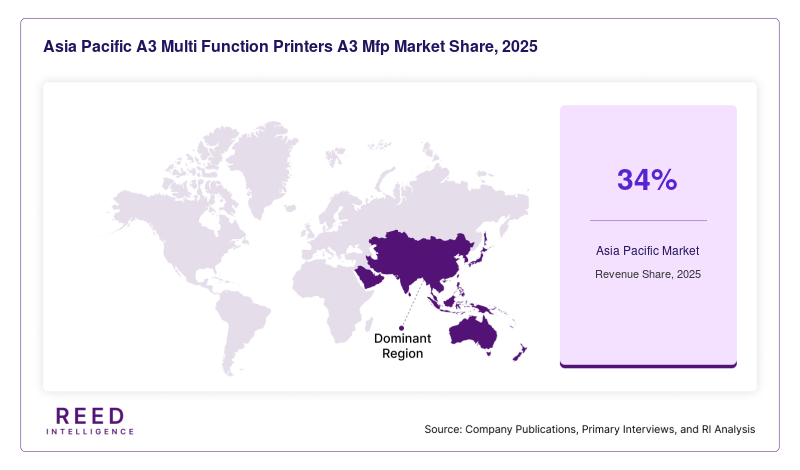
Asia-Pacific accounted for approximately 34% of the global A3 MFP market in 2025, making it the largest regional market. The region combines major office-equipment manufacturers with large corporate, government and SME customer bases.
Japan remains particularly important to the regional technology ecosystem, while China and India provide substantial enterprise and SME demand. Ricoh's 2025 Asia-Pacific product launch specifically targeted emerging-market businesses with A3 monochrome MFPs offering mobile and network compatibility.
Asia-Pacific is also the fastest-growing region, with a CAGR of approximately 6.2% through 2034. Growth is linked to office modernization, expansion of business services and replacement of older print fleets. Digitalization remains a counterbalance because organizations are simultaneously reducing paper-based workflows.
North America Maintains Strong Demand Through Enterprise Printing and Managed Services
North America accounted for approximately 29% of the market in 2025 and is projected to grow at approximately 5.1% CAGR.
The region has a mature installed base of A3 equipment and established managed-print-service infrastructure. The market is therefore increasingly replacement- and service-driven rather than dependent on first-time adoption.
Enterprise customers are also placing greater emphasis on security, remote management and workflow integration. This favors vendors capable of combining hardware with cloud services and fleet-management tools. However, hybrid work and declining routine print volumes constrain the number of devices required per office.
Europe Remains a Mature Market Focused on Efficiency and Sustainable Printing
Europe represented approximately 24% of the market in 2025 and is projected to grow at approximately 4.8% CAGR.
European organizations are increasingly evaluating printing equipment through energy efficiency, lifecycle management and resource consumption in addition to acquisition price. This supports replacement of older, less efficient fleets where the new equipment can reduce operational costs.
The mature nature of the regional market means growth depends heavily on technology upgrades, secure document workflows and managed services rather than large increases in print volumes.
Latin America Develops Through Office Modernization and SME Adoption
Latin America represented approximately 8% of the market in 2025 and is projected to grow at approximately 5.4% CAGR.
Demand is supported by modernization of corporate and public-sector offices and the continued use of physical documents across administrative and commercial processes.
Dealer and distributor networks remain important because installation, servicing and consumables availability influence purchasing decisions. Currency volatility and equipment-import costs can nevertheless extend replacement cycles.
Middle East & Africa Represents an Emerging Market for Digitally Connected Office Equipment
Middle East & Africa accounted for approximately 5% of the market in 2025 and is projected to grow at approximately 5.0% CAGR.
Demand is concentrated in corporate, government, education and commercial organizations with relatively high document-processing requirements. Newer MFPs offering secure scanning, network connectivity and centralized fleet management can address organizations seeking to modernize office infrastructure.
The main constraints include capital expenditure requirements, uneven distribution infrastructure and differences in digitalization levels between countries.
A3 Multi-Function Printers (A3 MFP) Market Competitive Landscape
Competition in the A3 MFP market is increasingly based on the ability to combine hardware reliability, print speed, document security, scanning, cloud integration, workflow software, energy efficiency and service coverage.
Canon is expanding its office MFD portfolio through the imageFORCE family and its existing imageRUNNER ADVANCE DX range. Canon stated in its 2025 annual report that it was progressively introducing imageFORCE products to expand its office MFD market position.
Ricoh is strengthening its A3 portfolio through intelligent, cloud-ready devices and high-volume color systems. Its 2025 launches included new A3 color and monochrome products, while the company's ETRIA joint venture with Toshiba Tec combines development, procurement and production capabilities for office MFPs.
Key Market Players
- Canon Inc.
- Ricoh Company, Ltd.
- Xerox Holdings Corporation
- Konica Minolta, Inc.
- Kyocera Corporation
- Sharp Corporation
- Toshiba Tec Corporation
- HP Inc.
- Brother Industries, Ltd.
- Lexmark International
- Epson Corporation
A3 Multi-Function Printers (A3 MFP) Market Recent Developments
- In April 2025, Ricoh introduced a new range of intelligent color A3 MFPs incorporating a PFU production-class scanner and an automatic single-pass document feeder designed to handle a wider variety of media. The technology allows organizations to digitize documents that can be difficult to process through conventional curved-path feeders.
- Canon reported in its 2025 Annual Report that it was progressively introducing products from its new imageFORCE series, describing the series as its first new office MFD platform in 15 years and highlighting new technologies designed to increase functionality.
A3 Multi Function Printers A3 Mfp Market Segments
By Type
- Color A3 MFP
- Monochrome A3 MFP
By Application
- Corporate Offices
- Government & Public Sector
- Education
- Healthcare
- Commercial & Others
By Distribution Channel
- Direct Sales
- Dealers & Distributors
- Online Channels
By Region
- North America
- Europe
- APAC
- Middle East and Africa
- LATAM