Abrasion Resistant Steel Plate Market Size, Share & Trends Analysis Report By Product Type (AR400, AR450, AR500, AR600 and Others), By Application (Mining, Construction, Agriculture, Recycling & Waste Management, Cement & Concrete and Others), By Thickness (Up to 20 mm, 21–50 mm and Above 50 mm) and By Region (North America, Europe, Asia-Pacific, Latin America, Middle East & Africa) Forecasts, 2026–2034
USD 3950
Abrasion Resistant Steel Plate Market Size
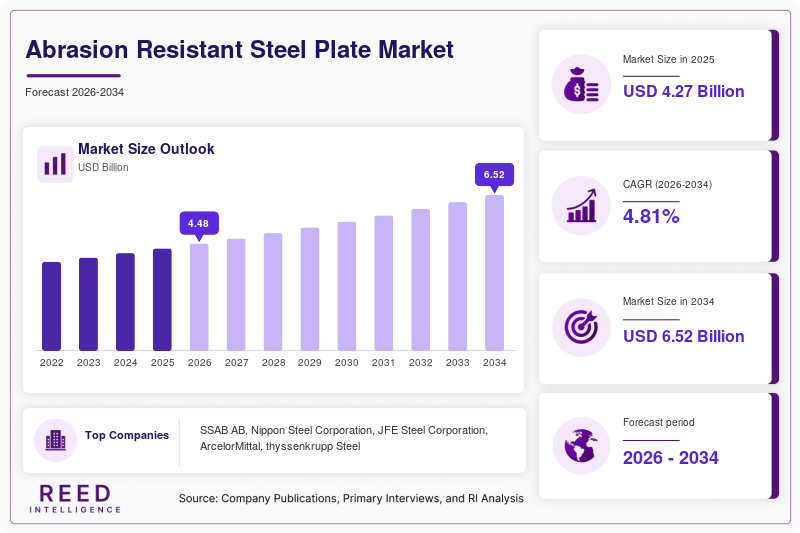
The global abrasion resistant steel plate market was valued at USD 4.27 billion in 2025 and is projected to grow from USD 4.47 billion in 2026 to USD 6.22 billion by 2034, registering a CAGR of 4.81% during the forecast period from 2026 to 2034.
Abrasion resistant steel plates are used where steel components are exposed to repeated sliding, impact, crushing and abrasive contact. The principal demand base comes from mining, quarrying, construction equipment, material handling, cement production, recycling, agriculture and industrial processing. Nippon Steel identifies construction machinery, industrial machinery and transportation equipment among the major applications for abrasion-resistant plate, while JFE Steel lists construction equipment, industrial machinery, transportation equipment and mining machinery as key application areas.
The commercial value proposition is based on extending component life while reducing repair frequency, equipment downtime and structural weight. Nippon Steel states that its ABREX plates can reduce structural weight while extending machinery and component service life, while SSAB positions Hardox grades for mining, quarrying, construction, recycling, cement and agricultural equipment.
Abrasion Resistant Steel Plate Market Drivers
Mining and Quarrying Equipment Requires Longer Wear Life Under Severe Abrasion
Mining and quarrying equipment operates continuously against rock, ore, sand and other abrasive materials, making wear-resistant steel a direct maintenance and productivity input. SSAB identifies mining buckets, haul-truck bodies, chutes, liners and other mining components as applications for Hardox wear plate, while JFE documents use of EVERHARD in loader buckets, truck liners, crusher components and chutes.
The market mechanism is straightforward: higher wear resistance can extend replacement intervals and reduce maintenance interruptions. This encourages equipment manufacturers and mine operators to specify higher-performance grades where the additional material cost is justified by longer service life. The strongest effect is in components experiencing continuous abrasive loading. However, steel prices, equipment utilization and mine investment cycles can delay upgrades.
Higher-Performance Plates Allow Equipment Manufacturers to Reduce Structural Weight
The combination of hardness, toughness and strength is allowing manufacturers to use thinner wear components without simply increasing the risk of premature failure. Nippon Steel states that ABREX can reduce the weight of structural members exposed to severe abrasive conditions, while SSAB highlights thinner wear packages and lighter dump bodies as applications of high-performance Hardox grades.
The commercial mechanism extends beyond replacement demand: lighter truck bodies and buckets can increase payload or reduce the weight carried by the machine itself. This creates demand for higher-grade plates even where the total steel tonnage per machine may decline. The counterbalance is that fabrication requirements, welding procedures and grade availability can influence whether equipment manufacturers switch from conventional steel.
Product Innovation Is Expanding Wear Plate Applications Beyond Conventional Abrasion
Steelmakers are developing grades that address combinations of abrasion, impact, corrosion and temperature rather than abrasion alone. SSAB's Hardox HiAce is designed for corrosive wear and elevated-temperature environments, while Hardox 600 targets severe wear applications across mining, mineral processing, cement, recycling and industrial equipment.
This broadens the addressable market because components exposed to moisture, acidic materials or elevated temperatures can require more specialized material solutions. The commercial impact is strongest in recycling, waste processing, pulp and paper, cement and process industries. Adoption can nevertheless be limited where conventional AR grades already provide adequate service life at a lower acquisition cost.
Abrasion Resistant Steel Plate Market Restraints
Steel and Alloy Costs Can Limit Adoption of Higher-Hardness Grades
Abrasion-resistant plates require controlled alloy chemistry and heat treatment to achieve high hardness while retaining toughness and processability. JFE describes the use of carbon and other alloying elements together with specialized heat treatment to obtain the required hardness, while Nippon Steel emphasizes controlled composition and processing for ABREX grades.
The economic mechanism is that higher-performance grades can increase material and fabrication costs compared with conventional structural steel. Buyers therefore evaluate the additional cost against expected maintenance savings, equipment utilization and component life. This creates stronger adoption in applications where downtime or replacement costs are substantial.
Fabrication Requirements Can Constrain Grade Substitution
High-hardness plate must balance wear resistance with cutting, bending and welding requirements. Nippon Steel specifically markets ABREX around weldability and bending formability, while SSAB emphasizes workshop-friendly cutting, machining and welding characteristics for its Hardox grades.
This means material substitution is not determined solely by hardness. Equipment manufacturers also need compatible fabrication processes, qualified welding procedures and appropriate workshop capabilities. The constraint is particularly relevant when customers attempt to replace established steel grades without modifying production processes.
Abrasion Resistant Steel Plate Market Opportunities
Low-Carbon Wear Plates Can Differentiate Steel Suppliers in Equipment Procurement
Decarbonization is becoming an additional purchasing consideration for steel-intensive equipment manufacturers. SSAB introduced Hardox 450 made from SSAB Zero in 2024 and showcased the product at Bauma 2025 for construction, mining and quarrying applications. SSAB states that SSAB Zero uses recycled steel and a production process powered by fossil-free electricity and biogas, with very low fossil-carbon emissions from its own Scope 1 and 2 steelmaking operations.
The opportunity is to combine wear performance with lower production-related emissions, particularly for equipment manufacturers with supplier-emissions targets. Adoption will depend on availability, certification requirements and the willingness of customers to pay for lower-carbon material.
Corrosion-Resistant Wear Plate Opens Demand in Recycling and Process Industries
Equipment operating in wet, acidic or corrosive environments can experience accelerated material degradation. SSAB developed Hardox HiAce specifically for situations where abrasion and corrosion occur together, including waste and recycling, pulp and paper, sawmills, biomass and process industries.
This creates an opportunity for suppliers to replace conventional AR steel, stainless steel or other wear materials where combined corrosion and abrasion create high maintenance costs. The market opportunity is strongest when a specialized plate can extend component life without requiring major changes to fabrication practices.
Product Type Segment Analysis
AR450 Holds the Largest Share Because It Balances Wear Resistance, Toughness and Fabrication Requirements
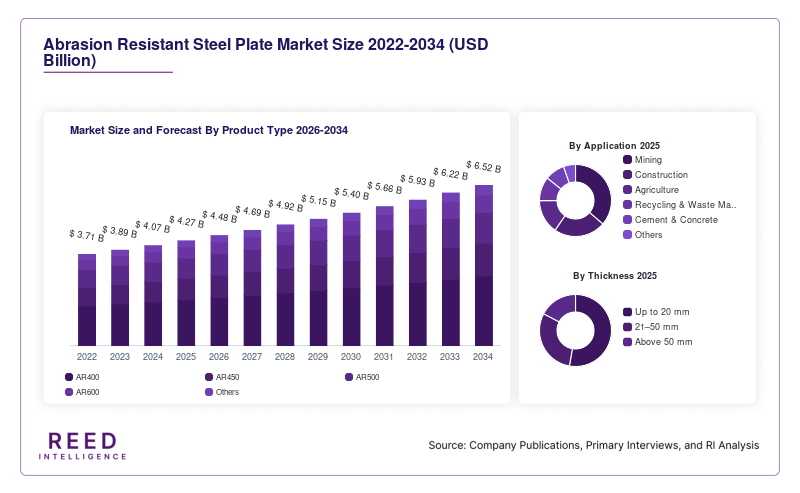
AR450 accounted for approximately 34% of the global market in 2025, making it the largest product-type segment. Its position reflects the need for a material that provides stronger abrasion resistance than conventional structural steel while retaining the toughness and processability required for equipment fabrication. SSAB describes Hardox 450 as a versatile abrasion-resistant steel with structural properties, while its product range demonstrates the use of the grade across demanding equipment applications.
AR500 represented approximately 27% of the market and is projected to grow at a CAGR of approximately 5.1%. Its higher hardness makes it appropriate for more severe wear conditions, including liners, crusher components and other wear-intensive applications.
AR400 accounted for approximately 23%, with a CAGR of approximately 4.3%, while AR600 represented approximately 10% and is projected to grow at approximately 5.0% CAGR. Other grades represented the remaining 6%, with a CAGR of approximately 4.0%.
AR600 Is Expanding Faster as Severe-Wear Applications Shift Toward Higher-Performance Materials
AR600 is the fastest-growing major product segment, with approximately 5.0% CAGR and a 10% share in 2025. Its growth is connected to applications where conventional wear grades require frequent replacement. SSAB positions Hardox 600 for mining, quarrying, earthmoving, cement, concrete, steel, energy and recycling applications involving severe wear.
Higher-hardness grades can support thinner liner packages and longer service intervals, creating a lifecycle-cost argument even when the initial material price is higher. However, adoption remains dependent on fabrication requirements, application severity and the customer's willingness to move toward specialized grades.
Application Segment Analysis
Mining Represents the Largest Application Through Continuous Exposure to Abrasive Materials
Mining accounted for approximately 39% of the global market in 2025, making it the largest application segment. Mining equipment is exposed to rock, ore, sand and impact throughout excavation, hauling and material processing, creating recurring demand for wear liners, buckets, truck bodies, chutes and crusher components. SSAB and JFE both document extensive applications of wear plate across mining equipment and mineral-processing systems.
Construction represented approximately 24% and is projected to grow at approximately 4.9% CAGR, supported by demand for wear-resistant buckets, blades, dump bodies and other heavy equipment components. Agriculture represented 11%, recycling and waste management 9%, cement and concrete 8%, and other applications 9%.
Recycling & Waste Management Is the Fastest-Growing Application as Equipment Faces Combined Wear and Corrosion
Recycling & waste management accounted for approximately 9% of the market in 2025 and is projected to grow at approximately 6.0% CAGR. Shredders, containers, chutes, hammers and other equipment can experience simultaneous abrasion, impact, moisture and corrosion. SSAB identifies recycling and waste equipment as an application for specialized wear steels, including corrosion-resistant Hardox HiAce and higher-hardness grades.
The faster expansion reflects the growing need for materials capable of maintaining service life in mixed wear environments. Adoption could be constrained by equipment-specific design requirements and competition from alternative wear materials.
Thickness Segment Analysis
21–50 mm Plates Represent the Largest Thickness Category
Plates between 21 and 50 mm represented approximately 46% of the market in 2025, reflecting their suitability for heavy equipment structures, liners, buckets, truck bodies and material-handling components requiring a combination of structural strength and abrasion resistance.
Above 50 mm plates accounted for approximately 31% and are projected to grow at approximately 4.9% CAGR. They are used in particularly demanding structural and wear applications where impact toughness and section thickness remain important. SSAB's product portfolio extends to substantially thick wear plate, including Hardox 400 and 450 grades, while its HiTuf product is specifically positioned for thick structural wear applications.
Up to 20 mm plates represented approximately 23% of the market and are projected to grow at approximately 4.5% CAGR, supported by applications where lower component weight and easier fabrication are priorities.
Abrasion Resistant Steel Plate Market Regional Analysis
Asia-Pacific Holds the Largest Regional Share Through Mining, Construction and Industrial Equipment Demand
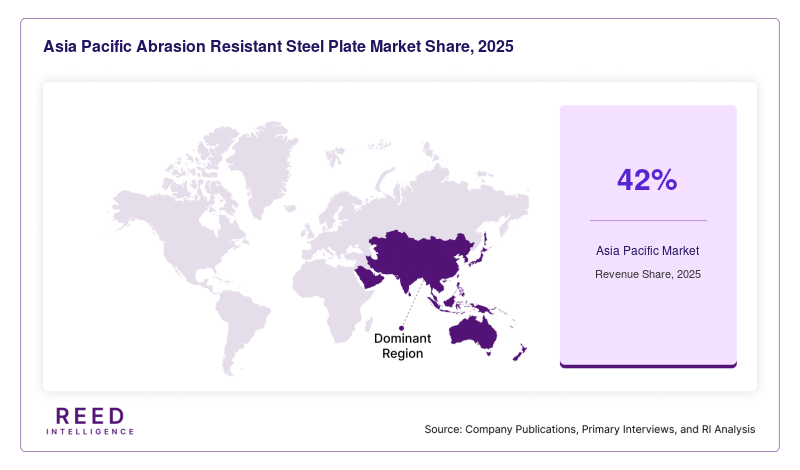
Asia-Pacific accounted for approximately 42% of the global market in 2025, making it the largest regional market. The region combines major steelmaking capacity with extensive mining, construction equipment, infrastructure and industrial machinery activity.
Japan has established abrasion-resistant product portfolios from Nippon Steel and JFE Steel, while regional equipment manufacturing creates an additional route to demand. Nippon Steel's ABREX portfolio is specifically targeted at construction machinery, dump-truck bodies, conveyor hoppers and other equipment exposed to abrasive materials.
Asia-Pacific is also the fastest-growing region, with approximately 5.4% CAGR through 2034. The growth mechanism is the combination of equipment replacement, mining and quarrying activity, infrastructure development and industrial processing. Price competition and fluctuations in construction and mining investment can moderate adoption.
North America Maintains Demand Through Mining, Construction Equipment and Heavy-Duty Manufacturing
North America represented approximately 25% of the market in 2025 and is projected to grow at approximately 4.7% CAGR.
Demand is supported by mining, aggregates, construction equipment, waste processing and heavy-duty transportation applications. SSAB's North American product offering includes multiple Hardox grades for mining, construction, recycling and other heavy-wear applications.
The region's market is increasingly influenced by lifecycle economics. Equipment owners can justify higher-performance plate when longer service intervals reduce maintenance interruptions. However, replacement cycles and commodity-sensitive capital expenditure can create fluctuations in demand.
Europe Remains an Established Market With Increasing Emphasis on Material Efficiency and Carbon Footprint
Europe represented approximately 20% of the market in 2025 and is projected to grow at approximately 4.3% CAGR.
The regional market is supported by established heavy-equipment, steel-processing, recycling and industrial machinery industries. Material efficiency is an important demand mechanism because higher-performance grades can allow thinner components while maintaining wear resistance.
Low-carbon steel is becoming an additional product differentiator. SSAB's Hardox 450 made from SSAB Zero provides an example of how wear-plate suppliers are incorporating lower-carbon steelmaking into the product proposition.
Latin America Develops Through Mining and Mineral-Processing Applications
Latin America accounted for approximately 8% of the market in 2025 and is projected to grow at approximately 4.8% CAGR.
Mining creates a direct demand base for abrasion-resistant plate because crushers, chutes, truck bodies, buckets and processing equipment are exposed to abrasive ores and rock. JFE's application documentation identifies mining plants and components such as truck liners, crusher parts, chutes and feeder systems as wear-plate applications.
Demand remains sensitive to mining investment, commodity cycles and equipment replacement schedules.
Middle East & Africa Represents an Emerging Wear-Plate Market Linked to Mining, Construction and Industrial Processing
Middle East & Africa represented approximately 5% of the market in 2025 and is projected to grow at approximately 4.6% CAGR.
Demand is concentrated in construction machinery, quarrying, mining, cement production and material handling. Wear-resistant steel becomes economically relevant where equipment downtime and component replacement are costly.
The region's development depends on mining and infrastructure investment as well as access to specialized steel grades and fabrication services. Import dependence and project timing can lengthen procurement cycles.
Abrasion Resistant Steel Plate Market Competitive Landscape
Competition is based on more than hardness. Steelmakers differentiate through grade consistency, toughness, weldability, formability, thickness range, application engineering, product availability and lifecycle performance.
SSAB has built a broad Hardox portfolio covering standard structural wear grades and specialized products for severe, corrosive and high-temperature environments. Its portfolio includes Hardox 400, 450, 500 Tuf, 500, 550, 600, HiTuf, HiAce and Extreme.
Nippon Steel competes through the ABREX series, emphasizing abrasion resistance together with weldability, bending performance and weight reduction. The company states that ABREX provides abrasion resistance substantially above mild steel and is designed for severe earth- and sand-abrasion conditions.
Key Market Players
- SSAB AB
- Nippon Steel Corporation
- JFE Steel Corporation
- ArcelorMittal
- thyssenkrupp Steel
- voestalpine AG
- Tata Steel
- Baosteel
- Nucor Corporation
- POSCO
Abrasion Resistant Steel Plate Market Recent Developments
- In February 2025, SSAB announced that Hardox 450 made from SSAB Zero would be showcased at Bauma 2025 for construction, mining and quarrying applications. SSAB reported that the product used a production process with fossil-carbon emissions below 0.05 kg CO₂e/kg steel for its Scope 1 and 2 emissions. The development connects low-carbon steel production with three major wear-plate customer groups and provides an additional product attribute for equipment manufacturers addressing supply-chain emissions.
- In April 2025, SSAB highlighted Hardox HiAce for applications where abrasion occurs alongside corrosive conditions. The material is targeted at environments where conventional abrasion-resistant steels can experience accelerated degradation, including recycling, waste, pulp and paper and other industrial processing applications. The development broadens the competitive basis of wear plate from simple abrasion resistance toward combined corrosion, wear and temperature performance.
Abrasion Resistant Steel Plate Market Segments
By Product Type
- AR400
- AR450
- AR500
- AR600
- Others
By Application
- Mining
- Construction
- Agriculture
- Recycling & Waste Management
- Cement & Concrete
- Others
By Thickness
- Up to 20 mm
- 21–50 mm
- Above 50 mm
By Region
- North America
- Europe
- APAC
- Middle East and Africa
- LATAM