Adhesive Equipment Market Size, Share & Trends Analysis Report By Product Type (Hot Melt Adhesive Equipment, Cold Adhesive Equipment, Adhesive Controllers, Adhesive Pumping Systems), By Application (Packaging, Automotive, Construction, Electronics & Electrical, Woodworking & Furniture), By End Use (Industrial Manufacturing, Consumer Goods, Automotive & Transportation, Building & Construction), By Distribution Channel (Direct Sales, Distributors & Dealers, Online Channels) Forecasts, 2026–2034
USD 3950
Adhesive Equipment Market Size
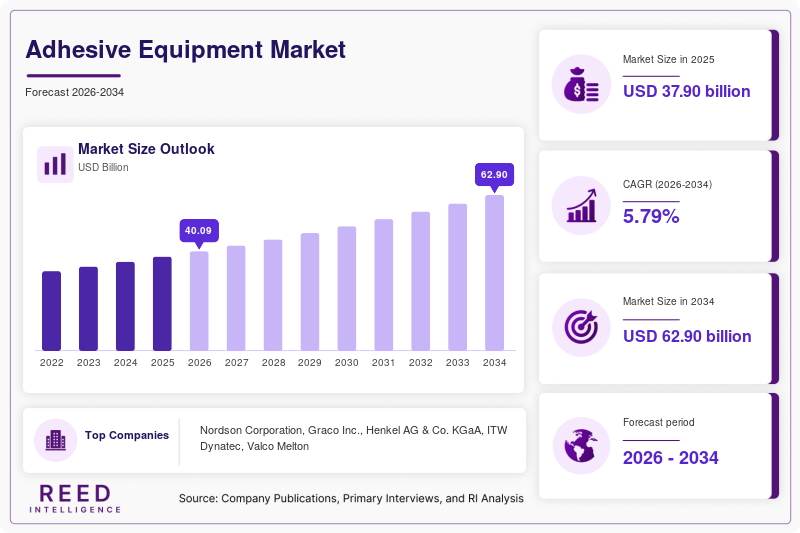
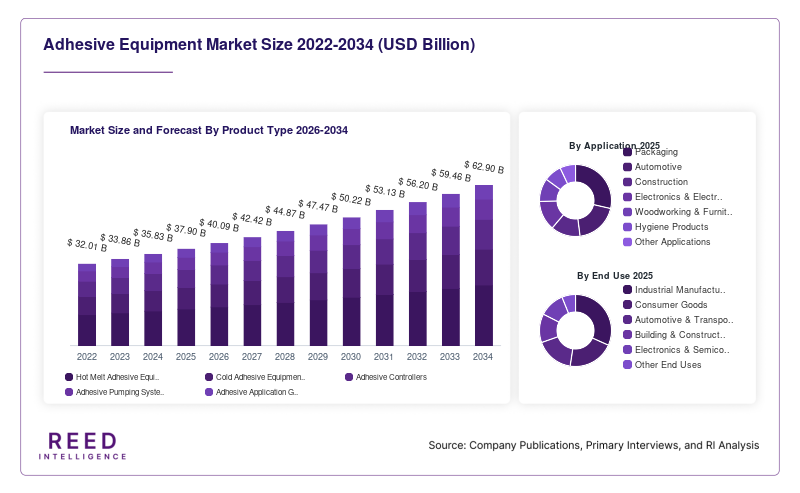
The global Adhesive Equipment Market size was valued at USD 37.90 billion in 2025 and is projected to grow from USD 40.09 billion in 2026 to USD 62.90 billion by 2034, registering a CAGR of 5.79% during the forecast period from 2026 to 2034.
The adhesive equipment market is shifting from basic glue application toward precision dispensing, automated metering, process monitoring, quality inspection, and digitally controlled bonding. Equipment is increasingly purchased as part of a complete manufacturing process rather than as a standalone machine. Henkel, for example, offers manual, semi-automated, and robotic dispensing systems, including controllers, pumps, valves, and light-curing systems designed around adhesive chemistry, package size, production rate, and required dispense pattern.
Packaging remains an important demand center because carton sealing, labeling, tray forming, beverage packaging, pharmaceuticals, e-commerce packaging, and pallet stabilization require high-speed and repeatable adhesive application. Nordson supplies hot-melt systems across these applications and emphasizes controlled adhesive quantity, reduced stringing, and reliable production performance.
Automotive and electronics are changing the technical requirements of the equipment. EV battery assembly increasingly uses structural, thermal, insulating, and specialty adhesive systems, creating demand for high-speed and accurate dispensing. Henkel introduced new thermal interface materials for EV batteries in 2026, including a thermally conductive adhesive designed for cell-to-pack architectures. Electronics and semiconductor packaging similarly require increasingly precise dispensing for encapsulation, thermal management, bonding, and advanced packaging. Nordson's 2026 Vantage XL system was specifically introduced for panel-level packaging driven by AI, HPC, and advanced semiconductor applications.
Adhesive Equipment Market Drivers
Automation and precision manufacturing are increasing equipment requirements:
Manufacturers are replacing manual adhesive application with programmable dispensing, robotic application, automated mixing, and inline monitoring where production volume and quality requirements justify the investment. Henkel's robotic systems are designed to repeat adhesive patterns consistently, reduce material waste, improve production speed, and integrate directly into assembly lines. Graco's automated dispensing systems similarly incorporate visual recognition, positioning technology, real-time dispensing data, and process-quality monitoring for electronics manufacturing. The mechanism is straightforward: as manufacturers move toward higher throughput and lower defect rates, manually controlled adhesive quantity and placement become less acceptable. Equipment therefore becomes part of the process-control architecture. This particularly benefits automated dispensing robots, precision valves, meter-mix systems, controllers, and inspection technologies.
Growth of electronics, semiconductor packaging, and miniaturized assemblies:
Electronics manufacturing is increasing demand for dispensing systems capable of depositing small, repeatable amounts of adhesive, encapsulant, thermal material, and other fluids. Nordson identifies electronics applications ranging from thin-line dispensing for miniaturized devices to gasketing, encapsulation, shielding, and bonding. The trend is extending into advanced semiconductor packaging. In August 2026, Nordson introduced its ASYMTEK Vantage XL platform for panel-level packaging, specifically addressing throughput and yield requirements associated with AI, high-performance computing, and advanced packaging. This creates a higher-value equipment opportunity because semiconductor and electronics customers place greater emphasis on dispensing accuracy, repeatability, process monitoring, contamination control, and equipment integration than conventional high-volume gluing applications.
Expansion of adhesive-intensive EV and lightweight manufacturing:
Automotive manufacturing is increasingly using adhesives to join dissimilar materials, reduce vehicle weight, improve vibration performance, and assemble battery systems. Henkel states that EV batteries require structural and thermal adhesives for cell stabilization, crash performance, and thermal management, while controlled debonding is becoming increasingly relevant for repair and recycling. In May 2026, Henkel introduced the Teroson EP 52 Series, a structural adhesive combining structural integrity with vibration damping and designed for integration into automated body-in-white production using standard pump dispensing systems. This directly increases demand for compatible pumps, meters, applicators, mixers, valves, controllers, and automated dispensing systems as automotive production becomes more adhesive-intensive.
Adhesive Equipment Market Restraints
High equipment cost and process-integration complexity:
Advanced adhesive equipment can require substantial investment in pumps, heated hoses, applicators, controllers, robotics, vision systems, curing equipment, and maintenance infrastructure. The economic benefit depends on production volume and the cost of defects, adhesive waste, downtime, and labor. Graco's meter-mix systems illustrate the complexity: equipment must maintain accurate material ratios, volumes, pressure, and temperature across different adhesive chemistries and viscosities. Integration can become particularly demanding when equipment must communicate with robotics, manufacturing execution systems, inspection equipment, or existing production machinery. Smaller manufacturers may therefore continue using manual or semi-automated systems where production volumes do not justify complete automation.
Exposure to cyclical industrial production:
Adhesive equipment is ultimately a capital-equipment market and therefore responds to factory investment, industrial production, automotive output, packaging demand, and electronics manufacturing cycles. Henkel's 2025 results illustrate this uneven environment: its Adhesive Technologies business generated organic growth of 1.5%, but Packaging & Consumer Goods declined organically while automotive demand remained muted in Europe and North America. During the first half of 2026, however, Henkel's Adhesive Technologies business accelerated to 4.5% organic growth, led particularly by Mobility & Electronics, while Packaging & Consumer Goods also grew strongly. Equipment suppliers therefore face periods where customers delay machinery purchases even when long-term adhesive consumption remains structurally positive.
Adhesive Equipment Market Opportunities
Integrated dispensing and quality-assurance platforms:
The next opportunity is to combine adhesive application with real-time quality verification. Graco's acquisition of Valco Melton demonstrates this direction: Valco Melton supplies precision adhesive application and vision-based quality assurance systems, and Graco stated that the acquisition would expand its dispensing capabilities while adding inspection technology. This changes the equipment value proposition from simply applying adhesive to controlling the complete bonding process. Manufacturers can use cameras, sensors, controllers, and software to identify missing adhesive, incorrect patterns, excessive application, or other defects before products leave the line. This is particularly valuable in packaging, automotive, electronics, hygiene products, and other applications where a bonding defect can create downstream scrap or warranty costs.
Energy-efficient and sustainable hot-melt processing:
Equipment manufacturers can capture demand by reducing adhesive degradation, energy consumption, material waste, and maintenance requirements. ITW Dynatec's equipment portfolio includes melt-on-demand technology that heats only the adhesive required by the application, while its Dynamelt SR system is designed to consume less energy and air than comparable equipment. Packaging customers are also under pressure to improve material efficiency and reduce waste as e-commerce and sustainable packaging expand. Henkel highlights sustainability, circularity, and food safety as major trends influencing packaging and consumer-goods adhesive solutions. Equipment that delivers accurate adhesive patterns while reducing energy and material consumption can therefore provide a measurable operating-cost advantage.
Segmental Analysis
By Product Type
Hot Melt Adhesive Equipment represents approximately 37% of the global market in 2025, supported by high-speed packaging, hygiene products, woodworking, product assembly, and converting applications. Hot-melt systems combine adhesive melting, pumping, heated hoses, controllers, and application heads and are particularly suited to continuous manufacturing. Nordson describes hot-melt dispensing as a core technology across packaging, product assembly, nonwovens, automotive, appliances, and building applications. ITW Dynatec also supplies complete hot-melt systems ranging from low-volume melters to high-volume supply units, applicators, controllers, and feed systems.
Adhesive Controllers are the fastest-growing product category, with an estimated 7.1% CAGR through 2034. Controllers are increasingly connected to sensors, dispensing valves, pumps, robotics, and inspection systems, allowing manufacturers to regulate adhesive patterns, timing, temperature, pressure, and application quantity. ITW Dynatec's controllers manage adhesive application patterns by activating solenoids for hot-melt and cold-glue systems. The transition toward automated and data-monitored production increases the value of intelligent control equipment.
By Application
Packaging accounts for approximately 31% of the global market in 2025, making it the largest application. Carton sealing, case forming, tray making, beverage packaging, pharmaceutical packaging, labeling, and e-commerce packaging use high-speed adhesive application systems. Nordson serves these applications with hot-melt and cold-adhesive technologies and emphasizes accurate application to prevent stringing, tailing, squeeze-out, and packaging defects. Henkel also identifies sustainability, circularity, and food safety as important packaging trends shaping adhesive technology requirements.
Electronics & Electrical is the fastest-growing application, with an estimated 7.4% CAGR. Electronics manufacturers require increasingly precise dispensing for bonding, gasketing, encapsulation, shielding, thermal management, and component assembly. Nordson's electronics business supports semiconductor packaging, PCB assembly, 3D packaging, camera modules, and other applications, while its 2026 Vantage XL launch specifically targeted panel-level packaging for AI and HPC applications.
By End Use
Industrial Manufacturing represents approximately 29% of the market in 2025, reflecting the broad use of adhesive equipment in general assembly, machinery, appliances, maintenance, components, and engineered products. Henkel serves more than 800 industrial applications through its Adhesive Technologies business, covering mobility, electronics, packaging, construction, and general manufacturing.
Electronics & Semiconductor is the fastest-growing end-use category, with an estimated 8.0% CAGR. Semiconductor packaging and advanced electronics assembly increasingly require controlled application of adhesives, thermal interface materials, encapsulants, and other fluids. Nordson's electronics portfolio covers 2D, 2.5D, and 3D heterogeneous integration and chiplet architectures, while the company's 2026 Vantage XL platform was designed for panel-level packaging requirements driven by AI and HPC.
By Distribution Channel
Direct Sales account for approximately 57% of the market, reflecting the engineering-intensive nature of adhesive equipment. Customers frequently require application testing, equipment configuration, installation, operator training, maintenance, spare parts, and technical support. Henkel's equipment business combines equipment engineering, application engineering, and technical support, while Nordson maintains direct offices and service capabilities in more than 35 countries.
Online Channels are the fastest-growing distribution route, with an estimated 8.2% CAGR. Standardized dispensers, valves, nozzles, replacement parts, controllers, hoses, and accessories can increasingly be researched and purchased digitally, although complex automated systems continue to depend heavily on direct engineering sales and distributors. The strongest online growth is therefore likely to remain concentrated in standardized equipment, replacement components, and consumables rather than complete factory-integrated systems.
Regional Analysis
North America Adhesive Equipment Market
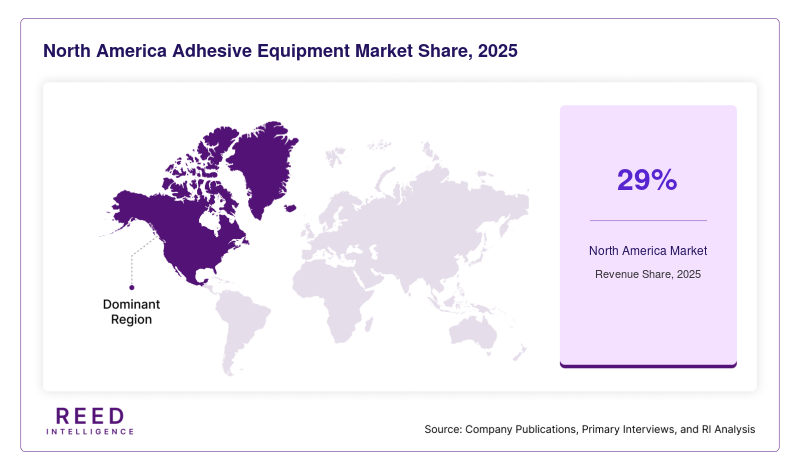
North America represents approximately 29% of the global adhesive equipment market in 2025 and is growing at around 5.0% CAGR. The region benefits from a large industrial manufacturing base, sophisticated packaging operations, automotive production, electronics manufacturing, aerospace activity, and established equipment suppliers. Graco, Nordson, and other U.S.-based equipment manufacturers have extensive industrial and global operations, while Nordson maintains direct sales and technical service in more than 35 countries.
The strongest demand mechanism is automation. North American manufacturers face pressure to improve labor productivity, reduce material waste, and maintain consistent product quality. Automated dispensing systems address these requirements by controlling adhesive volume and location and integrating with production machinery. Graco's electronics dispensing systems incorporate visual positioning and real-time process monitoring, illustrating the increasing importance of automation and quality data.
Packaging is another important demand center. Nordson supplies equipment for case and carton sealing, beverage packaging, pharmaceutical packaging, e-commerce, labeling, and pallet stabilization. The expansion of e-commerce packaging adds demand for high-speed, reliable adhesive application.
Automotive demand is increasingly linked to EVs and lightweight construction. Henkel's current automotive portfolio includes structural adhesives, battery assembly adhesives, thermal materials, and specialty tapes, creating corresponding opportunities for dispensing and application equipment. The main constraint is cyclical capital spending: manufacturers can postpone new equipment projects when industrial production or vehicle demand weakens.
Europe Adhesive Equipment Market
Europe accounts for approximately 24% of the global market and is growing at around 4.6% CAGR. Europe has a mature industrial manufacturing base across automotive, packaging, machinery, electronics, furniture, construction, and consumer products. Adhesive technologies are particularly relevant to Europe's transition toward lightweight vehicles, EV battery manufacturing, sustainable packaging, and more automated production.
Henkel's 2025 results show the mixed industrial environment. Adhesive Technologies generated EUR 10.667 billion of sales, while Mobility & Electronics achieved 3.3% organic growth. Packaging & Consumer Goods declined 0.6%, while Craftsmen, Construction & Professional grew 1.3%. The variation across applications indicates that equipment suppliers need exposure to multiple end markets rather than depending on one manufacturing segment.
EV production is an important long-term mechanism. Henkel identifies battery adhesives as important for structural bonding, thermal management, insulation, and lightweight architectures, while its 2026 developments include thermally conductive adhesives and battery specialty tapes. These materials require controlled application systems capable of processing two-component, thermally conductive, and structural chemistries.
European sustainability requirements also create demand for equipment that reduces adhesive waste, energy consumption, and production defects. ITW Dynatec's melt-on-demand systems illustrate how equipment manufacturers are addressing energy and material efficiency.
APAC Adhesive Equipment Market
APAC represents approximately 34% of the global market in 2025 and is the fastest-growing region, with an estimated CAGR of 7.1%. The region combines large-scale packaging, electronics, semiconductor, automotive, consumer electronics, furniture, and hygiene-product manufacturing. China, Japan, South Korea, Taiwan, India, and Southeast Asia provide major production bases for adhesive-intensive industries.
Electronics is the strongest regional growth mechanism. Henkel reported strong electronics growth in China during 2025 and 2026, while it opened a new electronics customer application center in Bengaluru in March 2026 to support India's expanding electronics manufacturing ecosystem. The facility is designed to help customers test, validate, and scale advanced adhesive and thermal-management solutions locally, reducing the need to send development work overseas.
Semiconductor packaging creates an additional high-value opportunity. Nordson's Vantage XL platform was launched at SEMICON Taiwan 2026 for panel-level packaging and AI/HPC applications. The equipment requirements in these applications are more demanding than conventional gluing because manufacturers need tight control over dispensing volume, location, speed, and process repeatability.
Packaging and consumer goods also remain important because APAC has extensive manufacturing capacity and rapidly expanding e-commerce. Henkel reported strong Packaging & Consumer Goods performance in the first half of 2026, while Nordson maintains a broad packaging application portfolio covering cartons, beverages, pharmaceuticals, e-commerce, and labeling.
Middle East and Africa Adhesive Equipment Market
Middle East and Africa accounts for approximately 7% of the global market and is growing at around 6.2% CAGR. Demand is concentrated in packaging, construction materials, consumer goods, hygiene products, automotive assembly, and industrial manufacturing. The region is increasingly investing in manufacturing localization and logistics infrastructure, creating opportunities for automated adhesive application systems.
Packaging represents an important entry point because food, beverage, pharmaceutical, consumer-product, and e-commerce supply chains require reliable case sealing, labeling, carton forming, and pallet stabilization. Nordson's packaging systems cover these applications across both hot-melt and cold-adhesive processes.
Construction provides another demand channel through flooring, insulation, panels, windows, doors, and building-material assembly. Henkel's Craftsmen, Construction & Professional business serves construction, manufacturing, maintenance, and DIY applications, demonstrating the breadth of adhesive use across the built environment.
The region remains smaller than APAC, North America, and Europe because local production of sophisticated dispensing machinery is limited. Complex systems are therefore frequently supplied through global manufacturers and regional distributors. Growth will depend on manufacturing localization, infrastructure investment, packaging production, and adoption of automated production processes.
LATAM Adhesive Equipment Market
LATAM represents approximately 6% of the global market and is growing at around 5.8% CAGR. Demand is concentrated in food and beverage packaging, consumer goods, automotive, furniture, construction, hygiene products, and general manufacturing. Brazil and Mexico provide the strongest industrial bases for adhesive-equipment consumption because of their manufacturing scale and established packaging industries.
Packaging is particularly relevant because high-speed adhesive application is required for cartons, cases, labels, beverage packaging, and consumer products. Nordson's broad packaging portfolio demonstrates the types of applications that can generate recurring equipment and replacement-part demand.
Automotive production provides another route for growth as manufacturers introduce lightweight components, structural adhesives, acoustic bonding, and EV-related assembly processes. Henkel reported strong Latin American development in Mobility & Electronics in 2025, with double-digit growth in that business area during the first quarter.
The principal constraints are currency volatility, imported equipment costs, uneven industrial investment, and lower automation penetration among smaller manufacturers. These factors favor modular and semi-automated equipment that can provide productivity improvements without requiring a complete production-line transformation.
Competitive Landscape
The adhesive equipment market contains specialized dispensing-equipment companies, fluid-management manufacturers, adhesive producers with integrated equipment portfolios, and industrial automation providers. Competition increasingly centers on precision, uptime, material efficiency, process monitoring, application expertise, service coverage, and the ability to integrate equipment with factory automation.
Nordson has one of the broadest dedicated adhesive-equipment portfolios, covering hot-melt dispensing, engineered fluid dispensing, electronics applications, packaging, product assembly, and inspection. Its global service infrastructure and specialization across packaging and electronics give it exposure to both high-volume adhesive consumption and high-precision applications.
Graco combines fluid-handling expertise with meter-mix, dispense, automated adhesive application, and industrial equipment. Its 2026 acquisition of Valco Melton for USD 447 million materially broadened its adhesive application and quality-assurance portfolio. Valco Melton generated approximately USD 145 million of revenue in 2025, served customers in more than 80 countries, and added vision-based inspection capabilities to Graco's Industrial division.
Key Market Players
- Nordson Corporation
- Graco Inc.
- Henkel AG & Co. KGaA
- ITW Dynatec
- Valco Melton
- Robatech AG
- Valco Cincinnati
- Meler
- Glue Machinery Corporation
- Valco Melton / Graco Industrial
- Bühnen GmbH & Co. KG
- Preo S.r.l.
- Gluing Systems & Machinery
- Avery Dennison
- Coesia S.p.A.
- Focke & Co.
- W. H. Leary
- ITW
- Dymax Corporation
Recent Market Developments
- August 2026 – Graco: Graco completed its acquisition of Valco Melton after announcing the USD 447 million transaction in May. The acquisition adds precision adhesive application and vision-based quality assurance capabilities to Graco's Industrial division and expands its exposure to packaging and industrial manufacturing.
- August 2026 – Nordson: Nordson Electronics Solutions launched the ASYMTEK Vantage XL fluid dispensing platform for panel-level packaging at SEMICON Taiwan 2026. The system targets throughput and yield requirements associated with AI, HPC, and advanced semiconductor packaging.
Adhesive Equipment Market Segments
By Product Type
- Hot Melt Adhesive Equipment
- Cold Adhesive Equipment
- Adhesive Controllers
- Adhesive Pumping Systems
- Adhesive Application Guns & Dispensers
By Application
- Packaging
- Automotive
- Construction
- Electronics & Electrical
- Woodworking & Furniture
- Hygiene Products
- Other Applications
By End Use
- Industrial Manufacturing
- Consumer Goods
- Automotive & Transportation
- Building & Construction
- Electronics & Semiconductor
- Other End Uses
By Distribution Channel
- Direct Sales
- Distributors & Dealers
- Online Channels
By Region
- North America
- Europe
- APAC
- Middle East and Africa
- LATAM