AI Companion Market Size, Share & Trends Analysis Report By Type (Text-Based, Voice-Based, Multimodal), By Application (Social Interaction & Companionship, Mental Health Support, Personal Assistance, Education & Learning, Entertainment), By Industry (Consumer, Healthcare, Education, Business) and By Region (North America, Europe, Asia-Pacific, Middle East and Africa, Latin America) Forecasts, 2026–2034
USD 3950
AI Companion Market Size
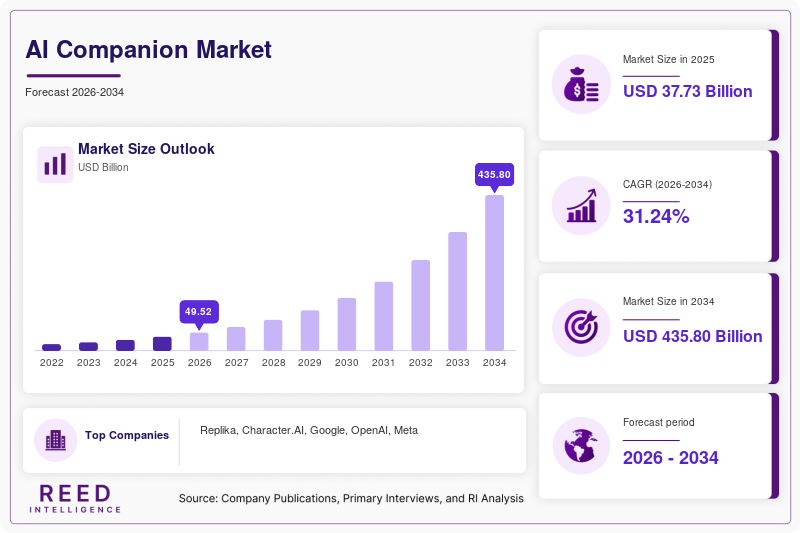
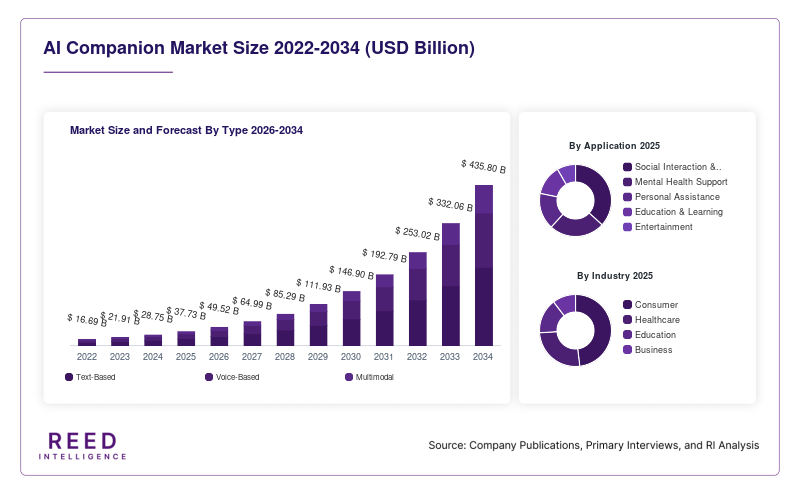
The AI companion market was valued at USD 37.73 billion in 2025 and is projected to grow from USD 49.52 billion in 2026 to USD 435.90 billion by 2034, registering a CAGR of 31.24% during the forecast period from 2026 to 2034.
The AI companion market is moving from basic conversational chatbots toward persistent digital relationships that combine conversation, memory, personalization, voice, multimodal interaction and task support. Products such as Replika position the companion around ongoing personalized conversations, memories and emotional interaction, while Character.AI supports user-created characters and roleplay experiences.
The commercial mechanism is increasingly based on repeated engagement rather than one-time software usage. An AI companion can maintain a continuing interaction history and personalize responses over time, creating opportunities for subscriptions, premium features, voice interaction, digital experiences and other recurring monetization models. Replika, for example, describes its product around persistent personality, memories and personalized interaction.
AI Companion Market Drivers
Persistent Personalization Is Increasing the Commercial Value of AI Companion Relationships
AI companions differ from conventional question-and-answer systems because the product experience can become more personalized through repeated interactions. Replika states that conversations, memories and user feedback contribute to an individualized companion experience, while its service supports different relationship configurations and ongoing interaction.
The market mechanism is recurring engagement. When an AI system remembers preferences, conversation history and interaction patterns, users have a reason to return rather than treating each session as an isolated query. This can support subscription features, premium interaction modes, voice capabilities and personalized digital experiences.
The strongest impact is likely in consumer companionship, entertainment and personal assistance, where repeated interaction is central to perceived value.
The counterbalance is privacy and trust. Greater personalization requires more user data and longer interaction histories, increasing the importance of transparent data practices and user controls.
Voice and Multimodal Interaction Are Expanding AI Companions Beyond Text
AI companion products are increasingly incorporating voice, images and other modalities alongside text. Replika, for example, offers voice calls and AI-generated visual interactions as part of its companion experience.
The market mechanism is increased interaction depth. Voice can make conversations more immediate, while visual capabilities allow companions to participate in activities that are difficult to reproduce through text alone. This broadens the potential use cases from messaging toward entertainment, coaching, learning and daily interaction.
Multimodal systems also create opportunities for premium subscriptions because voice, image generation and higher-capability models require additional computing resources.
However, multimodal interaction increases infrastructure costs and introduces additional safety and privacy challenges. Voice and image features also require stronger controls against impersonation, inappropriate content and misuse.
AI Safety and Personalization Controls Are Becoming Part of the Product Architecture
AI companion providers are investing more heavily in age assurance, content filtering, moderation and differentiated user experiences. Character.AI states that it provides different model behavior and content controls for users under 18 and has introduced age-assurance mechanisms to distinguish age groups.
The market mechanism is two-sided. Stronger controls can increase the ability of platforms to operate at larger user scale and address regulatory or platform requirements, while excessive restrictions can reduce the types of interactions that make companion products attractive.
This makes trust and safety a competitive component rather than simply a compliance expense. Providers that serve children, teenagers, healthcare users or other sensitive populations face particularly strong requirements.
The counterbalance is that implementing moderation, age assurance and safety infrastructure increases operating costs and can constrain product functionality.
AI Companion Market Restraints
Privacy Concerns Increase the Cost of Building Highly Personalized Companions
AI companions depend on interaction data to personalize conversations, memories and recommendations. Character.AI states that it collects information provided by users as well as data generated through interactions and uses such information to operate, improve and personalize its services.
The economic mechanism is a trade-off between personalization and data governance. More persistent user information can improve the companion experience, but it also increases the amount of information that companies must secure, govern and disclose.
This constraint is particularly relevant to healthcare, education and emotionally sensitive applications, where users may disclose highly personal information.
Providers can reduce the constraint through clearer controls, regional privacy compliance, data minimization and transparent retention policies, but these measures can increase technical and operational requirements.
Safety Risks Can Restrict Monetizable Interaction Categories
The same characteristics that make AI companions engaging can create risks when conversations involve minors, emotional dependence, sexual content, self-harm or other sensitive subjects. Character.AI has introduced specific protections for under-18 users and removed open-ended chat for users under 18 in 2025.
The commercial mechanism is direct: restricting certain interaction types can reduce engagement or premium feature availability, while inadequate controls can expose platforms to regulatory, reputational and platform-distribution risks.
Character.AI's continued safety updates in 2026 demonstrate that moderation remains an ongoing product-development requirement rather than a one-time implementation.
AI Companion Market Opportunities
AI Companions Can Expand Into Specialized Personal Assistance and Daily-Life Support
The transition of conventional digital assistants toward generative AI creates an opportunity for companion products to combine emotional interaction with practical assistance. Google has described Gemini as a more personal AI assistant capable of interacting with applications and services used by consumers.
This creates space for products that combine conversational companionship with scheduling, learning, planning, information retrieval and personalized recommendations.
The commercial opportunity is strongest where users want continuity across multiple tasks rather than a collection of disconnected utilities. A companion can potentially serve as a persistent interface through which users access multiple digital services.
Adoption may be limited where consumers prefer conventional task-specific applications or where privacy concerns prevent users from granting AI systems access to personal information.
Specialized Companions Can Extend AI Into Education, Wellness and Professional Use
AI companion technology can be adapted around specific objectives rather than general conversation. Replika describes its product primarily as an empathetic companion rather than a traditional virtual assistant, illustrating the distinction between emotional interaction and task-oriented assistance.
Specialized companions can therefore be designed for learning support, language practice, coaching, elder engagement, entertainment or professional knowledge interaction.
The market mechanism is specialization: a narrowly designed companion can use domain-specific prompts, knowledge, memory and interaction patterns to provide a differentiated experience.
The principal barrier is evidence and trust. Applications involving healthcare, education or vulnerable users require stronger safeguards and may face additional regulatory or institutional requirements.
Type Analysis
By Type
Text-based AI companions account for approximately 43% of the global market in 2025. Text remains the most accessible interaction format because it requires comparatively limited hardware capability and works across smartphones, computers and web platforms. Character.AI's core experience, for example, centers on users interacting with AI-generated characters through conversations.
The format also allows providers to build persistent conversational histories and personalized interaction without requiring continuous voice or visual processing.
Multimodal AI companions account for approximately 27% of the market and represent the fastest-growing type, with an allocated CAGR of approximately 35.20% through 2034. The segment benefits from combining text, voice, images and other interaction modes, increasing the range of activities that can be conducted within a companion experience.
Voice-based companions account for approximately 30% of the market and are projected to grow at approximately 29.60% CAGR. Voice can increase conversational naturalness, although speech-processing costs, privacy concerns and user-environment limitations can affect adoption.
Application Analysis
By Application
Social Interaction & Companionship accounts for approximately 32% of the 2025 market. These applications are built around ongoing conversations, relationship simulation, entertainment and personalized interaction. Replika explicitly positions its product around friendship, emotional connection and personalized relationships, while Character.AI enables users to interact with and create characters.
Personal Assistance accounts for approximately 24% of the market and is projected to grow at approximately 34.10% CAGR, making it the fastest-growing application segment. The expansion reflects the movement of AI systems toward more personal, context-aware assistance and interaction with digital services. Google's Gemini strategy illustrates this broader assistant model.
Mental Health Support accounts for approximately 19% and is projected to grow at approximately 30.80% CAGR.
Education & Learning represents approximately 14% and is projected to grow at approximately 29.40% CAGR, while Entertainment accounts for approximately 11% and is projected to grow at approximately 31.10% CAGR.
Industry Analysis
By Industry
The consumer industry accounts for approximately 62% of the market in 2025. Consumer applications include companionship, entertainment, roleplay, personal assistance and general conversational interaction. Replika's consumer positioning and Character.AI's character-based entertainment model demonstrate the importance of individual users to the market.
Healthcare accounts for approximately 15% of the market and is projected to grow at approximately 34.60% CAGR, making it the fastest-growing industry segment. Potential applications include patient engagement, wellness interaction and non-clinical support, although clinical deployment requires substantially stronger evidence, privacy and safety controls.
Education accounts for approximately 13% and is projected to grow at approximately 31.70% CAGR.
Business applications represent approximately 10% and are projected to grow at approximately 33.00% CAGR, supported by personalized knowledge assistance, employee support and customer-facing conversational experiences.
AI Companion Market Regional Analysis
North America Holds the Largest Share Because Its Consumer AI Ecosystem Supports Early Adoption of Companion Platforms
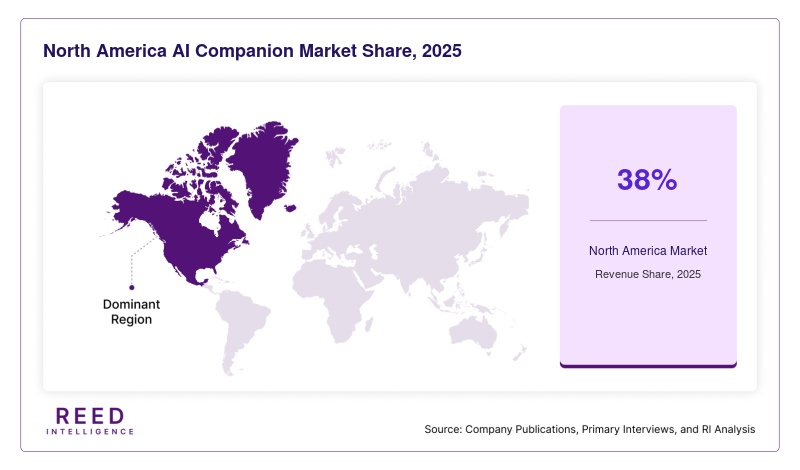
North America accounts for approximately 38% of the global AI companion market in 2025 and is projected to grow at approximately 29.70% CAGR through 2034. The region benefits from a mature consumer technology ecosystem, strong AI infrastructure and the presence of major AI companies and specialized companion platforms.
The competitive environment includes general-purpose AI assistants as well as dedicated companion products. Replika reports users across its global platform, while Character.AI has developed a large user-created character ecosystem.
North American growth is increasingly connected to multimodal interaction, AI entertainment and personal assistance. However, privacy requirements, youth-safety concerns and growing scrutiny of emotionally engaging AI systems can influence product design.
The region's mature digital-payment ecosystem also supports subscription-based monetization, while intense competition places pressure on providers to differentiate through model quality, memory, voice capabilities and safety.
Europe Represents a Significant Market as Privacy and Safety Requirements Shape AI Companion Development
Europe accounts for approximately 26% of the market in 2025 and is projected to grow at approximately 30.20% CAGR through 2034. The region combines high digital adoption with stronger emphasis on privacy, data rights and online safety.
Character.AI's policies specifically distinguish European users in its age and privacy framework, while its privacy disclosures address regional rights and data-processing requirements.
The commercial mechanism is therefore two-sided. Stronger privacy and safety requirements can increase development and compliance costs, but they can also favor platforms capable of demonstrating transparent data practices and effective safeguards.
Demand is expected to concentrate around consumer companionship, education, productivity and entertainment, with deployment shaped by regional requirements governing personal data and online safety.
Asia-Pacific Represents the Fastest-Growing Regional Market as Mobile AI Adoption and Digital Interaction Expand
Asia-Pacific accounts for approximately 22% of the market in 2025 and is projected to grow at approximately 35.40% CAGR through 2034, making it the fastest-growing region. The region combines large mobile-user populations with rapidly expanding AI adoption and diverse digital-entertainment ecosystems.
AI companions can be delivered through mobile applications, messaging environments and voice interfaces, reducing the hardware barrier to adoption. Localization is particularly important because language, cultural expectations and preferred interaction styles differ significantly across Asia-Pacific markets.
The fastest growth is likely to occur in consumer companionship, entertainment, language learning and personal assistance. Multilingual models can expand the addressable user base while voice interfaces can improve accessibility in markets where conversational interaction is more natural than extended text input.
Constraints include varying privacy regulations, platform policies and differences in consumer willingness to pay for AI subscriptions.
Middle East and Africa Develop Through Smartphone-Based AI Interaction and Digital Service Adoption
Middle East and Africa account for approximately 7% of the global market in 2025 and are projected to grow at approximately 32.00% CAGR through 2034. Smartphone-based AI services provide a relatively accessible distribution channel for companion applications, particularly where dedicated hardware is unnecessary.
Potential demand extends across entertainment, education, language assistance and personal interaction. Arabic and other localized language capabilities can become important differentiators because the quality of companion interaction depends heavily on language understanding and culturally appropriate responses.
The principal constraints are differences in disposable income, digital infrastructure and access to advanced AI services across countries. Subscription affordability can therefore influence the conversion of free users into paying customers.
Latin America Represents an Emerging Market as Mobile-First AI Experiences Expand
Latin America accounts for approximately 7% of the market in 2025 and is projected to grow at approximately 31.60% CAGR through 2034. Mobile applications provide a practical distribution route for AI companion services, while Spanish and Portuguese language support allows providers to address large regional user groups.
Consumer entertainment, companionship, education and personal assistance represent important application areas. AI companions can also provide conversational access to information and learning without requiring users to navigate multiple specialized interfaces.
The main limitations are purchasing power, subscription affordability, local data requirements and uneven access to advanced digital infrastructure. Freemium models and lower-cost subscription tiers can therefore influence monetization.
AI Companion Market Competitive Landscape
The competitive structure is divided between dedicated AI companion platforms and large general-purpose AI providers increasingly adding personalized assistant capabilities.
Replika remains a dedicated companion platform centered on persistent relationships, personalization, memories and emotional interaction. Its product includes voice and visual interaction capabilities, allowing it to compete beyond text-based chat.
Character.AI competes through user-created characters, roleplay and an extensive conversational ecosystem. Its competitive position is closely connected to its character-creation model, while its recent product development has placed increasing emphasis on age assurance, moderation and differentiated experiences for younger users.
Key Market Players
AI Companion Market Recent Developments
- September 2026 – Character.AI announced additional safety developments for AI entertainment. The company said it continues to improve safety protocols, technology and models after previously removing open-ended chat for users under 18. The development demonstrates that youth safety and interaction controls remain active components of companion-platform product development.
- 2025 – Google accelerated the transition from Google Assistant toward Gemini on mobile. Google described Gemini as a more personal, AI-powered assistant designed to interact with applications and services while supporting productivity and creativity. The development broadens the competitive overlap between conventional assistants and AI companion-style experiences.
AI Companion Market Segments
By Type
- Text-Based
- Voice-Based
- Multimodal
By Application
- Social Interaction & Companionship
- Mental Health Support
- Personal Assistance
- Education & Learning
- Entertainment
By Industry
- Consumer
- Healthcare
- Education
- Business
By Region
- North America
- Europe
- APAC
- Middle East and Africa
- LATAM