AI Training Dataset Market Size, Share & Trends Analysis Report By Dataset Type (Text, Image, Video, Audio and Multimodal), By Data Source (Publicly Available Data, Proprietary Data, Synthetic Data and Crowdsourced Data), By Application (Computer Vision, Natural Language Processing, Speech Recognition, Generative AI and Others), By End User (Technology Companies, Automotive & Transportation, Healthcare, Financial Services, Retail & E-commerce and Others) and By Region (North America, Europe, Asi
USD 3950
AI Training Dataset Market Size
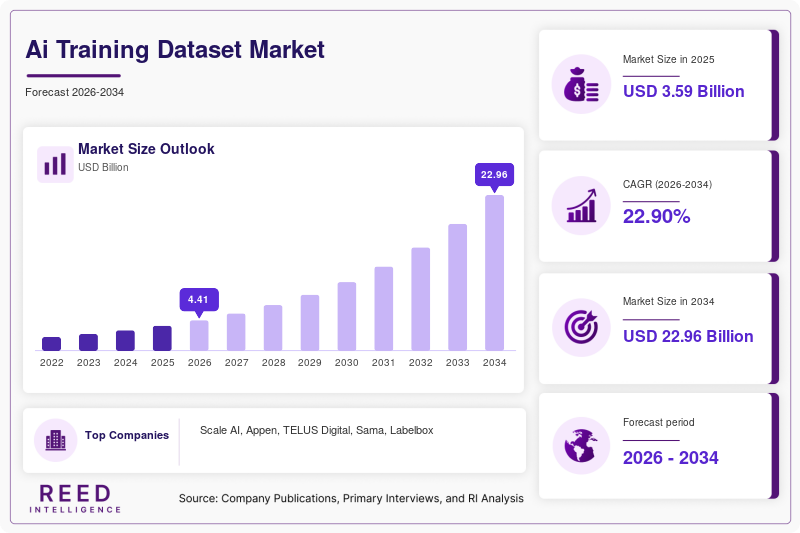
The global AI training dataset market was valued at USD 3.59 billion in 2025 and is projected to grow from USD 4.44 billion in 2026 to USD 22.96 billion by 2034, registering a CAGR of 22.90% during the forecast period from 2026 to 2034.
AI training datasets are structured collections of data used to train, validate and fine-tune artificial intelligence and machine learning models. They include text, images, video, audio, sensor information, transactional data and multimodal datasets, depending on the AI application. The market is expanding rapidly as organizations deploy AI across enterprise software, autonomous systems, healthcare, financial services, retail, manufacturing and customer-facing applications. The growth of generative AI has further increased demand for large, diverse and high-quality datasets capable of supporting foundation models and specialized AI systems.
Dataset providers increasingly differentiate themselves through data quality, annotation accuracy, domain specialization, licensing, privacy compliance, multilingual coverage and synthetic-data generation capabilities. The growing complexity of AI models is also changing dataset requirements. Modern AI systems increasingly require multimodal and domain-specific datasets rather than relying exclusively on generic datasets.
AI Training Dataset Market Drivers
Rapid Expansion of Generative AI
The expansion of generative AI is one of the strongest drivers of the AI training dataset market. Large language models, image-generation systems, video models and multimodal AI require substantial quantities of high-quality training and fine-tuning data.
Organizations are increasingly seeking domain-specific datasets to customize general-purpose models for legal, financial, healthcare, technical and enterprise applications.
This creates demand for curated datasets that provide higher relevance and accuracy than unrestricted internet-scale data.
Increasing Enterprise Adoption of Artificial Intelligence
Businesses across industries are adopting AI for automation, prediction, personalization, fraud detection, customer service, document processing and decision support.
As enterprises deploy AI models for specialized tasks, they require datasets tailored to individual industries and use cases.
This is expanding demand for commercially licensed datasets, annotated data and managed data services.
Growing Demand for High-Quality Annotated Data
Raw data is often unsuitable for supervised machine-learning applications without labeling or annotation.
Image segmentation, object detection, sentiment analysis, speech transcription and entity recognition require accurately labeled training examples.
The increasing importance of model accuracy is therefore encouraging organizations to invest in high-quality annotation and dataset curation.
Increasing Adoption of Synthetic Data
Synthetic data is becoming an important complement to real-world datasets, particularly where data is scarce, expensive to collect or subject to privacy restrictions.
Synthetic datasets can be generated for autonomous driving, robotics, healthcare, financial modeling and other specialized applications.
The ability to generate large volumes of controlled training examples is creating new opportunities for dataset providers and AI infrastructure companies.
AI Training Dataset Market Restraints
Data Privacy and Regulatory Requirements
AI training datasets may contain personally identifiable information, copyrighted content or sensitive business information.
Organizations must therefore manage data collection, processing, storage and licensing carefully.
Privacy regulations and evolving AI governance requirements can increase the cost and complexity of creating commercially usable datasets.
Copyright and Data Licensing Challenges
The use of copyrighted books, articles, images, videos and other digital content for AI training has created significant legal and commercial questions.
Dataset providers increasingly need clear provenance and licensing mechanisms to demonstrate that data can legally be used for model development.
Uncertainty around data rights can slow dataset commercialization and increase legal risk.
High Cost of Dataset Curation
Creating high-quality datasets involves data acquisition, cleaning, deduplication, labeling, validation and quality assurance.
Specialized datasets can be particularly expensive because they may require domain experts to perform annotation.
These costs can limit the ability of smaller organizations to develop proprietary training datasets at scale.
AI Training Dataset Market Opportunities
Multimodal Datasets Create New Growth Opportunities
AI systems are increasingly capable of processing text, images, audio and video simultaneously.
This is creating demand for multimodal datasets that connect different data formats and provide richer contextual information.
Multimodal training data can support applications such as AI assistants, robotics, autonomous vehicles and advanced search systems.
Domain-Specific Datasets Are Gaining Importance
General-purpose datasets are not always sufficient for specialized applications.
Healthcare, finance, legal services, manufacturing and scientific research require datasets containing industry-specific terminology and contextual information.
Providers capable of developing high-quality domain-specific datasets can capture demand from organizations seeking more accurate specialized AI models.
Data Provenance and Licensing Services Offer Opportunities
As organizations become more concerned about copyright and data governance, dataset provenance is becoming increasingly important.
Providers that can document where data originated, how it was processed and what licensing rights apply can offer greater transparency to AI developers.
This is creating opportunities for trusted commercial data marketplaces and dataset-management platforms.
Synthetic Data Supports Privacy-Sensitive Applications
Synthetic data can reduce dependence on sensitive real-world information in selected applications.
Healthcare organizations, financial institutions and other industries can use synthetic datasets to develop and test AI systems while reducing exposure to personal or confidential information.
Dataset Type Segment Analysis
Text Datasets Hold the Largest Share
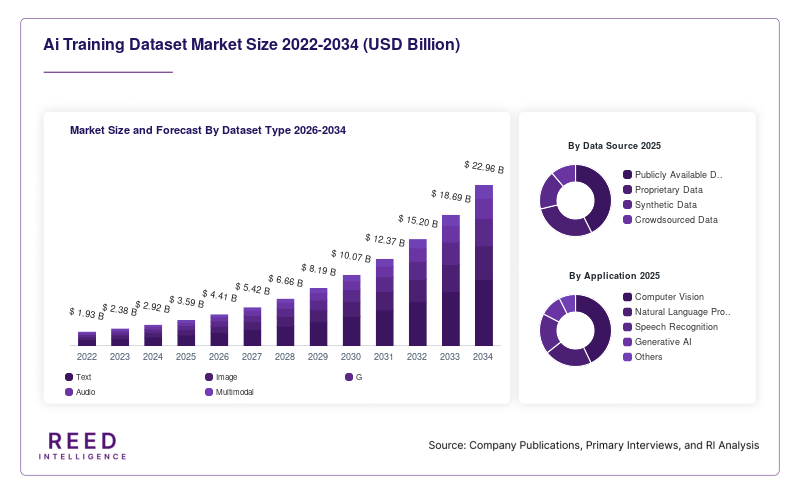
Text datasets accounted for approximately 31% of the AI training dataset market in 2025, making them the largest dataset-type segment. Text remains fundamental to natural language processing, conversational AI, search, document intelligence and large language models.
The expansion of enterprise generative AI applications is supporting continued demand for high-quality multilingual, domain-specific and instruction-tuning datasets.
Multimodal datasets accounted for approximately 17% and are projected to grow at approximately 27.8% CAGR, making them the fastest-growing major dataset type. Increasing adoption of AI systems capable of processing multiple information formats is driving demand for interconnected text, image, audio and video data.
Image datasets represented approximately 24%, video 16%, and audio 12%.
Data Source Segment Analysis
Publicly Available Data Holds the Largest Share
Publicly available data accounted for approximately 34% of the market in 2025, supported by the extensive availability of web content, open datasets, public documents and open-source data resources.
However, the commercial value of publicly available data increasingly depends on quality, provenance, licensing and suitability for specific AI applications.
Synthetic data accounted for approximately 22% and is projected to grow at approximately 30.1% CAGR, making it the fastest-growing major data-source segment. Increasing privacy concerns, data scarcity and the need for controllable training examples are accelerating synthetic-data adoption.
Proprietary data represented approximately 28%, while crowdsourced data accounted for approximately 16%.
Application Segment Analysis
Natural Language Processing Holds the Largest Share
Natural language processing accounted for approximately 29% of the market in 2025, supported by the extensive use of training datasets in language models, conversational systems, search engines, document analysis and text classification.
The expansion of enterprise AI assistants and language-based applications continues to support demand for specialized text datasets.
Generative AI accounted for approximately 25% and is projected to grow at approximately 29.6% CAGR, making it the fastest-growing major application segment. Foundation models require extensive training and fine-tuning data across text, images, audio and video.
Computer vision represented approximately 22%, speech recognition 14%, and other applications approximately 10%.
End-User Segment Analysis
Technology Companies Hold the Largest Share
Technology companies accounted for approximately 42% of the market in 2025, making them the largest end-user segment. AI developers, cloud companies, software providers and model developers require large-scale datasets for training, testing and fine-tuning.
Healthcare accounted for approximately 12% and is projected to grow at approximately 25.8% CAGR, making it the fastest-growing major end-user segment. Increasing use of AI for medical imaging, clinical documentation, drug discovery and healthcare analytics is creating demand for specialized datasets.
Automotive & transportation represented approximately 15%, financial services 11%, retail & e-commerce 10%, and other industries approximately 10%.
AI Training Dataset Market Regional Analysis
North America Holds the Largest Share
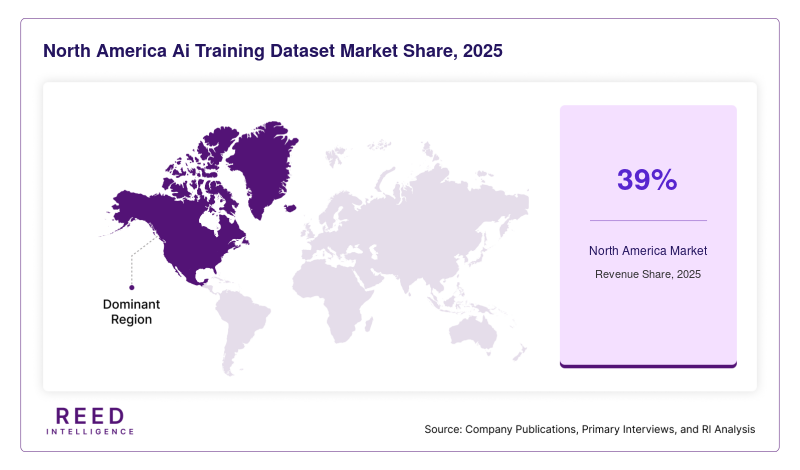
North America accounted for approximately 39% of the global AI training dataset market in 2025, making it the largest regional market. The region benefits from a strong concentration of AI developers, cloud-computing companies, technology startups, research institutions and enterprise AI adopters.
The United States remains a major center for foundation-model development and commercial AI deployment, supporting demand for large-scale and specialized datasets.
Asia-Pacific accounted for approximately 27% and is projected to grow at approximately 26.4% CAGR, making it the fastest-growing major region. Expanding AI investment, growing technology ecosystems, increasing enterprise digitization and demand for multilingual datasets are supporting regional growth.
Europe Maintains Strong Demand for Trusted AI Data
Europe accounted for approximately 24% of the market in 2025 and is projected to grow at approximately 21.5% CAGR.
The region's AI ecosystem, enterprise digitization and increasing emphasis on responsible AI and data governance support demand for compliant, traceable and high-quality datasets.
European organizations are also increasingly interested in domain-specific and multilingual datasets.
Asia-Pacific Is the Fastest-Growing Region
Asia-Pacific is projected to grow at approximately 26.4% CAGR through 2034. The region combines rapidly expanding AI adoption with large volumes of multilingual and multimodal data.
China, Japan, India, South Korea and Southeast Asian markets are investing in AI infrastructure, enterprise applications and domestic model development.
The region's large consumer and industrial data environments also create opportunities for localized training datasets.
Latin America Shows Increasing AI Data Demand
Latin America accounted for approximately 6% of the market in 2025 and is projected to grow at approximately 21.8% CAGR.
Increasing adoption of AI in financial services, retail, telecommunications and customer-service applications is supporting demand for localized Spanish- and Portuguese-language datasets.
Middle East & Africa Represents an Emerging Opportunity
Middle East & Africa accounted for approximately 4% of the market in 2025 and is projected to grow at approximately 23.2% CAGR.
Government-led digital-transformation programs, AI investments and growing enterprise adoption are creating demand for region-specific datasets, particularly Arabic-language and industry-specific data.
AI Training Dataset Market Competitive Landscape
Competition in the AI training dataset market is based on data quality, scale, licensing rights, annotation accuracy, domain expertise, data provenance, privacy compliance, multilingual coverage and dataset freshness.
Companies are increasingly investing in synthetic data, data marketplaces, automated annotation, specialized datasets and provenance technologies.
Key Market Players
- Scale AI
- Appen
- TELUS Digital
- Sama
- Labelbox
- Surge AI
- Defined.ai
- Amazon Web Services
- Microsoft
AI Training Dataset Market Recent Developments
- Scale AI has continued expanding its data services for advanced AI and generative AI model development. Its offerings include data labeling, evaluation and human-feedback capabilities designed to support increasingly sophisticated AI systems. The development reflects the industry's shift from basic annotation toward higher-quality training, evaluation and reinforcement data.
- Appen continues to provide training-data services covering language, speech, image, video and other AI applications. The company's focus on multilingual data and human annotation supports the growing need for localized datasets as AI systems expand into new markets and languages.
Ai Training Dataset Market Segments
By Dataset Type
- Text
- Image
- G
- Audio
- Multimodal
By Data Source
- Publicly Available Data
- Proprietary Data
- Synthetic Data
- Crowdsourced Data
By Application
- Computer Vision
- Natural Language Processing
- Speech Recognition
- Generative AI
- Others
By End User
- Technology Companies
- Automotive & Transportation
- Healthcare
- Financial Services
- Retail & E-commerce
- Others
By Region
- North America
- Europe
- APAC
- Middle East and Africa
- LATAM