Audio Market Size, Share & Trends Analysis Report By Product Type (Headphones & Earphones, Home Audio Systems, Professional Audio Equipment, Portable Speakers, Smart Speakers), By Technology (Wireless, Wired), By Application (Consumer, Automotive, Commercial, Professional), By Distribution Channel (Online, Offline) and By Region (North America, Europe, Asia-Pacific, Latin America, Middle East & Africa) Forecasts, 2026–2034
USD 3950
Audio Market Size
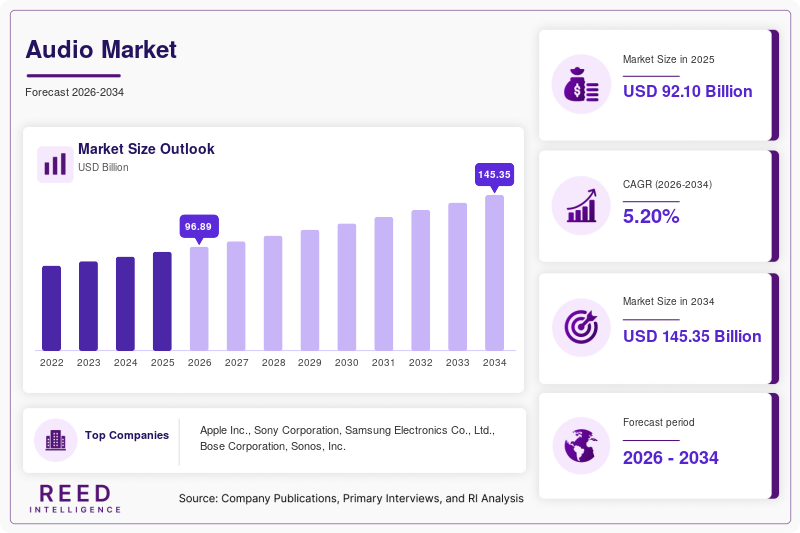
The global audio market was valued at USD 92.10 billion in 2025 and is projected to grow from USD 95.40 billion in 2026 to USD 143.30 billion by 2034, registering a CAGR of 5.20% during the forecast period from 2026 to 2034.
The audio market is shifting from standalone sound-reproduction equipment toward connected personal, home, automotive, professional and assistive audio ecosystems. Wireless headphones and earbuds, networked speakers, soundbars, automotive audio systems and professional equipment increasingly combine acoustic hardware with software, connectivity and intelligent processing. Bluetooth SIG identifies wireless audio as a major Bluetooth solution area and describes LE Audio as the next generation of Bluetooth audio, adding lower-power operation, improved performance, hearing-aid support and Auracast broadcast audio.
The most important demand change is the continued migration from wired to wireless listening. Consumers increasingly expect compact devices to provide active noise cancellation, spatial audio, voice interaction and seamless smartphone integration. Apple, for example, introduced AirPods 4 with active noise cancellation and expanded AirPods Pro 2 with hearing-test and hearing-aid capabilities in 2024, demonstrating how premium personal-audio products are adding functions beyond conventional playback.
Audio Market Drivers
Wireless Connectivity Is Expanding the Addressable Personal-audio market
Wireless connectivity is changing purchasing behavior by eliminating the physical connection between smartphones and listening devices while enabling additional software-driven features. Bluetooth LE Audio provides a lower-power architecture and supports applications including hearing aids and Auracast broadcast audio.
The market mechanism extends beyond replacing wired headphones. Wireless products can incorporate active noise cancellation, spatial audio, multipoint connectivity, voice assistants and health-related functions, allowing manufacturers to differentiate products through software and signal processing.
Apple's recent AirPods portfolio illustrates this transition. AirPods 4 introduced ANC, while AirPods Pro 2 added hearing-test and hearing-aid functionality, turning a conventional listening accessory into a multifunctional personal device.
The effect is strongest in headphones and earbuds, portable speakers and connected home audio. Battery life, device compatibility and pricing remain counterbalances, particularly in value-oriented markets.
Premium Audio Devices Are Adding Software-Enabled Features
Audio manufacturers are increasingly competing through computational audio rather than only through speakers, drivers and amplifiers. Spatial audio, adaptive noise cancellation, personalization, voice processing and hearing-related functions create additional reasons for consumers to upgrade.
Apple's AirPods Pro 2 hearing-health functionality illustrates this change: the product combines acoustic hardware, microphones, software processing and regulated health features. Apple stated that its Hearing Test and Hearing Aid functions were designed for users with mild to moderate hearing loss and required regulatory authorization in applicable markets.
The commercial mechanism is higher functionality per device. Manufacturers can create premium price tiers by integrating multiple use cases into one product, while software updates can extend product capabilities after purchase.
The limitation is increasing regulatory and technical complexity when audio products move into health-related applications.
Auracast Is Creating New Public and Commercial Audio Use Cases
Auracast expands Bluetooth audio from one-to-one connections toward broadcast communication. Bluetooth SIG describes the technology as enabling a transmitter to send audio to an unlimited number of nearby compatible receivers, including earbuds, speakers and hearing devices.
This creates applications in theaters, museums, universities, stadiums, transportation facilities and other public environments. Bluetooth SIG reports that Auracast infrastructure is already being deployed in locations including theaters, universities, churches, museums and stadiums.
The commercial mechanism is the creation of an additional equipment category involving transmitters, receivers and venue infrastructure. It also links consumer audio with accessibility requirements.
Adoption depends on compatible devices, venue investment and the replacement cycle of existing assistive-listening infrastructure.
Audio Market Restraints
Short Product Cycles Increase Replacement Pressure and Cost Sensitivity
Rapid product launches in headphones, earbuds, speakers and connected audio devices can shorten perceived product lifecycles. Consumers increasingly compare products based on battery performance, wireless standards, software functionality and ecosystem compatibility rather than only sound reproduction.
This creates pressure on manufacturers to continuously invest in product development, acoustic engineering and software integration. It also increases inventory and component-management risks when new generations are introduced quickly.
Premium brands can offset some of the pressure through differentiated features, while lower-priced manufacturers compete primarily through cost and specifications. Consequently, the market remains exposed to consumer spending conditions and discretionary electronics budgets.
Fragmented Standards and Ecosystems Complicate Interoperability
Audio products increasingly operate across Bluetooth, Wi-Fi, proprietary wireless technologies, mobile operating systems and streaming platforms. While standards such as Bluetooth LE Audio are designed to improve interoperability, implementation still depends on device capabilities and manufacturer strategies.
Auracast illustrates the transition: Bluetooth SIG states that products require specific LE Audio capabilities and that existing-device upgradeability depends on underlying hardware and supplier strategy.
The commercial consequence is additional development and certification complexity. Consumers may also delay purchases when compatibility between new features and existing devices is unclear.
Audio Market Opportunities
Hearing-Enabled Consumer Audio Creates a New Product Category
The integration of hearing-health functions into mainstream earbuds creates an opportunity at the intersection of consumer electronics and assistive listening. Apple's AirPods Pro 2 introduced Hearing Test and Hearing Aid capabilities, while Bluetooth LE Audio provides a standards-based foundation for hearing-aid connectivity.
The commercial opportunity comes from using a familiar consumer device for multiple daily activities rather than requiring separate hardware for listening and certain hearing-support functions.
The opportunity is particularly relevant to premium earbuds, hearing devices, smartphones and audio-processing software. Regulatory approval, clinical requirements and regional feature availability can constrain adoption.
Public-Space Broadcast Audio Can Expand Professional Audio Demand
Auracast creates a potential infrastructure market for venues that need accessible and personalized audio. Bluetooth SIG identifies applications including public broadcasting and assistive listening, while its current materials cite deployments in museums, stadiums, universities, churches and theaters.
Venue operators can use broadcast audio for guided tours, presentations, entertainment and accessibility without requiring each listener to use a dedicated proprietary receiver.
The opportunity therefore extends beyond consumer headphones into professional audio transmitters, installation services and venue-management systems. Adoption remains dependent on the installed base of compatible receivers and venue investment cycles.
Product Type Analysis
By Product Type
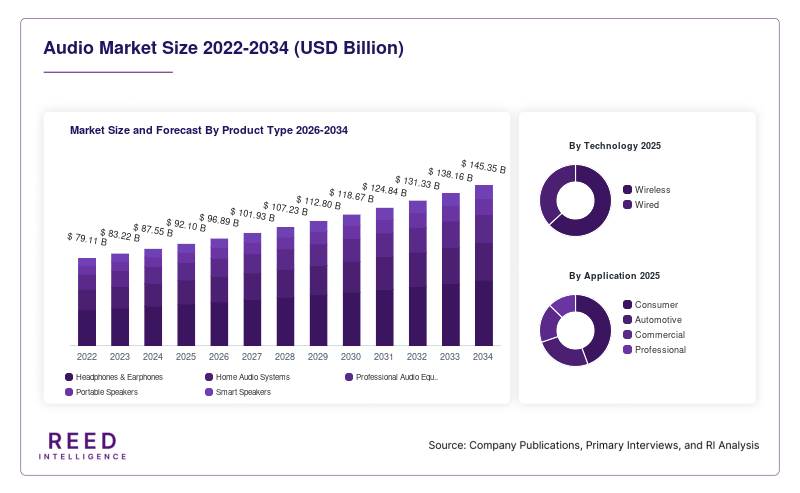
Headphones & Earphones accounted for approximately 42% of the product-type segment in 2025. Personal audio benefits from frequent daily usage, smartphone integration and rapid feature development. Wireless earbuds and headphones increasingly combine ANC, microphones, spatial audio, voice interaction and health-related functionality.
Apple's recent AirPods launches demonstrate the movement toward multifunctional personal audio, while Bluetooth LE Audio provides a technology foundation for lower-power wireless listening and hearing applications.
The recurring replacement cycle of personal audio devices supports demand as consumers seek improved battery life, comfort, sound quality and connectivity.
The segment's main risks include intense price competition, battery degradation and limited differentiation among lower-priced products.
Smart Speakers accounted for approximately 13% of the product-type segment in 2025 and are projected to grow at approximately 7.1% CAGR through 2034. Their expansion is linked to voice interfaces, smart-home control, streaming services and multi-room audio.
The product increasingly serves as an interface between consumers and connected home ecosystems rather than simply reproducing music.
Home Audio Systems represented approximately 21% of the product segment in 2025 and are projected to grow at approximately 4.7% CAGR, while Professional Audio Equipment represented approximately 15% and is projected to grow at approximately 5.4% CAGR. Portable Speakers represented approximately 9% and are projected to grow at approximately 6.3% CAGR.
Technology Analysis
By Technology
Wireless audio accounted for approximately 69% of the technology segment in 2025. Bluetooth connectivity, smartphone integration and the elimination of cables have made wireless devices the principal format for personal audio.
Bluetooth SIG continues to expand LE Audio capabilities, while its 2025 update highlighted wider deployment of Auracast and LE Audio applications.
Wireless technology is projected to grow at approximately 6.4% CAGR through 2034, compared with approximately 2.8% CAGR for wired audio.
Wired equipment retains demand where reliability, low latency, professional monitoring and high-fidelity connections are important. Professional studios, live sound and certain audiophile applications therefore continue to provide a stable wired-audio base.
Application Analysis
By Application
Consumer applications accounted for approximately 54% of the application segment in 2025. Demand is supported by smartphones, streaming entertainment, gaming, home theater and personal listening.
The consumer segment is also where wireless connectivity and computational audio are most rapidly incorporated into mainstream products.
Automotive audio accounted for approximately 19% of the application segment in 2025 and is projected to grow at approximately 6.8% CAGR through 2034.
Modern vehicles increasingly incorporate multi-speaker systems, immersive sound, voice interfaces and connected infotainment. Audio therefore becomes part of the vehicle's broader digital experience rather than a standalone radio component.
Commercial applications represented approximately 16% and are projected to grow at approximately 5.2% CAGR, while Professional applications represented approximately 11% and are projected to grow at approximately 4.8% CAGR.
Audio Market Regional Analysis
North America Represents the Largest Regional Market
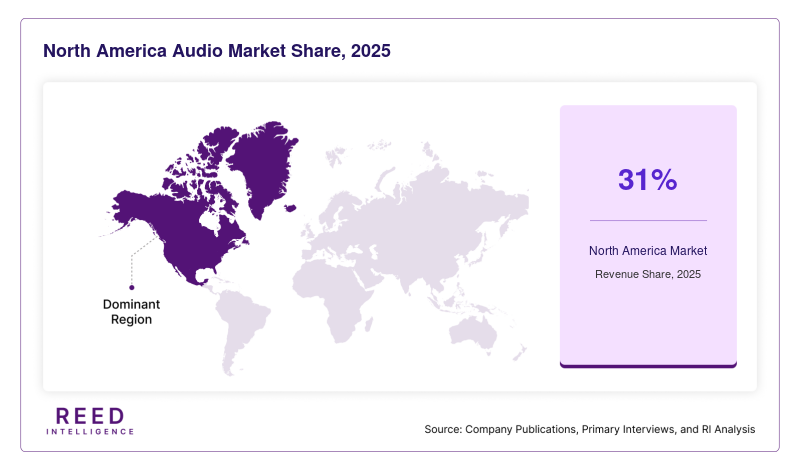
North America accounted for approximately 31% of global revenue in 2025. The region benefits from high consumer-electronics adoption, established premium audio brands, strong streaming consumption and demand for connected home and personal devices.
The United States is the principal market, supported by high adoption of wireless headphones, smart speakers, home-theater equipment and professional audio systems.
The region is also an important launch market for premium audio innovation. Apple's 2024 introduction of AirPods 4 and expanded hearing-health functions for AirPods Pro 2 demonstrates the importance of North America for premium personal-audio products.
Auracast is creating an additional commercial pathway through accessibility and public-venue applications. Bluetooth SIG identifies theaters, universities, museums and stadiums among the locations where Auracast deployments are emerging.
The primary constraints are market maturity, replacement-cycle variability and intense competition among established consumer-electronics brands.
Asia-Pacific Is the Fastest-Growing Regional Market
Asia-Pacific accounted for approximately 29% of global revenue in 2025 and is projected to grow at approximately 6.4% CAGR through 2034. The region combines large consumer populations with extensive electronics manufacturing capabilities, rising disposable incomes and increasing adoption of smartphones and wireless devices.
China, Japan, South Korea and India are important markets, while Southeast Asia provides additional consumer-electronics demand.
The region also has strategic importance in the audio value chain because major electronics manufacturers, component suppliers and device-assembly operations are concentrated across Asian markets.
Bluetooth SIG reported in its 2026 review that Samsung and other technology companies expanded LE Audio and Auracast capabilities across smartphones and tablets, supporting wider ecosystem development.
Price sensitivity and intense local competition remain constraints, particularly in mass-market headphones and speakers.
Europe Maintains a Strong Market for Premium and Professional Audio
Europe accounted for approximately 24% of global revenue in 2025 and is projected to grow at approximately 4.8% CAGR through 2034. Demand is supported by premium consumer electronics, professional audio, automotive sound systems and public-sector accessibility applications.
Germany, the United Kingdom, France and Italy are important markets, with established automotive, consumer-electronics and professional-audio industries.
Auracast also creates opportunities in public venues and assistive listening. Bluetooth SIG highlights the technology's application to museums, theaters and other public environments.
Europe's mature consumer-electronics market means replacement and premiumization are more important than first-time adoption. Regulatory requirements and higher product standards can also increase development costs.
Latin America Is Expanding Through Consumer Electronics Adoption
Latin America accounted for approximately 10% of global revenue in 2025 and is projected to grow at approximately 5.3% CAGR through 2034. Brazil and Mexico represent the principal markets, supported by smartphone adoption, streaming entertainment and increasing use of wireless personal audio.
Affordable earbuds, portable speakers and entry-level home audio systems are important demand categories because they provide relatively accessible upgrades to consumers entering connected audio.
The main constraints are currency fluctuations, import costs and uneven purchasing power, which can shift demand toward lower-priced products and extend replacement cycles.
Middle East & Africa Represents an Emerging audio market
Middle East & Africa accounted for approximately 6% of global revenue in 2025 and is projected to grow at approximately 5.8% CAGR through 2034. Demand is concentrated in higher-income markets such as the United Arab Emirates and Saudi Arabia, while South Africa provides an important market in the broader African region.
Hospitality, commercial installations, entertainment venues and premium consumer electronics support demand for professional and connected audio equipment.
Auracast could create additional applications in public venues because the technology is designed for broadcast audio and assistive listening.
Infrastructure differences and lower consumer purchasing power in several markets remain constraints.
Audio Market Competitive Landscape
Competition in the audio market is divided across consumer electronics, premium personal audio, home audio, professional equipment, automotive systems and component technologies. Competitive differentiation increasingly depends on wireless connectivity, acoustic engineering, software, ecosystem integration, battery performance, ANC, spatial audio and intelligent processing.
Apple competes through tightly integrated personal audio hardware and software. Its AirPods portfolio increasingly combines listening, noise management and hearing-related functions, increasing the functional scope of premium earbuds.
Sony maintains exposure across headphones, portable audio, home entertainment and professional products. Its participation in the Bluetooth ecosystem is also relevant to emerging Auracast applications.
Key Market Players
- Apple Inc.
- Sony Corporation
- Samsung Electronics Co., Ltd.
- Bose Corporation
- Sonos, Inc.
- Sennheiser electronic GmbH & Co. KG
- Audio-Technica Corporation
- Shure Incorporated
- Harman International Industries
- JBL
- LG Electronics
- Panasonic Holdings Corporation
- Yamaha Corporation
- Bang & Olufsen
- Marshall Group
Audio Market Recent Developments
- Bluetooth SIG currently identifies Auracast deployments across theaters, universities, churches, museums and stadiums, demonstrating that the technology is moving beyond laboratory demonstrations toward venue-level applications. The development creates potential demand for professional transmitters, installation services, compatible receivers and accessibility-oriented audio infrastructure.
- Bluetooth SIG's 2026 review reported that Sony considers Auracast important for public spaces and that several Sony products already support the technology. The company highlighted applications associated with accessibility and venue experiences. The development increases the relevance of Auracast to established consumer and professional audio manufacturers and provides a pathway for compatible receivers to become part of mainstream audio portfolios.
Audio Market Segments
By Product Type
- Headphones & Earphones
- Home Audio Systems
- Professional Audio Equipment
- Portable Speakers
- Smart Speakers
By Technology
- Wireless
- Wired
By Application
- Consumer
- Automotive
- Commercial
- Professional
By Distribution Channel
- Online
- Offline
By Region
- North America
- Europe
- APAC
- Middle East and Africa
- LATAM