Air Starters Market Size, Share & Trends Analysis Report By Type (Vane-Type Air Starters, Turbine-Type Air Starters and Radial Vane Air Starters), By Application (Aircraft Engines, Helicopter Engines, Industrial Engines, Marine Engines and Others), By Pressure (Low Pressure, Medium Pressure and High Pressure), By End User (Aerospace & Defense, Industrial, Marine and Others) and By Region (North America, Europe, Asia-Pacific, Latin America, Middle East & Africa) Forecasts, 2026–2034
USD 3950
Air Starters Market Size
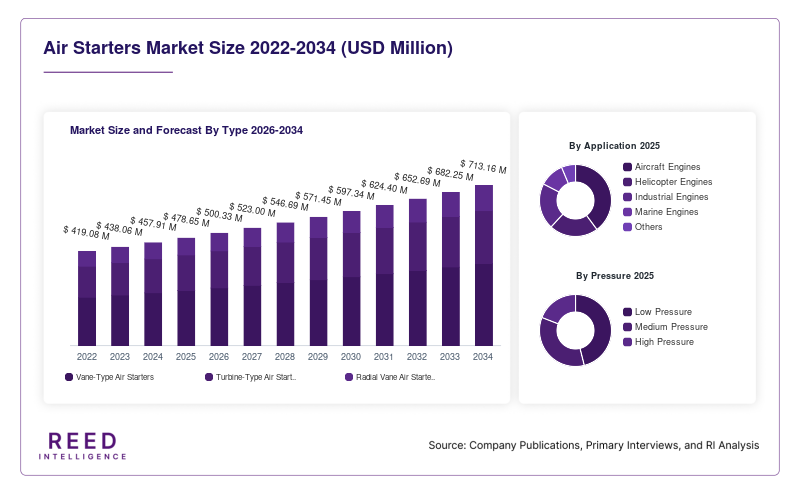
The global air starters market was valued at USD 478.65 million in 2025 and is projected to grow from USD 500.35 million in 2026 to USD 713.41 million by 2034, registering a CAGR of 4.53% during the forecast period from 2026 to 2034.
Air starters are pneumatic starting systems used to initiate rotation of engines and other heavy-duty machinery without relying on conventional electric starter motors. They use compressed air to drive a turbine, vane motor or other starting mechanism, providing high starting torque while reducing reliance on large electrical systems.
The market is closely associated with commercial and military aviation, helicopters, industrial gas turbines, marine propulsion systems and heavy-duty industrial equipment. Aerospace applications represent an important demand center because air starters can provide reliable engine starting while minimizing electrical-system weight.

Air Starters Market Drivers
Increasing Aircraft Production Supports Demand
Growth in commercial aviation and military aircraft production supports demand for engine-starting equipment, including pneumatic air starters.
Aircraft manufacturers require reliable starting systems capable of operating consistently under demanding temperature, vibration and pressure conditions. New aircraft programs therefore create opportunities for air-starter manufacturers supplying engines and auxiliary systems.
Fleet expansion and replacement of older aircraft also contribute to demand for starter components through both original equipment and aftermarket channels.
High Starting Torque Drives Pneumatic Starter Adoption
Air starters can provide high torque relative to their size and weight, making them suitable for applications where engines require substantial starting power.
This is particularly valuable for aircraft engines, industrial turbines and marine propulsion systems.
Pneumatic systems can also be advantageous in environments where conventional electrical starting systems may face limitations related to power requirements, ignition risk or operating conditions.
Growing Focus on Lightweight Aerospace Systems
Weight reduction remains an important objective in aircraft design.
Pneumatic starting systems can provide an alternative to heavy electrical starter arrangements in selected aircraft architectures. Reducing starter-system weight can contribute to broader aircraft efficiency objectives.
This supports continued demand for compact and high-performance air starters in aerospace applications.
Expansion of Industrial and Marine Equipment
Air starters are also used in industrial engines, compressors, pumps, generators and marine propulsion systems.
Industrial facilities often require reliable starting systems for large engines operating in demanding environments.
The expansion of industrial infrastructure and marine equipment creates additional opportunities beyond aerospace applications.
Air Starters Market Restraints
Increasing Electrification of Aircraft Systems
Aircraft manufacturers are increasingly adopting more-electric architectures.
The development of advanced electric starter-generators and integrated electrical systems could reduce the addressable market for traditional pneumatic starting systems in certain aircraft applications.
This creates a long-term technology transition challenge for air-starter manufacturers.
Dependence on Compressed-Air Infrastructure
Pneumatic starting systems require a suitable compressed-air source.
In some applications, maintaining air reservoirs, compressors and associated pneumatic infrastructure can increase system complexity.
Where electrical starting systems can provide adequate performance without dedicated pneumatic infrastructure, customers may prefer alternative technologies.
High Reliability and Certification Requirements
Aerospace air starters must operate reliably under extreme vibration, temperature and pressure conditions.
Products used on aircraft engines must meet stringent qualification and certification requirements, increasing development costs and lengthening product-validation cycles.
Air Starters Market Opportunities
Growth of Aircraft MRO Creates Aftermarket Opportunities
The expanding global aircraft fleet creates recurring demand for maintenance, repair and overhaul services.
Air starters are subject to inspection, repair and replacement during aircraft maintenance cycles.
The aftermarket therefore provides opportunities for manufacturers and specialized service providers to generate recurring revenue from installed starter systems.
Advanced Turbine Air Starters Offer Efficiency Improvements
Manufacturers are developing more efficient and compact air-starter designs capable of providing high starting torque with lower weight and improved operating characteristics.
Improvements in turbine efficiency, materials and manufacturing can help air starters remain competitive in demanding applications.
Military Aviation Supports Specialized Demand
Military aircraft require reliable engine-starting systems capable of operating in diverse and demanding environments.
New fighter aircraft, transport aircraft, helicopters and unmanned systems can create opportunities for specialized starter technologies.
Defense programs can also generate long-term supply and maintenance contracts.
Industrial Applications Provide Market Diversification
Industrial gas turbines, generators, compressors and other heavy-duty machinery require reliable starting systems.
Air starters can be particularly attractive for applications where high starting torque and reliable operation are required.
This allows manufacturers to diversify beyond the commercial aviation market.
Type Segment Analysis
Vane-Type Air Starters Hold the Largest Share
Vane-type air starters accounted for approximately 46% of the global air starters market in 2025, making them the largest type segment. Their established technology, compact design and ability to deliver reliable starting torque support widespread use in aerospace and industrial applications.
Vane starters can provide dependable performance across a range of engine-starting requirements and have an established installed base.
Turbine-type air starters accounted for approximately 36% and are projected to grow at approximately 5.3% CAGR, making them the fastest-growing major type segment. Turbine starters can provide high starting efficiency and favorable power-to-weight characteristics, supporting their use in newer and demanding applications.
Radial vane air starters represented approximately 18% of the market.
Application Segment Analysis
Aircraft Engines Hold the Largest Share
Aircraft engines accounted for approximately 48% of the market in 2025, making them the largest application segment. Air starters are used to initiate engine rotation before fuel and combustion systems take over the engine-starting process.
Commercial and military aircraft programs therefore represent an important source of demand.
Industrial engines accounted for approximately 19% and are projected to grow at approximately 5.1% CAGR, making them the fastest-growing major application segment. Demand is supported by industrial machinery, generators, compressors and other heavy-duty equipment requiring reliable starting systems.
Helicopter engines represented approximately 15%, marine engines 12%, and other applications approximately 6%.
Pressure Segment Analysis
Medium Pressure Holds the Largest Share
Medium-pressure air starters accounted for approximately 43% of the market in 2025, making them the largest pressure segment. They provide a balance between starting capability, equipment requirements and operating efficiency across a broad range of applications.
High-pressure air starters accounted for approximately 31% and are projected to grow at approximately 5.4% CAGR, making them the fastest-growing major pressure segment. High-pressure systems are suitable for applications requiring greater starting power and demanding engine-starting conditions.
Low-pressure systems represented approximately 26%.
End-User Segment Analysis
Aerospace & Defense Holds the Largest Share
Aerospace & defense accounted for approximately 52% of the market in 2025, making it the largest end-user segment. Air starters remain important in aircraft engine applications because of their high starting torque and suitability for weight-sensitive systems.
Industrial end users accounted for approximately 25% and are projected to grow at approximately 5.2% CAGR, making them the fastest-growing major end-user segment. Industrial gas turbines, generators, compressors and heavy-duty engines continue to require reliable starting technologies.
Marine applications represented approximately 16%, while other end users accounted for approximately 7%.
Air Starters Market Regional Analysis
North America Holds the Largest Share
North America accounted for approximately 38% of the global air starters market in 2025, making it the largest regional market. The region benefits from a substantial aerospace manufacturing base, defense aviation programs, industrial equipment production and a large aircraft MRO ecosystem.
The United States remains a major center for aircraft-engine manufacturing, defense aviation and industrial turbine applications.
Asia-Pacific accounted for approximately 24% and is projected to grow at approximately 6.0% CAGR, making it the fastest-growing major region. Increasing aircraft production, commercial fleet expansion, industrial infrastructure development and defense modernization are supporting regional demand.
Europe Maintains a Strong Aerospace Base
Europe accounted for approximately 29% of the market in 2025 and is projected to grow at approximately 4.2% CAGR.
The region has a well-developed aerospace and defense industry, alongside established marine and industrial-engine markets.
Aircraft manufacturing and MRO activities provide continuing demand for air-starter systems and replacement components.
Asia-Pacific Is the Fastest-Growing Region
Asia-Pacific is projected to grow at approximately 6.0% CAGR through 2034. Commercial aviation expansion is increasing aircraft fleet requirements, while regional aerospace manufacturing capabilities are developing.
China, India, Japan, South Korea and Southeast Asian economies are also investing in industrial infrastructure and defense aviation.
These developments support demand for both original-equipment and aftermarket air-starter systems.
Latin America Shows Moderate Growth
Latin America accounted for approximately 5% of the market in 2025 and is projected to grow at approximately 3.9% CAGR.
Commercial aviation, industrial equipment and marine activities provide demand for engine-starting systems. MRO activity also creates opportunities for replacement and repair services.
Middle East & Africa Represents an Emerging Market
Middle East & Africa accounted for approximately 4% of the market in 2025 and is projected to grow at approximately 4.8% CAGR.
The region's aviation, oil and gas, industrial and marine sectors provide opportunities for pneumatic engine-starting systems.

Air Starters Market Competitive Landscape
Competition in the air starters market is based on starting performance, reliability, power-to-weight ratio, operating pressure, durability, certification, customization capabilities and aftermarket support.
Leading manufacturers are focusing on lightweight designs, improved turbine efficiency, advanced materials and starter systems capable of meeting increasingly demanding aerospace and industrial requirements.
Key Market Players
- Honeywell International Inc.
- Safran
- Collins Aerospace
- Parker Hannifin Corporation
- Ingersoll Rand
- Aero Engine Corporation
- GALI International
- Champion Aerospace
- Kinetics
- Turbomeca
Air Starters Market Recent Developments
- Honeywell continues to develop aircraft power-management and engine-related technologies as aerospace manufacturers seek improved electrical and pneumatic system performance. The increasing integration of aircraft systems is encouraging suppliers to develop lighter and more efficient equipment capable of supporting modern aircraft architectures.
- Safran continues to develop electrical and power systems for next-generation aircraft, including technologies associated with more-electric aircraft architectures. While electrification can create competitive pressure for traditional pneumatic starters, it also encourages development of advanced starting and power-management solutions capable of integrating with evolving aircraft systems.
Air Starters Market Segments
By Type
- Vane-Type Air Starters
- Turbine-Type Air Starters
- Radial Vane Air Starters
By Application
- Aircraft Engines
- Helicopter Engines
- Industrial Engines
- Marine Engines
- Others
By Pressure
- Low Pressure
- Medium Pressure
- High Pressure
By End User
- Aerospace & Defense
- Industrial
- Marine
- Others
By Region
- North America
- Europe
- APAC
- Middle East and Africa
- LATAM