B2B Information Services Market Size, Share & Trends Analysis Report By Service Type (Business Information & Company Data, Market Intelligence, Credit & Risk Information, Sales & Marketing Intelligence, Industry & Financial Information), By Enterprise Size (Large Enterprises, SMEs), By Application (Risk Management, Sales & Marketing, Procurement & Supply Chain, Financial Analysis, Compliance & Regulatory, Strategy & Research), By End User (Financial Services, Manufacturing, Retail & E-commerce,
USD 3950
B2B Information Services Market Size
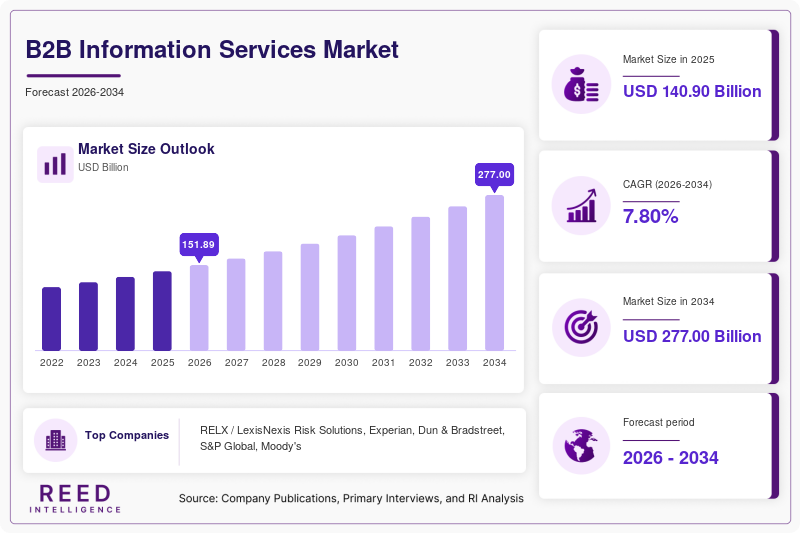
The b2b information services market was valued at USD 140.90 billion in 2025 and is estimated to reach USD 151.89 billion in 2026. The market is projected to reach USD 277.00 billion by 2034, registering a CAGR of 7.80% during 2026–2034.
B2B information services are shifting from static databases and conventional business directories toward subscription-based platforms that combine company information, financial data, risk indicators, market intelligence, sales intelligence and analytics. The commercial value increasingly comes from converting large datasets into decision-support tools rather than simply providing access to information.
This change is visible among major information providers. RELX describes its Risk business as combining public and industry-specific content with technology and algorithms to help customers evaluate risk and improve operational efficiency. Its 2025 Risk revenue reached GBP 3.485 billion, with underlying growth of 8%, while the company highlighted AI-enabled analytics and decision tools as a source of growth.
B2B Information Services Market Drivers
AI Converts Business Databases Into Higher-Value Decision Tools
AI is changing the commercial role of B2B information platforms by allowing providers to extract patterns, summarize records and generate decision-support outputs from large proprietary datasets. RELX states that its Risk business uses extractive AI and machine learning to generate actionable insights and improve decision-making, while its broader portfolio is incorporating additional AI functionality into products.
The market mechanism is a shift from selling access to information toward selling workflow outcomes. Customers can use automated analysis for risk screening, fraud detection, research, prospect identification and compliance activities.
This supports higher-value subscriptions among financial institutions, insurers, corporations and professional-services firms. The counterbalance is that AI output remains dependent on the quality, legality and completeness of underlying data.
Growing Business Risk Complexity Increases Demand for Verified Company Information
Companies increasingly need to evaluate customers, suppliers, counterparties and transactions before entering or continuing commercial relationships. Business information platforms address this requirement through company profiles, financial information, ownership data, risk indicators and compliance-related datasets.
RELX reports continued demand for financial-crime compliance and digital fraud-and-identity solutions within its Risk business, while its 2025 annual report describes the use of data and analytics to help customers make risk-adjusted decisions.
The market mechanism is recurring information consumption: customers need updated information because company ownership, financial conditions, sanctions exposure and business relationships can change over time. Data freshness therefore becomes an important competitive attribute.
Subscription-Based Information Tools Embed Data Into Recurring Business Workflows
B2B information providers increasingly deliver information through subscription or transactional models rather than one-time reports. RELX states that its Risk products are sold directly to clients through subscription or transactional pricing, supported by partner distribution.
The commercial mechanism is recurring use. Once information services are integrated into credit decisions, compliance screening, sales prospecting or research workflows, customers have a continuing need for updated datasets.
This increases the value of data platforms that provide APIs, workflow integrations and automated alerts. However, customers can reduce spending when information is duplicative, poorly integrated or insufficiently differentiated from competing databases.
B2B Information Services Market Restraints
Data Privacy Regulation Constrains the Collection and Monetization of Business Information
B2B information providers frequently process information connected to companies, individuals, transactions and commercial relationships. Regulatory changes affecting the collection and use of personal data can therefore alter what information providers are permitted to collect, combine or commercialize.
RELX explicitly identifies changes in laws and regulations affecting personal-data collection and use as a principal business risk.
The market mechanism is higher compliance cost and potential limitations on datasets. Providers may need additional consent controls, data-governance systems and regional data-handling processes, while restrictions can reduce the breadth of information available for certain products.
Data Quality and Source Availability Limit the Value of Information Platforms
The commercial value of B2B information depends on accuracy, coverage, timeliness and consistency. RELX identifies disruption or loss of third-party data sources as a risk because it can restrict the collection and use of information available to customers.
Incomplete company records, inconsistent identifiers and delayed updates can reduce the reliability of analytics and automated decisions. Providers therefore need multiple data sources, validation processes and technology infrastructure.
This creates a cost barrier for smaller providers attempting to compete with established platforms that have accumulated broad datasets and long-standing data relationships.
B2B Information Services Market Opportunities
AI-Powered Research and Decision Automation Creates Higher-Value Information Products
The expansion of generative AI and machine learning provides an opportunity to turn B2B information into automated research workflows. Instead of requiring users to search multiple databases, AI-enabled systems can combine company information, financial data, industry intelligence and risk indicators into structured outputs.
RELX reports that AI is being used to add functionality to existing products and accelerate product development, while its Risk business uses AI and machine learning to generate actionable insights.
The opportunity is particularly relevant for compliance, financial analysis, sales intelligence and strategic research. Adoption can be constrained by concerns about data provenance, hallucinations, explainability and regulatory accountability.
API-Based Data Delivery Expands the Addressable Customer Base
Businesses increasingly need information to flow directly into CRM, procurement, lending, compliance and enterprise systems. API-based delivery allows information providers to become embedded within customer workflows rather than requiring employees to access separate research platforms.
The commercial mechanism is increased frequency of data consumption and greater customer dependence on the information infrastructure.
Providers with standardized APIs, reliable identifiers and frequently updated datasets can target software companies and enterprises seeking to automate decisions. Integration costs and cybersecurity requirements remain potential adoption barriers.
B2B Information Services Market Service Type Analysis
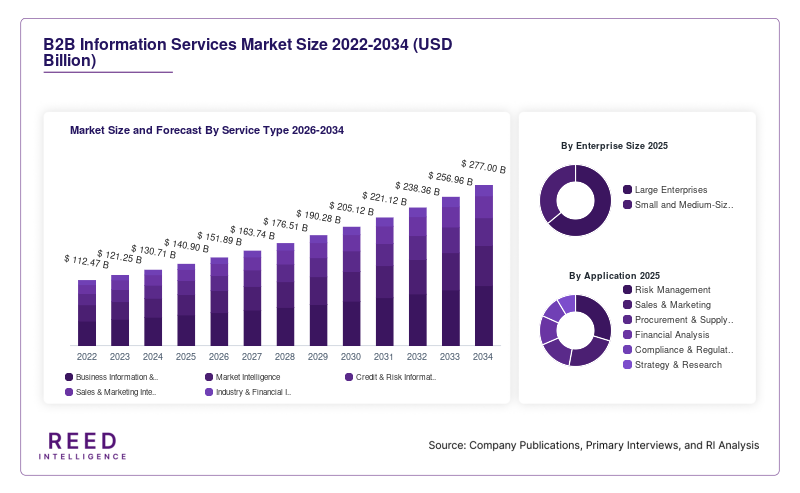
Business Information & Company Data accounts for approximately 29% of the market in 2025. Company identity, ownership, financial characteristics and organizational information form the basic data layer used across credit assessment, sales prospecting, procurement and due diligence.
Its broad application base creates recurring demand because customers need updated information on existing and prospective business relationships. The segment also provides the underlying datasets from which more specialized risk and intelligence products can be developed.
Credit & Risk Information is projected to register approximately 9.60% CAGR during 2026–2034. Financial institutions, insurers and enterprises increasingly require structured information to evaluate counterparties, transactions and fraud exposure.
RELX reported continued growth in financial-crime compliance and fraud-and-identity solutions within its Risk business in 2025 and 2026.
B2B Information Services Market Enterprise Size Analysis
Large enterprises account for approximately 68% of the market in 2025. Large organizations typically manage greater numbers of customers, suppliers, counterparties and regulatory requirements, creating recurring demand for external business information.
Their spending is also supported by API integrations, enterprise contracts and multiple departmental use cases spanning sales, finance, procurement, risk and compliance.
SMEs are projected to register approximately 9.10% CAGR during 2026–2034. Cloud-based subscriptions allow smaller organizations to access business databases and intelligence without building internal research infrastructure.
The strongest use cases include prospect identification, supplier verification, credit assessment and competitive research. Budget sensitivity and limited internal analytical resources can nevertheless constrain adoption.
B2B Information Services Market Application Analysis
Risk Management accounts for approximately 27% of the market in 2025. Organizations use external information to evaluate customers, suppliers, transactions and counterparties before making financial or commercial decisions.
The recurring nature of risk assessment supports frequent data consumption, particularly when information is integrated into automated screening systems.
Sales & Marketing is projected to register approximately 9.40% CAGR during 2026–2034. Sales organizations increasingly use company databases and intelligence platforms to identify prospects, enrich customer records and prioritize accounts.
The market mechanism is the integration of external company information with CRM and sales workflows. Providers that offer frequently updated contact and firmographic information can therefore increase the frequency with which customers use their platforms.
B2B Information Services Market End-User Analysis
Financial Services accounts for approximately 24% of the market in 2025. Banks, insurers, lenders and other financial institutions have recurring requirements for company information, credit assessment, fraud detection, compliance and transaction-risk analysis.
RELX identifies financial-crime compliance, fraud and identity solutions as important contributors to growth within its Risk business.
IT & Telecom is projected to register approximately 9.30% CAGR during 2026–2034. Technology companies increasingly use external information for enterprise prospecting, market intelligence, vendor evaluation, customer verification and competitive analysis.
API integration is particularly relevant because information can be incorporated directly into software platforms and automated workflows.
B2B Information Services Market Regional Analysis
North America Holds the Largest Regional Share Through a Mature Information and Analytics Ecosystem
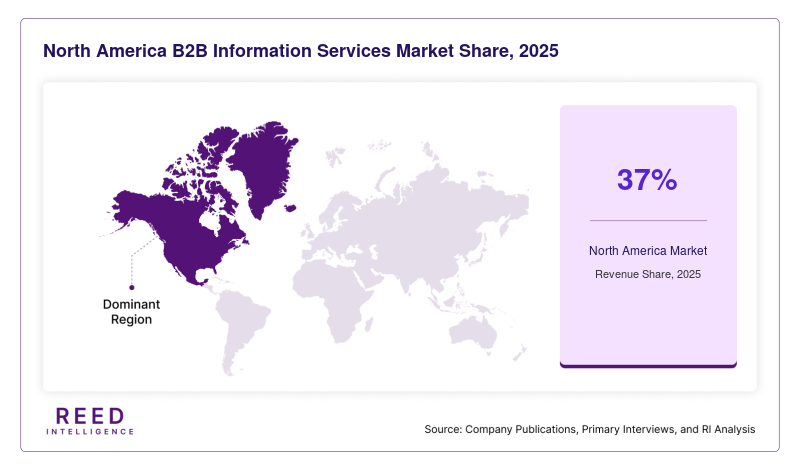
North America accounts for approximately 37% of the market in 2025. The region has a mature base of financial institutions, technology companies, professional-services firms and large enterprises that regularly purchase business data, risk information and market intelligence.
The region is also a major center for data and analytics providers. RELX's LexisNexis Risk Solutions has principal operations across multiple U.S. locations and serves customers globally.
Future growth is linked to AI-enabled decision tools, fraud prevention, sales intelligence and API-based information delivery. Privacy requirements, cybersecurity and competition among established providers remain constraints.
Europe Maintains a Strong Market Through Demand for Risk, Compliance and Business Intelligence
Europe accounts for approximately 28% of the market in 2025. Financial services, professional services, manufacturing and multinational enterprises generate recurring requirements for company information and regulatory intelligence.
Data governance has particular importance because information providers must operate within a complex regulatory environment. RELX identifies regulatory changes affecting personal-data collection and use as a business risk.
The market mechanism increasingly involves embedding information into compliance, risk and enterprise workflows. Cross-border data requirements can increase implementation complexity.
Asia-Pacific Is the Fastest-Growing Region as Enterprise Digitization Expands
Asia-Pacific is projected to register approximately 9.40% CAGR during 2026–2034. Expanding digital commerce, financial services, manufacturing and technology activity increases the number of businesses requiring external information for customer acquisition, supplier assessment and risk management.
The opportunity is particularly relevant to organizations moving from manual research toward automated information systems. Local-language data, fragmented company records and differences in data regulation can limit regional standardization.
Latin America Develops Through Financial Services and Commercial Data Adoption
Latin America accounts for approximately 7% of the market in 2025. Financial institutions, multinational companies and growing digital businesses require business information for customer assessment, sales development and supplier management.
Cloud delivery and subscription models can reduce the infrastructure required to access external information. Data fragmentation and varying availability of standardized corporate information remain constraints.
Middle East and Africa Represent an Emerging Market for Business Intelligence and Risk Data
Middle East and Africa account for approximately 6% of the market in 2025. Financial services, government-related organizations, energy companies and multinational enterprises provide important demand sources.
The opportunity is connected to increasing digitization of commercial workflows and the need for structured information when evaluating counterparties and suppliers. Local data availability, regulatory differences and infrastructure requirements can slow adoption.
B2B Information Services Market Competitive Landscape
Competition is increasingly based on data coverage, data freshness, proprietary datasets, analytical capabilities, AI integration, workflow integration, regulatory compliance and geographic reach.
Large providers benefit from accumulated datasets and established customer relationships. RELX, for example, describes its Risk business as combining public and industry-specific content with advanced technology and algorithms, while its 2025 results show continued investment in AI-enabled analytics and decision tools.
The competitive environment includes broad information providers, credit bureaus, financial-data companies, sales-intelligence platforms and specialist industry-information providers. Differentiation depends on the customer's specific workflow: a bank may prioritize risk and compliance data, while a sales organization may prioritize prospect intelligence and CRM enrichment.
Key Market Players
- RELX / LexisNexis Risk Solutions
- Experian
- Dun & Bradstreet
- S&P Global
- Moody's
- Bloomberg
- FactSet
- ZoomInfo
- Cerved
- Bureau van Dijk / Moody's
B2B Information Services Market Recent Developments
- RELX reported in 2025 that the evolution of AI was enabling additional product functionality and faster product development. Its Risk business also uses extractive AI and machine learning to generate actionable insights from large datasets.
- RELX reported continued growth in Financial Crime Compliance and digital Fraud & Identity solutions in its Risk business during 2025 and 2026.
B2B Information Services Market Segments
By Service Type
- Business Information & Company Data
- Market Intelligence
- Credit & Risk Information
- Sales & Marketing Intelligence
- Industry & Financial Information
By Enterprise Size
- Large Enterprises
- Small and Medium-Sized Enterprises
By Application
- Risk Management
- Sales & Marketing
- Procurement & Supply Chain
- Financial Analysis
- Compliance & Regulatory
- Strategy & Research
By End User
- Financial Services
- Manufacturing
- Retail & E-commerce
- Healthcare
- IT & Telecom
- Professional Services
- Government
- Others
By Region
- North America
- Europe
- APAC
- Middle East and Africa
- LATAM