Breath Biopsy Testing Market Size, Share & Trends Analysis Report By Test Type (Volatile Organic Compound (VOC) Analysis, Metabolomic Analysis, Isotope Analysis, Microbial Analysis), By Application (Cancer Detection, Respiratory Disease Detection, Gastrointestinal Disease Detection, Liver Disease Detection, Infectious Disease Detection, Other Applications), By Technology (Gas Chromatography-Mass Spectrometry, Sensor-Based Analysis, Infrared Spectroscopy, Mass Spectrometry, Other Technologies), B
USD 3950
Breath Biopsy Testing Market Size
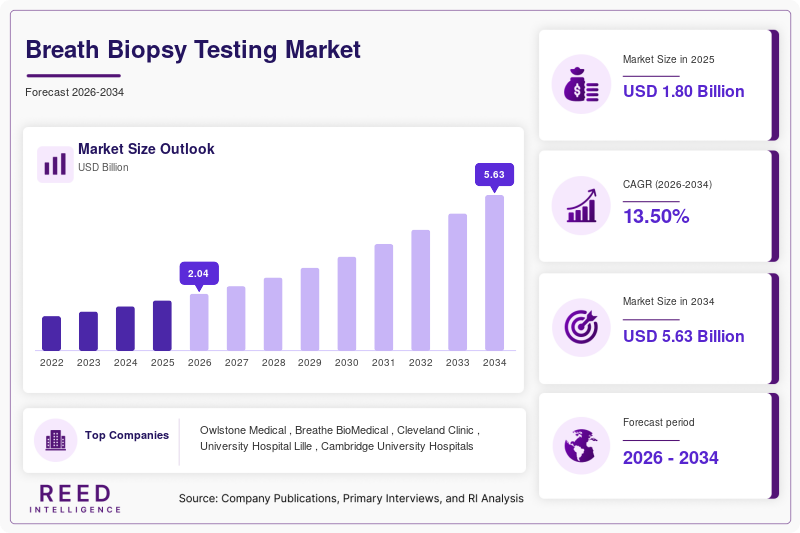
The breath biopsy testing market was valued at USD 1.80 billion in 2025 and is estimated to reach USD 2.04 billion in 2026. The market is projected to reach USD 5.63 billion by 2034, registering a 13.50% CAGR from 2026 to 2034.
The breath biopsy testing market is moving from exploratory biomarker research toward clinical-development and testing applications built around non-invasive molecular analysis of exhaled breath. Breath samples can contain VOCs originating from metabolic processes throughout the body, creating a potential route for identifying disease-associated biochemical signatures without tissue extraction or blood collection. Owlstone Medical's Breath Biopsy platform, for example, is designed to collect and analyze volatile compounds in breath for applications including cancer, liver and digestive disease research.
The strongest commercial mechanism is the possibility of using breath analysis where conventional diagnostic pathways are invasive, expensive, time-consuming or difficult to repeat. Cleveland Clinic researchers have described breath testing as non-invasive and have investigated VOC signatures across gastrointestinal, respiratory and other conditions.
Breath Biopsy Testing Market Drivers
Non-Invasive Sampling Creates a Practical Alternative to Repeated Tissue-Based Testing
Breath collection can be performed through simple exhalation and can potentially be repeated without the procedural burden associated with tissue biopsy. Cleveland Clinic has highlighted the non-invasive nature of breath testing as one of its principal advantages, particularly for conditions where conventional procedures can be difficult or burdensome.
The market mechanism is therefore strongest in applications requiring repeated monitoring, early screening or testing of patients who are unsuitable for invasive procedures. Owlstone's ReCIVA system, for example, was developed to standardize breath collection across research settings.
The counterbalance is that a simpler sample does not automatically produce a clinically validated diagnostic test; analytical reproducibility and disease-specific performance still determine adoption.
Cancer Early-Detection Research Is Expanding the Addressable Application Base
Cancer is one of the most commercially significant application areas because breath VOCs may provide metabolic signals associated with tumors. The PAN study is evaluating whether breath VOC profiles can distinguish people with and without multiple cancer types, including gastric, esophageal and liver cancers.
More recent research is extending the approach to additional cancers. ClinicalTrials.gov lists a breast-cancer breath study that began in February 2025 and is evaluating VOC patterns and test-performance characteristics, with estimated completion in 2027.
If these research programs establish clinically reproducible signatures, the market mechanism would extend from specialized research services toward screening, diagnostic support and longitudinal monitoring.
Analytical Technology Is Becoming More Standardized
Breath testing depends on reliably collecting and identifying compounds that can occur at very low concentrations. GC-MS, mass spectrometry, infrared spectroscopy and sensor-based platforms provide different routes to identifying these molecular patterns.
A 2024 clinical study of lung-cancer breath analysis used standardized VOC collection followed by GC-MS, while FDA records demonstrate that VOC breath analysis has already been incorporated into regulated medical-device applications.
The development of standardized collection systems and reference libraries can reduce variability between studies. Owlstone has specifically emphasized standardized collection and analytical workflows through its Breath Biopsy OMNI platform.
Breath Biopsy Testing Market Restraints
Biomarker Reproducibility Remains a Major Clinical-Translation Constraint
Breath contains thousands of chemical compounds, but distinguishing disease-specific biomarkers from signals caused by diet, medications, smoking, environment and other physiological conditions is technically difficult. Research organizations have identified inconsistent methodologies as a barrier to comparing results and validating breath biomarkers across studies.
This affects the market economically because diagnostic laboratories and healthcare providers require reproducible results before incorporating a test into routine clinical pathways. A technology may therefore demonstrate promising performance in a controlled study without immediately translating into widespread clinical procurement.
Regulatory Validation Is Still Limited for Broad Disease Screening
FDA records currently identify VOC breath-analysis devices under Humanitarian Device Exemption pathways for specific applications, including assessment of grade 3 heart-transplant rejection.
This demonstrates that breath VOC analysis can enter a regulated medical-device pathway, but it does not establish broad regulatory acceptance for cancer screening or general disease diagnosis. Developers therefore face additional clinical-validation and regulatory requirements before research platforms can become routine diagnostic products.
Breath Biopsy Testing Market Opportunities
Breath-Based Multi-Cancer Early Detection
The largest potential opportunity is the development of a non-invasive platform capable of identifying molecular signatures associated with several cancers from a single breath sample. Owlstone Medical received an award of up to USD 49.1 million from ARPA-H in 2025 for the POSEIDON program, which aims to develop an at-home multi-cancer early-detection test using breath and urine samples.
The commercial opportunity comes from combining simple sampling with potentially broad disease coverage. However, adoption depends on demonstrating sufficient sensitivity and specificity across diverse populations and confirming that breath testing can improve clinical outcomes rather than simply identify biomarkers.
Point-of-Care and At-Home Breath Testing
The shift from centralized laboratory analysis toward portable and home-based testing could materially broaden the addressable market. Owlstone's 2025 ARPA-H program explicitly targets at-home testing, while the company's research platform is also being developed around standardized sample collection.
The commercial mechanism would be a reduction in testing friction: patients could provide samples outside conventional diagnostic facilities, increasing the potential frequency of monitoring and screening. Analytical stability, device cost, connectivity and regulatory authorization remain adoption constraints.
Pharmaceutical Biomarker and Clinical-Trial Applications
Pharmaceutical companies can use breath biomarkers for patient stratification, treatment-response monitoring and biomarker discovery. Owlstone reported that its breath research services were being used at more than 100 sites worldwide, including by pharmaceutical companies and academic institutions.
This creates a nearer-term commercial pathway than relying exclusively on population screening because pharmaceutical and research customers can use breath analysis as an investigational tool before broader clinical adoption.
Breath Biopsy Testing Market Test Type Analysis
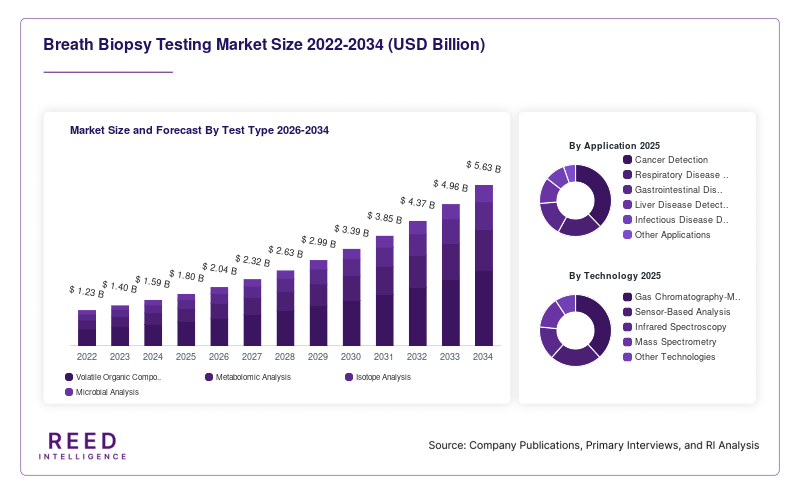
VOC analysis is internally modelled as the largest test-type segment, representing approximately 52% of the 2025 market, equivalent to USD 936 million. VOCs are the principal molecular signals being investigated across breath-based cancer, respiratory, gastrointestinal and metabolic applications. Clinical research has demonstrated the use of VOC profiling for distinguishing disease and control groups, while FDA records confirm regulated applications using VOC breath analysis.
Metabolomic analysis is modelled at 24% of the 2025 market, representing approximately USD 432 million. The segment focuses on broader patterns of metabolites rather than individual compounds and is relevant where disease produces multiple biochemical changes.
Isotope analysis accounts for an internally modelled 14% share, or USD 252 million in 2025. Its role is more specialized and is linked to tracing metabolic processes through isotopically labelled compounds rather than broad routine diagnostic screening.
Microbial analysis represents the remaining 10%, equivalent to approximately USD 180 million. Breath-derived microbial signatures and related metabolic products can support research into infectious and gastrointestinal conditions, although clinical standardization remains important.
Breath Biopsy Testing Market Application Analysis
Cancer detection is internally modelled as the largest application at 38% of the 2025 market, equivalent to USD 684 million. Cancer is attracting substantial breath-biopsy research because VOC signatures may reflect tumor-associated metabolic activity. The PAN study and more recent breast-cancer research illustrate the continuing clinical-development pipeline.
Respiratory disease detection accounts for approximately 21%, representing USD 378 million in 2025. Lung cancer and other respiratory diseases are particularly compatible with breath sampling because the sample directly reflects compounds present in exhaled air. A 1,500-participant lung-cancer study at University Hospital Lille illustrates the scale of clinical research in this area.
Gastrointestinal disease detection is modelled at 17%, equivalent to USD 306 million. Breath biomarkers have been investigated for conditions including inflammatory and functional gastrointestinal disorders. Cleveland Clinic researchers have also evaluated breath VOCs for eosinophilic esophagitis, demonstrating the potential for non-invasive assessment in gastrointestinal care.
Liver disease detection represents approximately 10% of the 2025 market, or USD 180 million. Breath VOCs can provide metabolic information associated with liver function and disease. Owlstone currently identifies liver disease as one of its major Breath Biopsy development areas.
Infectious disease detection is internally modelled at 8%, representing USD 144 million. Breath VOC research has been explored for infectious conditions, including work evaluating VOC patterns associated with C. difficile infection.
Other applications account for approximately 6%, equivalent to USD 108 million. This includes metabolic research, inflammatory diseases, treatment monitoring and exploratory biomarker applications.
Breath Biopsy Testing Market Technology Analysis
GC-MS is internally modelled as the largest technology segment at 35% of the 2025 market, equivalent to USD 630 million. Its role is supported by clinical research in which VOCs are collected and subsequently identified using chromatographic and mass-spectrometric methods.
Sensor-based analysis represents approximately 27%, or USD 486 million in 2025. Sensor platforms have potential commercial advantages where compact, portable or point-of-care testing is required, although sensitivity, selectivity and calibration remain important technical considerations.
Infrared spectroscopy accounts for an internally modelled 16% share, equivalent to USD 288 million. Clinical research has used infrared spectroscopy to investigate VOC patterns associated with lung and breast cancer.
Mass spectrometry-based analysis represents approximately 14%, or USD 252 million. The technology supports high-resolution characterization of breath metabolites and is particularly relevant to research laboratories and biomarker discovery.
Other technologies account for approximately 8%, representing USD 144 million in 2025. This includes emerging sensor architectures, spectroscopy approaches and analytical platforms.
Breath Biopsy Testing Market End-User Analysis
Hospitals and clinics are internally modelled at 34% of the 2025 market, representing approximately USD 612 million. Their demand is linked to clinical diagnostics, disease monitoring and access to patients participating in validation studies.
Diagnostic laboratories account for 28%, equivalent to USD 504 million. Centralized laboratories can support high-sensitivity analytical workflows such as GC-MS and mass spectrometry while maintaining standardized sample-processing procedures.
Research institutes represent approximately 22%, or USD 396 million in 2025. Their role remains important because many breath biomarkers are still being validated rather than routinely used in clinical diagnosis.
Pharmaceutical and biotechnology companies account for the remaining 16%, equivalent to USD 288 million. These customers can use breath analysis for biomarker discovery, patient characterization and clinical-trial research. Owlstone reports collaborations with pharmaceutical companies and academic institutions through its research services.
Breath Biopsy Testing Market Regional Analysis
North America Breath Biopsy Testing Market
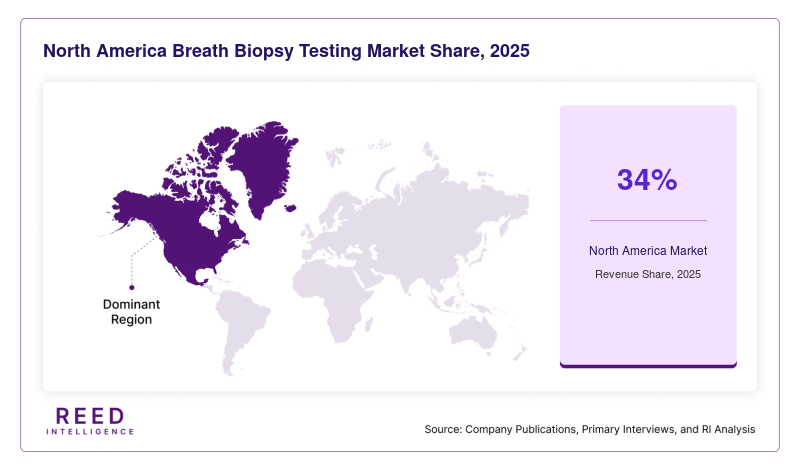
North America is internally modelled as the largest regional market, accounting for 34% of the 2025 market, or approximately USD 612 million. The region benefits from substantial clinical-research infrastructure, biotechnology activity and regulatory development in breath-based diagnostics.
The FDA's device database provides evidence that VOC breath analysis has already entered a regulated medical-device framework for specific clinical applications.
North America also represents an important commercialization center because developers can connect diagnostic technologies with large hospital networks, pharmaceutical companies and academic research institutions. Owlstone's 2025 ARPA-H award further demonstrates U.S. public-sector support for developing at-home multi-cancer early-detection technology.
The principal constraint is the evidence threshold required for clinical adoption. Breath-based cancer screening remains a developing area, so commercial expansion depends on prospective validation, regulatory authorization and demonstration of clinical utility.
Europe Breath Biopsy Testing Market
Europe is internally modelled at 29% of the 2025 market, equivalent to approximately USD 522 million. Europe has an established research base in breath biomarkers, with clinical programs involving universities, hospitals and specialist technology developers.
The PAN cancer study is a prominent example of collaborative research involving Cambridge University Hospitals, the University of Cambridge, Cancer Research UK and Owlstone Medical.
The region also hosts specialized breath-analysis companies and research laboratories. Owlstone's Breath Biopsy platform and laboratory infrastructure in Cambridge support research across cancer, liver disease and digestive disease.
European adoption is likely to remain closely tied to clinical validation and health-system evidence. The ability to demonstrate that breath testing improves diagnostic pathways will be more important than simply demonstrating analytical biomarker differences.
Asia-Pacific Breath Biopsy Testing Market
Asia-Pacific is internally modelled at 23% of the 2025 market, representing approximately USD 414 million, and is assigned the fastest regional CAGR in the model at 15.1%. The region's potential is associated with expanding healthcare infrastructure, diagnostic capacity and research activity across large patient populations.
Breath testing is particularly relevant where a low-burden sampling method could complement conventional diagnostic infrastructure. Cancer and respiratory disease applications provide substantial potential research areas, while gastrointestinal and infectious-disease applications broaden the use case.
The primary limitation is uneven availability of advanced analytical equipment and specialized biomarker-validation capabilities across countries. Expansion therefore depends on partnerships between technology developers, hospitals, laboratories and research institutions.
Latin America Breath Biopsy Testing Market
Latin America is modelled at 8% of the 2025 market, equivalent to approximately USD 144 million. The opportunity is connected to demand for less invasive diagnostic methods and expansion of laboratory-based molecular testing.
However, high-end analytical technologies such as GC-MS and advanced mass spectrometry can require substantial capital investment and specialized technical expertise. Adoption may therefore initially concentrate in major private hospitals, research institutions and centralized laboratories.
Middle East and Africa Breath Biopsy Testing Market
The Middle East and Africa are internally modelled at 6% of the 2025 market, representing approximately USD 108 million. Demand is expected to remain concentrated in advanced healthcare centers, research institutions and specialized diagnostic laboratories.
The region's development mechanism is likely to involve partnerships that bring breath-collection technology and analytical services into existing clinical research infrastructure rather than immediate broad-based deployment. Cost, laboratory capacity and regulatory requirements remain constraints.
Breath Biopsy Testing Market Competitive Landscape
Competition is developing around three complementary capabilities: breath-sample collection, analytical infrastructure and clinically validated diagnostic applications.
Owlstone Medical is one of the most visible specialist companies in the field. Its portfolio includes ReCIVA breath collection, Breath Biopsy OMNI analysis and disease-specific diagnostic programs. The company reported a USD 27 million first close in Series E financing in January 2025, with proceeds intended to accelerate commercialization and clinical trials for lung cancer, liver disease and digestive disease applications.
The company's subsequent up-to-USD 49.1 million ARPA-H award in October 2025 represents a further shift toward multi-cancer and at-home testing, with partnerships involving MIT, Boston University, Georgia Tech Research Corporation, Qurin and Planned Systems International.
Key Market Players
- Owlstone Medical
- Breathe BioMedical
- Cleveland Clinic
- University Hospital Lille
- Cambridge University Hospitals
- University of Cambridge
- Cancer Research UK
Breath Biopsy Testing Market Recent Developments
- Owlstone Medical raised USD 27 million in the first close of its Series E financing in January 2025. The funding was intended to accelerate commercialization and clinical trials for Breath Biopsy diagnostic tests and point-of-care devices targeting lung cancer, liver disease and digestive disease.
- A breast-cancer breath study began in February 2025, with ClinicalTrials.gov listing an estimated enrollment of 5,175 participants and completion in 2027. The study is evaluating VOC patterns and performance characteristics including sensitivity and specificity.
Breath Biopsy Testing Market Segments
By Test Type
- Volatile Organic Compound (VOC) Analysis
- Metabolomic Analysis
- Isotope Analysis
- Microbial Analysis
By Application
- Cancer Detection
- Respiratory Disease Detection
- Gastrointestinal Disease Detection
- Liver Disease Detection
- Infectious Disease Detection
- Other Applications
By Technology
- Gas Chromatography-Mass Spectrometry
- Sensor-Based Analysis
- Infrared Spectroscopy
- Mass Spectrometry
- Other Technologies
By End User
- Hospitals & Clinics
- Diagnostic Laboratories
- Research Institutes
- Pharmaceutical & Biotechnology Companies
By Region
- North America
- Europe
- APAC
- Middle East and Africa
- LATAM