Business Tax Services Market Size, Share & Demand Report By Service Type (Tax Compliance Services, Tax Preparation Services, International Tax Advisory Services, Transfer Pricing Services), By Enterprise Size (Small & Medium Enterprises), By End-Use Industry (Manufacturing, Technology & IT Services, Healthcare, Retail & E-commerce, Energy & Utilities, Others), By Region & Segment Forecasts, 2026–2034
USD 3950
Market Overview
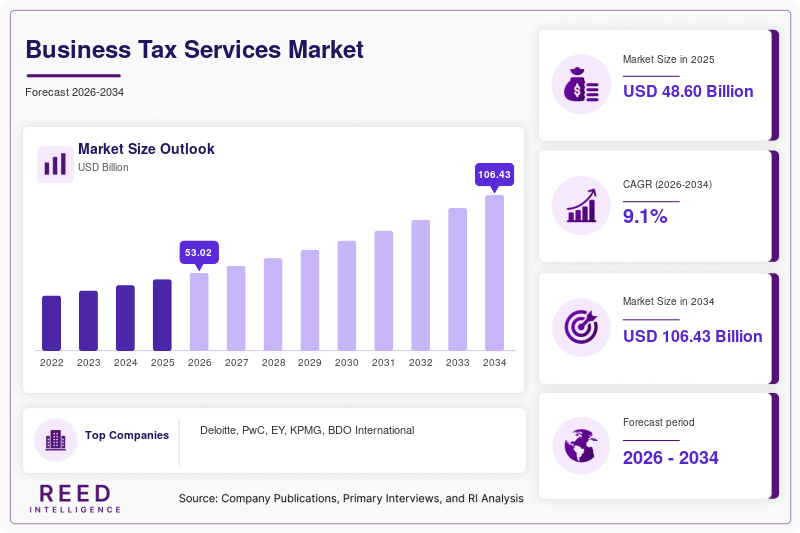
The global Business Tax Services Market size was valued at USD 48.6 billion in 2026 and is projected to reach USD 97.8 billion by 2034, expanding at a CAGR of 9.1% during 2026–2034. The market continues to evolve as organizations face increasingly complex tax regulations, digital reporting requirements, and cross-border compliance obligations. Businesses across industries are investing in professional tax advisory, tax compliance management, transfer pricing support, and digital tax consulting services to reduce financial risks and maintain regulatory compliance.
A major global factor supporting market growth is the rapid digitalization of tax administration systems. Governments worldwide are implementing electronic invoicing, real-time tax reporting, and digital filing frameworks. These developments require organizations to modernize tax processes and engage specialized service providers capable of managing evolving compliance obligations. At the same time, multinational enterprises are expanding into new markets, creating demand for strategic tax planning and international tax advisory services.
Key Highlights
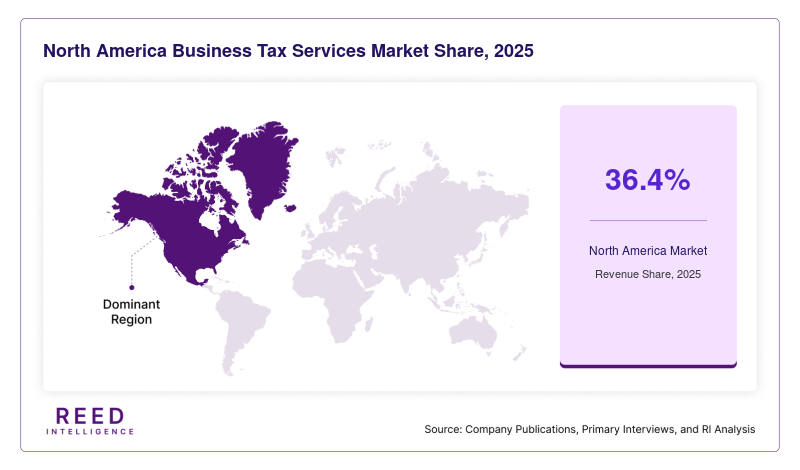
- North America dominated the market with a 36.4% share in 2025.
- while Asia Pacific is expected to grow at the fastest CAGR of 11.4% during 2026–2034.
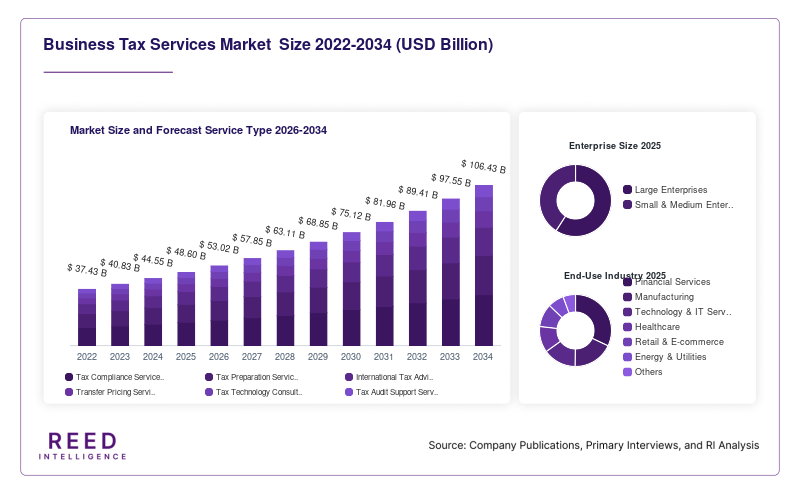
- By service type, Tax Compliance Services accounted for the largest share of 39.1%.
- while International Tax Advisory Services are projected to grow at a CAGR of 11.9%.
- By enterprise size, Large Enterprises held a leading share of 62.8%.
- whereas Small & Medium Enterprises are expected to expand at a CAGR of 10.8%.
- By end-use industry, Financial Services led with a 24.6% share.
- while Technology & IT Services are projected to grow at a CAGR of 12.3%.
- The United States remained the dominant country, with market values of USD 12.8 billion in 2024 and USD 13.7 billion in 2025.
Market Trends
Expansion of Digital Tax Transformation Services
Digital transformation has become a defining trend across the Business Tax Services Market. Organizations are increasingly seeking tax service providers that offer automated compliance solutions, cloud-based tax management platforms, and integrated reporting systems. Governments are introducing mandatory electronic filing and digital reporting requirements, prompting businesses to modernize tax operations. Service providers are responding by investing in automation technologies that streamline tax calculations, document management, and regulatory reporting. The growing adoption of artificial intelligence and machine learning tools enables faster processing of tax data while reducing human errors. As enterprises seek efficiency and transparency, digital tax transformation services are becoming an essential component of long-term tax management strategies.
Growing Demand for Cross-Border Tax Advisory
International business expansion is creating significant demand for cross-border tax advisory services. Companies operating across multiple jurisdictions must navigate varying tax regulations, transfer pricing requirements, and international reporting standards. Tax authorities are also increasing scrutiny of multinational transactions, requiring organizations to maintain detailed documentation and compliance frameworks. As a result, businesses are engaging specialized tax consultants to optimize tax structures and reduce compliance risks. The rise of remote workforces, digital commerce, and global supply chains further contributes to the complexity of international taxation. This trend is encouraging tax service providers to expand global expertise and deliver integrated advisory solutions that address evolving international tax challenges.
Market Drivers
Increasing Complexity of Tax Regulations
The growing complexity of domestic and international tax regulations is a major factor driving the Business Tax Services Market. Governments continue to introduce new reporting standards, transparency requirements, and compliance obligations that require specialized expertise. Businesses often face challenges in interpreting and implementing regulatory changes, particularly when operating across multiple jurisdictions. Professional tax service providers help organizations manage these complexities through advisory support, compliance management, and risk assessment services. The need to avoid penalties, maintain accurate reporting, and improve tax governance encourages companies to invest in external expertise. As tax regulations continue to evolve, demand for professional tax services is expected to remain strong throughout the forecast period.
Rising Adoption of Outsourced Tax Functions
Organizations are increasingly outsourcing tax functions to improve operational efficiency and reduce administrative burdens. Maintaining in-house tax teams can be costly, especially for small and medium-sized enterprises that may lack specialized expertise. Outsourced tax service providers offer access to experienced professionals, advanced technologies, and scalable service models. Businesses benefit from improved compliance accuracy, reduced operational costs, and access to current regulatory knowledge. Furthermore, outsourcing enables internal finance teams to focus on strategic activities rather than routine compliance tasks. The growing acceptance of remote service delivery and cloud-based collaboration platforms is accelerating the adoption of outsourced tax services across multiple industry sectors.
Market Restraint
Data Security and Confidentiality Concerns
Data security and confidentiality concerns remain a significant challenge for the Business Tax Services Market. Tax service providers manage highly sensitive financial information, including corporate earnings data, payroll records, transaction histories, and confidential business strategies. The increasing use of cloud-based platforms and digital data exchange systems creates additional cybersecurity risks. Organizations may hesitate to outsource critical tax functions if they perceive potential vulnerabilities related to unauthorized access, data breaches, or compliance violations.
The impact of these concerns is particularly evident among highly regulated industries such as banking, healthcare, and government contracting. Businesses operating within these sectors often require extensive security audits and compliance assessments before engaging external service providers. Additionally, evolving privacy regulations across different jurisdictions increase compliance complexity for tax service firms. To address these challenges, providers must invest continuously in cybersecurity infrastructure, encryption technologies, employee training, and regulatory compliance frameworks. Although digital tax services offer substantial efficiency benefits, security concerns may slow adoption rates among risk-averse organizations and create additional operational costs for service providers.
Market Opportunities
Growth Potential in Small and Medium-Sized Enterprises
Small and medium-sized enterprises represent a substantial growth opportunity within the Business Tax Services Market. Many SMEs operate with limited internal tax expertise and face increasing pressure to comply with evolving tax regulations. As governments implement digital filing requirements and enhanced reporting standards, smaller businesses are turning to external tax specialists for support. Affordable subscription-based service models and cloud-enabled platforms are making professional tax services more accessible to this customer segment.
The opportunity is further strengthened by increasing entrepreneurial activity and startup formation across emerging economies. New businesses often require assistance with tax registration, compliance planning, and financial reporting. Service providers that develop scalable and cost-effective solutions tailored to SME needs are likely to achieve significant market expansion. As awareness of compliance risks grows, demand from this segment is expected to increase steadily.
Emergence of AI-Enabled Tax Consulting Solutions
Artificial intelligence presents a significant opportunity for innovation and market expansion. AI-enabled tax consulting solutions can automate routine processes, identify compliance risks, and generate predictive insights that support strategic decision-making. Businesses increasingly value data-driven recommendations that improve tax efficiency and reduce administrative workloads. Tax service providers are integrating AI technologies into advisory platforms to deliver faster and more accurate services.
The adoption of AI also enables providers to manage larger client portfolios without proportionally increasing staffing requirements. Automated data extraction, document classification, and tax scenario modeling improve operational productivity while enhancing client experiences. As organizations seek advanced analytics capabilities and real-time reporting solutions, AI-driven tax consulting services are expected to become an increasingly important growth area within the market.
Segmental Analysis
By Service Type
Tax Compliance Services represented the dominant subsegment, accounting for 39.1% of market share in 2024. Organizations across industries prioritize compliance services to ensure accurate tax filings, regulatory adherence, and risk mitigation. The increasing frequency of regulatory updates and digital reporting mandates has strengthened demand for professional compliance support. Large enterprises and multinational corporations rely on specialized providers to manage complex filing requirements across multiple jurisdictions. Additionally, the expansion of electronic tax administration systems has increased the importance of automated compliance solutions, supporting the continued dominance of this segment.
International Tax Advisory Services are expected to register the fastest CAGR of 11.9% during the forecast period. Growth is driven by increasing globalization, cross-border investments, and international trade activities. Businesses expanding into foreign markets require expert guidance on transfer pricing, tax treaties, and international reporting obligations. Regulatory scrutiny of multinational tax structures is also increasing demand for specialized advisory services. As companies seek to optimize tax efficiency while maintaining compliance, international tax advisory providers are expected to experience substantial growth opportunities.
By Enterprise Size
Large Enterprises held the leading position within the market, accounting for 62.8% share in 2024. These organizations typically operate across multiple jurisdictions and face complex tax obligations that require comprehensive professional support. Large enterprises invest heavily in compliance management, strategic tax planning, transfer pricing documentation, and regulatory risk mitigation. Their substantial financial resources enable long-term engagement with specialized service providers. Furthermore, the increasing integration of tax technologies and advanced analytics within corporate finance functions supports continued demand from this segment.
Small and Medium Enterprises are projected to grow at a CAGR of 10.8% through 2034. Rising awareness of compliance risks and increasing regulatory complexity are encouraging SMEs to seek professional assistance. Cloud-based tax platforms and subscription-based service models have improved affordability and accessibility for smaller organizations. Many SMEs prefer outsourcing tax functions to reduce administrative burdens and gain access to specialized expertise. Continued growth in entrepreneurship and startup activity is expected to further support demand within this rapidly expanding segment.
By End-Use Industry
Financial Services emerged as the dominant end-use segment, capturing 24.6% of market share in 2024. Banks, insurance companies, investment firms, and financial institutions operate within highly regulated environments that require extensive tax reporting and compliance management. Frequent regulatory updates and complex financial transactions increase the need for specialized tax expertise. These organizations often engage professional service providers to manage tax risk, optimize reporting processes, and ensure compliance with domestic and international regulations. The sector's significant operational scale contributes to its leading market position.
Technology & IT Services are expected to achieve the fastest CAGR of 12.3% during the forecast period. The sector's rapid expansion, global workforce models, and cross-border revenue streams create increasingly complex tax challenges. Technology companies frequently require guidance related to digital taxation, intellectual property structures, and international compliance obligations. Additionally, ongoing innovation and market expansion activities generate demand for strategic tax planning services. As digital business models continue to evolve, tax service providers are expected to benefit from growing demand within the technology industry.
Regional Analysis
North America
North America accounted for 36.4% of the global Business Tax Services Market in 2025 and continues to maintain a leading position due to mature professional services infrastructure and extensive regulatory requirements. The region is projected to expand at a CAGR of 8.5% through 2034. Businesses across the United States and Canada increasingly rely on specialized tax advisory services to address complex federal, state, and international tax obligations. Digital tax transformation initiatives are also supporting market expansion.
The United States remains the dominant country within the region. A key growth factor is the widespread adoption of advanced tax technologies among enterprises seeking greater efficiency and compliance accuracy. Large multinational corporations continue to invest heavily in tax planning and advisory services to manage global operations, creating sustained demand for professional service providers.
Europe
Europe represented 28.1% of the global market in 2025 and is anticipated to record a CAGR of 8.8% during the forecast period. The region benefits from strong demand for compliance services associated with evolving tax transparency regulations and cross-border reporting requirements. Organizations operating within the European market often require specialized expertise to navigate diverse national tax frameworks while maintaining regulatory compliance.
Germany remains the leading country in the European market. A unique growth factor is the region's emphasis on regulatory harmonization and digital tax administration initiatives. Businesses are increasingly investing in advisory services to adapt to electronic invoicing mandates and evolving reporting requirements, contributing to steady demand for tax consulting expertise.
Asia Pacific
Asia Pacific held approximately 22.7% market share in 2025 and is forecast to register the fastest CAGR of 11.4% through 2034. Rapid economic development, growing business formation, and expanding international trade activities are driving demand for tax compliance and advisory services. Governments across the region are implementing digital tax systems that require businesses to modernize tax management processes and seek external expertise.
China leads the regional market due to its extensive business ecosystem and ongoing regulatory modernization efforts. A key growth factor is the increasing digitalization of tax administration systems. Enterprises are engaging professional service providers to manage complex compliance requirements and integrate advanced technologies into tax operations, supporting strong market growth.
Middle East & Africa
The Middle East & Africa accounted for 6.5% of the global market in 2025 and is projected to grow at a CAGR of 9.6% over the forecast period. The introduction of new tax frameworks, including value-added tax systems and corporate taxation measures in several countries, is creating opportunities for tax advisory and compliance service providers. Businesses require professional guidance to adapt to evolving regulatory environments.
The United Arab Emirates represents the dominant country in the region. A distinctive growth factor is the ongoing diversification of national economies beyond traditional sectors. Expanding private sector activities and foreign investment inflows are increasing demand for tax planning, compliance management, and regulatory advisory services across multiple industries.
Latin America
Latin America captured 6.3% of the global Business Tax Services Market in 2025 and is expected to expand at a CAGR of 9.1% through 2034. The region is witnessing increasing adoption of professional tax services as governments strengthen tax enforcement and introduce digital reporting mechanisms. Businesses are investing in specialized expertise to improve compliance efficiency and manage regulatory changes effectively.
Brazil remains the largest market within Latin America. A unique growth factor is the complexity of the country's tax structure, which requires extensive compliance management and advisory support. Companies operating in Brazil frequently engage external specialists to optimize tax processes, maintain compliance, and navigate ongoing regulatory reforms.
Competitive Landscape
The Business Tax Services Market is moderately consolidated, with global accounting firms and specialized tax advisory providers competing through technology innovation, service diversification, and geographic expansion. Leading participants are investing heavily in digital tax platforms, automation tools, and artificial intelligence capabilities to improve service efficiency and client engagement. Strategic acquisitions and partnerships remain common approaches for strengthening market presence and expanding specialized expertise.
Deloitte continues to be a leading market participant due to its broad global network, extensive tax advisory capabilities, and integrated digital solutions portfolio. Recent developments across the industry include the launch of AI-powered compliance platforms, expansion of international tax advisory practices, and increased investment in cloud-based service delivery models.
Other major companies are focusing on industry-specific tax consulting solutions, cybersecurity enhancements, and advanced analytics capabilities. Competition is expected to intensify as organizations increasingly seek technology-enabled services that combine regulatory expertise with operational efficiency.
Key Players
- Deloitte
- PwC
- EY
- KPMG
- BDO International
- Grant Thornton
- RSM International
- Crowe Global
- Baker Tilly International
- Mazars
- Alvarez & Marsal Tax
- Andersen Global
- Ryan LLC
- Cherry Bekaert
- CLA (CliftonLarsonAllen)
Recent Developments
- Deloitte introduced an AI-enabled tax compliance platform designed to improve automated reporting and regulatory monitoring capabilities for multinational clients.
- PwC expanded its international tax advisory practice across Asia Pacific through new service hubs focused on cross-border compliance and digital tax consulting.
- EY launched an advanced cloud-based tax management solution that integrates compliance workflows, analytics, and real-time reporting functionalities.
- KPMG enhanced its transfer pricing advisory portfolio through technology-driven documentation and risk assessment tools.
- BDO International strengthened its SME-focused tax outsourcing services by expanding subscription-based digital tax support offerings
Business Tax Services Market Segments
Service Type
- Tax Compliance Services
- Tax Preparation Services
- International Tax Advisory Services
- Transfer Pricing Services
- Tax Technology Consulting
- Tax Audit Support Services
Enterprise Size
- Large Enterprises
- Small & Medium Enterprises
End-Use Industry
- Financial Services
- Manufacturing
- Technology & IT Services
- Healthcare
- Retail & E-commerce
- Energy & Utilities
- Others
By Region
- North America
- Europe
- APAC
- Middle East and Africa
- LATAM