Card Stock Market Size, Share & Trends Analysis Report By Product Type (Coated Card Stock, Uncoated Card Stock, Recycled Card Stock, Specialty Card Stock), By Weight (Lightweight, Mediumweight, Heavyweight), By Application (Printing & Publishing, Packaging, Stationery & Crafts, Business Cards & Invitations, Others), By Distribution Channel (Direct Sales, Specialty Stores, Office Supply Stores, Online Channels) and By Region (North America, Europe, Asia-Pacific, Latin America, Middle East & Afric
USD 3950
Card Stock Market Size
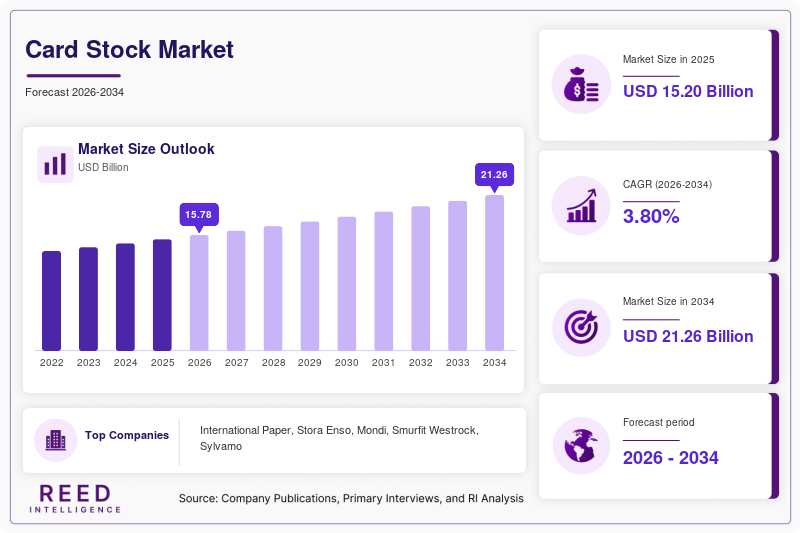
The global card stock market was valued at USD 15.20 billion in 2025 and is projected to grow from USD 15.80 billion in 2026 to USD 20.80 billion by 2034, registering a CAGR of 3.80% during the forecast period from 2026 to 2034.
The card stock market is supported by demand for heavier and more rigid paper grades used where standard printing paper does not provide sufficient stiffness, surface quality, or presentation characteristics. Commercial printing, packaging, business communications, invitations, greeting products, labels, educational materials and craft applications form the principal demand base. The market is therefore influenced by both traditional paper consumption and the continued use of paperboard-based formats in consumer-facing applications.
Packaging is an important demand mechanism. Stora Enso reported that global cartonboard consumption increased in 2025, while European corrugated packaging demand also increased, although the company noted that excess capacity remained a market constraint.
Card Stock Market Drivers
Packaging Applications Expand the Addressable Demand for Rigid Paper Grades
Card stock benefits from applications requiring greater stiffness and printability than conventional paper. Packaging, product inserts, tags, presentation materials and folding formats use heavier paper grades because structural performance and surface appearance directly influence the finished product. Stora Enso reported that global cartonboard consumption increased in 2025, while its consumer board deliveries also increased year over year. The underlying mechanism is the continued use of fiber-based formats in consumer packaging, retail presentation and branded products. Mondi likewise identifies continuing customer demand for sustainable packaging and paper solutions. The main counterbalance is excess capacity in several paper and board markets, which can pressure producer margins and limit pricing power.
Sustainability Requirements Strengthen Demand for Recyclable Fiber-Based Materials
Environmental requirements are influencing purchasing specifications for paper and paperboard products. The EU Packaging and Packaging Waste Regulation requires packaging placed on the market to meet recyclability requirements, with additional design-for-recycling requirements taking effect from 2030. These rules create a mechanism for greater preference toward recyclable fiber-based materials in applications where paper or board can replace less recyclable formats. Mondi reported that 88% of its 2025 revenue came from reusable, recyclable or compostable products, compared with 74% in its 2020 baseline year. For card-stock manufacturers, the opportunity is strongest in grades that combine printability, stiffness and recyclability.
Premium Printing and Specialty Paper Applications Sustain Higher-Value Demand
Although digitalization has reduced some conventional print volumes, physical printed products remain relevant where paper quality contributes to the perceived value of the finished item. Business cards, invitations, greeting products, luxury packaging, certificates, promotional materials and specialty stationery rely on heavier stocks because rigidity and surface finish affect both handling and appearance. This creates a demand mechanism different from commodity office paper: customers purchase the material based partly on its presentation characteristics. However, this segment faces competition from digital communications and electronic documents, limiting the ability of specialty printing to fully offset structural declines in some traditional publishing applications.
Card Stock Market Restraints
Digitalization Reduces Conventional Print Consumption
Digital communication continues to reduce demand for some applications that historically consumed substantial quantities of printing paper. Stora Enso reported that European publication paper demand declined in 2025, reflecting structural demand erosion alongside macroeconomic uncertainty. The impact on card stock is uneven because business cards, invitations, packaging and specialty print remain physical products, while documents and some commercial communications can be digitized. Consequently, manufacturers serving conventional publishing and office-print applications face a more limited addressable market than suppliers focused on packaging and specialty grades.
Paper and Board Overcapacity Can Constrain Producer Economics
Supply-side capacity remains an important constraint. Stora Enso reported that the global cartonboard market remained oversupplied in 2025, partly because of increased capacity, particularly in China. Oversupply can increase competition among mills and converters, placing pressure on utilization, pricing and producer margins. Mondi also described the broader paper and packaging industry as operating through a prolonged cyclical downturn in 2025. For card-stock producers, efficient production, differentiated grades and customer relationships therefore become important defenses against commodity-style price competition.
Card Stock Market Opportunities
Recyclable Specialty Grades Create Product-Differentiation Opportunities
The shift toward recyclable packaging and paper products creates an opportunity for manufacturers to develop card-stock grades combining stiffness, print performance and improved environmental attributes. EU packaging rules are increasing the importance of recyclability and design-for-recycling considerations. Mondi's reported expansion of reusable, recyclable and compostable product revenue demonstrates how sustainability requirements are translating into product development priorities. Card-stock suppliers can target premium packaging, retail inserts, stationery and printed promotional products where customers require both physical performance and sustainability credentials. Adoption can nevertheless be constrained by higher material costs and the technical requirements of specialized coatings or finishes.
Flexible Production Supports Premium and Short-Run Printing Demand
Digital printing and short-run commercial production create an opportunity for card-stock suppliers that can provide consistent surface characteristics across specialized grades. Printers increasingly need materials compatible with modern digital presses while maintaining stiffness, image quality and finishing performance. This is particularly relevant to customized invitations, business cards, labels, promotional materials and small-batch packaging. The opportunity is less dependent on overall print-volume expansion and more dependent on the value of customization and premium presentation. Suppliers that cannot meet printer-specific requirements or maintain competitive pricing may struggle to capture this demand.
Product Type Analysis
By Product Type
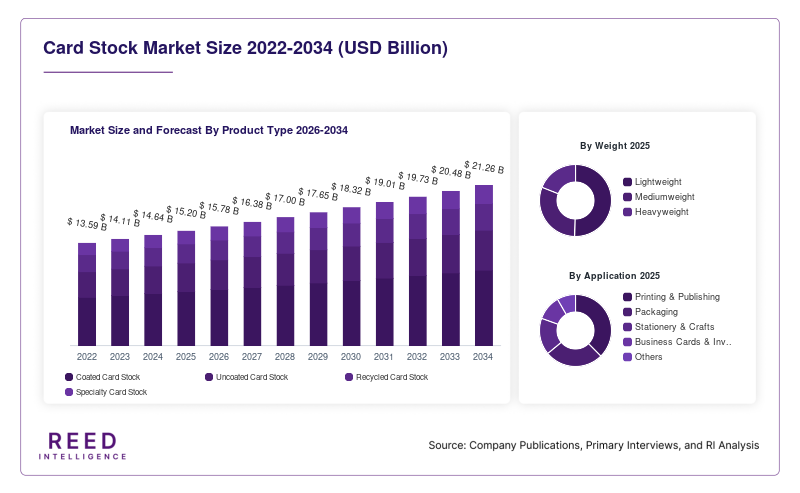
Coated Card Stock accounted for approximately 39% of the global market in 2025. Its leading position is associated with applications where image reproduction, smoothness, color consistency and presentation quality are important purchasing criteria. Commercial printing, premium stationery, promotional materials, packaging inserts and high-quality cards can justify the additional processing associated with coated grades. The segment benefits from applications where the physical appearance of the finished product influences purchasing decisions. However, coating requirements can increase production complexity and may create recycling considerations depending on the coating formulation. The segment therefore faces pressure from customers seeking simpler recyclable constructions while retaining acceptable print quality.
Recycled Card Stock represented approximately 22% of the market in 2025 and is projected to expand at about 4.8% CAGR through 2034. Its expansion is connected to growing demand for paper products with recycled-fiber content and increasing attention to circular-material procurement. EU packaging policy places greater emphasis on recyclability and recycled-material systems, while major paper companies are expanding sustainable product portfolios. Recycled card stock is particularly relevant to stationery, packaging, promotional products and corporate materials where buyers can communicate sustainability attributes alongside product functionality. Its expansion can be limited by fiber quality requirements, color consistency, availability of recovered fiber and the performance requirements of premium printing.
Other product-type growth: Uncoated Card Stock is projected to grow at approximately 3.4% CAGR, while Specialty Card Stock is projected to grow at approximately 4.2% CAGR through 2034.
Weight Analysis
By Weight
Mediumweight Card Stock accounted for approximately 46% of the market in 2025. It provides a balance between rigidity, printability, handling and material cost, allowing it to serve multiple applications rather than being restricted to either lightweight printing or heavy premium constructions. Commercial cards, invitations, promotional materials, stationery and packaging inserts can all use mediumweight grades. This broad application base supports recurring demand across printers, stationery manufacturers and commercial users.
Heavyweight Card Stock accounted for approximately 31% of the market in 2025 and is projected to grow at about 4.5% CAGR through 2034. Its expansion is linked to premium packaging, presentation materials, luxury stationery, high-end invitations and applications where rigidity contributes directly to product perception. The segment benefits when brands prioritize physical presentation and structural performance. Higher material consumption per unit and increased shipping weight, however, can limit adoption in cost-sensitive applications.
Other weight-category growth: Lightweight Card Stock is projected to grow at approximately 3.1% CAGR through 2034.
Application Analysis
By Application
Printing & Publishing accounted for approximately 32% of the global market in 2025. The segment remains supported by commercial cards, brochures, covers, promotional materials, publications and other printed products requiring greater stiffness than ordinary paper. However, its growth is constrained by digital substitution. Stora Enso's 2025 data showing declining European publication-paper demand illustrates the structural pressure affecting conventional print markets.
Packaging is the fastest-growing major application, accounting for approximately 28% of the market in 2025 and expanding at about 4.7% CAGR through 2034. Packaging provides a stronger physical-use case because card stock and related board grades provide rigidity while remaining printable and fiber-based. Global cartonboard consumption increased in 2025, according to Stora Enso, while companies such as Mondi continue investing in sustainable packaging formats.
Other application growth: Stationery & Crafts is projected to grow at approximately 3.7% CAGR, Business Cards & Invitations at 3.2%, and Others at approximately 2.9% CAGR through 2034.
Distribution Channel Analysis
By Distribution Channel
Direct Sales accounted for approximately 43% of the market in 2025. Large printers, packaging converters, stationery manufacturers and commercial buyers frequently require specification-based purchasing, recurring volumes and consistent grades, making direct supplier relationships commercially important. Direct procurement also allows manufacturers to negotiate technical specifications, delivery schedules and volume terms.
Online Channels accounted for approximately 17% of the market in 2025 and are projected to grow at about 5.2% CAGR through 2034. Online purchasing is particularly relevant to small printers, designers, crafts businesses and consumers purchasing specialty card-stock formats in smaller quantities. Product comparison, specification visibility and convenient delivery reduce the friction associated with smaller orders. The segment's expansion may be constrained by shipping costs for heavy paper products and the need to physically evaluate paper texture and color before purchase.
Other distribution-channel growth: Specialty Lighting Stores is not applicable to this market; for Card Stock, Specialty Stores are projected to grow at approximately 3.6% CAGR, while Office Supply Stores are projected to grow at approximately 2.8% CAGR through 2034.
Card Stock Market Regional Analysis
Asia-Pacific Represents the Largest and Fastest-Growing Regional Market Through Manufacturing and Packaging Demand
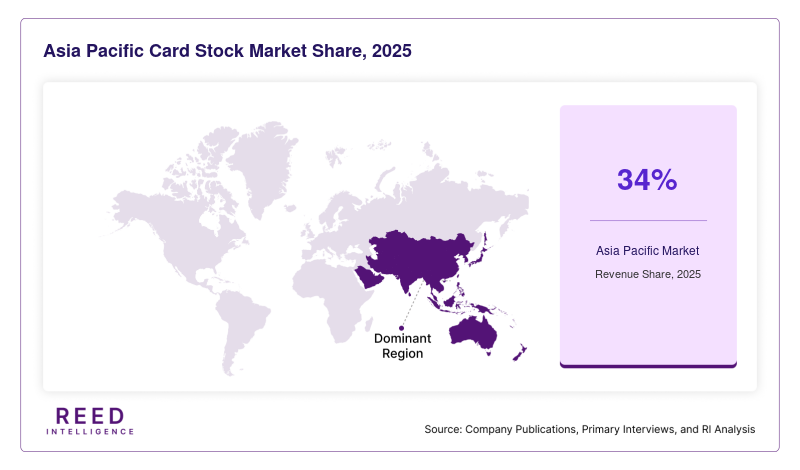
Asia-Pacific accounted for approximately 34% of the global market in 2025 and is projected to grow at about 4.6% CAGR through 2034. The region's position reflects its large manufacturing, printing, packaging and consumer-goods base. Stora Enso's 2025 estimates show Asia and Oceania consuming substantially more consumer board and containerboard than either Europe or North America, highlighting the scale of the region's broader board ecosystem. China is particularly important because of its extensive paper and packaging production capacity. The principal growth mechanism is the interaction between consumer-goods manufacturing, retail packaging, commercial printing and expanding demand for presentation-oriented paper products. Excess capacity remains a constraint, particularly where additional Asian production intensifies competition.
North America Maintains a Large Market Through Commercial Printing and Premium Packaging
North America accounted for approximately 27% of the global market in 2025 and is projected to grow at about 3.5% CAGR through 2034. Demand is supported by commercial printing, packaging, stationery, greeting products and business communications. The region also has a mature distribution structure serving professional printers and small businesses. Smurfit Westrock's extensive North American and international packaging footprint demonstrates the scale of the broader paper-packaging supply chain serving regional customers. Growth is moderated by digital substitution in conventional printed communications, while packaging and specialty applications provide a more durable demand base.
Europe Focuses on Recyclability and Higher-Specification Paper Products
Europe represented approximately 23% of the market in 2025 and is projected to grow at about 3.1% CAGR through 2034. European demand is shaped by established printing industries and packaging applications, but sustainability regulation is becoming a more important product-selection factor. The EU's Packaging and Packaging Waste Regulation establishes recyclability requirements and design-for-recycling provisions that affect paper and cardboard packaging. European producers are consequently investing in recyclable and fiber-based solutions. Stora Enso's consumer-board investment in Finland, including a 750,000-tonne annual-capacity line, illustrates continued investment in packaging-board production. The principal constraints are weak conventional publishing demand and existing board overcapacity.
Latin America Develops Through Packaging, Retail and Commercial Printing
Latin America represented approximately 10% of the market in 2025 and is projected to grow at about 3.6% CAGR through 2034. Demand is connected to retail packaging, food and consumer-product presentation, commercial printing and stationery. Packaging provides a comparatively resilient physical-use case because products still require labels, cartons, inserts and promotional materials even as some document-based printing moves online. Growth depends on consumer spending, industrial production and the development of modern retail channels. Currency volatility, imported paper costs and uneven recycling infrastructure can constrain market development.
Middle East & Africa Remains a Smaller Market with Growth Concentrated in Commercial and Consumer Applications
Middle East & Africa accounted for approximately 6% of the market in 2025 and is projected to grow at about 3.2% CAGR through 2034. Demand is supported by commercial printing, education, retail packaging, hospitality-related materials and stationery. Growth is more closely linked to population expansion, urbanization and development of organized retail and service industries than to mature publishing markets. Local converting and distribution capabilities influence availability because many specialized grades depend on international supply chains. Infrastructure limitations, purchasing-power differences and logistics costs can restrict adoption of premium card-stock products.
Competitive Landscape
Competition in the Card Stock Market is based on grade consistency, fiber sourcing, coating technology, printability, sustainability credentials, manufacturing scale, distribution reach and customer-specific specifications.
Stora Enso is expanding its consumer-packaging-board position through the Oulu investment in Finland. The new line has annual capacity of 750,000 tonnes and is designed to produce folding box board and coated unbleached kraft.
Mondi is positioning its paper and packaging portfolio around recyclable and sustainable materials while continuing targeted investments in production assets. The company reported that 88% of its 2025 revenue came from reusable, recyclable or compostable products.
Key Market Players
Card Stock Market Recent Developments
- March 2025 — Stora Enso began production ramp-up of its new consumer packaging board line at Oulu, Finland, in March 2025. The line is designed for folding box board and coated unbleached kraft, with annual capacity of 750,000 tonnes. The development increases European production capability for packaging-board grades and strengthens Stora Enso's ability to serve customers seeking fiber-based packaging materials.
- 2025 — The EU adopted Regulation 2025/40 establishing requirements covering packaging sustainability, recyclability and design for recycling. The regulation specifically includes paper and cardboard within its packaging-material framework. For card-stock and related board suppliers, the development increases the importance of material composition, recyclability and product design when supplying packaging customers.
Card Stock Market Segments
By Product Type
- Coated Card Stock
- Uncoated Card Stock
- Recycled Card Stock
- Specialty Card Stock
By Weight
- Lightweight
- Mediumweight
- Heavyweight
By Application
- Printing & Publishing
- Packaging
- Stationery & Crafts
- Business Cards & Invitations
- Others
By Distribution Channel
- Direct Sales
- Specialty Stores
- Office Supply Stores
- Online Channels
By Region
- North America
- Europe
- APAC
- Middle East and Africa
- LATAM