Digital Cross Border Remittance Market Size, Share, Growth Demand Report By Channel Type (Mobile-Based Platforms, Bank Transfers, Blockchain-Enabled Solutions, Agent-Based Networks), By End-User (Migrant Workers, SMEs, Enterprises, Freelancers & Gig Economy Users), By Application (Personal Remittances, Business Payments, Trade Settlements, International Payroll Services) By Region & Segment Forecasts, 2026–2034
USD 3950
Market Overview
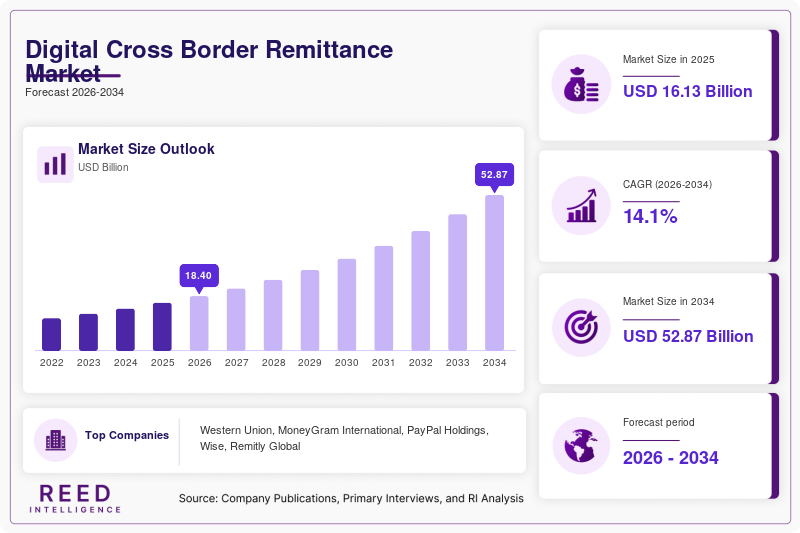
The Digital Cross Border Remittance Market size is projected to reach USD 18.4 billion in 2026 and is expected to advance to approximately USD 52.7 billion by 2034, registering a CAGR of 14.1% during the forecast period 2026–2034. The market growth is primarily supported by the rapid expansion of digital financial infrastructure and the increasing penetration of mobile-based payment platforms across both developed and emerging economies. The shift from traditional remittance channels to digital-first ecosystems has significantly reduced transaction costs and processing time, encouraging widespread adoption among migrant workers and international businesses.
A key global factor driving market expansion is the rising volume of cross-border workforce migration combined with increasing dependency on instant money transfer services. The integration of fintech platforms with banking systems and the growing acceptance of digital wallets have further strengthened transaction efficiency. In addition, regulatory improvements across multiple regions have enhanced transparency and security, increasing consumer confidence in digital remittance services.
Key Highlights
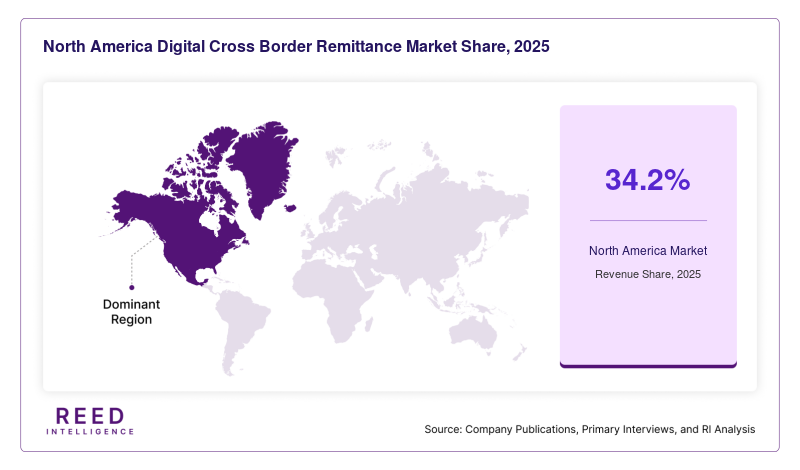
- North America dominated the market with a 34.2% share in 2025.
- Asia Pacific is expected to grow at the fastest CAGR of 11.2% during 2026–2034.
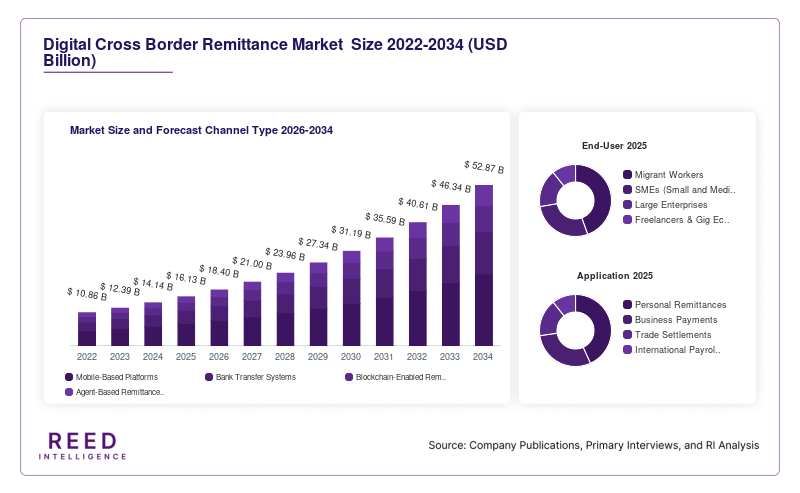
- By channel type, mobile-based remittance platforms accounted for the largest share of 38.5%, while blockchain-enabled remittance solutions are projected to grow at a CAGR of 12.4%.
- By end-user, migrant labor services led with a 41.7% share, whereas SME cross-border payments are expected to expand at a CAGR of 11.8%.
- The United States remained the dominant country, with market values of USD 510 million in 2024 and USD 560 million in 2025.
Market Trends
Expansion of Mobile-First Remittance Ecosystems
The adoption of mobile-first financial ecosystems is reshaping the Digital Cross Border Remittance Market by enabling users to send and receive money instantly through smartphones. Mobile applications integrated with digital wallets and banking APIs are reducing dependency on physical remittance centers. This shift is particularly evident in emerging economies where smartphone penetration is rising rapidly. Financial institutions and fintech providers are investing in user-friendly interfaces, multilingual support, and low-fee transfer options. The growing preference for real-time transaction tracking and instant notifications is also strengthening user engagement and trust in mobile-based remittance platforms across global corridors.
Integration of Blockchain and Real-Time Settlement Systems
Blockchain technology is increasingly being integrated into cross-border remittance systems to improve transparency, reduce transaction costs, and enhance security. Distributed ledger systems allow real-time settlement without intermediaries, which significantly reduces processing delays. Financial institutions are also exploring hybrid blockchain models that combine traditional banking compliance with decentralized efficiency. This trend is gaining traction among corporate users and high-volume remittance corridors. Additionally, real-time payment networks are being adopted to ensure instant fund clearance, improving liquidity management for both senders and recipients. These innovations are transforming operational efficiency in the Digital Cross Border Remittance Market.
Market Drivers
Rising Global Migration and Workforce Mobility
The increasing movement of skilled and unskilled labor across international borders is a major driver of the Digital Cross Border Remittance Market. Migrant workers regularly send funds back to their home countries, creating consistent demand for efficient and low-cost transfer solutions. Governments in several regions are also promoting legal remittance channels to ensure financial inclusion and transparency. Digital platforms offer a faster and more affordable alternative to traditional money transfer operators. As urbanization and global employment opportunities expand, remittance volumes are expected to grow steadily, reinforcing the need for scalable digital payment infrastructure worldwide.
Expansion of Fintech and Digital Banking Infrastructure
The rapid development of fintech ecosystems and digital banking services is significantly accelerating market growth. Financial institutions are collaborating with technology providers to develop integrated remittance platforms that support multi-currency transactions and instant settlements. Open banking frameworks and API-driven connectivity are enabling seamless interoperability between banks and fintech companies. Additionally, the rise of neobanks and digital-only financial institutions is increasing competition and improving service affordability. These advancements are making cross-border payments more accessible to underserved populations while enhancing transaction speed, security, and transparency in the global remittance ecosystem.
Market Restraint
Regulatory Complexity and Compliance Challenges
The Digital Cross Border Remittance Market faces significant constraints due to complex regulatory frameworks across different countries. Varying compliance requirements related to anti-money laundering (AML), know-your-customer (KYC), and data protection laws create operational difficulties for service providers. These regulations often increase onboarding time and operational costs, particularly for fintech startups entering multiple markets. Additionally, inconsistent international financial regulations can slow down cross-border interoperability between payment systems. In some regions, stringent capital controls further restrict remittance flow, limiting market expansion potential and creating friction in seamless digital transaction processing across global corridors.
Market Opportunities
Expansion in Underserved Emerging Economies
Emerging economies present substantial opportunities for the Digital Cross Border Remittance Market due to high inbound remittance dependency and limited access to traditional banking services. Countries in Africa, South Asia, and parts of Latin America are witnessing rapid adoption of mobile financial services. Digital remittance providers can capitalize on this trend by offering low-cost, accessible, and localized solutions. The expansion of agent networks and partnerships with telecom operators is further improving accessibility. As financial inclusion initiatives grow, the demand for efficient cross-border payment systems is expected to rise significantly across underserved populations.
Adoption of AI-Driven Fraud Detection Systems
Artificial intelligence is creating new opportunities in enhancing transaction security and risk management within the remittance ecosystem. AI-powered fraud detection systems can analyze transaction patterns in real time, identifying suspicious activities and preventing financial crimes. These systems also improve customer verification processes and reduce false positives in compliance checks. As cross-border transactions grow in volume, the need for automated risk monitoring tools becomes critical. Financial institutions adopting AI-based analytics are improving operational efficiency while strengthening trust among users, making digital remittance platforms more secure and scalable.
Segmental Analysis
Channel Type Segment
Mobile-based platforms continued to dominate the Digital Cross Border Remittance Market with a 38.5% share in 2024, supported by rapid smartphone penetration, expanding digital literacy, and increasing consumer preference for app-based financial services. These platforms allow users to execute real-time transfers, track transactions instantly, and access multi-currency wallets within a single interface. The integration of biometric authentication, QR-based payments, and seamless banking APIs has further strengthened adoption across both developed and emerging economies. Additionally, reduced transaction fees compared to traditional remittance channels have made mobile platforms the preferred choice among migrant workers and freelancers engaged in frequent cross-border transfers.
Blockchain-enabled remittance solutions represent the fastest-growing subsegment, projected to expand at a CAGR of 13.6% during 2026–2034, driven by the increasing demand for transparency, security, and faster settlement cycles. These systems eliminate multiple intermediaries, thereby significantly reducing transaction costs and processing time. Financial institutions and fintech startups are actively experimenting with hybrid blockchain models that comply with regulatory frameworks while maintaining decentralized efficiency. Growing institutional interest in distributed ledger technology for cross-border settlements is also accelerating adoption. Furthermore, rising concerns around data security and fraud prevention are pushing enterprises to invest in blockchain-based infrastructures for high-value international transactions.
End-User Segment
Migrant workers remained the dominant end-user group, accounting for a 41.7% share in 2024, as they represent the largest volume of recurring cross-border transactions globally. This segment relies heavily on remittance services to support family income, education expenses, and healthcare needs in home countries. Digital platforms offer significant advantages such as lower transfer fees, instant delivery, and 24/7 accessibility, making them highly suitable for this user base. The growing shift from cash-based remittance agents to mobile-first platforms has further enhanced convenience and reduced dependency on physical infrastructure. In addition, government-led financial inclusion programs are encouraging formal digital channels, improving transparency and increasing adoption among migrant populations.
SME cross-border payments are the fastest-growing subsegment, projected to grow at a CAGR of 12.9% during 2026–2034, driven by the expansion of global trade, e-commerce exports, and freelance digital services. Small and medium enterprises are increasingly adopting digital remittance solutions for supplier payments, international payroll, and subscription-based global services. The integration of API-driven banking systems and automated invoicing tools is enabling seamless financial operations across borders. Furthermore, fintech innovations are reducing foreign exchange conversion costs and improving transaction speed, which is particularly beneficial for SMEs operating on thin margins. The rise of digital marketplaces and global outsourcing trends is expected to further strengthen this segment.
Application Segment
Personal remittances dominated the market with a 44.2% share in 2024, primarily driven by the continuous flow of international migration and the financial dependency of families in developing economies. This segment benefits from high-frequency, low-value transactions that require fast, secure, and affordable transfer mechanisms. Digital platforms are increasingly replacing traditional remittance corridors due to their ability to offer real-time transfers, lower fees, and enhanced accessibility. Mobile wallets and fintech applications have become the primary channels for personal remittances, especially among younger, tech-savvy users. Additionally, increased awareness of formal financial systems is reducing reliance on informal cash-based transfers, strengthening the digital ecosystem.
Business payments are emerging as the fastest-growing subsegment, projected to grow at a CAGR of 12.7% during 2026–2034, driven by globalization of supply chains and rising cross-border e-commerce activity. Enterprises are adopting digital remittance solutions to streamline international vendor payments, contractor settlements, and recurring subscription-based services. The shift toward cloud-based accounting systems and integrated financial platforms is enabling automated cross-border transactions with improved accuracy and reduced settlement time. Moreover, the increasing adoption of real-time payment networks and multi-currency business accounts is enhancing liquidity management for companies operating in multiple regions.
Regional Analysis
North America
North America accounted for a 34.2% market share in 2025 and is expected to grow at a CAGR of 12.8% during 2026–2034, driven by strong fintech penetration and advanced digital payment infrastructure. The region benefits from a mature financial ecosystem where digital banking, mobile wallets, and real-time payment systems are widely adopted. Cross-border remittance flows between the United States, Mexico, and Canada remain a key contributor to market expansion. Additionally, increasing adoption of AI-powered fraud detection and blockchain-based payment systems is improving transaction security and efficiency, further strengthening the region’s leadership in digital remittance innovation.
The United States remains the dominant country in North America due to its large immigrant population and high volume of outbound and inbound remittance transactions. A key growth factor is the rapid integration of fintech services into traditional banking systems, enabling seamless cross-border transfers through digital platforms. The expansion of neobanks and partnerships between financial institutions and technology providers is also accelerating service innovation. Moreover, increasing consumer preference for low-cost, instant money transfer solutions continues to drive strong market adoption across diverse user segments.
Europe
Europe held a 27.5% market share in 2025 and is projected to grow at a CAGR of 11.6% during 2026–2034, supported by regulatory harmonization and strong digital banking adoption. The region benefits from the Single Euro Payments Area (SEPA), which facilitates efficient cross-border transactions across member countries. Rising intra-European labor mobility and increasing migration from non-EU countries are contributing to steady remittance demand. Furthermore, the adoption of instant payment systems and open banking frameworks is enhancing interoperability between financial institutions, improving user experience and reducing transaction delays.
Germany leads the European market due to its strong economy, large expatriate workforce, and advanced financial infrastructure. A key growth factor in Germany is the rapid adoption of digital-first banking solutions combined with strong regulatory compliance frameworks that support secure cross-border transactions. Additionally, increasing fintech investments across the United Kingdom, France, and Nordic countries are driving innovation in mobile-based remittance platforms. Growing demand for transparent and cost-efficient international payment systems is further strengthening market expansion across Europe.
Asia Pacific
Asia Pacific accounted for 23.8% market share in 2025 and is expected to grow at the fastest CAGR of 15.2% during 2026–2034, driven by large-scale labor migration, rising smartphone penetration, and rapid digital financial transformation. The region has a high dependency on remittance inflows, particularly in countries such as India, the Philippines, and Bangladesh. Government initiatives promoting cashless economies and digital financial inclusion are significantly boosting the adoption of mobile-based remittance platforms. Additionally, increasing cross-border e-commerce activity is contributing to higher transaction volumes across the region.
India and China dominate the Asia Pacific market due to their large migrant populations and advanced fintech ecosystems. In India, the widespread adoption of Unified Payments Interface (UPI) and digital wallets is accelerating cross-border remittance flows. In China, strong integration of fintech platforms with banking systems is enabling seamless international transactions. A key growth factor across the region is the rapid expansion of digital infrastructure combined with supportive government policies encouraging financial digitization and cross-border payment modernization.
Middle East & Africa
Middle East & Africa held a 9.4% market share in 2025 and is projected to grow at a CAGR of 13.5% during 2026–2034, driven by high expatriate populations and strong remittance inflows from Gulf Cooperation Council (GCC) countries. The region relies heavily on foreign labor, resulting in consistent cross-border fund transfers to South Asia and Africa. Increasing smartphone adoption and the growth of digital wallet ecosystems are further enhancing access to formal remittance channels. Additionally, regulatory reforms aimed at improving financial transparency are supporting market expansion.
The United Arab Emirates leads the regional market due to its large migrant workforce and advanced digital financial infrastructure. A key growth factor is the government’s strong push toward cashless payment systems and fintech adoption, which is transforming traditional remittance channels. The expansion of mobile banking services and partnerships between financial institutions and telecom operators is also improving accessibility. Moreover, rising investment in digital payment gateways across Saudi Arabia and South Africa is contributing to broader regional growth.
Latin America
Latin America accounted for 5.1% market share in 2025 and is expected to grow at a CAGR of 12.1% during 2026–2034, driven by increasing remittance inflows from North America and rising adoption of digital financial services. The region has a strong dependence on cross-border transfers, particularly from migrant workers in the United States. Growing smartphone penetration and expansion of fintech startups are accelerating the shift toward digital remittance platforms. Additionally, increasing government support for financial inclusion is improving access to formal banking channels.
Mexico is the dominant country in the Latin American market due to its high remittance inflows and proximity to the United States. A key growth factor is the rapid expansion of mobile banking services and digital wallets, which are making cross-border transactions more accessible and affordable. The increasing collaboration between fintech companies and traditional banks is further strengthening financial infrastructure. Additionally, rising adoption of digital payment solutions among younger populations is supporting long-term market growth in the region.
Competitive Landscape
The Digital Cross Border Remittance Market is highly competitive, with major players focusing on digital transformation, partnerships, and technological innovation. Leading companies are investing in AI-based compliance tools, blockchain integration, and mobile-first platforms to strengthen their global presence.
Key players include Western Union, MoneyGram International, PayPal Holdings, Wise (TransferWise), and Remitly Global. Among these, PayPal Holdings remains a leading company due to its extensive digital payment ecosystem and continuous expansion into cross-border services. A recent development includes PayPal’s enhancement of real-time international transfer capabilities through expanded fintech partnerships and API integration, improving transaction speed and global reach.
Key Players
- Western Union
- MoneyGram International
- PayPal Holdings
- Wise
- Remitly Global
- WorldRemit
- Ria Money Transfer
- Xoom Corporation
- Payoneer
- Revolut
- Stripe
- Skrill
- TransferGo
- Azimo
- OFX Group
Recent Developments
- In 2025, digital remittance providers expanded the deployment of AI-driven compliance systems to strengthen real-time fraud detection, improve transaction monitoring, and reduce onboarding delays across high-volume cross-border corridors.
- In 2025, several fintech companies enhanced blockchain-based settlement pilots to enable near-instant international transfers, reducing reliance on traditional correspondent banking networks and improving cost efficiency for end users.
- In 2024, leading digital remittance platforms introduced upgraded mobile wallet integrations with multi-currency support, allowing users to store, convert, and transfer funds seamlessly across multiple regions through unified applications.
- In 2024, major cross-border payment providers strengthened strategic partnerships with regional banks and telecom operators to expand agent networks and improve financial inclusion in underserved rural and semi-urban markets.
Digital Cross Border Remittance Market Segments
Channel Type
- Mobile-Based Platforms
- Bank Transfer Systems
- Blockchain-Enabled Remittance Solutions
- Agent-Based Remittance Networks
End-User
- Migrant Workers
- SMEs (Small and Medium Enterprises)
- Large Enterprises
- Freelancers & Gig Economy Users
Application
- Personal Remittances
- Business Payments
- Trade Settlements
- International Payroll Services
By Region
- North America
- Europe
- APAC
- Middle East and Africa
- LATAM