Dispute Advisory And International Arbitration Market Size, Share, Demand Report By Service Type (Arbitration Advisory Services, Litigation Support Services, Dispute Management & Resolution Consulting, AI-Driven Legal Analytics & Case Assessment Solutions), By End-Use Industry (Corporate Enterprises, Construction & Infrastructure, Energy & Utilities, Financial Services, Government & Public Sector), By Dispute Type (Commercial Contract Disputes, Investment Treaty Disputes, Construction & Engineer
USD 3950
Market Overview
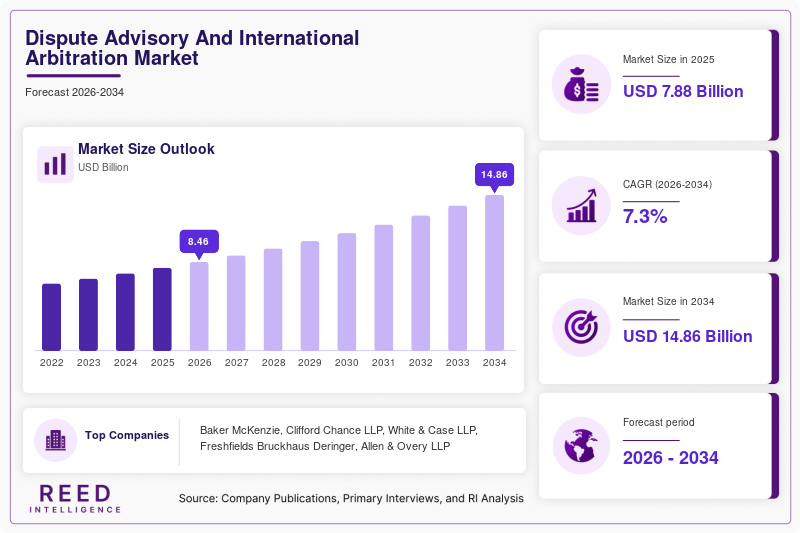
The Dispute Advisory And International Arbitration Market size is projected to reach USD 8.45 billion in 2026 and is expected to attain USD 14.92 billion by 2034, growing at a CAGR of 7.3% during the forecast period (2026–2034). The market is expanding due to increasing cross-border trade disputes, rising geopolitical tensions, and the growing complexity of international commercial contracts. Organizations are increasingly relying on structured arbitration frameworks and dispute advisory services to resolve conflicts efficiently outside traditional court systems.
One major global factor supporting market growth is the rapid globalization of supply chains, which has significantly increased the probability of multi-jurisdictional contractual disputes. Companies operating across multiple legal systems require neutral arbitration mechanisms to reduce litigation costs and time delays. Additionally, international arbitration has gained preference due to its enforceability under global conventions such as the New York Convention, which enhances legal certainty in cross-border dispute resolution. The market is also benefiting from the integration of digital technologies, including AI-assisted case analysis, e-discovery tools, and virtual arbitration hearings. These innovations are improving efficiency and reducing procedural delays, making arbitration more accessible to mid-sized enterprises as well.
Key Highlights
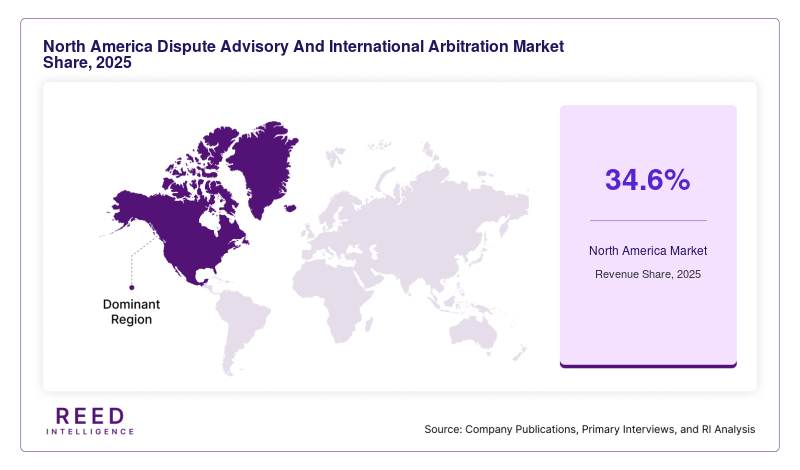
- North America dominated the market with a 34.6% share in 2025.
- Asia Pacific is expected to grow at the fastest CAGR of 11.5% during 2026–2034.
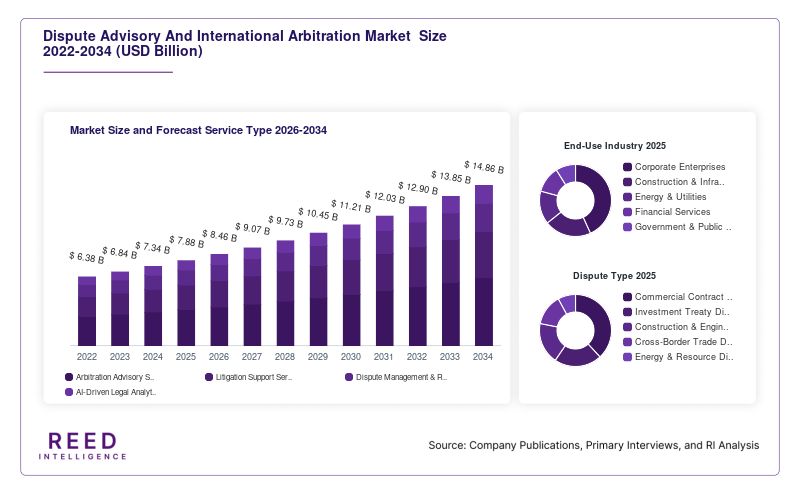
- By service type, arbitration advisory services accounted for the largest share of 39.1%, while litigation support solutions are projected to grow at a CAGR of 12.2%.
- By end-use, corporate enterprises led with a 42.8% share, whereas construction and infrastructure disputes represent the fastest-growing segment at 11.9% CAGR.
- The United States remained the dominant country, with market values of USD 1.18 billion in 2024 and USD 1.26 billion in 2025.
Market Trends
Digital Transformation of Arbitration Processes
The Dispute Advisory And International Arbitration Market is witnessing a strong shift toward digital transformation, where arbitration proceedings are increasingly conducted through virtual platforms. Law firms and arbitration institutions are adopting cloud-based case management systems, AI-powered document review tools, and automated evidence classification systems. This transition is significantly reducing administrative burdens and accelerating case resolution timelines. Virtual hearings have also become a standard practice for cross-border disputes, especially after global disruptions increased the need for remote legal proceedings. The use of blockchain for secure evidence storage is also emerging as a key innovation, ensuring data integrity and transparency across arbitration cases.
Increasing Preference for Institutional Arbitration Frameworks
Another significant trend shaping the market is the growing preference for institutional arbitration over ad hoc arbitration. Institutions such as international arbitration centers provide standardized procedures, neutral administration, and enforceable procedural rules, which enhance trust among disputing parties. Businesses are increasingly selecting established arbitration bodies to mitigate risks associated with inconsistent rulings and procedural inefficiencies. Additionally, multinational corporations prefer institutional frameworks due to their credibility in handling high-value disputes. The trend is further reinforced by rising cross-border mergers, acquisitions, and infrastructure projects, where legal certainty and neutrality are critical for dispute resolution outcomes.
Market Drivers
Rising Cross-Border Commercial Disputes
One of the primary drivers of the Dispute Advisory And International Arbitration Market is the continuous increase in cross-border commercial transactions, which naturally leads to a higher incidence of contractual disputes. Globalization has expanded trade relationships across jurisdictions with different legal frameworks, increasing the complexity of resolving disagreements. Companies engaged in international trade require efficient mechanisms that avoid lengthy litigation in foreign courts. Arbitration provides a neutral, faster, and more enforceable solution. Additionally, multinational corporations are embedding arbitration clauses into contracts as a standard risk mitigation strategy, further driving demand for advisory services and dispute resolution professionals.
Expansion of Infrastructure and Energy Projects
Large-scale infrastructure, energy, and construction projects are significantly contributing to market growth due to their high-value contracts and long execution timelines. These projects often involve multiple stakeholders across different countries, increasing the likelihood of disputes over delays, cost overruns, and contract interpretations. International arbitration is widely preferred in these sectors due to its technical expertise and confidentiality. Governments and private investors are increasingly incorporating arbitration clauses in public-private partnership agreements to ensure efficient dispute resolution. The rising investment in renewable energy and cross-border infrastructure corridors is further strengthening demand for specialized arbitration advisory services.
Market Restraint
High Cost and Complexity of Arbitration Proceedings
Despite its advantages, the Dispute Advisory And International Arbitration Market faces challenges due to the high cost and procedural complexity associated with arbitration proceedings. Legal fees, arbitrator charges, institutional expenses, and expert witness costs can become substantial, particularly in multi-party international disputes. Small and medium-sized enterprises often find these costs prohibitive, limiting their access to arbitration mechanisms. Additionally, complex procedural requirements and extensive documentation processes can lead to prolonged case durations, reducing the perceived efficiency of arbitration. In some regions, lack of awareness regarding cost-effective arbitration alternatives further restricts market penetration among smaller organizations.
Market Opportunities
Growth of Technology-Driven Arbitration Solutions
The increasing integration of advanced technologies presents a major opportunity in the Dispute Advisory And International Arbitration Market. Artificial intelligence, machine learning, and natural language processing are being used to analyze legal documents, predict case outcomes, and streamline evidence management. These innovations significantly reduce the time required for dispute resolution and improve accuracy in legal assessments. Additionally, online dispute resolution platforms are expanding access to arbitration services for smaller businesses. The development of fully digital arbitration ecosystems is expected to democratize access to international dispute resolution services, especially in emerging economies.
Expansion in Emerging Economies
Emerging markets present substantial growth opportunities due to rapid industrialization, foreign investment inflows, and evolving legal frameworks. Countries in Asia Pacific, Latin America, and parts of Africa are strengthening their arbitration laws to attract international investors and improve ease of doing business. The establishment of regional arbitration centers is enhancing accessibility and reducing dependency on Western institutions. As multinational companies expand operations in these regions, demand for localized dispute advisory services is increasing. This trend is creating opportunities for global law firms and arbitration specialists to establish regional partnerships and expand their service offerings.
Segmental Analysis
Service Type
Arbitration Advisory Services dominated the Dispute Advisory And International Arbitration Market with a 39.1% share in 2024, driven by rising complexity in cross-border contracts and increasing reliance on expert legal structuring at the pre-dispute stage. Large multinational corporations prefer advisory services to design arbitration clauses that reduce jurisdictional ambiguity and ensure enforceability across multiple legal systems. The growing volume of international trade agreements, joint ventures, and mergers and acquisitions has further strengthened demand for advisory-led dispute prevention strategies. In addition, organizations are increasingly engaging specialized arbitration consultants to evaluate risk exposure before contract execution, which is becoming a standard compliance practice in global business environments.
Litigation Support and Dispute Resolution Services are expected to grow at a CAGR of 12.2%, supported by the rapid adoption of digital legal technologies and AI-driven case analytics. This segment is gaining momentum as firms seek faster, more cost-efficient dispute handling solutions in high-value international cases. The integration of e-discovery tools, automated document review systems, and predictive case outcome modeling is significantly improving efficiency in arbitration proceedings. Additionally, the rising number of complex infrastructure and energy disputes is increasing demand for technical expert support within arbitration cases, further accelerating growth in this segment.
End-Use Industry
Corporate Enterprises accounted for the largest share of 42.8% in 2024, primarily due to their extensive involvement in global supply chains, licensing agreements, and cross-border investment activities. These enterprises frequently encounter contractual disagreements related to pricing structures, delivery obligations, intellectual property rights, and regulatory compliance. As a result, arbitration has become the preferred dispute resolution mechanism due to its confidentiality, neutrality, and enforceability across jurisdictions. Large corporations are also investing in in-house dispute advisory teams and external arbitration specialists to proactively manage legal risks and reduce exposure to costly litigation.
The Construction and Infrastructure segment is projected to grow at a CAGR of 11.9%, making it one of the fastest-expanding end-use industries. This growth is fueled by large-scale public-private partnership projects, international infrastructure development, and cross-border engineering contracts. Disputes in this sector often involve project delays, cost overruns, contract variations, and technical disagreements, requiring specialized arbitration expertise. Increasing investments in smart cities, renewable energy infrastructure, and transportation networks are further intensifying demand for structured dispute resolution mechanisms. Arbitration is widely preferred in this segment due to its ability to handle technically complex and high-value disputes efficiently.
Dispute Type
Commercial Disputes held the dominant position with a 41.5% share in 2024, driven by the expansion of global trade networks and increasing complexity of international commercial contracts. These disputes often arise from disagreements over contract interpretation, payment terms, supply chain obligations, and service delivery failures. Arbitration is widely used in commercial disputes due to its speed, confidentiality, and global enforceability, particularly under international conventions. The growing digitization of trade agreements and cross-border e-commerce transactions is further contributing to the rising frequency of commercial disputes.
Investment Treaty Disputes are expected to grow at a CAGR of 10.8%, supported by increasing foreign direct investment activities and government-private sector collaborations in emerging markets. These disputes typically involve conflicts between investors and sovereign states over regulatory changes, taxation policies, and expropriation claims. The rising complexity of international investment agreements and geopolitical uncertainties has significantly increased reliance on arbitration tribunals. Governments are also strengthening bilateral investment treaties, which is expected to further expand this segment over the forecast period.
Regional Analysis
North America
North America held a dominant 34.6% share of the global Dispute Advisory And International Arbitration Market in 2025 and is expected to grow at a CAGR of 6.8% during the forecast period. The region’s leadership is supported by a highly developed legal ecosystem, strong enforcement of arbitration awards, and the presence of major multinational corporations. Increasing cross-border transactions with Europe and Asia continues to generate demand for structured dispute resolution mechanisms. The widespread adoption of digital legal technologies and AI-powered litigation tools is also enhancing efficiency in arbitration processes across the region.
The United States leads the North American market due to its strong arbitration institutions, high concentration of global law firms, and frequent involvement in international commercial disputes. A key growth factor is the increasing integration of technology-driven legal solutions, including predictive analytics and virtual hearing platforms, which are significantly improving case management efficiency. Canada also contributes steadily to regional growth, supported by strong trade relations and a stable regulatory environment that encourages arbitration-based dispute resolution.
Europe
Europe accounted for 27.9% of the global market share in 2025 and is projected to grow at a CAGR of 7.1% during the forecast period. The region benefits from a well-established legal framework, strong institutional arbitration systems, and high adoption of standardized dispute resolution practices across countries. Increasing intra-European trade, infrastructure development, and energy transition projects are driving demand for arbitration services. The presence of multiple arbitration centers further strengthens the region’s position in the global market.
Germany dominates the European market due to its export-driven economy and strong industrial base, which frequently engages in cross-border contracts. A key growth driver is the rising number of disputes emerging from renewable energy investments and large-scale infrastructure modernization projects. The United Kingdom also remains a major hub for arbitration services, supported by its global legal expertise, strong judicial support for arbitration enforcement, and its role as a preferred jurisdiction for international commercial contracts.
Asia Pacific
Asia Pacific held a 23.4% market share in 2025 and is projected to grow at the fastest CAGR of 11.5% during the forecast period. Rapid industrialization, expanding foreign direct investment, and large-scale infrastructure development are driving strong demand for arbitration services. The region is increasingly becoming a global hub for dispute resolution, supported by the establishment of modern arbitration centers and reforms in commercial laws. Cross-border trade expansion within ASEAN and Belt and Road Initiative-related projects further strengthens market growth.
China leads the Asia Pacific market due to its massive infrastructure investments and extensive global trade relationships. A major growth factor is the development of international arbitration institutions supporting large-scale infrastructure and construction contracts. India is also emerging as a significant market due to regulatory reforms, increasing foreign investment inflows, and growing awareness of alternative dispute resolution mechanisms among corporate enterprises.
Middle East & Africa
The Middle East & Africa region accounted for 8.2% of the global market share in 2025 and is expected to grow at a CAGR of 9.3% during the forecast period. Growth is driven by large-scale infrastructure investments, oil and gas sector disputes, and increasing participation of international contractors in regional projects. Governments in the region are actively strengthening arbitration laws to attract foreign investors and improve ease of doing business. The growing number of mega-projects in construction and energy is significantly contributing to demand for dispute advisory services.
The United Arab Emirates leads the regional market due to its position as a global arbitration hub and its well-developed legal infrastructure supporting international dispute resolution. A key growth factor is the increasing volume of real estate and energy-related disputes arising from large-scale development projects. Saudi Arabia is also witnessing strong growth, driven by economic diversification initiatives under national transformation programs and rising foreign investment in infrastructure and industrial sectors.
Latin America
Latin America held a 6.9% share of the global market in 2025 and is projected to grow at a CAGR of 8.4% during the forecast period. The region’s growth is supported by economic reforms, increasing foreign direct investment, and expanding infrastructure development projects. Governments are increasingly adopting arbitration-friendly legal frameworks to attract international investors and reduce litigation risks. Trade liberalization policies are also contributing to a higher volume of cross-border commercial agreements requiring dispute resolution mechanisms.
Brazil dominates the Latin American market due to its large industrial base and active participation in global trade networks. A key growth factor is the rising number of public-private partnership projects in transportation, energy, and urban development sectors, which frequently require arbitration services. Mexico is also emerging as a strong market, supported by its integration into global supply chains and increasing cross-border trade activities with North America.
Competitive Landscape
The Dispute Advisory And International Arbitration Market is moderately consolidated, with leading firms focusing on expanding global arbitration capabilities and integrating digital legal technologies. Major players include international law firms, arbitration institutions, and specialized dispute advisory consultancies. Firms are increasingly investing in AI-based legal analytics and cross-border advisory networks to enhance competitiveness. A key market leader recently expanded its Asia Pacific arbitration division to strengthen regional presence and improve service delivery for infrastructure-related disputes.
Key Players
- Baker McKenzie
- Clifford Chance LLP
- White & Case LLP
- Freshfields Bruckhaus Deringer
- Allen & Overy LLP
- Herbert Smith Freehills
- Jones Day
- Skadden, Arps, Slate, Meagher & Flom LLP
- Linklaters LLP
- WilmerHale
- King & Spalding LLP
- Norton Rose Fulbright
- Dentons
- CMS Legal Services
- Reed Smith LLP
Recent Developments
- In 2025, major international arbitration institutions expanded their digital hearing infrastructure by integrating advanced virtual case management systems to support fully remote cross-border dispute resolution. This development is improving accessibility for multinational corporations and reducing procedural delays in high-value international arbitration cases.
- In 2025, leading global law firms introduced AI-powered dispute advisory platforms designed to automate document review, contract analysis, and legal risk assessment. These solutions are enhancing efficiency in arbitration preparation and significantly reducing turnaround time for complex multi-jurisdictional disputes.
- In 2024, several arbitration centers across Europe and Asia Pacific upgraded their institutional frameworks by adopting blockchain-based evidence management systems to improve transparency, data security, and traceability of submitted legal documents in international arbitration proceedings.
Dispute Advisory And International Arbitration Market Segments
Service Type
- Arbitration Advisory Services
- Litigation Support Services
- Dispute Management & Resolution Consulting
- AI-Driven Legal Analytics & Case Assessment Solutions
End-Use Industry
- Corporate Enterprises
- Construction & Infrastructure
- Energy & Utilities
- Financial Services
- Government & Public Sector
Dispute Type
- Commercial Contract Disputes
- Investment Treaty Disputes
- Construction & Engineering Disputes
- Cross-Border Trade Disputes
- Energy & Resource Disputes
By Region
- North America
- Europe
- APAC
- Middle East and Africa
- LATAM