Dry Ice Cleaning Market Size, Share, Demand Report By Equipment Type (Dry Ice Blasting Machines, Nozzle Systems, Compressors, Accessories), By Application (Industrial Equipment Cleaning, Automotive Maintenance, Aerospace Maintenance, Electronics Cleaning, Food Processing, Restoration Services), By End-Use (Manufacturing, Oil & Gas, Power Generation, Food & Beverage, Healthcare, Transportation) By Regional Outlook & Segment Forecasts, 2026–2034
USD 3950
Market Overview
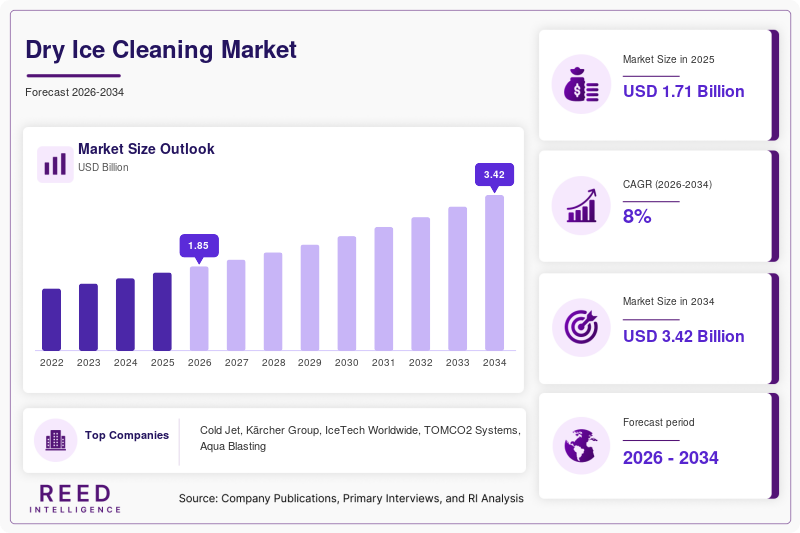
The Dry Ice Cleaning Market size is projected to reach approximately USD 1.85 billion in 2026 and is anticipated to grow to nearly USD 3.42 billion by 2034, registering a CAGR of 8.0% during 2026–2034. The market is gaining structured momentum due to increasing industrial emphasis on non-abrasive, chemical-free cleaning technologies that improve operational uptime and reduce equipment downtime across manufacturing and processing facilities. Rising regulatory pressure on solvent-based cleaning methods and a global shift toward sustainable industrial maintenance practices have further strengthened adoption across multiple end-use industries. Dry ice cleaning, which uses solid CO₂ pellets for surface cleaning without secondary waste, continues to expand in sectors requiring precision and contamination control, such as aerospace, food processing, automotive, and power generation.
One of the primary global factors supporting market expansion is the increasing modernization of industrial infrastructure combined with automation in maintenance systems. Industries are adopting advanced cleaning technologies that minimize manual intervention and reduce shutdown periods, thereby improving production efficiency. Additionally, the growing awareness of environmental compliance standards has encouraged organizations to replace traditional sandblasting and chemical cleaning methods with dry ice blasting systems
Key Highlights
- North America dominated the market with a 34.2% share in 2025.
- while Asia Pacific is expected to grow at the fastest CAGR of 11.2% during 2026–2034.
- By equipment type, dry ice blasting machines accounted for the largest share of 38.5%.
- while nozzle systems are projected to grow at a CAGR of 12.1%.
- By application, industrial equipment cleaning led with a 41.7% share.
- whereas aerospace maintenance applications are expected to expand at a CAGR of 11.5%.
- The United States remained the dominant country, with market values of USD 610 million in 2024 and USD 665 million in 2025.
Market Trends
Expansion of Non-Abrasive Industrial Cleaning Solutions
A notable trend in the Dry Ice Cleaning Market is the increasing shift toward non-abrasive and residue-free cleaning technologies across heavy industries. Manufacturing facilities are gradually replacing traditional methods such as sandblasting, steam cleaning, and chemical washing with dry ice blasting systems. This transition is driven by the need to preserve equipment integrity, reduce surface wear, and eliminate secondary waste generation. Industries such as automotive assembly, electronics manufacturing, and food processing are adopting these systems to maintain compliance with hygiene and safety regulations. The ability of dry ice cleaning to clean complex machinery without disassembly further enhances its adoption, especially in high-value production environments where downtime costs are significant.
Integration of Automated and Robotic Cleaning Systems
Another emerging trend is the integration of automated and semi-automated dry ice cleaning systems into industrial workflows. Companies are increasingly deploying robotic arms and programmable cleaning systems to improve precision and reduce labor dependency. These systems allow consistent cleaning performance in hazardous or hard-to-reach environments, such as turbine blades, engine components, and confined manufacturing units. The integration of IoT-based monitoring systems is also enabling real-time tracking of cleaning efficiency and equipment performance. This technological evolution is improving operational predictability and reducing maintenance-related disruptions across large-scale industrial facilities, thereby strengthening long-term market adoption.
Market Drivers
Increasing Demand for Sustainable Cleaning Technologies
The rising demand for environmentally sustainable industrial cleaning solutions is a major driver of the Dry Ice Cleaning Market. Organizations are increasingly adopting processes that eliminate chemical usage and reduce hazardous waste generation. Dry ice cleaning utilizes recycled CO₂ pellets, which sublimate upon impact, leaving no secondary residue. This makes it highly suitable for industries operating under strict environmental regulations. Sectors such as food and beverage processing, pharmaceuticals, and electronics manufacturing are particularly focused on minimizing contamination risks while adhering to sustainability goals. The shift toward green manufacturing practices is significantly accelerating market penetration across both developed and emerging economies.
Rising Need for Equipment Maintenance Efficiency
Another key driver is the growing need for efficient and cost-effective maintenance of industrial equipment. Traditional cleaning methods often require extended downtime and manual labor, leading to productivity losses. Dry ice cleaning reduces maintenance cycles by enabling in-place cleaning without disassembly. This improves asset utilization and extends equipment lifespan. Industries with continuous production lines, such as power generation and automotive manufacturing, are increasingly adopting this technology to maintain operational continuity. Additionally, the ability to clean sensitive electrical and mechanical components without moisture exposure is further increasing its application scope.
Market Restraint
High Initial Equipment Investment and Operational Costs
One of the primary restraints affecting the Dry Ice Cleaning Market is the relatively high initial investment required for equipment procurement and system installation. Dry ice blasting machines, compressors, and storage systems involve significant capital expenditure, which can limit adoption among small and medium-sized enterprises. Additionally, the recurring cost of dry ice supply and logistics adds to operational expenses. In regions with limited CO₂ production infrastructure, supply chain inefficiencies can further increase costs. These financial constraints often lead organizations to continue using conventional cleaning methods, particularly in price-sensitive industrial segments where cost optimization is prioritized over technological advancement.
Market Opportunities
Expansion in Emerging Industrial Economies
Emerging economies present a substantial growth opportunity for the Dry Ice Cleaning Market due to rapid industrialization and infrastructure development. Countries in Asia Pacific, Latin America, and parts of the Middle East are witnessing increased investments in manufacturing facilities, automotive production units, and energy plants. As these industries expand, the demand for efficient maintenance technologies is also rising. Dry ice cleaning systems are gaining attention due to their ability to improve productivity and reduce environmental impact. Government initiatives promoting sustainable industrial practices are further encouraging adoption, creating a favorable environment for market expansion across developing regions.
Growth in Aerospace and Precision Engineering Applications
The aerospace and precision engineering sectors offer strong growth potential for dry ice cleaning technologies. Aircraft maintenance requires high-precision cleaning methods that do not damage sensitive components or introduce moisture-related risks. Dry ice blasting is increasingly being used for turbine cleaning, engine maintenance, and composite surface preparation. Similarly, precision manufacturing industries such as semiconductor production and medical device manufacturing are adopting this technology for contamination-free cleaning. The increasing complexity of engineered components and stricter safety standards are expected to drive long-term adoption in these high-value industries.
Segmental Analysis
Equipment Type Segment
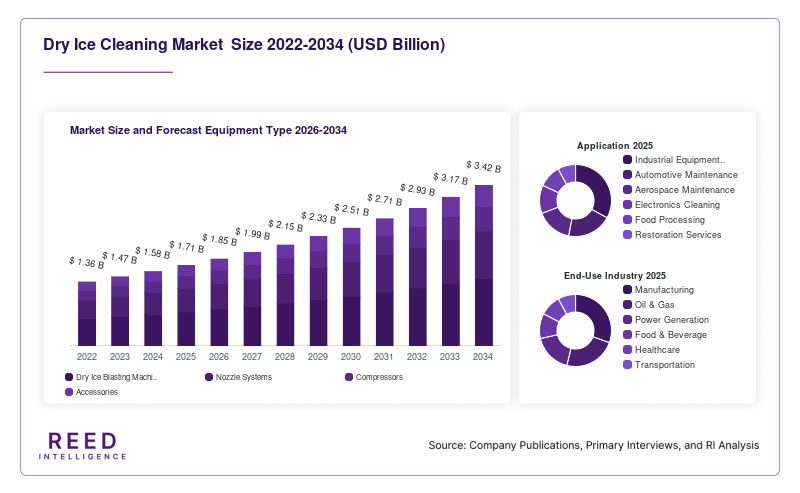
Dry ice blasting machines accounted for the dominant share of 38.5% in 2024 within the equipment type segment. These systems are widely used due to their efficiency in removing contaminants without damaging sensitive surfaces. Their adoption is particularly strong in large-scale industrial facilities where continuous cleaning operations are required. The demand is further supported by improvements in machine portability and energy efficiency.
Nozzle systems represent the fastest-growing subsegment with a CAGR of 12.1% during the forecast period. Growth is driven by advancements in precision cleaning technology and the need for customized cleaning patterns in complex machinery. Enhanced nozzle designs that improve pellet velocity control and reduce dry ice consumption are gaining traction across aerospace and electronics manufacturing sectors.
Application Segment
Industrial equipment cleaning led the application segment with a 41.7% share in 2024. This dominance is attributed to widespread usage in manufacturing plants, power generation units, and automotive assembly lines. The ability to clean machinery without disassembly and reduce downtime significantly supports this segment’s leadership position.
Aerospace maintenance is the fastest-growing application with a CAGR of 11.5%, driven by increasing aircraft fleet sizes and rising maintenance requirements. The need for moisture-free and non-corrosive cleaning methods is accelerating adoption in turbine and engine maintenance operations.
End-Use Segment
Manufacturing industries accounted for the largest share of 39.2% in 2024. High reliance on continuous production systems and the need for regular maintenance of machinery contribute to this dominance. Dry ice cleaning helps improve operational efficiency and reduce production interruptions.
The food & beverage sector is expected to grow at a CAGR of 10.9%, driven by strict hygiene standards and regulatory compliance requirements. The non-toxic and residue-free nature of dry ice cleaning makes it highly suitable for processing and packaging equipment
Regional Analysis
North America
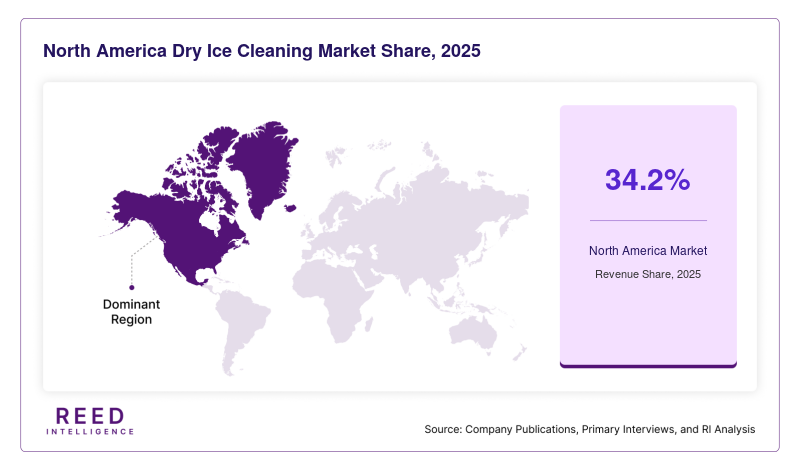
North America accounted for a 34.2% market share in 2025 and is expected to maintain steady growth during the forecast period. The region is projected to register a CAGR of 7.6% from 2026 to 2034, supported by strong industrial automation and advanced manufacturing infrastructure.
The United States dominates the regional landscape due to its extensive aerospace, automotive, and food processing industries. Growth is driven by increasing adoption of maintenance optimization technologies and strict environmental compliance regulations encouraging the replacement of chemical-based cleaning systems.
Europe
Europe held a 27.8% market share in 2025 and is projected to grow at a CAGR of 7.4% through 2034. The region benefits from strong regulatory frameworks focused on industrial sustainability and workplace safety.
Germany leads the European market due to its advanced automotive manufacturing base and engineering expertise. The adoption of energy-efficient and residue-free cleaning technologies is expanding across industrial facilities seeking compliance with environmental directives.
Asia Pacific
Asia Pacific captured a 25.6% market share in 2025 and is expected to grow at the fastest CAGR of 11.2% during the forecast period. Rapid industrial expansion and increasing manufacturing investments are driving demand.
China is the dominant country, supported by large-scale electronics, automotive, and heavy machinery production. Growth is further influenced by government-backed industrial modernization initiatives and increasing adoption of automated maintenance solutions.
Middle East & Africa
The Middle East & Africa region accounted for 7.3% of the market share in 2025 and is projected to grow at a CAGR of 8.5%. Expansion in oil & gas infrastructure and power generation facilities is supporting adoption.
Saudi Arabia leads the region due to large-scale refinery operations and industrial diversification programs under national development strategies. Increasing focus on reducing maintenance downtime in energy facilities is driving market uptake.
Latin America
Latin America held a 5.1% market share in 2025 and is expected to grow at a CAGR of 7.9% through 2034. Industrial modernization and growing manufacturing exports are supporting regional demand.
Brazil dominates the market due to its automotive and food processing industries. Rising investments in industrial efficiency and maintenance optimization technologies are contributing to gradual adoption of dry ice cleaning systems.
Competitive Landscape
The Dry Ice Cleaning Market is moderately consolidated with key players focusing on product innovation, service expansion, and automation integration. Leading companies include Cold Jet, IceTech Worldwidе, Karcher Group, TOMCO2 Systems, and Aqua Blasting. Cold Jet holds a leading position due to its extensive product portfolio and global distribution network. Recent developments include advancements in automated dry ice blasting systems and energy-efficient machine designs. Companies are increasingly investing in IoT-enabled monitoring systems and portable cleaning units to enhance operational flexibility and expand industrial applications.
Key Players
- Cold Jet
- IceTech Worldwide
- Karcher Group
- TOMCO2 Systems
- Aqua Blasting
- CO2 Air Blasting Systems
- CryoSnow
- Artimpex
- ESCA Blast
- Continental Carbonic
- Dry Ice Tech Solutions
- Kreussler Industrial Systems
- PolarTech Systems
- CO2 Blasting Technologies
- Advanced Cleaning Systems
Recent Developments
- In 2025, several manufacturers introduced automated dry ice blasting systems integrated with robotic arms to enhance precision cleaning in aerospace and automotive applications.
- These systems improved cleaning consistency and reduced manual labor requirements in complex maintenance environments.
- In early 2026, companies expanded production capacity for dry ice pellet manufacturing to address rising global demand, particularly in Asia Pacific and North America.
- This expansion aimed to stabilize supply chains and reduce operational delays.
- Additionally, strategic partnerships between equipment manufacturers and industrial service providers increased, focusing on offering bundled maintenance solutions that integrate dry ice cleaning with predictive maintenance technologies for industrial facilities.
Dry Ice Cleaning Market Segments
Equipment Type
- Dry Ice Blasting Machines
- Nozzle Systems
- Compressors
- Accessories
Application
- Industrial Equipment Cleaning
- Automotive Maintenance
- Aerospace Maintenance
- Electronics Cleaning
- Food Processing
- Restoration Services
End-Use Industry
- Manufacturing
- Oil & Gas
- Power Generation
- Food & Beverage
- Healthcare
- Transportation
By Region
- North America
- Europe
- APAC
- Middle East and Africa
- LATAM