Engine Mounts Market Size, Share & Trends Analysis Report By Product Type (Elastomer Mounts, Hydraulic Mounts, Electrohydraulic Mounts, Active Mounts), By Vehicle Type (Passenger Cars, Commercial Vehicles, Off-Highway Vehicles), By Propulsion Type (Gasoline, Diesel, Hybrid), By Sales Channel (OEM, Aftermarket) and By Region (North America, Europe, Asia-Pacific, Middle East and Africa, Latin America) Forecasts, 2026–2034
USD 3950
Engine Mounts Market Size
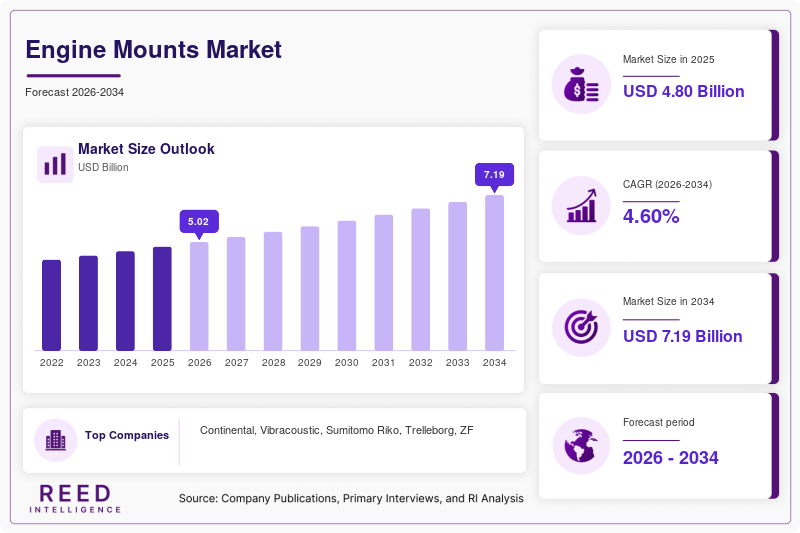
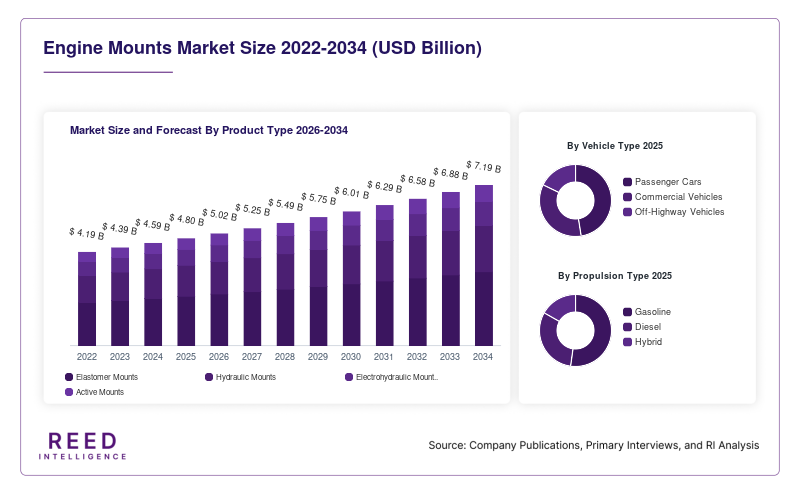
The engine mounts market was valued at USD 4.80 billion in 2025 and is estimated to reach USD 5.02 billion in 2026. The market is projected to reach USD 7.19 billion by 2034, registering a CAGR of 4.60% during 2026–2034.
Engine mounts connect the powertrain to the vehicle structure while controlling vibration, movement and noise transmitted into the passenger compartment and chassis. The market is therefore closely linked to vehicle production, powertrain architecture and increasingly demanding noise, vibration and harshness (NVH) requirements. Mount designs range from conventional elastomer solutions to hydraulic and electronically controlled systems, with the choice determined by engine characteristics, vehicle packaging, load requirements and NVH targets. Trelleborg, for example, offers mount designs using rubber in shear and compression as well as hydraulic mounts intended to provide damping and vibration isolation.
The market is being reshaped by powertrain diversification rather than by vehicle production alone. Hybrid vehicles retain internal-combustion engines while introducing additional operating modes and vibration characteristics, creating demand for more precisely tuned mounting systems. At the same time, battery-electric vehicles reduce the addressable requirement for conventional engine mounts, creating a longer-term structural constraint for suppliers dependent on ICE applications. Industry analysis also identifies hybrid powertrains and advanced mounting technologies as important areas of development.
Engine Mounts Market Drivers
Hybrid Powertrains Increase Demand for More Precisely Tuned Mounting Systems
Hybrid vehicles combine an internal-combustion engine with electric propulsion, producing operating conditions that differ from conventional powertrains. Engine start-stop events, transitions between propulsion modes and varying engine operating points increase the importance of vibration isolation and mount tuning.
The market mechanism is that OEMs require mounting systems capable of controlling vibration across a wider range of operating conditions. This supports demand for hydraulic, electrohydraulic and active solutions alongside conventional elastomer mounts. Industry analysis identifies hybrid powertrains as a faster-growing portion of automotive engine-and-mount demand.
The strongest impact is therefore concentrated in passenger vehicles with hybrid architectures and higher NVH requirements. However, increasing battery-electric vehicle penetration limits the long-term addressable market for conventional engine-mounted applications.
Stricter NVH Requirements Increase the Technical Value of Advanced Mounts
Vehicle manufacturers increasingly treat NVH performance as part of vehicle refinement, making mount stiffness, damping and dynamic response important engineering parameters. Trelleborg's product portfolio demonstrates the range of mount technologies designed to manage vibration, shock, movement and isolation across engine and vehicle applications.
The commercial mechanism is a shift from mounts selected primarily for load support toward systems engineered around specific dynamic characteristics. Hydraulic and active technologies can provide greater control over vibration behavior than basic passive designs.
Premium passenger vehicles, hybrid platforms and vehicles requiring greater comfort are particularly relevant. The constraint is cost: advanced mounts require additional components, engineering and validation, making conventional elastomer designs attractive where NVH requirements are less demanding.
Continued Vehicle Production Sustains Replacement and OEM Demand
Engine mounts remain required wherever internal-combustion or hybrid powertrains are installed. The component also operates under repeated mechanical and thermal loading, creating replacement demand after deterioration or failure.
OEM purchasing provides the largest commercial channel because mounts are engineered into vehicle platforms and supplied as part of the original powertrain architecture. Aftermarket demand develops as vehicles age and mounting components experience wear.
The mechanism therefore combines new-vehicle production with the installed vehicle population. The counterbalance is that EV adoption reduces the number of conventional engine-mounted applications, meaning future volume growth depends increasingly on hybrids, commercial vehicles, replacement demand and higher-value mounting technologies.
Engine Mounts Market Restraints
Battery-Electric Vehicle Adoption Reduces the Addressable Market for Conventional Engine Mounts
Battery-electric vehicles eliminate the conventional combustion engine and therefore reduce demand for traditional engine-mount configurations. Industry analysis identifies electrification as a structural headwind for conventional engine-mount demand, particularly in markets with rapid EV adoption.
The effect is not uniform because hybrid vehicles continue to require engine mounting systems. Suppliers can also adapt vibration-isolation expertise toward electric-motor, battery and other vehicle mounting applications.
Nevertheless, companies heavily concentrated in conventional ICE mounts face a long-term portfolio transition as OEMs allocate more vehicle platforms to electrified architectures.
Rubber, Steel and Other Input-Cost Volatility Pressures Supplier Margins
Engine mounts combine elastomers, metals and, in advanced designs, hydraulic or electronic components. Trelleborg's portfolio illustrates the use of rubber-metal construction across multiple mount configurations.
Changes in rubber and metal input costs can therefore affect production economics, particularly for suppliers operating under long-term OEM contracts where passing cost increases through to customers can be difficult.
Larger suppliers can mitigate the effect through purchasing scale, material engineering and supply-chain diversification. Smaller manufacturers may face greater margin pressure when raw-material costs fluctuate.
Engine Mounts Market Opportunities
Active and Electrohydraulic Mounts Create Higher-Value Applications
Advanced mounts can dynamically adjust damping or vibration response rather than relying entirely on fixed mechanical characteristics. This is commercially relevant to hybrid and premium vehicles where powertrain operating conditions vary considerably.
The opportunity lies in moving from a basic mechanical component toward an engineered mechatronic system. Suppliers with capabilities in elastomer engineering, hydraulics, electronics and control software can participate in higher-value programs.
Industry analysis identifies electrohydraulic and active mounting technologies as faster-growing areas within automotive mounting applications. Adoption remains dependent on OEM willingness to absorb additional component cost and system complexity.
Mounting Technologies for Electrified Powertrains Open an Adjacent Market
Electrification reduces traditional engine-mount demand but creates new vibration-isolation requirements around electric motors, battery systems and other powertrain components. This creates an opportunity for established mount manufacturers to transfer material, damping and NVH expertise into electric-powertrain applications.
The commercial mechanism is portfolio substitution: suppliers can protect engineering relationships with OEMs by developing mounting systems for new powertrain architectures rather than remaining dependent on combustion engines.
The main barrier is that EV mounting requirements differ from those of ICE systems, requiring new designs, validation and customer qualification.
Engine Mounts Market Product Type Analysis
Elastomer mounts account for approximately 68% of the market in 2025. Their position reflects relatively straightforward construction, established OEM manufacturing processes and suitability across a broad range of vehicle and engine applications.
Rubber-based mounts can combine load support with vibration isolation through controlled stiffness in different directions. Trelleborg's RA mount, for example, uses rubber in shear and compression to provide vertical flexibility and horizontal stability.
Their main advantage is economic: manufacturers can meet many conventional mounting requirements without the additional components associated with hydraulic or electronically controlled systems. Their limitation is reduced adaptability where vehicles require highly controlled dynamic response.
Active mounts are projected to register approximately 9.80% CAGR during 2026–2034. Their expansion is associated with hybrid powertrains, premium vehicles and applications requiring dynamic control of vibration.
Unlike fixed-stiffness systems, active designs can modify their response according to operating conditions, potentially improving NVH performance across a wider range of engine states.
The segment remains smaller than conventional elastomer mounting because of higher cost, greater system complexity and additional validation requirements. Its expansion therefore depends on OEM adoption in platforms where the NVH benefit justifies the additional engineering content.
Engine Mounts Market Vehicle Type Analysis
Passenger cars represent approximately 73% of the market in 2025. The segment benefits from its large installed vehicle base and extensive use of engine mounting systems across gasoline, diesel and hybrid powertrains.
Mount requirements also become more demanding as passenger vehicles place greater emphasis on cabin comfort and NVH refinement. This creates a differentiated market extending from basic elastomer components to hydraulic and active systems.
Commercial vehicles are projected to grow at approximately 5.20% CAGR during 2026–2034. Trucks, buses and other heavy-duty vehicles place high mechanical loads on mounting systems and require durability under demanding operating conditions.
Trelleborg's engine and powertrain mounting portfolio includes solutions designed for high-load applications and commercial vehicles.
The segment's expansion is supported by fleet replacement and continued use of combustion and hybrid powertrains. However, commercial-vehicle electrification can gradually reduce conventional engine-mount demand in selected applications.
Engine Mounts Market Propulsion Type Analysis
Gasoline powertrains account for approximately 59% of the market in 2025. Their large installed base and continued use across passenger vehicles sustain demand for conventional and advanced mounting systems.
Gasoline engines also create substantial NVH requirements because combustion events generate vibration that must be isolated from the vehicle structure.
Hybrid powertrains are projected to register approximately 10.20% CAGR during 2026–2034. Hybrid architectures retain an internal-combustion engine while introducing electric propulsion and frequent operating-state transitions.
This increases the need for mounts capable of handling different vibration conditions. Industry analysis similarly identifies hybrid powertrains as a faster-growing area within automotive engine-and-mount demand.
Diesel remains important in commercial applications but faces longer-term electrification and emissions-related constraints.
Engine Mounts Market Sales Channel Analysis
OEM sales account for approximately 81% of the market in 2025. Engine mounts are generally engineered into vehicle platforms, requiring suppliers to meet automaker specifications for load capacity, durability, dimensions and NVH behavior.
OEM relationships therefore create relatively high switching barriers once a mount supplier has qualified for a vehicle platform. Suppliers compete on engineering capability, quality, cost, delivery reliability and global manufacturing coverage.
The aftermarket is projected to grow at approximately 4.90% CAGR during 2026–2034. Mount deterioration creates replacement demand as vehicles accumulate mileage and experience repeated thermal, mechanical and vibration loads.
The opportunity is particularly relevant in older passenger and commercial vehicle fleets. The segment is nevertheless more price-sensitive than OEM purchasing and faces competition from lower-cost replacement components.
Engine Mounts Market Regional Analysis
Asia-Pacific Holds the Largest Regional Share Through Vehicle Manufacturing Scale
Asia-Pacific accounts for approximately 43% of the market in 2025. The region benefits from a large automotive manufacturing base and substantial demand for passenger and commercial vehicles.
China, Japan, India and South Korea provide important production and component-manufacturing ecosystems. The region also has a significant mix of conventional and electrified powertrains, creating demand for both established elastomer mounts and newer mounting technologies.
The future market mechanism is increasingly linked to hybridization, local vehicle production and the development of regional component supply chains. The counterbalance is the faster transition toward battery-electric vehicles in some markets, which reduces conventional ICE applications.
North America Maintains a Significant Market Through Large Vehicles and Established Automotive Production
North America represents approximately 25% of the market in 2025. Demand is supported by passenger vehicles, SUVs, light commercial vehicles and established automotive manufacturing operations.
Mounting requirements are influenced by vehicle size, engine configuration and cabin-comfort expectations. The region also provides an important aftermarket base because of its large installed vehicle population.
Future growth will increasingly depend on hybrid platforms, replacement demand and advanced NVH systems, while EV adoption limits expansion of conventional engine-mount applications.
Europe Remains an Established Market With Strong Demand for Advanced NVH Technologies
Europe accounts for approximately 19% of the market in 2025. European OEMs have historically placed significant emphasis on vehicle refinement, emissions performance and powertrain efficiency, supporting engineering demand for specialized mounting solutions.
Hybridization provides an important transition market for mount suppliers because it retains the combustion engine while increasing powertrain complexity.
The main structural constraint is the region's rapid shift toward electrified vehicles, which reduces conventional engine applications and increases the need for suppliers to diversify into electric-powertrain mounting.
Latin America Develops Through Vehicle Production and the Installed Aftermarket Base
Latin America represents approximately 7% of the market in 2025. Demand is supported by vehicle production, commercial transportation and replacement requirements across an installed fleet.
The aftermarket provides an important demand mechanism because older vehicles continue to require replacement components. Price sensitivity, currency fluctuations and dependence on imported components can constrain premium technology adoption.
Middle East and Africa Remain Emerging Markets Supported by Commercial and Off-Highway Applications
Middle East and Africa account for approximately 6% of the market in 2025. Commercial vehicles, off-highway equipment and passenger vehicles provide the principal application base.
Durability and vibration isolation are particularly relevant in demanding operating environments, supporting demand for robust mounting systems. Trelleborg offers mount products specifically designed for engines and off-highway vehicles, illustrating the relevance of these applications.
Infrastructure development and vehicle fleet expansion can support demand, although lower adoption of advanced mounting technologies and fragmented distribution remain constraints.

Engine Mounts Market Competitive Landscape
Competition in engine mounts is shaped by OEM qualification, NVH engineering, elastomer technology, hydraulic and active-mount development, manufacturing scale and geographic proximity to vehicle-production facilities.
Established suppliers benefit from long-term relationships with automakers because engine mounts are platform-specific components that must satisfy durability, dimensional, thermal and vibration requirements. Once qualified, suppliers can gain recurring demand throughout a vehicle platform's production cycle.
Technology differentiation is becoming more important as hybrid powertrains create more complex vibration profiles. Conventional elastomer mounts remain competitive where cost and reliability dominate, while hydraulic and active systems allow suppliers to compete on dynamic NVH performance.
Manufacturing footprint is another competitive factor because OEMs increasingly seek localized supply chains. Companies with facilities close to major automotive production clusters can reduce logistics exposure and support just-in-time manufacturing.
Key Market Players
- Continental
- Vibracoustic
- Sumitomo Riko
- Trelleborg
- ZF
- Hutchinson
- Cooper Standard
- BOGE Rubber & Plastics
- Yamashita Rubber
- BWI Group
Engine Mounts Market Recent Developments
- Suppliers are developing broader portfolios that include hydraulic, active and specialized vibration-isolation products. Trelleborg's current portfolio includes conventional rubber mounts, hydraulic mounts and products designed for different load and vibration conditions.
- The continued development of hybrid powertrains creates operating conditions in which engines repeatedly start, stop and transition between different propulsion states. Industry analysis identifies hybrid powertrains as an important growth area for engine-and-mount technologies.
Engine Mounts Market Segments
By Product Type
- Elastomer Mounts
- Hydraulic Mounts
- Electrohydraulic Mounts
- Active Mounts
By Vehicle Type
- Passenger Cars
- Commercial Vehicles
- Off-Highway Vehicles
By Propulsion Type
- Gasoline
- Diesel
- Hybrid
By Sales Channel
- OEM
- Aftermarket
By Region
- North America
- Europe
- APAC
- Middle East and Africa
- LATAM