Expense Management Software Market Size, Share & Trends Analysis Report By Component (Software, Services), By Deployment (Cloud, On-Premises), By Organization Size (Large Enterprises, SMEs), By Application (Travel & Expense Management, Employee Reimbursements, Corporate Card & Spend Management, Invoice & Payment Expense Management, Other Applications), By End Use (BFSI, IT & Telecom, Healthcare, Retail & E-commerce, Manufacturing, Government & Public Sector, Other Industries) and By Region (Nort
USD 3950
Expense Management Software Market Size
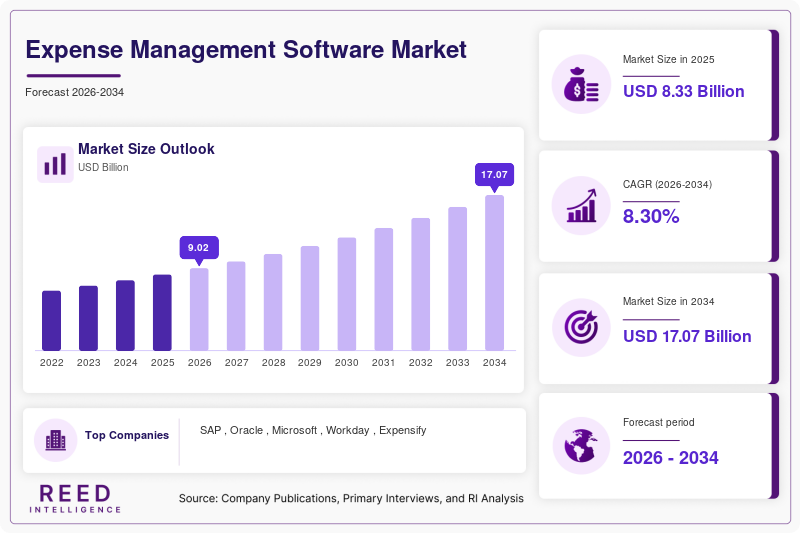
The expense management software market was valued at USD 8.33 billion in 2025 and is estimated to reach USD 9.09 billion in 2026. The market is projected to reach USD 17.07 billion by 2034, registering a CAGR of 8.30% during 2026–2034.
The expense management software market is shifting from digital expense-reporting tools toward automated spend-control platforms connected to corporate cards, reimbursement workflows, accounting systems and enterprise resource planning (ERP) platforms. The underlying commercial requirement is not simply faster expense submission; finance teams increasingly need transactions to be captured, categorized, checked against policy and transferred into accounting systems with limited manual intervention.
Product development during 2025–2026 shows this transition clearly. SAP Concur has introduced AI capabilities covering expense-account mapping, expense-type classification and policy-related workflows, while its Joule generative-AI integration is designed to help employees prepare expense reports with less manual effort. Oracle has similarly expanded its Expenses Agent to capture receipts, extract expense details, match card transactions, validate expenses against policy and handle exceptions.
Expense Management Software Market Drivers
AI-Based Automation Is Reducing Manual Expense Processing
Expense management vendors are moving beyond optical receipt capture toward automated classification, policy validation, exception handling and accounting synchronization. SAP Concur's AI capabilities include automated identification and mapping of expense accounts and expense types, while Oracle's Expenses Agent extracts receipt information, matches expenses with corporate-card transactions and validates expenses against company policies.
The market mechanism is a reduction in repetitive finance and employee tasks. When software can automatically process compliant transactions and escalate only exceptions, the value proposition shifts from electronic reporting toward continuous expense administration. This supports demand particularly among large organizations with high transaction volumes. Adoption can nevertheless be constrained by data-quality issues, integration requirements and concerns about automated decisions in financial-control processes.
Real-Time Spend Controls Are Expanding Expense Software into Broader Spend Management
Modern platforms increasingly connect expense management with pre-spend controls. Ramp allows organizations to establish spending limits, merchant restrictions, approval workflows and policy controls before transactions occur, while Brex similarly applies spending rules and limits to transactions.
This changes the purchasing rationale for software. Instead of buying a system solely to process expenses after employees spend money, companies can use the platform to prevent unauthorized spending and maintain visibility throughout the transaction lifecycle. The mechanism particularly benefits finance departments seeking tighter budget control. The counterbalance is that excessive controls can create employee friction and require careful policy configuration.
Integration with ERP and Accounting Systems Increases the Value of Automated Expense Data
Expense software is increasingly positioned as part of a broader financial workflow. Ramp automatically maps and synchronizes transactions with ERP systems, while Brex provides automated accounting rules and ERP exports. Oracle likewise connects expense processing with accounting segments, allocations and financial workflows.
The market mechanism is the conversion of employee spending data into accounting-ready information without repeated manual entry. This can shorten reconciliation and month-end processes and increase the usefulness of real-time expense data. Demand is strongest where businesses operate multiple payment methods, departments or geographic entities. Integration complexity and data-governance requirements remain adoption barriers.
Expense Management Software Market Restraints
Integration Complexity Can Extend Implementation Cycles
Expense management software must frequently connect with corporate cards, ERP platforms, accounting systems, HR systems and reimbursement processes. Brex, for example, has expanded integrations involving HR systems and accounting fields to support expense controls and reporting.
The economic mechanism is implementation cost. Organizations may need configuration, data mapping, policy redesign, employee training and system testing before realizing the full value of automation. This can delay deployment, particularly for large enterprises with complex financial structures.
Automated Expense Decisions Require Strong Governance and Data Accuracy
AI-based expense processing can reduce manual work, but financial teams still need reliable controls around categorization, policy interpretation and exception handling. Brex explicitly notes that its AI assistant can make mistakes and that generated information should be reviewed.
This creates a governance requirement: companies must establish review mechanisms for unusual or high-risk transactions rather than treating automation as fully autonomous accounting. Privacy, access controls and auditability can also influence procurement decisions.
Expense Management Software Market Opportunity
Agentic Expense Management Creates a Shift Toward Touchless Financial Workflows
The strongest emerging opportunity is the movement from traditional expense reports toward agentic expense processing. Oracle's Expenses Agent can capture receipts, create expense items, match transactions, request missing information and submit compliant reports automatically. SAP Concur is also incorporating AI into expense workflows through Joule and related AI capabilities.
The commercial opportunity comes from removing multiple manual steps from the expense lifecycle. Employees can interact with the system through conversational interfaces, while finance teams focus on exceptions and policy decisions. The opportunity is strongest among organizations with large employee populations and high volumes of recurring expenses. Adoption may be limited by concerns about AI accuracy, security, integration and organizational readiness.
Expense Management Software Market Component Analysis
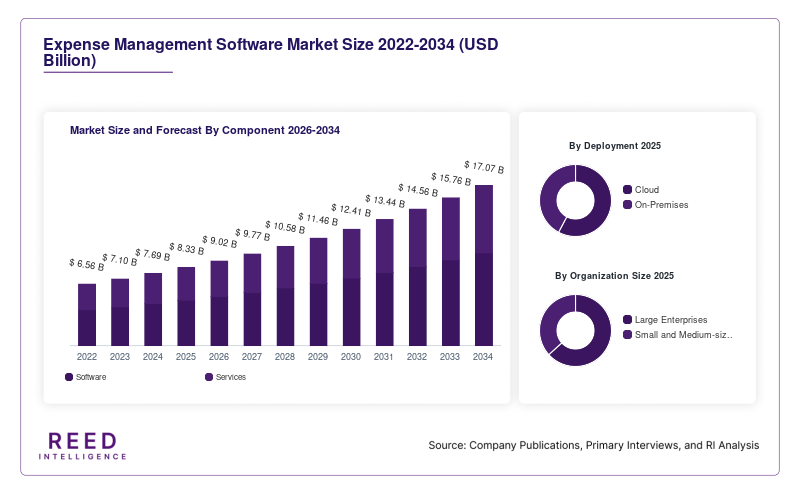
The Software segment accounts for approximately 79% of the 2025 market, making it the dominant component. Expense capture, policy enforcement, approval workflows, reimbursement management, reporting and accounting integration are increasingly delivered through unified software platforms rather than isolated manual processes.
Software demand is reinforced by the expansion of AI capabilities. Oracle, SAP Concur, Ramp and Brex are incorporating automation directly into expense workflows, including receipt processing, categorization, policy checks and accounting tasks.
The segment's recurring revenue model also supports continued software adoption. However, competition is increasing as ERP vendors, corporate-card providers and specialized fintech platforms converge on expense management functionality.
The Services segment represents approximately 21% of the 2025 market. Demand is associated with implementation, configuration, integration, training, policy migration and ongoing support.
Services become particularly relevant when expense software must connect with ERP, HR, corporate-card and accounting systems. As platforms add AI agents and automated workflows, customers may require additional configuration to ensure policies, approval structures and accounting rules operate correctly.
The segment can benefit from increasing software complexity, although standardized cloud deployments may reduce the amount of traditional implementation work required over time.
Expense Management Software Market Deployment Analysis
The Cloud segment accounts for approximately 74% of the 2025 market. Cloud deployment supports centralized access, continuous software updates, integration with other SaaS applications and mobile expense submission.
The model also fits the increasing use of real-time expense controls and AI-based processing. Platforms such as Ramp provide centralized expense, card, reimbursement, reporting and policy capabilities, while Oracle and SAP integrate expense automation into broader cloud financial ecosystems.
The On-Premises segment represents approximately 26% of the 2025 market. Demand is more closely associated with organizations that require specific infrastructure, data-control or legacy-system arrangements.
Its share faces pressure as cloud platforms increasingly provide enterprise security, integrations and centralized administration. Nevertheless, migration can be slower where expense management is deeply connected to existing financial infrastructure.
Expense Management Software Market Organization Size Analysis
Large Enterprises account for approximately 67% of the 2025 market. Large organizations typically manage multiple departments, payment methods, approval structures and expense policies, increasing the administrative value of automated controls.
The growing emphasis on ERP synchronization and policy enforcement further strengthens demand from complex organizations. Ramp's enterprise offering, for example, emphasizes real-time transaction visibility, automated policy review and ERP synchronization.
The SME segment is projected to expand at a CAGR of approximately 9.25% during 2026–2034, faster than the overall market. Cloud delivery, mobile expense capture and automated policy management allow smaller businesses to adopt capabilities that previously required larger finance teams.
Ramp reports that more than 70,000 businesses use its platform, illustrating the expansion of integrated expense and financial-operations software across company sizes.
The constraint is budget sensitivity. Smaller organizations may consolidate expense functionality into broader accounting or banking platforms instead of purchasing a dedicated system.
Expense Management Software Market Application Analysis
Travel and expense management remains a major application because business travel generates receipts, card transactions, mileage claims, approvals and policy checks. Automation reduces the need for employees to manually construct expense reports and allows finance teams to focus on exceptions.
Employee reimbursement workflows benefit from receipt capture, approval routing and automated policy validation. Mobile and conversational submission capabilities can reduce the friction associated with submitting smaller or infrequent expenses. Oracle's Expense Assistant, for example, supports expense creation, modification and status checks through conversational channels.
Corporate-card and spend-management applications are becoming increasingly integrated with expense software. The connection allows transactions to be captured automatically, categorized and checked against predefined policies. This creates a shift toward controlling spending before and immediately after a transaction rather than relying solely on post-period expense reviews.
Integration between expenses, invoices and payment systems allows finance teams to consolidate spending information and improve accounting visibility. The opportunity is particularly relevant where companies use multiple payment channels and require centralized controls.
Other applications include allowances, mileage, project expenses, cash advances and specialized employee spending programs. These applications contribute to demand where organizations require granular allocation of spending to projects, departments or cost centers.
Expense Management Software Market End-Use Analysis
Banks and financial institutions require detailed financial controls, audit trails and policy enforcement. Expense software can support employee spending while maintaining structured approval and accounting processes.
IT and telecom companies generate distributed employee expenses, travel spending and technology-related purchases. Integration with corporate cards and accounting platforms can reduce manual processing.
Healthcare organizations require controlled employee and operational spending while maintaining financial oversight across departments. Expense automation can support centralized policy management.
Retail and e-commerce organizations manage geographically distributed operations, employees and suppliers. Centralized expense visibility can help finance teams monitor spending across locations and departments.
Manufacturers generate expenses across corporate offices, plants, field operations and travel-intensive teams. Allocation capabilities can connect employee expenses with projects, departments and operational locations.
Government organizations require strong auditability, approval controls and adherence to spending policies. Expense systems can digitize reporting while maintaining structured controls over employee expenditure.
Expense Management Software Market Regional Analysis
North America Holds the Largest Regional Share Through Enterprise Software Adoption and High Demand for Automated Financial Controls
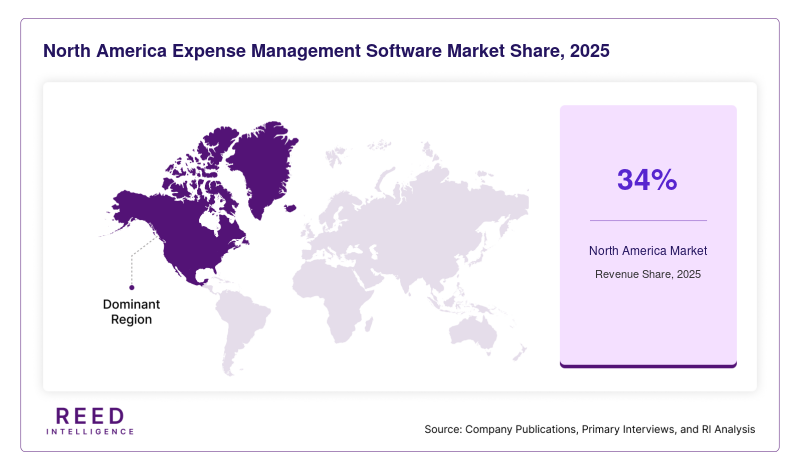
North America accounts for approximately 34% of the 2025 market. The region's established enterprise-software ecosystem supports adoption of expense platforms connected with ERP, accounting, corporate-card and HR systems.
The commercial mechanism is increasingly focused on reducing manual finance work and improving control over corporate spending. Ramp, Brex and other fintech-oriented providers have expanded automation, AI-based policy review and real-time expense controls, while established enterprise vendors such as Oracle and SAP continue embedding AI into financial workflows.
The region also has a mature market for corporate cards and cloud financial applications, supporting integration between payment activity and expense records. Competition is consequently occurring between traditional enterprise software providers and newer spend-management platforms.
Europe Maintains a Significant Market Through Compliance-Focused Expense Management
Europe accounts for approximately 27% of the 2025 market. Demand is supported by enterprise digitization, cross-border operations and the need for structured financial controls across multiple jurisdictions.
Expense platforms can centralize reimbursement policies, approval workflows and accounting information while supporting organizations operating across different countries. Privacy and data governance also affect technology procurement, increasing the importance of security and controlled access to employee financial information.
The principal constraint is market fragmentation across countries, financial systems and organizational policies, which can increase implementation requirements for multinational businesses.
Asia-Pacific Is the Fastest-Growing Region as Cloud Financial Software Adoption Broadens
Asia-Pacific is projected to register the fastest regional CAGR of approximately 10.05% during 2026–2034. Expansion is supported by increasing enterprise digitization, adoption of cloud financial applications and the need to manage employee spending across growing organizations.
The market mechanism is particularly strong among businesses moving from spreadsheet-based or fragmented expense processes toward integrated financial systems. Cloud deployment reduces the need for extensive infrastructure investment, while AI-based receipt processing and automated policy enforcement can reduce administrative requirements.
The region's diversity remains a constraint because businesses differ substantially in accounting practices, regulatory requirements, payment infrastructure and technology maturity.
Middle East and Africa Develops Through Enterprise Digitization and Centralized Financial Controls
Middle East and Africa account for approximately 7% of the 2025 market. Demand is associated with financial digitization among enterprises, multinational operations and organizations seeking more centralized control over employee spending.
Cloud-based platforms can be particularly relevant where companies want to deploy standardized financial workflows without building extensive local infrastructure. Expense management can also become more valuable as organizations introduce formalized approval and compliance structures.
Adoption remains constrained by differences in digital infrastructure, enterprise-software maturity and procurement practices across countries.
Latin America Represents a Developing Market with Increasing Demand for Digital Expense Workflows
Latin America accounts for approximately 7% of the 2025 market. Demand is supported by the transition from manual expense reporting toward cloud-based accounting and financial-management workflows.
The commercial mechanism involves reducing spreadsheet-based processes, improving reimbursement visibility and connecting employee expenses with accounting systems. Mobile submission and automated receipt processing can further reduce administrative friction.
Economic volatility and variations in enterprise technology adoption can affect purchasing decisions, particularly among smaller organizations.
Expense Management Software Market Competitive Landscape
Competition is increasingly divided between large enterprise software providers, corporate-card and fintech platforms, and specialized expense-management vendors.
SAP Concur competes through its integration of travel, expense and broader business-spend workflows. Its recent deployment of Joule and other AI features demonstrates a shift toward automated expense preparation, policy assistance and workflow orchestration.
Oracle benefits from its position within enterprise financial software. Its Expenses Agent processes receipts, matches transactions and validates expenses against policies, allowing expense management to become part of a broader ERP workflow.
Key Market Players
Expense Management Software Market Recent Developments
- In March 2025, SAP announced the integration of its Joule generative-AI copilot into SAP Concur solutions. Within Concur Expense, Joule is designed to answer employee questions and help ensure expense reports are ready for submission with less manual effort. The development moves competition toward AI-assisted expense preparation and positions conversational interfaces as an alternative to traditional form-based reporting.
- Ramp's 2025 product releases introduced policy agents that review expenses, automatically approve compliant transactions and flag expenses requiring human judgment. The company also introduced automated employee follow-ups for missing expense information. Expense-management software is shifting toward exception-based workflows in which finance teams review anomalies rather than manually processing every transaction.
Expense Management Software Market Segments
By Component
- Software
- Services
By Deployment
- Cloud
- On-Premises
By Organization Size
- Large Enterprises
- Small and Medium-sized Enterprises
By Application
- Travel & Expense Management
- Employee Reimbursements
- Corporate Card & Spend Management
- Invoice & Payment Expense Management
- Other Applications
By End Use
- BFSI
- IT & Telecom
- Healthcare
- Retail & E-commerce
- Manufacturing
- Government & Public Sector
- Other Industries
By Region
- North America
- Europe
- APAC
- Middle East and Africa
- LATAM