Geomechanics Software and Services Market Size, Share & Trends Analysis Report By Component (Software, Services), By Deployment Mode (On-Premise, Cloud-Based), By Application (Oil & Gas Exploration, Mining & Geotechnical Engineering, Civil Construction, Environmental Studies, Other Applications), By Software Type (Standalone Software, Integrated Software Suites), By End User (Oil & Gas Companies, Mining Operators, Civil Engineering Firms, Research Institutions) and By Region (North America, Euro
USD 3950
Geomechanics Software and Services Market Size
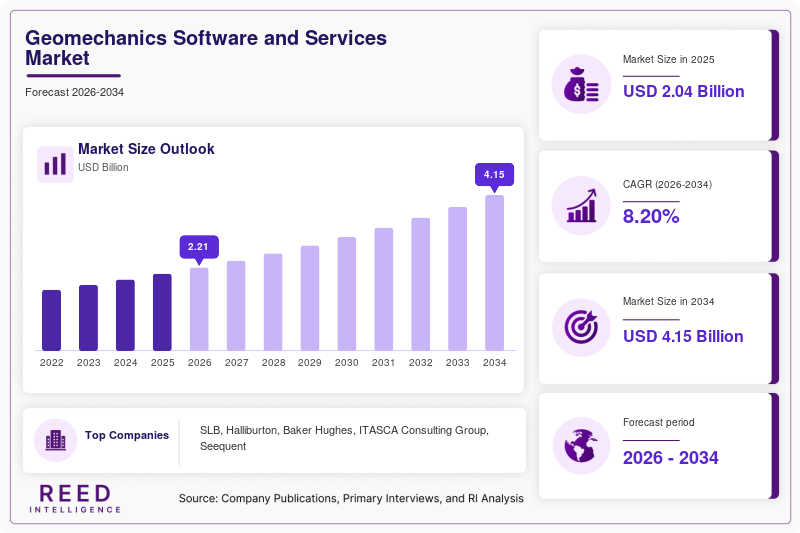
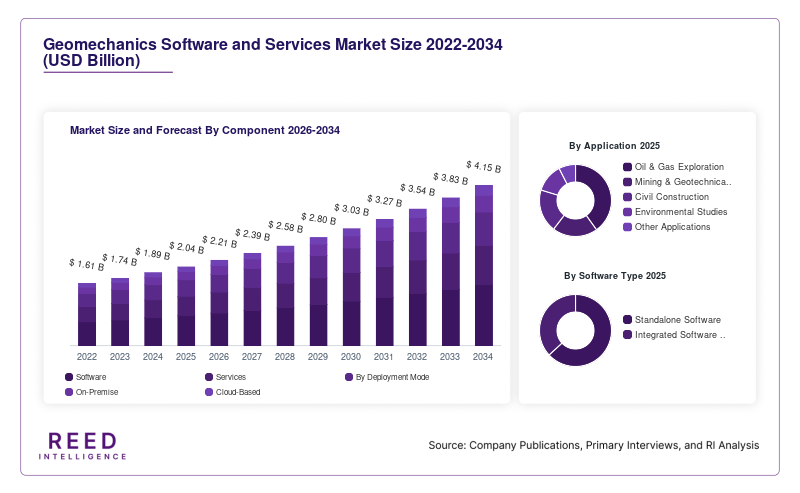
The geomechanics software and services market was valued at USD 2.04 billion in 2025 and is estimated to reach USD 2.21 billion in 2026. The market is projected to reach USD 4.15 billion by 2034, registering a CAGR of 8.20% during 2026–2034.
The geomechanics software and services market is shifting from specialist numerical modeling toward integrated digital workflows that connect subsurface data, well planning, reservoir simulation and engineering decisions. The underlying commercial requirement is risk reduction: operators need to understand how stress, pore pressure, rock deformation and structural conditions can affect drilling, production, excavation and infrastructure performance.
In oil and gas, geomechanics is used for wellbore stability, pore-pressure prediction, fracture-gradient assessment, reservoir compaction, subsidence, fault stability and injection planning. SLB's current offering combines geomechanics software with drilling, reservoir and production workflows, while Halliburton provides applications ranging from well-scale 1D models to reservoir-scale 3D analysis.
Geomechanics Software and Services Market Drivers
Integrated Geomechanics Workflows Are Reducing the Separation Between Modeling and Engineering Decisions
Geomechanics increasingly forms part of multidisciplinary subsurface workflows rather than operating as an isolated specialist function. SLB integrates wellbore stability, pore-pressure prediction, hydraulic-fracture modeling and reservoir geomechanics within its broader subsurface software environment.
The commercial mechanism is straightforward: when geomechanical outputs can be transferred directly into drilling, reservoir or production workflows, engineering teams can use the analysis during planning rather than treating it as a separate technical study. Halliburton similarly connects petrophysics, geomechanics and rock physics through integrated workflows.
This supports demand for integrated software suites and associated technical services. The counterbalance is implementation complexity, because integrating legacy datasets and workflows can require substantial training and technical support.
More Complex Subsurface Conditions Increase the Need for Advanced Modeling
Complex wells, depleted reservoirs, faults, salt formations and unconventional formations can create mechanical conditions that are difficult to capture through simplified models. Halliburton specifically identifies highly deviated, extended-reach, deepwater, HPHT and pre-salt drilling as environments where advanced geomechanical analysis is relevant.
The market mechanism is that greater geological complexity increases the economic consequence of inaccurate pressure and stability assumptions. Customers therefore have stronger incentives to use 3D modeling, coupled simulations and specialist consulting.
The same mechanism applies outside oil and gas. ITASCA's software addresses underground mining, slopes, tunnels, foundations and other complex rock and soil problems.
Data Integration and Cloud Delivery Are Expanding the Usable Customer Base
Software vendors are increasingly connecting geomechanics with broader data ecosystems. Baker Hughes' JewelSuite platform links geomechanics with subsurface modeling, drilling engineering and reservoir stimulation, while its cloud-based delivery makes the applications accessible through the Azure Marketplace.
ITASCA's February 2025 Site Data Link enhancement provides another example, allowing external site data to be integrated into its numerical modeling environment.
The mechanism is a reduction in data-transfer friction and improved collaboration between geographically distributed engineering teams. However, cybersecurity, data governance, legacy-system compatibility and connectivity requirements can slow migration from traditional deployments.
Geomechanics Software and Services Market Restraints
High Technical Complexity Limits Adoption Outside Specialized Engineering Teams
Geomechanical simulation requires specialist knowledge of rock and soil behavior, constitutive models, numerical methods, boundary conditions and interpretation. The complexity is visible in the range of specialized products offered by ITASCA, including FLAC3D, 3DEC, UDEC, PFC and other numerical modeling tools.
The commercial implication is that purchasing software alone may not be sufficient. Customers often require consulting, implementation, training and technical support, which raises the total cost of adoption.
This creates an opportunity for vendors offering integrated interfaces, automation and managed services, but it also means smaller engineering firms may continue relying on external consultants rather than maintaining extensive in-house modeling capabilities.
Validation and Data Quality Affect Model Reliability
Geomechanical models depend heavily on the quality of geological, geophysical, well-log, pressure and mechanical-property data. Baker Hughes' geomechanics studies, for example, incorporate several types of analysis including pore pressure, fracture pressure, wellbore stability, fault slip, fracture networks and compaction.
If input data are incomplete or poorly calibrated, sophisticated numerical models cannot eliminate uncertainty. This creates a commercial constraint because customers must invest not only in software but also in data acquisition, calibration and engineering expertise.
Geomechanics Software and Services Market Opportunities
Integrated Software for Energy Transition and Subsurface Storage Projects
CO₂ sequestration, underground storage and geothermal development create applications where understanding stress evolution, caprock integrity, fault stability and pressure changes is essential. ITASCA's current FLAC2D applications include CO₂ sequestration, caprock integrity, induced seismicity, reservoirs and salt caverns.
Halliburton also identifies coupled geomechanical-flow simulations as a tool for evaluating risks associated with CO₂ injection and EOR operations.
The opportunity therefore comes from applying established geomechanical capabilities to emerging subsurface-energy projects. Adoption will depend on project economics, regulatory requirements, monitoring standards and the development pace of carbon-storage and geothermal projects.
Data-Connected Mining Geomechanics
Mining creates demand for stress analysis, slope stability, underground excavation modeling, material-flow analysis and mine-scale simulations. ITASCA's software portfolio specifically covers these applications, while its 2025 Site Data Link enhancement connects external site data with its numerical modeling environment.
The commercial opportunity is to move from static engineering models toward continuously updated mine models that incorporate operational data. Such systems can support planning and risk assessment, although integration with mine-management systems and the availability of reliable site data remain adoption requirements.
Cloud-Based Collaborative Engineering
Cloud deployment creates an opportunity to make geomechanical analysis more accessible across multidisciplinary and geographically distributed engineering teams. Baker Hughes' JewelSuite ecosystem is designed around interconnected subsurface applications and real-time data exchange, while Seequent emphasizes integrated workflows linking geological modeling, data management and numerical analysis.
The commercial mechanism is reduced duplication of data and improved collaboration between geologists, geophysicists, drilling engineers and geomechanics specialists. Security, intellectual-property protection and customer preference for on-premise infrastructure remain counterbalances.
Geomechanics Software and Services Market Component Analysis
Software is internally modeled as the largest component, accounting for approximately 58.2% of the 2025 market, equivalent to USD 1.19 billion. Its position reflects the central role of numerical modeling, simulation, visualization and workflow integration in modern geomechanical analysis.
The software component includes standalone numerical modeling tools as well as integrated platforms. ITASCA offers continuum and discontinuum modeling products such as FLAC3D, 3DEC and UDEC, while SLB integrates geomechanics into Petrel and Techlog workflows.
The software segment is internally modeled to grow at approximately 7.3% CAGR through 2034, reaching around USD 2.24 billion as its share moderates to approximately 54% of the global market.
Services represent approximately 41.8% of the 2025 market, equivalent to USD 853 million. Services include consulting, modeling, simulation, field studies, technical support and implementation.
The segment benefits from the technical complexity of geomechanics. Halliburton provides drilling and reservoir geomechanics consulting, while Baker Hughes offers studies covering compaction, subsidence, fault stability, wellbore failure and fracture analysis.
Services are internally modeled to grow at approximately 9.4% CAGR, reaching about USD 1.91 billion by 2034. The faster modeled expansion reflects continued demand for specialist expertise alongside software deployment.
Geomechanics Software and Services Market Deployment Mode Analysis
On-premise deployment is internally modeled to account for approximately 63% of the 2025 market, or USD 1.29 billion. Engineering organizations with sensitive subsurface datasets and established internal computing infrastructure may continue to prefer local environments.
Cloud-based deployment represents approximately 37% of the 2025 market, or USD 755 million. The segment is expanding as vendors connect geomechanics with broader cloud subsurface ecosystems. Baker Hughes' JewelSuite applications, for example, are available through the Azure Marketplace and are designed around interconnected subsurface workflows.
The faster transition toward cloud is linked to collaboration, scalable computing and data integration, although data-security requirements and customer infrastructure policies can moderate adoption.
Geomechanics Software and Services Market Application Analysis
Oil & gas exploration and production is internally modeled as the largest application, accounting for approximately 42.5% of the 2025 market, or USD 867 million. Geomechanics is embedded in well planning, pore-pressure prediction, wellbore stability, reservoir management, hydraulic-fracture design and production-related deformation analysis. SLB and Halliburton both integrate geomechanics into drilling and reservoir workflows.
The segment is modeled at approximately 6.8% CAGR, reaching around USD 1.58 billion by 2034.
Mining and geotechnical engineering represents approximately 24% of the 2025 market, equivalent to USD 490 million. Applications include slope stability, underground excavation, mine-scale stress analysis, ground support and material-flow modeling.
ITASCA's product portfolio directly addresses these requirements through FLAC3D, 3DEC, UDEC, IMAT and other tools.
The segment is modeled at approximately 10.1% CAGR, making it one of the faster-expanding application categories and bringing its modeled 2034 value to approximately USD 1.16 billion.
Civil construction accounts for approximately 18% of the 2025 market, or USD 367 million. Tunnels, foundations, dams, excavations, slopes and underground structures require assessment of ground deformation and stability.
Seequent's PLAXIS products address excavations, foundations, tunnels, embankments and ground-structure interaction, illustrating the integration of geomechanics into civil engineering workflows.
The segment is internally modeled at approximately 8.9% CAGR, reaching approximately USD 789 million by 2034.
Environmental studies represent approximately 8% of the 2025 market, equivalent to USD 163 million. Relevant applications include underground storage, groundwater, subsurface containment and assessment of geological stability.
The segment's development is linked to projects requiring evaluation of subsurface pressure and structural behavior, including CO₂ storage and underground waste-management applications.
Other applications account for approximately 7.5% of the 2025 market, or USD 153 million. These include research, specialized energy projects, materials analysis and other engineering applications where rock and soil mechanics affect project performance.
Geomechanics Software and Services Market Software Type Analysis
Standalone software is internally modeled at approximately 56% of the 2025 software market, representing about USD 663 million. It remains relevant where customers require specialized numerical simulation, finite-element or discontinuum analysis without adopting a broader subsurface platform.
Integrated software suites account for approximately 44% of software revenue in 2025, equivalent to around USD 524 million. The segment benefits from demand for connected workflows that transfer geological, petrophysical and geomechanical information between applications.
Baker Hughes' JewelSuite ecosystem and Seequent's integrated geotechnical portfolio illustrate this shift toward connected workflows rather than isolated analytical applications.
Geomechanics Software and Services Market End-User Analysis
Oil & gas companies represent approximately 44% of the 2025 market, or USD 898 million. Their requirements cover drilling, reservoir management, wellbore stability, completion design, production and injection.
Mining operators account for approximately 24% of the 2025 market, equivalent to USD 490 million. Demand centers on slope stability, underground excavation, mine planning and ground-control analysis.
Civil engineering firms represent approximately 20% of the 2025 market, or USD 408 million. Their requirements are concentrated around foundations, tunneling, excavations, dams and infrastructure-related geotechnical risk.
Research institutions account for approximately 12% of the 2025 market, equivalent to USD 245 million. Universities and research organizations use advanced numerical modeling for constitutive-model development, rock mechanics, energy research, mining and geotechnical studies.
Geomechanics Software and Services Market Regional Analysis
North America Geomechanics Software and Services Market
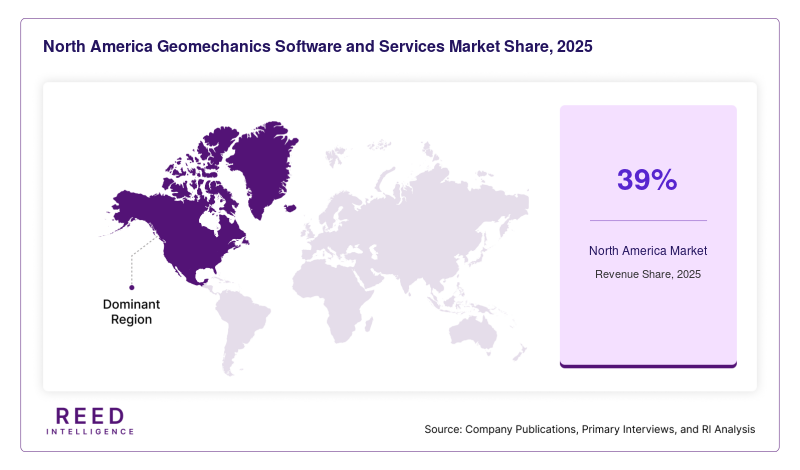
North America is internally modeled as the largest regional market, representing approximately 39% of 2025 revenue, or USD 796 million. The region benefits from a mature oil-and-gas engineering base, established geotechnical consulting capabilities and significant software development activity.
Energy applications create demand for wellbore stability, pore-pressure prediction, reservoir geomechanics and stimulation modeling. At the same time, mining and infrastructure projects provide a second demand base.
The region also contains major technology providers. SLB and Halliburton integrate geomechanics into their broader subsurface platforms, while ITASCA maintains a substantial geomechanics software portfolio covering energy, mining and civil engineering.
The future market mechanism is increasingly tied to cloud-based collaboration, automation and integration with real-time operational data. The main constraint is the technical and organizational cost associated with migrating established engineering workflows.
Europe Geomechanics Software and Services Market
Europe is internally modeled at approximately 27% of the 2025 market, equivalent to USD 551 million. The region has a broad geotechnical engineering base spanning tunneling, civil infrastructure, energy, mining and environmental applications.
Seequent's PLAXIS and GeoStudio products demonstrate the importance of European-developed geotechnical software capabilities across infrastructure and ground-engineering projects.
Demand is increasingly connected to integrated digital engineering, advanced numerical modeling and infrastructure resilience. Carbon storage and subsurface-energy projects provide additional application areas.
The primary limitation is the fragmentation of engineering markets and project-specific regulatory requirements, which can increase the time required to standardize software workflows across organizations.
Asia-Pacific Geomechanics Software and Services Market
Asia-Pacific represents approximately 21% of the 2025 market, or USD 428 million, and is internally modeled as the fastest-growing region at approximately 10.3% CAGR. The regional opportunity is linked to mining, infrastructure construction, underground development and energy projects.
Mining and large infrastructure projects require modeling of slopes, tunnels, foundations, underground excavations and ground behavior. ITASCA's applications, for example, cover mining, civil engineering and energy projects.
The growth mechanism is the increasing use of numerical simulation as projects become larger and more technically complex. Adoption may remain uneven because access to specialist geomechanics expertise and advanced software varies substantially between markets.
Latin America Geomechanics Software and Services Market
Latin America accounts for approximately 7% of the 2025 market, representing about USD 143 million. Mining remains an important application base, while oil and gas developments provide demand for reservoir and drilling geomechanics.
The region's market expansion depends on investment in mining and energy projects and the availability of specialist engineering capabilities. Software vendors with local consulting and training support can address the technical barrier associated with advanced numerical modeling.
Middle East and Africa Geomechanics Software and Services Market
The Middle East and Africa account for approximately 6% of the 2025 market, or USD 122 million. Oil and gas remains a major application base, particularly for reservoir management, drilling, wellbore stability and production-related geomechanical studies.
Halliburton identifies depleted reservoirs, fault reactivation, compaction, subsidence and injection-related integrity as areas where reservoir geomechanics can influence operating decisions.
Mining and infrastructure projects add demand outside hydrocarbons. However, adoption remains dependent on specialist personnel, project economics and investment in digital engineering infrastructure.
Geomechanics Software and Services Market Competitive Landscape
The competitive structure combines large oilfield-service companies, specialist geomechanics software developers, geotechnical software vendors and engineering-service providers.
SLB competes through an integrated software-and-services model. Its portfolio combines Petrel, Techlog and geomechanics workflows covering wellbore stability, pore-pressure modeling, hydraulic-fracture analysis and reservoir geomechanics.
Halliburton combines software with consulting capabilities. Its geomechanics services span pre-drill, real-time and post-drill analysis, while its reservoir geomechanics offering covers wellbore stability, compaction, subsidence, fault reactivation and injection risks.
Key Market Players
- SLB
- Halliburton
- Baker Hughes
- ITASCA Consulting Group
- Seequent
- Ikon Science
- CGG
- Rocscience
- Rockfield Global Technologies
- Weatherford
Geomechanics Software and Services Market Recent Developments
- ITASCA introduced Site Data Link for its IMAT mining software in February 2025, enabling third-party site data to be incorporated into its numerical modeling environment. This moves mining geomechanics toward more data-connected analysis rather than isolated engineering models.
- Baker Hughes expanded cloud access to JewelSuite applications, including JewelSuite Geomechanics, through the Azure Marketplace. The move supports deployment of geomechanics alongside broader subsurface modeling workflows.
Geomechanics Software and Services Market Segments
By Component
- Software
- Services
- By Deployment Mode
- On-Premise
- Cloud-Based
By Application
- Oil & Gas Exploration
- Mining & Geotechnical Engineering
- Civil Construction
- Environmental Studies
- Other Applications
By Software Type
- Standalone Software
- Integrated Software Suites
By End User
- Oil & Gas Companies
- Mining Operators
- Civil Engineering Firms
- Research Institutions
By Region
- North America
- Europe
- APAC
- Middle East and Africa
- LATAM