Atmospheric Transport Systems Market Size, Share Demand Report By Type (Pneumatic Tube Systems, Vacuum Transport Systems, Hybrid Atmospheric Systems), By Application (Healthcare, Industrial Manufacturing, Retail & Logistics, Commercial and Institutional Facilities) By Region & Segment Forecasts, 2026–2034
USD 3950
Atmospheric Transport Systems Market Size
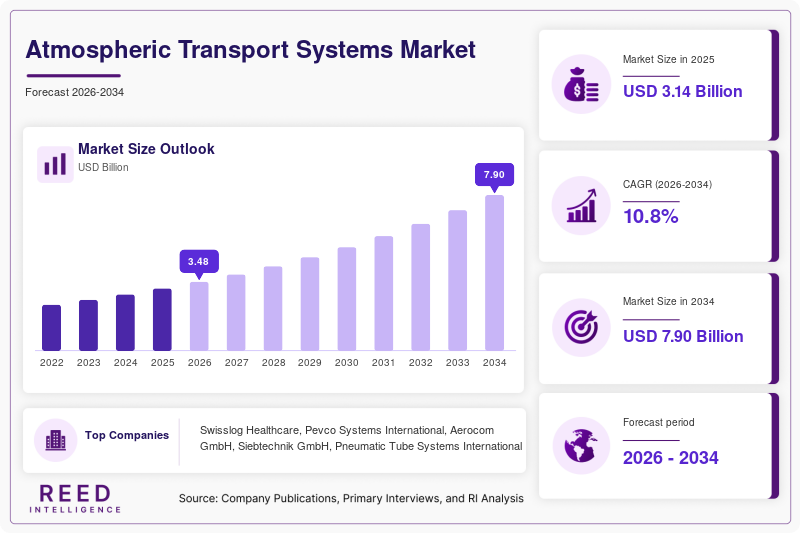
Atmospheric Transport Systems market size is projected at USD 3.48 billion in 2026 and is expected to hit USD 7.92 billion by 2034 with a CAGR of 10.8%. The market is witnessing strong investments in automated material handling infrastructure, smart logistics networks, and healthcare transportation systems. Growing demand for efficient transportation of documents, samples, pharmaceuticals, and industrial components is strengthening the competitive landscape across developed and emerging economies.
Atmospheric transport systems refer to automated pneumatic and vacuum-based transportation networks that move materials, products, and documents through enclosed tube systems using pressure differentials. In 2025, global deployment exceeded 142,000 operational units across hospitals, manufacturing plants, warehouses, and commercial facilities. Healthcare applications accounted for approximately 38% of installations, while industrial manufacturing contributed 34%. Adoption rates surpassed 62% among large hospitals and 41% among advanced manufacturing facilities, reinforcing Atmospheric Transport Systems market growth.
Atmospheric Transport Systems Market Trends
Rising Adoption of Smart Automated Transport Networks
The integration of IoT sensors, AI-driven monitoring platforms, and predictive maintenance technologies is transforming the market landscape. More than 18 million transport cycles are completed daily through atmospheric transport networks worldwide. Smart monitoring solutions have improved operational efficiency by 27% while reducing downtime by 19%. Industrial facilities are increasingly deploying connected systems to enhance productivity and workflow optimization, supporting Atmospheric Transport Systems market trend.
The shift toward energy-efficient vacuum technologies is accelerating market expansion. Advanced systems now consume 22% less energy compared to conventional installations while achieving transport speeds exceeding 8 meters per second. Demand from healthcare laboratories, pharmaceutical facilities, and e-commerce fulfillment centers increased by 31%, 28%, and 25%, respectively, during the past three years, strengthening Atmospheric Transport Systems market demand.
Atmospheric Transport Systems Market Drivers
Expansion of Automated Logistics Infrastructure
The rapid growth of automation across healthcare and industrial sectors is driving market expansion. More than 9,500 hospitals globally utilize pneumatic transport systems, while industrial automation investments surpassed USD 230 billion in 2025. Automated transport networks reduce labor requirements by nearly 35%, lower delivery times by 50%, and improve operational productivity by 24%, supporting Atmospheric Transport Systems market growth.
Atmospheric Transport Systems Market Restraints
High Initial Installation and Maintenance Costs
Implementation costs for large-scale atmospheric transport systems range from USD 500,000 to USD 10 million depending on facility size and network complexity. Maintenance expenditures account for approximately 8%–12% of annual operating budgets. Small and medium enterprises often face capital investment challenges, limiting adoption despite long-term efficiency benefits, affecting Atmospheric Transport Systems market insights.
Atmospheric Transport Systems Market Opportunities
Growing Demand from Healthcare and Pharmaceutical Facilities
Healthcare sample transportation volume exceeded 5.8 billion transactions globally in 2025. Pharmaceutical manufacturing output expanded by 7.4%, increasing the need for secure internal logistics. Automated transport systems reduce contamination risks by 42% and improve sample turnaround times by 33%, creating substantial opportunities for Atmospheric Transport Systems market demand.
Challenges in Atmospheric Transport Systems Market
Integration with Legacy Infrastructure
Retrofitting existing facilities with atmospheric transport systems remains challenging. Nearly 46% of older hospitals and manufacturing plants require structural modifications before deployment. Installation timelines often exceed 6 to 12 months, while integration costs can increase project budgets by 18%–25%, creating operational barriers for Atmospheric Transport Systems market growth.
Atmospheric Transport Systems Market Segmentation
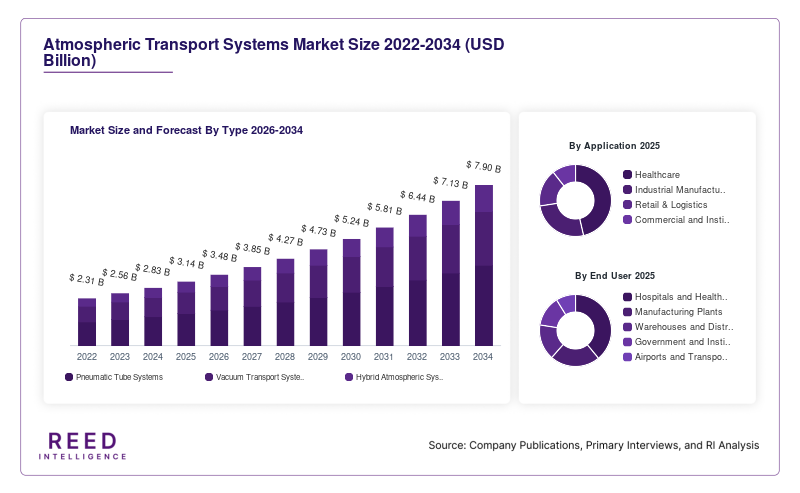
The market is segmented based on type and application. Pneumatic tube systems dominate with approximately 52% market share, while healthcare applications account for nearly 38% of total demand due to high-volume transportation requirements.
By Type
Pneumatic tube systems hold around 52% market share with more than 74,000 installations worldwide. These systems operate at speeds between 4 and 8 meters per second and are widely used in hospitals, banks, and laboratories. Annual production exceeded 32,000 units in 2025.
Vacuum transport systems account for approximately 31% of the market. More than 18,500 units were manufactured globally in 2025. These systems provide enhanced energy efficiency, achieving operational savings of up to 22% and handling loads up to 25 kilograms.
Hybrid atmospheric systems represent nearly 17% market share. These systems combine pneumatic and vacuum technologies for optimized performance. Production surpassed 8,200 units in 2025, with adoption increasing by 14% annually across industrial facilities.
By Application
Healthcare remains the largest application segment with 38% share. More than 5.8 billion laboratory samples and medical supplies are transported annually through atmospheric systems. Adoption exceeds 62% among major hospitals due to improved turnaround times and contamination control.
Industrial manufacturing accounts for approximately 29% share. More than 43,000 systems are deployed across automotive, electronics, and machinery facilities. Material handling efficiency improves by 28%, while labor costs decline by 20%.
Retail and logistics contribute nearly 21% share. Automated transport systems support warehouse operations and order fulfillment activities. More than 11,000 installations processed over 2.4 billion transactions during 2025.
Commercial facilities represent approximately 12% share. Airports, government buildings, and financial institutions increasingly deploy atmospheric transport systems to streamline internal logistics and document movement.
Atmospheric Transport Systems Market Regional Outlook
North America Atmospheric Transport Systems Market
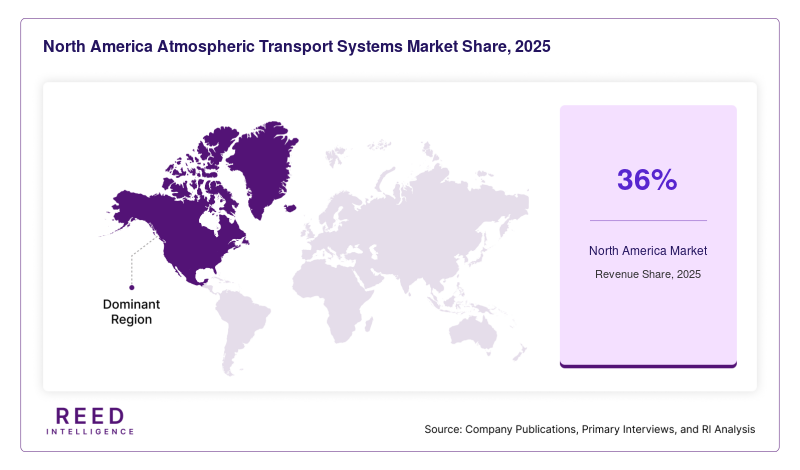
North America accounts for approximately 36% of the global market. The United States contributes nearly 81% of regional revenue with over 52,000 installed systems. Healthcare applications represent 44% of regional demand, while industrial manufacturing contributes 31%.
Europe Atmospheric Transport Systems Market
Europe holds around 29% market share. Germany, the United Kingdom, and France collectively account for over 63% of regional installations. More than 41,000 systems are operational across hospitals, logistics centers, and industrial facilities.
Asia-Pacific Atmospheric Transport Systems Market
Asia-Pacific represents approximately 25% share and is the fastest-growing region. China, Japan, South Korea, and India contribute over 72% of regional demand. Annual installations increased by 15%, supported by industrial automation and healthcare infrastructure expansion.
Latin America Atmospheric Transport Systems Market
Latin America accounts for nearly 6% of the market. Brazil and Mexico contribute more than 58% of regional installations. Investments in healthcare modernization and logistics automation are driving market adoption.
Middle East & Africa Atmospheric Transport Systems Market
The Middle East & Africa hold approximately 4% market share. GCC countries account for nearly 61% of regional demand. Smart hospital projects and industrial diversification initiatives continue to create deployment opportunities.
Top players in Atmospheric Transport Systems Market
- Swisslog Healthcare
- Pevco Systems International
- Aerocom GmbH
- Siebtechnik GmbH
- Pneumatic Tube Systems International
- Air-Log International
- Quirepace Ltd.
- Telelift GmbH
- Sumetzberger GmbH
- Hanazeder Electronic GmbH
- Kelly Systems Inc.
- Lamson Group
- Oppent S.p.A.
- Colombo Pneumatic Tube Systems
- Zip Pneumatics
Swisslog Healthcare
- Swisslog Healthcare holds an estimated 18% market share and maintains a leading position in hospital pneumatic transport systems.
- The company operates across more than 50 countries and supports over 3,000 healthcare installations globally.
- Its solutions process millions of laboratory samples annually while offering integrated automation and digital monitoring capabilities.
- Strong investment in AI-enabled transport management and predictive maintenance platforms strengthens its competitive position.
Pevco Systems International
- Pevco Systems International commands approximately 12% market share globally.
- The company specializes in high-performance pneumatic transport solutions for hospitals, laboratories, and industrial facilities.
- More than 7,500 systems have been deployed worldwide with transport speeds exceeding 7 meters per second.
- Continuous product innovation, energy-efficient technologies, and expansion into emerging markets reinforce its market presence and customer base.
Recent Developments in Atmospheric Transport Systems Market
- 2025: Swisslog Healthcare introduced next-generation IoT-enabled pneumatic transport monitoring solutions for healthcare facilities.
- 2025: Aerocom GmbH expanded manufacturing capacity by 18% to support increasing global demand.
Atmospheric Transport Systems Market Segments
By Type
- Pneumatic Tube Systems
- Vacuum Transport Systems
- Hybrid Atmospheric Systems
By Application
- Healthcare
- Industrial Manufacturing
- Retail & Logistics
- Commercial and Institutional Facilities
By End User
- Hospitals and Healthcare Facilities
- Manufacturing Plants
- Warehouses and Distribution Centers
- Government and Institutional Buildings
- Airports and Transportation Hubs
By Region
- North America
- Europe
- APAC
- Middle East and Africa
- LATAM