CCTV Motorized Zoom Lenses Market Size, Share, Demand Report By Type (DC Auto Iris Motorized Zoom Lenses, P-Iris Motorized Zoom Lenses, CS-Mount Motorized Zoom Lenses), By Application (Commercial Surveillance, Industrial Surveillance, Transportation Surveillance), By Distribution Channel (Direct Sales, Security Equipment Distributors, System Integrators, Online Sales, Specialty Electronics Stores) By Region & Segment Forecasts, 2026–2034
USD 3950
CCTV Motorized Zoom Lenses Market Size
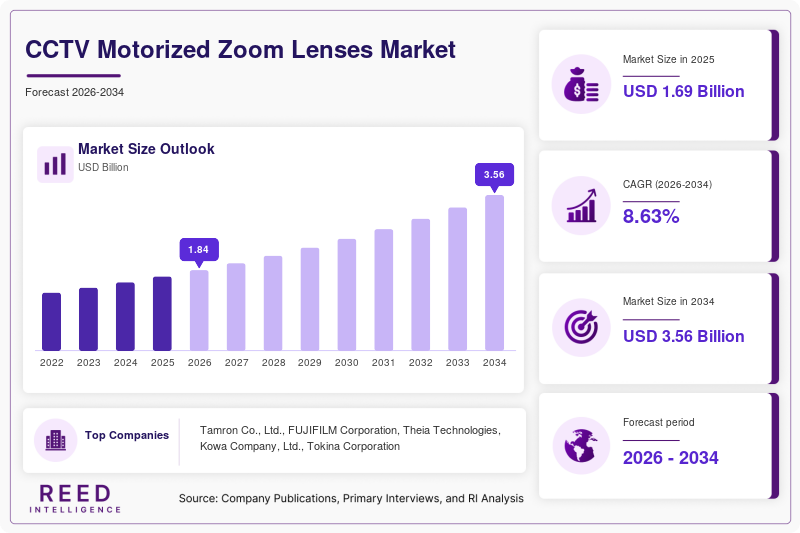
CCTV Motorized Zoom Lenses market size is projected at USD 1.84 billion in 2026 and is expected to hit USD 3.57 billion by 2034 with a CAGR of 8.63%. The industry is expanding due to increasing deployment of intelligent surveillance systems, rising investments in public security infrastructure, and growing demand for long-range imaging capabilities. The report evaluates market segmentation, technology adoption patterns, production capacities, and competitive positioning across major regions.
The CCTV Motorized Zoom Lenses market consists of optical lens systems designed to provide remote focal length adjustment and automatic image optimization in surveillance cameras. Global production exceeded 42 million units in 2025, with smart surveillance installations accounting for nearly 58% of total demand. Commercial surveillance represented approximately 46% of total revenue contribution, while transportation surveillance contributed 24%. Adoption of motorized zoom technology surpassed 52% among newly installed IP camera systems, strengthening the CCTV Motorized Zoom Lenses market.
CCTV Motorized Zoom Lenses Market Trends
Growing Integration of AI-Based Video Analytics and High-Resolution Imaging
Manufacturers are increasingly developing motorized zoom lenses compatible with 4K, 8MP, and AI-enabled surveillance systems. More than 24 million units of advanced motorized zoom lenses were shipped globally during 2025, representing nearly 57% of total production volume. Adoption of AI-integrated surveillance cameras increased from 31% in 2022 to 49% in 2025. Demand from smart city projects and critical infrastructure surveillance continues to shape CCTV Motorized Zoom Lenses trends.
The shift toward remote monitoring and cloud-connected security platforms is driving lens innovation. Approximately 44% of newly installed surveillance networks utilized remotely adjustable zoom functions during 2025. Transportation hubs, logistics centers, and industrial facilities accounted for over 18 million lens installations globally. Rising deployment of high-performance optics supports evolving CCTV Motorized Zoom Lenses trends.
CCTV Motorized Zoom Lenses Market Drivers
Expansion of Smart City and Public Security Investments
Global investments in smart city infrastructure exceeded USD 720 billion in 2025, with surveillance systems representing a significant component. More than 16 million surveillance cameras were deployed across urban monitoring projects, while public safety budgets increased by 7.8% year-over-year in major economies. Approximately 63% of new city surveillance projects incorporated motorized zoom functionality. These developments continue to accelerate CCTV Motorized Zoom Lenses market growth.
CCTV Motorized Zoom Lenses Market Restraints
High Installation and Maintenance Costs
Advanced motorized zoom lenses can cost 35% to 60% more than fixed focal length alternatives, limiting adoption among budget-sensitive end users. Maintenance expenditures for large surveillance networks increased by approximately 6.2% during 2025. Nearly 28% of small-scale security projects continue to rely on lower-cost lens systems. Cost-related challenges restrict wider penetration of the CCTV Motorized Zoom Lenses market.
CCTV Motorized Zoom Lenses Market Opportunities
Rising Demand for Intelligent Transportation Surveillance
Global transportation infrastructure projects surpassed USD 1.1 trillion in 2025, generating strong demand for advanced surveillance solutions. Airports, railway stations, and highways collectively installed more than 9 million surveillance cameras with zoom-enabled optics. Adoption rates of intelligent traffic monitoring systems exceeded 38% across developed markets. Such developments create significant opportunities within the CCTV Motorized Zoom Lenses market.
Challenges in CCTV Motorized Zoom Lenses Market
Technology Standardization and Cybersecurity Concerns
The surveillance industry faces challenges related to interoperability, cybersecurity, and evolving technical standards. Nearly 41% of network-connected surveillance systems require software and firmware upgrades annually. Cybersecurity incidents associated with connected security devices increased by 12% between 2023 and 2025. Addressing these issues remains critical for sustained development of the CCTV Motorized Zoom Lenses market.
CCTV Motorized Zoom Lenses Market Segmentation
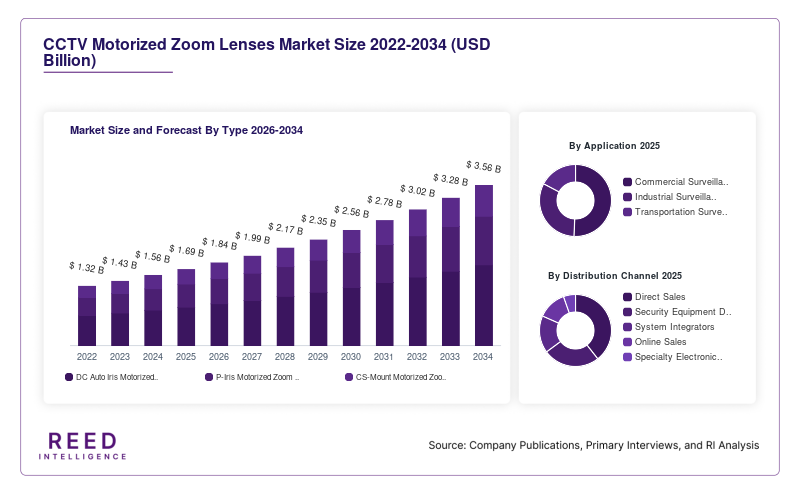
The market is segmented by type and application, with DC Auto Iris Motorized Zoom Lenses accounting for approximately 39% of total revenue in 2025. Commercial surveillance remained the dominant application segment, contributing nearly 46% of overall demand due to extensive deployment across retail, office, and institutional environments.
By Type
DC Auto Iris Motorized Zoom Lenses accounted for approximately 39% of market revenue during 2025. Production exceeded 16 million units globally. These lenses provide automatic exposure adjustment, focal ranges between 2.8 mm and 12 mm, and are widely used in commercial surveillance environments requiring consistent image quality.
P-Iris Motorized Zoom Lenses represented around 34% of total revenue. Annual production surpassed 14 million units. The segment offers enhanced depth of field, superior sharpness, and optimized aperture control. Adoption rates exceeded 42% in high-definition surveillance deployments.
CS-Mount Motorized Zoom Lenses held nearly 27% share of the market. Production reached approximately 12 million units during 2025. These lenses are commonly utilized in industrial monitoring, perimeter security, and transportation applications requiring flexible installation and extended zoom capabilities.
By Application
Commercial surveillance generated approximately 46% of total revenue. More than 19 million lens units were deployed across shopping centers, corporate facilities, banks, and educational institutions in 2025. Penetration of intelligent surveillance systems exceeded 54% within large commercial establishments.
Industrial surveillance accounted for nearly 30% of market revenue. Annual installations exceeded 12 million units across manufacturing facilities, warehouses, energy plants, and logistics hubs. High-resolution zoom capabilities support operational safety, asset monitoring, and perimeter protection.
Transportation surveillance represented approximately 24% of total revenue. More than 10 million units were installed across airports, railway stations, highways, and ports. Usage penetration exceeded 48% in newly developed transportation infrastructure projects due to increasing security requirements.
CCTV Motorized Zoom Lenses Regional Outlook
North America CCTV Motorized Zoom Lenses Market
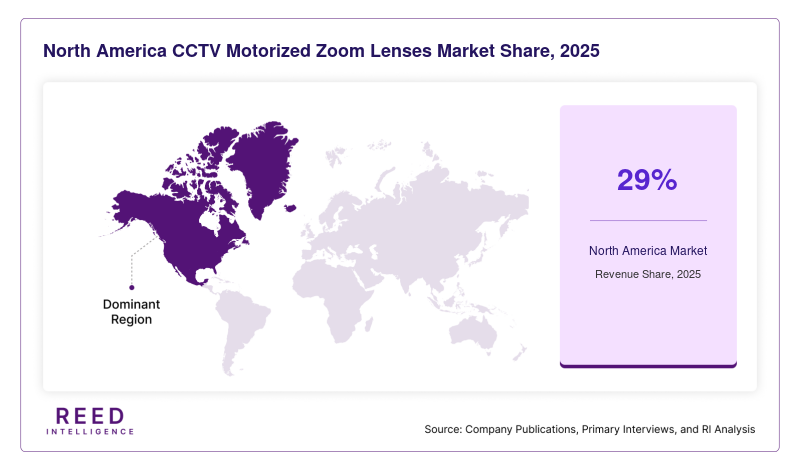
North America accounted for approximately 29% of global revenue in 2025. The United States contributed nearly 82% of regional demand, supported by smart infrastructure projects and enterprise security investments. Annual consumption exceeded 11 million units.
Europe CCTV Motorized Zoom Lenses Market
Europe represented approximately 25% of global market revenue. Germany, the United Kingdom, France, and Italy collectively accounted for more than 69% of regional demand. Production and deployment volumes exceeded 9 million units across commercial and transportation sectors.
Asia-Pacific CCTV Motorized Zoom Lenses Market
Asia-Pacific dominated global production with nearly 55% manufacturing share and held approximately 34% of total revenue. China produced over 20 million units annually, while Japan, South Korea, and India experienced strong surveillance infrastructure expansion. Smart city investments significantly contributed to regional demand.
Latin America CCTV Motorized Zoom Lenses Market
Latin America accounted for nearly 7% of market revenue. Brazil and Mexico contributed over 63% of regional demand. More than 2.8 million units were installed across commercial facilities and transportation networks during 2025.
Middle East & Africa CCTV Motorized Zoom Lenses Market
The Middle East & Africa region represented approximately 5% of global revenue. The UAE, Saudi Arabia, and South Africa were key markets, collectively accounting for over 58% of regional demand. Infrastructure modernization projects supported installations exceeding 2 million units.
Top players in CCTV Motorized Zoom Lenses Market
- Tamron Co., Ltd.
- FUJIFILM Corporation
- Theia Technologies
- Kowa Company, Ltd.
- Tokina Corporation
- Computar (CBC Group)
- Ricoh Imaging Company, Ltd.
- Schneider Kreuznach
- Axis Communications AB
- Hanwha Vision Co., Ltd.
- Hikvision Digital Technology Co., Ltd.
- Dahua Technology Co., Ltd.
- Sony Corporation
- Canon Inc.
- Bosch Security Systems
Tamron Co., Ltd.
- Estimated market share ranges between 13% and 15%.
- Maintains a leading position in precision surveillance optics and motorized zoom technologies.
- Strong portfolio covering commercial, transportation, and industrial surveillance applications.
- Extensive manufacturing capabilities support annual production exceeding several million lens units.
- Continuous investment in high-resolution and low-light imaging technologies strengthens competitiveness.
- Strong distribution network across North America, Europe, and Asia-Pacific supports long-term market presence.
FUJIFILM Corporation
- Estimated market share ranges between 10% and 12%.
- Recognized for advanced optical engineering and high-performance surveillance lens solutions.
- Focuses on 4K-compatible, AI-ready, and long-range motorized zoom lens systems.
- Strong presence in transportation, industrial monitoring, and smart city projects.
- Significant R&D investments support product innovation and technology leadership.
- Global manufacturing footprint and established brand reputation contribute to sustained growth.
Recent Developments in CCTV Motorized Zoom Lenses Market
- 2026: Multiple manufacturers introduced AI-optimized motorized zoom lenses designed for 8MP and 4K surveillance cameras.
- 2025: New transportation surveillance projects expanded deployment of long-range zoom lens systems across international airports.
- 2025: Leading optical manufacturers launched enhanced low-light imaging lenses for smart city security applications.
CCTV Motorized Zoom Lenses Market Segments
By Type
- DC Auto Iris Motorized Zoom Lenses
- P-Iris Motorized Zoom Lenses
- CS-Mount Motorized Zoom Lenses
By Application
- Commercial Surveillance
- Industrial Surveillance
- Transportation Surveillance
By Distribution Channel
- Direct Sales
- Security Equipment Distributors
- System Integrators
- Online Sales
- Specialty Electronics Stores
By Region
- North America
- Europe
- APAC
- Middle East and Africa
- LATAM