Cycling Shoe Covers Market Size, Share, Demand Report By Type (Waterproof Shoe Covers, Thermal Shoe Covers, Aero Shoe Covers), By Application (Road Cycling, Mountain Biking, Commuter Cycling), By Distribution Channel (Online Retail, Specialty Cycling Stores, Sporting Goods Stores, Department Stores, Direct-to-Consumer Sales) By Region & Segment Forecasts, 2026–2034
USD 3950
Cycling Shoe Covers Market Size
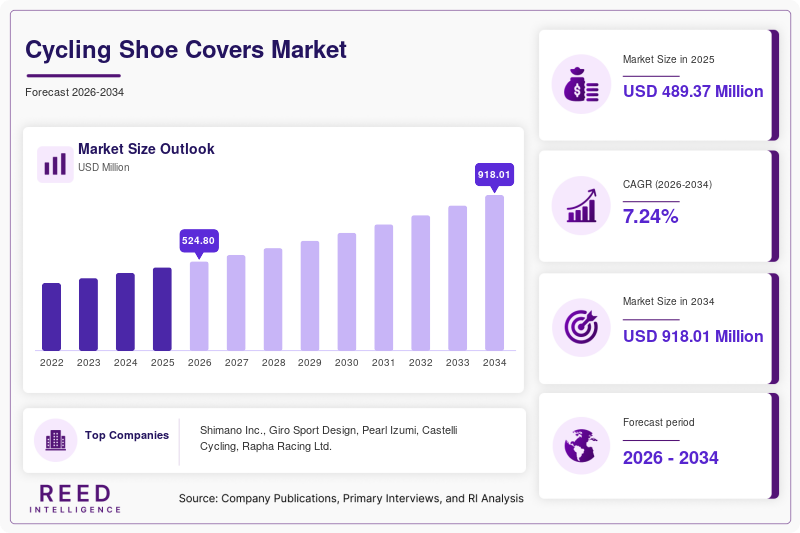
Cycling Shoe Covers market size is projected at USD 524.8 million in 2026 and is expected to hit USD 918.6 million by 2034 with a CAGR of 7.24%. Growing participation in recreational cycling, increasing demand for performance-oriented cycling apparel, and rising awareness regarding weather protection products are supporting industry expansion. The report provides detailed analysis of market segmentation, manufacturing output, distribution trends, and competitive positioning across key regions.
The Cycling Shoe Covers market consists of protective accessories designed to improve comfort, aerodynamics, insulation, and weather resistance during cycling activities. Global production exceeded 38 million pairs in 2025, with waterproof variants accounting for approximately 43% of total shipments. Road cycling applications contributed nearly 51% of industry revenue, while mountain biking represented 27%. Adoption of specialized cycling footwear accessories surpassed 46% among active cyclists in developed markets, reinforcing the Cycling Shoe Covers market.
Cycling Shoe Covers Market Trends
Rising Demand for Performance and Weather-Protection Cycling Accessories
Manufacturers are increasingly introducing lightweight, windproof, and waterproof shoe cover designs utilizing advanced neoprene, polyurethane, and elastic fabric technologies. More than 16 million pairs of waterproof shoe covers were produced globally during 2025, representing approximately 43% of total volume. Adoption rates among competitive cyclists increased from 39% in 2022 to 55% in 2025. The shift toward premium cycling gear continues to influence Cycling Shoe Covers trends.
The industry is witnessing growing use of aerodynamic fabrics and reflective safety materials. Nearly 48% of new product launches during 2025 incorporated high-visibility elements and thermal insulation features. Road cycling events, endurance races, and cycling clubs accounted for more than 12 million pairs of annual consumption. Increasing consumer focus on performance enhancement remains a key factor shaping Cycling Shoe Covers trends.
Cycling Shoe Covers Market Drivers
Growing Global Participation in Cycling Activities
More than 2.1 billion bicycles are estimated to be in use worldwide, while organized cycling event participation exceeded 95 million individuals in 2025. Cycling-related sporting activities increased by approximately 8.2% year-over-year across major markets. Sales of cycling accessories grew by 9.7%, with protective footwear products accounting for a substantial portion of demand. These developments continue to drive Cycling Shoe Covers market growth.
Cycling Shoe Covers Market Restraints
Seasonal Demand and Product Replacement Cycles
Demand for cycling shoe covers is heavily influenced by seasonal weather conditions, resulting in sales fluctuations across different regions. Approximately 34% of annual purchases occur during colder months, while replacement cycles typically range from 18 to 30 months. Lower participation rates in recreational cycling during adverse economic periods can affect purchasing activity. These factors restrain expansion of the Cycling Shoe Covers market.
Cycling Shoe Covers Market Opportunities
Expansion of E-Commerce and Premium Cycling Apparel
Global online sales of cycling apparel and accessories exceeded USD 12 billion in 2025. Nearly 58% of cycling enthusiasts purchased gear through digital platforms, compared with 44% in 2022. Premium cycling accessories experienced sales growth exceeding 11%, supported by direct-to-consumer brand strategies and personalized product offerings. Such developments create substantial opportunities within the Cycling Shoe Covers market.
Challenges in Cycling Shoe Covers Market
Intense Market Competition and Price Sensitivity
The market includes numerous international and regional brands competing across premium and value segments. More than 250 active manufacturers operate globally, creating pricing pressure and narrowing profit margins. Average selling prices declined by approximately 3.8% between 2023 and 2025 despite increasing material costs. Maintaining product differentiation remains a major challenge for the Cycling Shoe Covers market.
Cycling Shoe Covers Market Segmentation
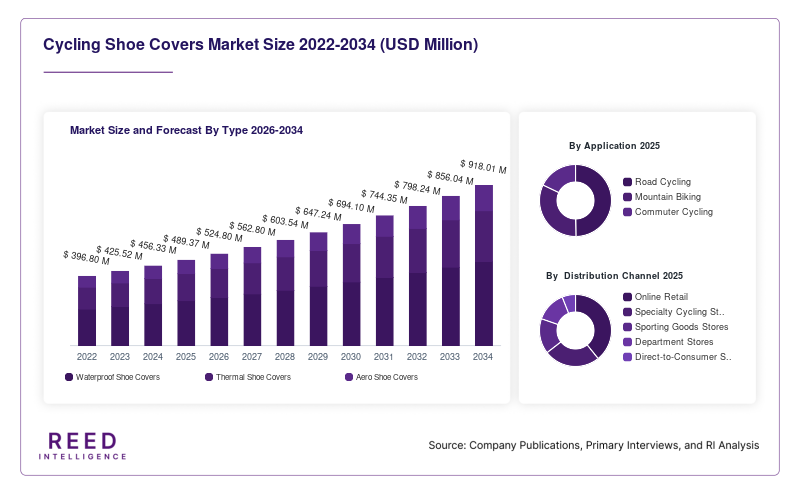
The market is segmented by type and application, with waterproof shoe covers accounting for approximately 43% of total revenue in 2025. Road cycling remained the dominant application segment with nearly 51% share due to growing participation in professional and recreational cycling activities.
By Type
Waterproof shoe covers represented approximately 43% of market revenue during 2025. Production exceeded 16 million pairs globally. These products utilize waterproof membranes, sealed seams, and durable synthetic materials to protect cyclists from rain and wet road conditions.
Thermal shoe covers accounted for nearly 32% of industry revenue. Annual production surpassed 12 million pairs. These products incorporate insulated neoprene materials, fleece linings, and thermal barriers to maintain foot warmth in temperatures below 10°C.
Aero shoe covers held approximately 25% of total market share. Production exceeded 10 million pairs during 2025. Lightweight stretch fabrics and aerodynamic construction reduce drag and improve cycling efficiency, making them popular among competitive road cyclists.
By Application
Road cycling generated approximately 51% of market revenue. More than 19 million pairs were sold to road cyclists globally in 2025. Usage penetration exceeded 59% among competitive riders due to increasing demand for weather protection and aerodynamic performance.
Mountain biking accounted for nearly 27% of market revenue. Annual consumption exceeded 10 million pairs. Durable, abrasion-resistant materials and waterproof construction support usage across rugged terrain and challenging environmental conditions.
Commuter cycling represented approximately 22% of industry revenue. More than 8 million pairs were purchased by urban cyclists during 2025. Growing bicycle commuting trends and sustainability initiatives continue to support segment growth.
Cycling Shoe Covers Regional Outlook
North America Cycling Shoe Covers Market
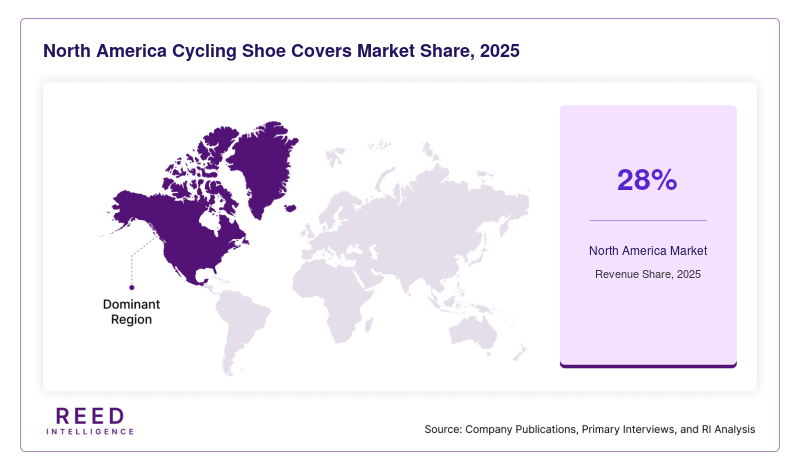
North America accounted for approximately 28% of global revenue during 2025. The United States contributed nearly 79% of regional demand, supported by rising participation in recreational cycling and endurance sports. Annual consumption exceeded 9 million pairs.
Europe Cycling Shoe Covers Market
Europe represented approximately 35% of global market revenue and remained the largest consumer region. Germany, the United Kingdom, France, Italy, and the Netherlands collectively accounted for more than 70% of regional demand. Consumption exceeded 13 million pairs during 2025.
Asia-Pacific Cycling Shoe Covers Market
Asia-Pacific held approximately 25% of total revenue and recorded strong production activity. China manufactured over 14 million pairs annually, while Japan, Australia, South Korea, and India experienced increasing cycling participation and sportswear spending.
Latin America Cycling Shoe Covers Market
Latin America accounted for nearly 7% of market revenue. Brazil, Mexico, and Argentina collectively represented more than 65% of regional demand. Consumption exceeded 2.5 million pairs during 2025.
Middle East & Africa Cycling Shoe Covers Market
The Middle East & Africa region represented approximately 5% of global revenue. South Africa, the UAE, and Saudi Arabia emerged as key markets due to growing interest in cycling events and fitness activities. Annual sales exceeded 1.8 million pairs.
Top players in Cycling Shoe Covers Market
- Shimano Inc.
- Giro Sport Design
- Pearl Izumi
- Castelli Cycling
- Rapha Racing Ltd.
- Sportful S.r.l.
- Endura Ltd.
- BBB Cycling
- Velotoze LLC
- Louis Garneau Sports Inc.
- Assos of Switzerland GmbH
- GripGrab ApS
- Santic Sports
- Vaude Sport GmbH
- Northwave S.r.l.
Shimano Inc.
- Estimated market share ranges between 13% and 15%.
- Maintains a strong position in cycling footwear and accessory categories across global markets.
- Extensive product portfolio includes waterproof, thermal, and performance-oriented shoe cover solutions.
- Strong retail distribution network across North America, Europe, and Asia-Pacific supports broad market penetration.
- Continuous investment in material innovation and athlete-focused product development enhances brand leadership.
- Established reputation among professional and recreational cyclists strengthens its position within the Cycling Shoe Covers market.
Castelli Cycling
- Estimated market share ranges between 9% and 11%.
- Recognized for premium cycling apparel and high-performance footwear accessories.
- Focuses on aerodynamic construction, thermal protection technologies, and weather-resistant fabrics.
- Strong presence in professional cycling events and competitive sports markets.
- Ongoing product innovation and premium branding strategies support revenue growth.
- Expansion through online sales channels and specialist cycling retailers contributes to increasing market presence.
Recent Developments in Cycling Shoe Covers Market
- 2026: Several manufacturers introduced ultra-lightweight aerodynamic shoe covers designed for competitive road cycling events.
- 2025: New waterproof membrane technologies improved weather resistance while reducing product weight by up to 15%.
- 2025: Leading brands expanded direct-to-consumer e-commerce platforms to strengthen global sales channels.
Cycling Shoe Covers Market Segments
By Type
- Waterproof Shoe Covers
- Thermal Shoe Covers
- Aero Shoe Covers
By Application
- Road Cycling
- Mountain Biking
- Commuter Cycling
By Distribution Channel
- Online Retail
- Specialty Cycling Stores
- Sporting Goods Stores
- Department Stores
- Direct-to-Consumer Sales
By Region
- North America
- Europe
- APAC
- Middle East and Africa
- LATAM