Food Grade Potassium Sorbate Market Size, Share Demand Report By Type (Powder Potassium Sorbate, Granular Potassium Sorbate, Liquid Potassium Sorbate Solutions), By Application (Bakery and Confectionery Products, Beverages and Dairy Products, Processed Foods and Sauces, Meat, Seafood, and Poultry Products), By End-User (Food Processing Companies, Beverage Manufacturers, Bakery and Confectionery Manufacturers, Retail and Household Food Preservation) By Region & Segment Forecasts, 2026–2034
USD 3950
Food Grade Potassium Sorbate Market Size
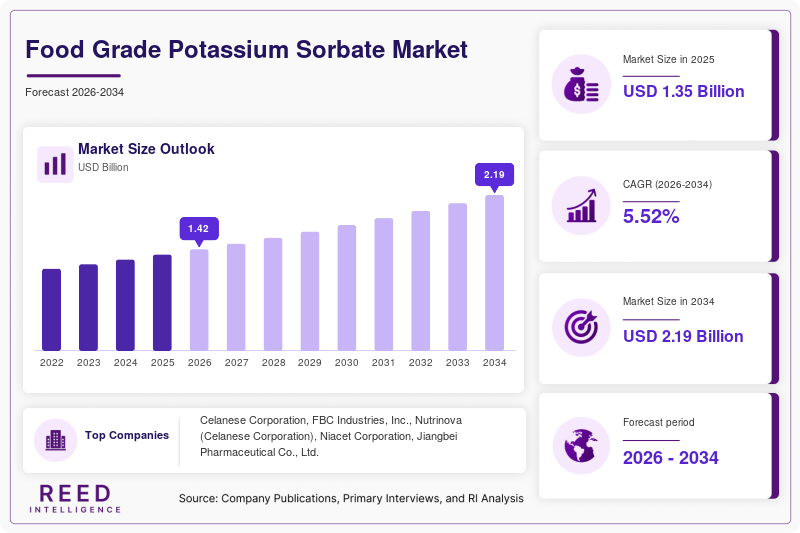
Food Grade Potassium Sorbate market size is projected at USD 1.42 billion in 2026 and is expected to hit USD 2.18 billion by 2034 with a CAGR of 5.52%. Rising demand for natural food preservation solutions, increasing processed food consumption, and expansion of the packaged food industry are supporting market development. The report provides detailed analysis of market segmentation, production capacity, application demand, regional performance, and competitive landscape.
The Food Grade Potassium Sorbate market covers potassium sorbate compounds used as preservatives to inhibit mold, yeast, and microbial growth in food and beverage products. The increasing adoption of clean-label preservation technologies and longer shelf-life requirements has accelerated demand across global food industries. Detailed evaluation of production volumes, consumption patterns, pricing trends, and industry strategies provides comprehensive Food Grade Potassium Sorbate market insights.
Food Grade Potassium Sorbate Market Trends
Growing Preference for Clean Label Food Preservation Solutions
The shift toward safe and effective food preservatives is significantly influencing industry trends. Global potassium sorbate production exceeded 390,000 metric tons in 2025, with food-grade applications representing nearly 86% of total consumption. More than 62% of processed food manufacturers are incorporating approved preservatives to improve shelf stability. Increased demand from bakery, dairy, and beverage producers continues to support Food Grade Potassium Sorbate trends.
Expansion of Processed Food and Beverage Manufacturing
Rising packaged food consumption is increasing potassium sorbate utilization worldwide. Global processed food production surpassed 2.5 billion tons in 2025, with preserved food products contributing approximately 38% of total processed categories. Beverage manufacturers accounted for nearly 31% of potassium sorbate consumption due to increasing demand for fruit drinks, sauces, and ready-to-drink products. Technological improvements in formulation and food safety standards continue to influence Food Grade Potassium Sorbate trends.
Food Grade Potassium Sorbate Market Drivers
Increasing Demand for Extended Shelf-Life Food Products
The growing global packaged food industry is a major driver for potassium sorbate demand. Worldwide packaged food sales exceeded USD 2.4 trillion in 2025, while processed food consumption increased by approximately 6.8% annually. More than 70% of commercial food manufacturers utilize preservatives to maintain product quality during storage and transportation. Expanding food distribution networks and rising consumer preference for convenient foods are accelerating Food Grade Potassium Sorbate market growth.
Food Grade Potassium Sorbate Market Restraints
Growing Preference for Natural and Preservative-Free Alternatives
Increasing consumer demand for clean-label products creates challenges for synthetic preservatives. Approximately 45% of consumers globally prefer foods with fewer chemical ingredients, while 28% of food manufacturers are investing in natural preservation alternatives. Regulatory limitations and changing consumer preferences may restrict growth opportunities in certain premium food segments. These factors create restraints for the Food Grade Potassium Sorbate market.
Food Grade Potassium Sorbate Market Opportunities
Rising Adoption in Emerging Food Processing Markets
Developing economies are creating significant opportunities due to rapid expansion of food processing industries. Asia-Pacific food manufacturing investments exceeded USD 320 billion in 2025, contributing nearly 48% of global processed food growth. Increasing urbanization and rising packaged food consumption are expected to increase potassium sorbate demand by more than 7% annually in emerging markets. These trends create strong opportunities within the Food Grade Potassium Sorbate market.
Challenges in Food Grade Potassium Sorbate
Regulatory Compliance and Raw Material Price Volatility
The market faces challenges due to strict food safety regulations and fluctuations in raw material costs. Production costs increased by approximately 9% during 2025 due to changes in chemical input prices. More than 35 countries have implemented specific food additive standards requiring compliance testing and certification. These regulatory and cost pressures influence manufacturers operating in the Food Grade Potassium Sorbate market.
Food Grade Potassium Sorbate Market Segmentation
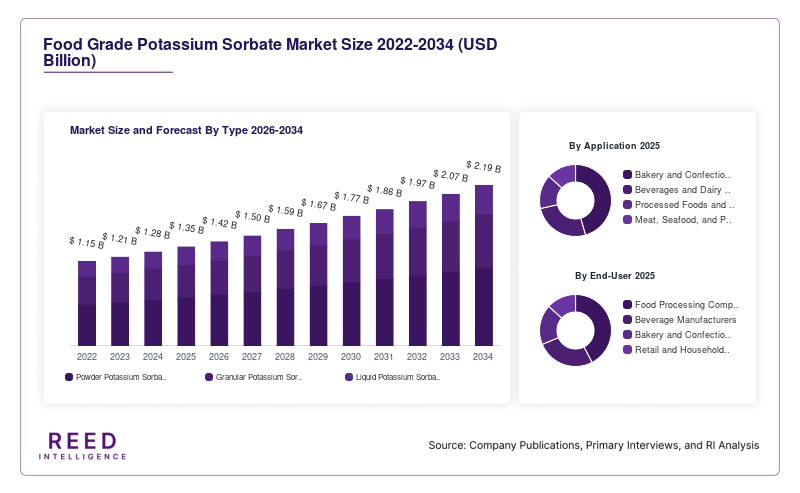
The Food Grade Potassium Sorbate market is segmented by form and application. Powder-based potassium sorbate dominated the market with approximately 58% revenue share in 2025 due to easier storage, transportation, and wider industrial usage. Food and beverage applications accounted for nearly 64% of total demand, driven by increasing consumption of processed products.
By Form
Powder form accounted for approximately 58% of market revenue in 2025. Global production exceeded 225,000 metric tons annually. Powder potassium sorbate offers high stability, easy handling, and efficient blending capabilities, making it widely used by large-scale food manufacturers.
Granular potassium sorbate represented nearly 27% of total market share. Production reached approximately 105,000 metric tons in 2025. Granular formulations provide controlled dissolution rates and are preferred in industrial food processing applications requiring consistent preservation performance.
Liquid potassium sorbate accounted for around 15% of market revenue. Annual production exceeded 60,000 metric tons. Liquid formulations are primarily used in beverage processing, sauces, and applications requiring rapid integration into food systems.
By Application
Food and beverage applications dominated with nearly 64% market share. More than 250,000 metric tons of potassium sorbate were consumed by food and beverage manufacturers in 2025. The ingredient is widely used in beverages, sauces, jams, and processed foods due to its antimicrobial properties and regulatory approval.
Bakery and confectionery applications contributed approximately 21% of market demand. Global bakery production exceeded 900 million tons in 2025, with potassium sorbate used in more than 45% of commercial bakery preservation processes. Increasing demand for packaged bread and confectionery products supports segment expansion.
Dairy applications accounted for nearly 15% of market revenue. More than 55,000 metric tons were utilized in dairy processing facilities during 2025. The preservative helps improve shelf stability of cheese, yogurt, and dairy-based products while maintaining quality standards.
Food Grade Potassium Sorbate Market Regional Outlook
North America Food Grade Potassium Sorbate Market
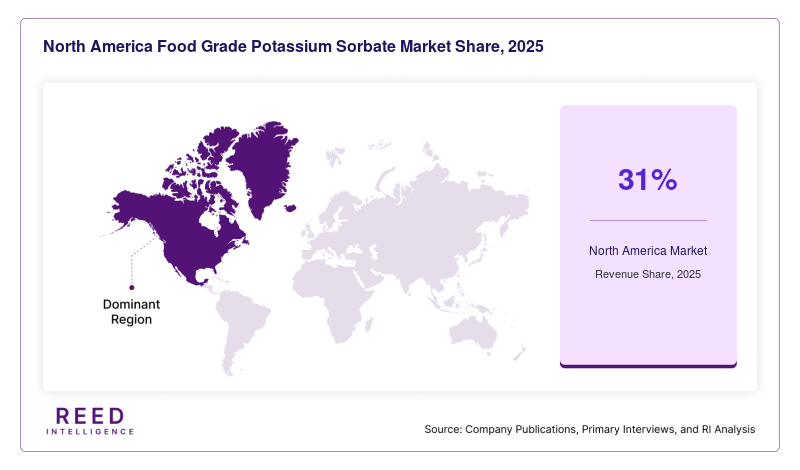
North America accounted for approximately 31% of global revenue in 2025. The United States contributed nearly 78% of regional demand due to strong processed food manufacturing and beverage production. More than 120,000 metric tons of food-grade potassium sorbate were consumed across the region, with beverages and bakery products representing over 60% of usage.
Europe Food Grade Potassium Sorbate Market
Europe held nearly 28% market share. Germany, France, Italy, and the United Kingdom were major contributors, collectively accounting for more than 70% of regional consumption. Strict food safety regulations and advanced food processing industries supported demand exceeding 100,000 metric tons annually.
Asia-Pacific Food Grade Potassium Sorbate Market
Asia-Pacific dominated growth with approximately 34% market share. China, India, Japan, and South Korea contributed significantly, with China accounting for nearly 45% of regional consumption. Regional demand exceeded 130,000 metric tons in 2025, supported by expanding food manufacturing and packaged food industries.
Latin America Food Grade Potassium Sorbate Market
Latin America represented nearly 5% of global revenue. Brazil and Mexico accounted for more than 65% of regional demand. Increasing processed food production and beverage consumption supported annual consumption exceeding 20,000 metric tons.
Middle East & Africa Food Grade Potassium Sorbate Market
The Middle East & Africa accounted for approximately 2% of market share. Rising food imports, urbanization, and packaged food consumption supported demand growth, with Saudi Arabia, UAE, and South Africa being key markets.
Top players in Food Grade Potassium Sorbate Market
- Celanese Corporation
- FBC Industries Inc.
- Merck KGaA
- Archer Daniels Midland Company
- Niacet Corporation
- Foodchem International Corporation
- Wego Chemical Group
- Prayon S.A.
- Macco Organiques Inc.
- Nutra Food Ingredients
- Jiangsu Muping Chemical Co., Ltd.
- Shandong Kunda Biotechnology Co., Ltd.
Celanese Corporation
- Holds an estimated market share of approximately 12%–15%.
- Maintains a strong position through advanced chemical manufacturing capabilities and global distribution networks.
- The company supplies high-quality potassium sorbate solutions for food preservation applications across multiple regions.
- Strong focus on product consistency, regulatory compliance, and sustainable manufacturing enhances its competitiveness.
- Its broad customer base across food, beverage, and industrial sectors supports long-term positioning in the Food Grade Potassium Sorbate market.
Niacet Corporation
- Holds an estimated market share of approximately 8%–10%.
- Recognized as a major supplier of specialty food preservation ingredients.
- The company focuses on innovation, quality certifications, and customized preservation solutions.
- Strong presence in bakery, dairy, and processed food industries strengthens market penetration.
- Continuous investment in production expansion and food safety technologies supports its leadership position within the Food Grade Potassium Sorbate market.
Recent Developments in Food Grade Potassium Sorbate Market
- 2026: Manufacturers expanded production capacity to meet increasing demand from processed food industries.
- 2025: Companies introduced improved food-grade preservation formulations with enhanced stability characteristics.
- 2025: Regional suppliers increased investments in Asia-Pacific manufacturing facilities.
Food Grade Potassium Sorbate Market Segments
By Type
- Powder Potassium Sorbate
- Granular Potassium Sorbate
- Liquid Potassium Sorbate Solutions
By Application
- Bakery and Confectionery Products
- Beverages and Dairy Products
- Processed Foods and Sauces
- Meat, Seafood, and Poultry Products
By End-User
- Food Processing Companies
- Beverage Manufacturers
- Bakery and Confectionery Manufacturers
- Retail and Household Food Preservation
By Region
- North America
- Europe
- APAC
- Middle East and Africa
- LATAM