Load Lock Chambers Market Size, Share & Demand Report By Type (Single Wafer Load Lock Chambers, Multi-Wafer Load Lock Chambers, Vacuum Load Lock Chambers), By Application (Semiconductor Manufacturing, Solar Cell Production, Research & Development Facilities), By Region & Segment Forecasts, 2026–2034
USD 3950
Load Lock Chambers Market Size
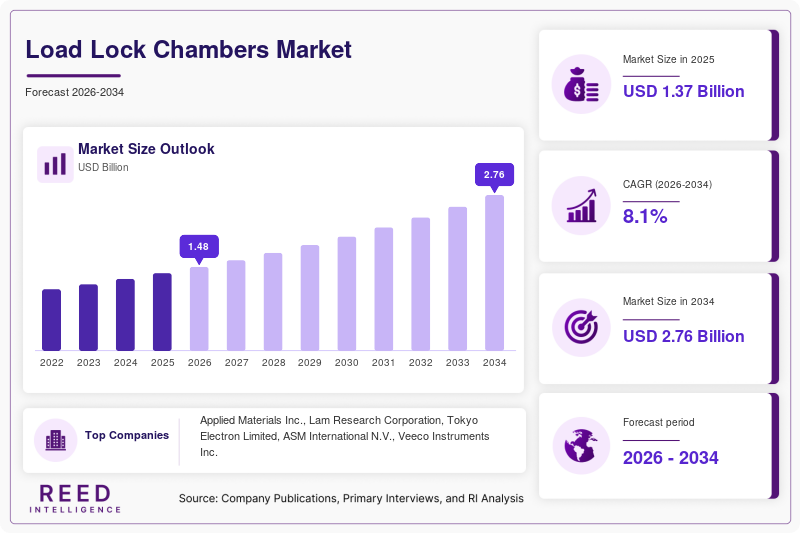
Load Lock Chambers market size is projected at USD 1.48 billion in 2026 and is expected to hit USD 2.74 billion by 2034 with a CAGR of 8.1%. The report provides comprehensive analysis of Load Lock Chambers market segmentation, technological developments, competitive landscape, production capacity, and regional demand patterns. The study evaluates historical performance from 2022–2024, the base year 2025, and forecast trends through 2034 to identify key growth opportunities and industry developments.
Load Lock Chambers are specialized vacuum-controlled chambers used in semiconductor fabrication equipment to transfer wafers between atmospheric and vacuum environments without disrupting process conditions. These systems are essential components in deposition, etching, lithography, and inspection processes where contamination control and pressure stability are critical. Global semiconductor wafer processing equipment installations exceeded USD 100 billion in 2025, supporting strong demand for advanced Load Lock Chambers.
Load Lock Chambers Trends
Increasing Automation and Advanced Vacuum Technologies
The Load Lock Chambers market is experiencing rapid adoption of automated vacuum handling systems integrated with robotics, sensors, and smart monitoring technologies. More than 75 million semiconductor wafers are processed annually through advanced vacuum equipment, increasing demand for high-performance load lock solutions. Manufacturers are developing compact chamber designs that reduce transfer time by 20–30% and improve equipment productivity.
Advanced semiconductor nodes below 7 nm require contamination levels below strict industry standards, resulting in more than 60% adoption of next-generation vacuum load lock systems in newly constructed fabrication facilities. These technological improvements are accelerating Load Lock Chambers market growth.
Growing Demand from Semiconductor and Renewable Energy Industries
Increasing investments in semiconductor manufacturing and photovoltaic production are creating significant demand for Load Lock Chambers. Global semiconductor capital expenditure surpassed USD 190 billion in 2025, with approximately 40% allocated toward advanced process technologies requiring efficient wafer transfer solutions.
Solar photovoltaic manufacturing facilities produced more than 500 GW of solar modules globally in 2025, increasing the requirement for vacuum-based production equipment. Rising automation penetration above 70% in large-scale manufacturing facilities continues to drive Load Lock Chambers market development.
Load Lock Chambers Market Drivers
Expansion of Semiconductor Fabrication Capacity
The expansion of semiconductor fabrication plants is the primary driver for the Load Lock Chambers market. Global wafer fabrication capacity increased by more than 8% annually, with over 90 new semiconductor facilities announced between 2024 and 2026. Advanced manufacturing processes require reliable vacuum transfer solutions, where Load Lock Chambers improve contamination prevention and production efficiency. Approximately 85% of new fabs integrate automated load lock systems, supporting long-term Load Lock Chambers market growth.
Load Lock Chambers Market Restraints
High Equipment Costs and Maintenance Requirements
High installation costs associated with advanced vacuum systems limit Load Lock Chambers adoption among small-scale manufacturers. Precision vacuum chambers require specialized materials, complex engineering, and strict quality testing, increasing equipment costs by 25–40%. Maintenance expenses can represent nearly 10% of annual equipment operating costs, creating challenges for manufacturers with limited capital budgets and affecting Load Lock Chambers market penetration.
Load Lock Chambers Market Opportunities
Increasing Investments in Advanced Semiconductor Technologies
The growing demand for artificial intelligence chips, automotive electronics, and high-performance computing devices creates significant opportunities for Load Lock Chambers suppliers. Semiconductor investments exceeding USD 500 billion globally are planned through 2030, generating demand for advanced fabrication equipment. Emerging semiconductor manufacturing hubs are expected to contribute more than 30% of new fabrication capacity additions, creating strong opportunities for Load Lock Chambers market expansion.
Challenges in Load Lock Chambers Market
Complex Engineering Standards and Supply Chain Limitations
The Load Lock Chambers market faces challenges related to strict engineering requirements, material availability, and supply chain disruptions. Vacuum chamber manufacturing requires high-grade stainless steel, aluminum alloys, and precision components with extremely low defect rates. Nearly 35% of manufacturers identify component supply reliability as a major challenge, while customization requirements increase production timelines by 15–25%, impacting Load Lock Chambers market scalability.
Load Lock Chambers Market Segmentation
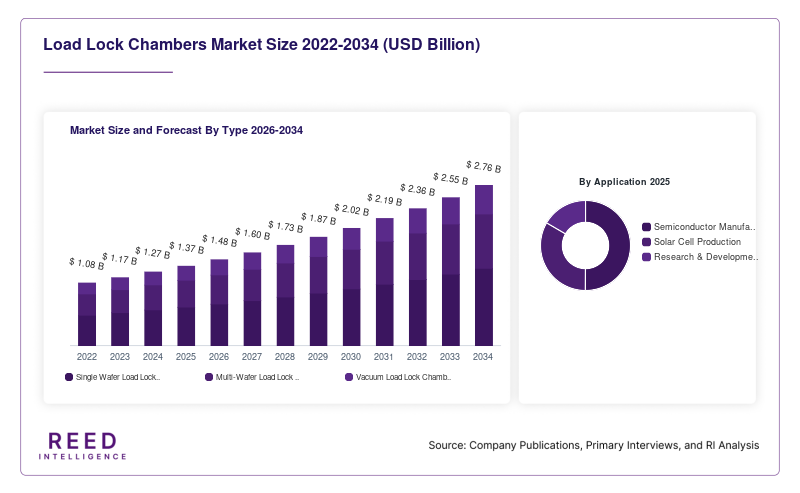
Load Lock Chambers market segmentation is categorized by type and application based on vacuum technology requirements and end-use industries. Vacuum Load Lock Chambers dominate with nearly 45% market share due to their importance in advanced semiconductor processing, while semiconductor manufacturing applications account for approximately 68% of total demand.
By Type
Single Wafer Load Lock Chambers account for nearly 40% market share and are widely used in advanced semiconductor fabrication processes. More than 30 million wafer transfer operations are performed annually using single wafer systems in modern fabs. These chambers provide high precision, rapid pressure stabilization, and compatibility with advanced deposition and etching equipment. Their ability to reduce particle contamination makes them suitable for semiconductor nodes below 10 nm.
Multi-Wafer Load Lock Chambers represent approximately 35% market share and support high-volume manufacturing environments. These systems can process multiple wafers simultaneously, improving production throughput by 20–35%. They are commonly used in memory chip manufacturing and large-scale semiconductor facilities requiring efficient material movement.
Vacuum Load Lock Chambers hold nearly 25% market share and provide enhanced environmental isolation between atmospheric and vacuum processing areas. These systems are capable of maintaining ultra-high vacuum conditions below 10⁻⁶ Torr and are increasingly adopted in advanced semiconductor, display, and research applications.
By Application
Semiconductor manufacturing dominates the Load Lock Chambers market with approximately 68% share. More than 15 billion semiconductor devices are produced annually, requiring efficient wafer transfer systems. Load Lock Chambers enable contamination control, automated movement, and stable vacuum transitions across lithography, etching, and deposition processes. Adoption exceeds 85% among advanced semiconductor fabrication facilities.
Solar cell production contributes nearly 20% market share due to increasing photovoltaic manufacturing capacity. Global solar module production exceeded 500 GW in 2025, requiring vacuum chambers for thin-film deposition and coating applications. More than 65% of advanced solar manufacturing lines utilize vacuum-based transfer equipment.
Research and development facilities account for around 12% market share. Universities, laboratories, and technology centers use Load Lock Chambers for material science, nanotechnology, and experimental semiconductor research. Adoption has increased by approximately 10% annually due to rising investments in advanced materials research.
Load Lock Chambers Market Regional Outlook
Asia-Pacific Load Lock Chambers Market
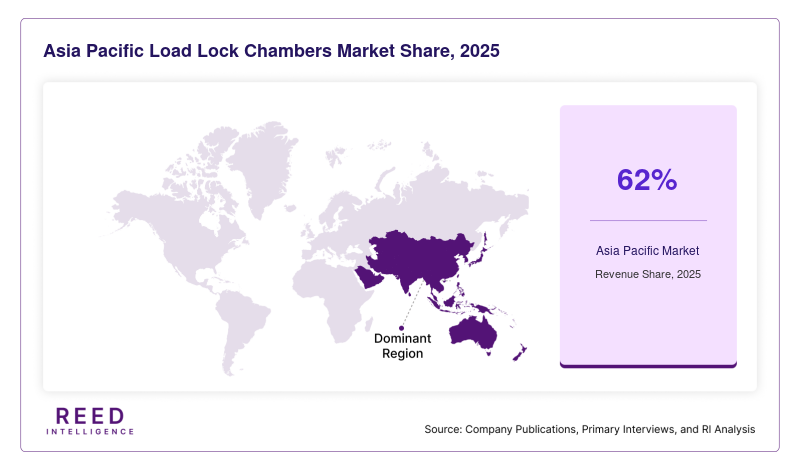
Asia-Pacific dominates the Load Lock Chambers market with approximately 62% market share due to strong semiconductor manufacturing activity in Taiwan, China, South Korea, and Japan. Taiwan contributes nearly 30% of regional demand through advanced semiconductor foundries, while South Korea represents around 20% due to memory chip production. The region accounts for more than 70% of global semiconductor fabrication expansion projects.
North America Load Lock Chambers Market
North America holds nearly 20% market share, driven by semiconductor manufacturing investments in the United States. More than USD 50 billion in new semiconductor projects are under development, increasing demand for vacuum processing equipment. The region focuses on advanced logic chips, defense electronics, and AI semiconductor production.
Europe Load Lock Chambers Market
Europe contributes approximately 12% market share, supported by automotive semiconductor and industrial electronics manufacturing. Germany, France, and the Netherlands represent major contributors. Around 40% of regional demand comes from automotive chip production requiring advanced fabrication technologies.
Rest of the World Load Lock Chambers Market
The remaining regions account for nearly 6% market share. Increasing semiconductor localization programs in India, Southeast Asia, and the Middle East are expected to support future Load Lock Chambers adoption. Regional demand is projected to grow above 7% annually through 2034.
Top players in Load Lock Chambers Market
- Applied Materials Inc.
- Lam Research Corporation
- Tokyo Electron Limited
- ASM International N.V.
- Veeco Instruments Inc.
- Oxford Instruments plc
- VAT Group AG
- Brooks Automation Inc.
- Kurt J. Lesker Company
- Shibaura Mechatronics Corporation
Applied Materials Inc.
- Maintains a leading position in the Load Lock Chambers market through advanced semiconductor manufacturing equipment solutions.
- The company supports major global semiconductor manufacturers with vacuum processing technologies.
- Its systems are integrated into high-volume fabrication facilities producing advanced logic and memory chips.
- Strong investments in semiconductor process innovation and automation technologies strengthen its competitive positioning.
Lam Research Corporation
- Holds significant market positioning through advanced wafer fabrication equipment technologies.
- The company provides vacuum-based solutions supporting etching, deposition, and semiconductor processing applications.
- Its Load Lock Chambers technologies are used extensively in advanced semiconductor manufacturing facilities.
- Increasing demand for AI chips and miniaturized semiconductor devices supports its long-term market presence.
Recent Developments in Load Lock Chambers Market
- 2026: Semiconductor equipment manufacturers introduced advanced automated Load Lock Chambers with improved wafer transfer efficiency.
- 2025: Major fabrication facilities expanded procurement of high-vacuum load lock systems for advanced process nodes.
- 2025: Equipment suppliers developed compact chamber designs to reduce semiconductor manufacturing cycle times.
Load Lock Chambers Market Segments
By Type
- Single Wafer Load Lock Chambers
- Multi-Wafer Load Lock Chambers
- Vacuum Load Lock Chambers
By Application
- Semiconductor Manufacturing
- Solar Cell Production
- Research & Development Facilities
By Region
- North America
- Europe
- APAC
- Middle East and Africa
- LATAM