Oil Absorbing Sheets for Face Market Size, Share Demand Report By Type (Natural Fiber Sheets, Synthetic Polymer Sheets, Blended Sheets), By Application (Personal Use, Salons & Spas, Cosmetics & Skincare Clinics), Regional Insights & Segment Forecasts, 2026–2034
USD 3950
Oil Absorbing Sheets for Face Market Size
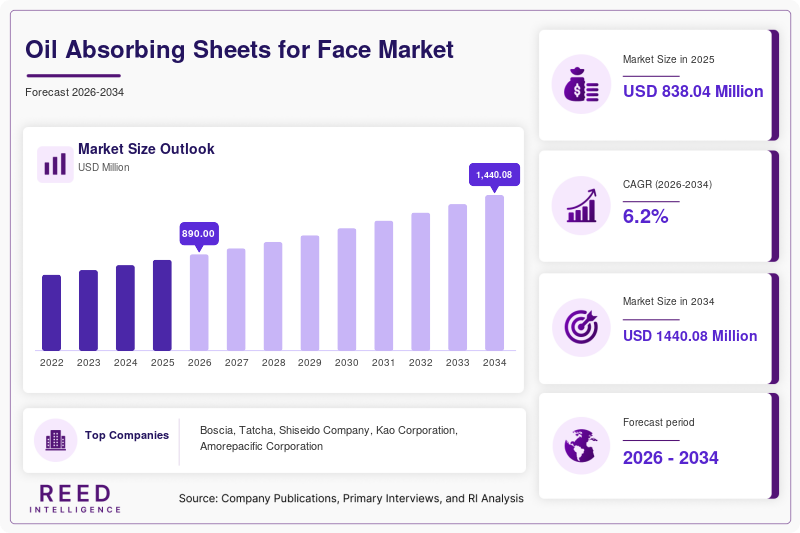
Oil Absorbing Sheets for Face market size is projected at USD 890 million in 2026 and is expected to hit USD 1,420 million by 2034 with a CAGR of 6.2% during the forecast period. The rising consumer focus on skincare and oil-control solutions, driven by environmental pollution and increased product availability, underpins market expansion. This report offers a detailed analysis of the Oil Absorbing Sheets for Face market, including segmentation by type and application, competitive landscape, and regional growth patterns, empowering stakeholders with critical intelligence. The Oil Absorbing Sheets for Face market continues to demonstrate robust growth potential, fueled by the global emphasis on personal grooming and the proliferation of beauty-conscious demographics.
Oil absorbing sheets for face, also known as blotting papers, are thin, absorbent papers designed to remove excess sebum and oil from the skin's surface without disturbing makeup. These sheets are typically made from materials such as natural fibers (e.g., rice paper, bamboo pulp), synthetic polymers (e.g., polypropylene), or blended compositions, offering a convenient solution for managing oily skin and shine. The global production volume of oil absorbing sheets reached approximately 3.8 billion sheets in 2025, reflecting widespread adoption across diverse consumer demographics. Penetration rates are notably high in urban areas of Asia-Pacific, where over 45% of skincare users incorporate these sheets into their daily routine, and the market is characterized by increasing demand for eco-friendly, biodegradable options. By type, natural fiber sheets dominate with a 48% market share, followed by synthetic polymer sheets at 32%, and blended sheets at 20%. The Oil Absorbing Sheets for Face market's trajectory is closely linked to the growing prevalence of combination and oily skin conditions, which affect an estimated 55-60% of the global population, as well as the rising influence of skincare routines driven by social media and beauty influencers.
Oil Absorbing Sheets for Face Market Trends
Surge in Demand for Eco-Friendly and Sustainable Solutions
The Oil Absorbing Sheets for Face market is witnessing a significant trend toward sustainable, biodegradable materials driven by increasing consumer environmental awareness and demand for plastic-free products. Production of natural fiber and recycled-material sheets surged to 1.9 billion sheets in 2025, representing a 50% share of total output and a year-on-year growth of 12%. Adoption rates for eco-friendly sheets have reached 38% in Western markets, with this figure projected to exceed 55% by 2030 as sustainability-focused formulations gain traction. Sector-specific demand is particularly evident in the personal use segment, where 65% of Millennial and Gen Z consumers prioritize sustainable packaging and materials. The Oil Absorbing Sheets for Face market's trend toward sustainability is reinforced by recent innovations in biodegradable polymers and plant-based fibers, with bamboo and hemp-based sheets growing at a CAGR of 9.5% since 2022.
Technological Advancements in Material Science and Functionality
Technological innovations in absorbent materials and sheet design are reshaping the Oil Absorbing Sheets for Face market, with manufacturers developing sheets that offer enhanced oil-absorption capacity, improved texture, and added skincare benefits. The adoption of multi-layer technology and micro-perforation designs has grown by 25% since 2023, with premium products now capable of absorbing up to 40% more oil than standard sheets. The market has also seen the introduction of sheets infused with skincare ingredients such as salicylic acid, green tea extract, and hyaluronic acid, which accounted for 18% of new product launches in 2025. The Oil Absorbing Sheets for Face market's innovation landscape is further characterized by the development of color-changing sheets that indicate optimal usage time and smart packaging with UV protection, representing a growing niche segment projected to reach USD 75 million by 2027.
Oil Absorbing Sheets for Face Market Drivers
The Oil Absorbing Sheets for Face market's expansion is primarily driven by the global rise in skincare consciousness and the increasing prevalence of oily skin conditions exacerbated by urbanization and environmental pollution. With the global skincare market valued at USD 155 billion in 2025 and growing at a CAGR of 5.2%, demand for targeted oil-control solutions has intensified, leading to a 14% increase in oil absorbing sheet usage among consumers aged 18-35. The growing trend of "skinimalism" and the focus on multi-functional, convenient skincare products further supports market growth, as consumers seek quick, effective solutions for midday shine control. The Oil Absorbing Sheets for Face market also benefits from the expansion of direct-to-consumer (D2C) channels and the influence of beauty influencers, which have increased brand discovery and trial rates by 30% since 2022.
Oil Absorbing Sheets for Face Market Restraints
Despite favorable growth tailwinds, the Oil Absorbing Sheets for Face market faces notable constraints, including the availability of cost-effective alternatives such as blotting papers and DIY solutions, which appeal to budget-conscious consumers. The low switching costs and limited brand loyalty in the commodity-like segment of the market create pricing pressures, with private-label and unbranded products accounting for an estimated 35% of total sales in developing regions. The Oil Absorbing Sheets for Face market's growth is also tempered by the environmental impact of single-use products, leading to increased scrutiny from eco-conscious consumers and regulators, which may accelerate the shift toward reusable and washable alternatives.
Oil Absorbing Sheets for Face Market Opportunities
The Oil Absorbing Sheets for Face market presents substantial opportunities in the development of multi-functional sheets that combine oil-absorption with active skincare benefits, such as acne treatment, pore minimizing, and mattifying effects. The market for medicated oil absorbing sheets, targeting acne-prone skin, is projected to grow at a CAGR of 8.5% during the forecast period. Emerging opportunities also exist in the travel-friendly and on-the-go segment, with the global travel retail market expected to reach USD 85 billion by 2028, creating avenues for compact, single-use packets and innovative packaging designs. The Oil Absorbing Sheets for Face market's opportunity profile is further enhanced by the growing trend of male grooming, with the male skincare market projected to reach USD 21.5 billion by 2027, and the increasing popularity of K-beauty and J-beauty routines worldwide, which emphasize oil-control as a key skincare step.
Challenges in Oil Absorbing Sheets for Face Market
The Oil Absorbing Sheets for Face market faces persistent challenges related to product differentiation and the management of consumer expectations regarding efficacy and environmental impact. The market has witnessed a proliferation of low-quality, unbranded products from emerging manufacturers, which account for approximately 28% of total production volume, intensifying price competition and potentially eroding consumer confidence. Maintaining consistent absorbency and sheet integrity across production batches remains a manufacturing challenge, with quality control failure rates averaging 3-5% in entry-level products. Additionally, the Oil Absorbing Sheets for Face market's challenge profile includes navigating the complex regulatory landscape regarding material safety and claims substantiation, particularly in the European Union and North America, requiring continuous R&D investment to meet evolving standards.
Oil Absorbing Sheets for Face Market Segmentation
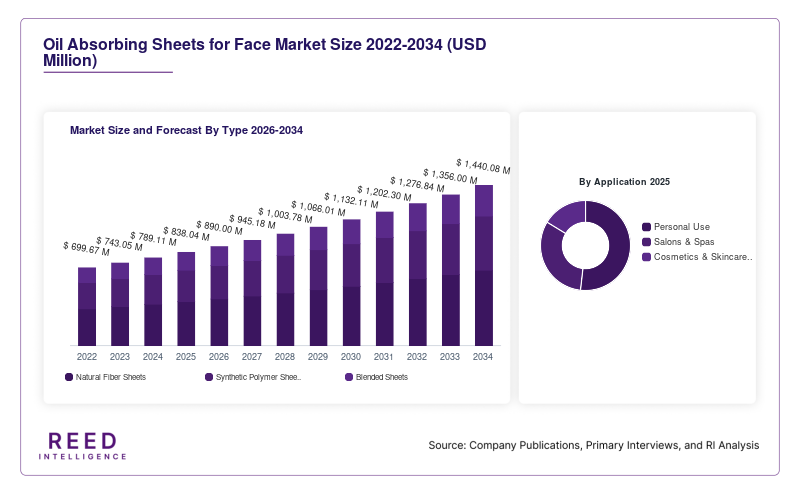
The Oil Absorbing Sheets for Face market is segmented by Type and Application to provide a comprehensive market perspective. By Type, Natural Fiber Sheets lead with a 48% market share, reflecting consumer preference for natural, biodegradable materials. The Application segment is dominated by Personal Use, which accounts for 65% of sales, followed by Salons & Spas at 22%, and Cosmetics & Skincare Clinics at 13%.
By Type
Natural Fiber Sheets represent the largest segment in the Oil Absorbing Sheets for Face market, commanding a 48% share, with production reaching 1.82 billion sheets in 2025. These sheets, primarily composed of plant-based materials such as rice paper, bamboo pulp, and cotton, are characterized by their high absorbency, softness, and biodegradability. Technical specifications for premium natural fiber sheets include grammage of 18-25 gsm, oil absorption capacity of 0.8-1.2 g per sheet, and pH neutrality to suit sensitive skin. The Oil Absorbing Sheets for Face market's natural fiber segment is driven by its alignment with consumer demand for clean beauty and sustainable packaging.
Synthetic Polymer Sheets capture a 32% share of the Oil Absorbing Sheets for Face market, with production of 1.22 billion sheets in 2025. These sheets, made from materials such as polypropylene and polyethylene, offer advantages in terms of cost-effectiveness, consistency, and durability, with oil absorption capacity of 1.0-1.5 g per sheet. The segment is characterized by its widespread availability in mass-market and drugstore channels. The Oil Absorbing Sheets for Face market's synthetic segment is projected to grow at a steady CAGR of 5.4%, driven by ongoing demand for affordable, effective oil-control solutions.
Blended Sheets represent the fastest-growing type segment in the Oil Absorbing Sheets for Face market, with a 20% share and a CAGR of 7.8%, reaching 760 million sheets produced in 2025. These sheets combine natural and synthetic fibers to optimize performance, typically using a core-sheath structure where a natural fiber core provides absorbency and a synthetic sheath adds strength. Blended sheets are particularly popular in the premium segment, with average selling prices ranging from USD 0.08 to USD 0.25 per sheet. The Oil Absorbing Sheets for Face market's blended segment is gaining traction among consumers seeking a balance between sustainability and performance.
By Application
Personal Use dominates the Oil Absorbing Sheets for Face market, accounting for 65% of sales, representing approximately 2.47 billion sheets consumed in 2025. This segment is driven by daily skincare routines, with 70% of consumers using these sheets 3-4 times per week, and 25% using them daily. The penetration rate in urban areas exceeds 60% among women aged 15-45, and is growing among men, who now represent 18% of users. The Oil Absorbing Sheets for Face market's personal use segment is increasingly influenced by subscription models and value packs, which account for 30% of online sales.
Salons & Spas represent the second-largest application segment, accounting for 22% of the Oil Absorbing Sheets for Face market, with consumption of approximately 836 million sheets in 2025. These establishments use high-quality sheets as part of facial treatments and makeup services, with professional-grade sheets accounting for 40% of the segment's value. The segment is growing at a CAGR of 5.5%, driven by the increasing number of beauty salons globally and the rising popularity of premium spa experiences. The Oil Absorbing Sheets for Face market's professional segment is characterized by a preference for bulk packaging and cost-effective, reliable performance.
Cosmetics & Skincare Clinics account for the remaining 13% of the Oil Absorbing Sheets for Face market, with consumption of 494 million sheets in 2025. This segment includes sheets used during and after facial treatments, chemical peels, and other professional skincare procedures to remove excess oil and sebum. The segment is growing at the fastest CAGR of 7.2%, driven by the expansion of medical aesthetics clinics and the growing popularity of minimally invasive skincare treatments. The Oil Absorbing Sheets for Face market's clinical segment is distinguished by its requirement for sterile, medical-grade sheets with high purity standards.
Oil Absorbing Sheets for Face Market Regional Outlook
Asia-Pacific Oil Absorbing Sheets for Face Market
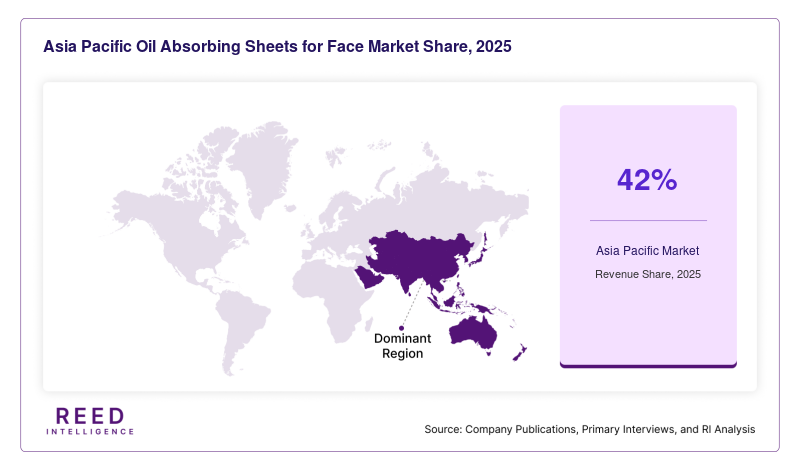
Leads the Oil Absorbing Sheets for Face market, commanding a 42% share, with consumption reaching 1.6 billion sheets in 2025. China and Japan are the primary drivers, accounting for 60% of regional demand, driven by high adoption of K-beauty and J-beauty routines and the prevalence of oily skin types. The Asia-Pacific Oil Absorbing Sheets for Face market is characterized by its innovation in eco-friendly materials and premium product launches, with bamboo and charcoal-infused sheets growing at 12% annually.
North America Oil Absorbing Sheets for Face Market
Represents the second-largest market, capturing a 28% share with consumption of 1.06 billion sheets in 2025. The United States dominates regional demand, accounting for 75% of consumption, driven by the growing popularity of "skinimalism" and the influence of beauty influencers. The Oil Absorbing Sheets for Face market in North America is distinguished by strong e-commerce penetration, with online channels accounting for 35% of sales.
Europe Oil Absorbing Sheets for Face Market
Accounts for 20% of the global Oil Absorbing Sheets for Face market, with consumption of 760 million sheets in 2025. Germany, the UK, and France collectively represent 55% of the regional market. The European market is characterized by strong preference for sustainable and eco-friendly products, with 45% of consumers willing to pay a premium for biodegradable options. The Oil Absorbing Sheets for Face market in Europe is projected to grow at a CAGR of 5.8% through 2034.
Middle East & Africa and Latin America Oil Absorbing Sheets for Face Market
Together account for the remaining 10% of the Oil Absorbing Sheets for Face market, with the Middle East emerging as a key growth region driven by high per capita spending on skincare and increasing western beauty influences. Brazil leads the Latin American market, accounting for 45% of regional sales, with the country's beauty market benefiting from a large, beauty-conscious population. Both regions are projected to grow at CAGRs exceeding 7%, presenting attractive opportunities for market expansion.
Top players in Oil Absorbing Sheets for Face Market
- Boscia
- Tatcha
- Shiseido Company
- Kao Corporation
- Amorepacific Corporation
- L'Oréal S.A. (NYX Professional Makeup, IT Cosmetics)
- Estée Lauder Companies Inc.
- Procter & Gamble (Olay)
- Unilever PLC
- Cover FX Skin Care
- DHC Corporation
- Muji
- Sephora Collection
- Palladio Beauty Group
- E.l.f. Beauty, Inc.
Tatcha
Tatcha holds a leading position in the premium Oil Absorbing Sheets for Face market, with an estimated 8% global market share, particularly strong in the natural fiber segment. The company's signature Aburatorigami Japanese Blotting Papers are renowned for their use of pure abaca leaf fibers and gold flakes, offering a luxurious, biodegradable oil-absorbing experience. Tatcha's market leadership is reinforced by its strong presence in Sephora and other prestige retailers, commanding a 15% share of the North American premium segment. The company has leveraged its "mindful beauty" positioning to capture the growing demand for sustainable, clean beauty products, with its blotting sheets being a top-selling product in its portfolio, generating over USD 25 million in annual sales.
Boscia
Boscia is a dominant player in the natural and botanical-based Oil Absorbing Sheets for Face market, commanding approximately 6% of the global market share. The company's Booster Blotting Linens, made from natural wood pulp and infused with charcoal and botanical extracts, are particularly popular in the personal use segment. Boscia's market strength lies in its ability to combine oil-absorbing functionality with skincare benefits, positioning its products as both a practical tool and a treatment. The company holds a 10% market share in the natural sheet segment and has seen 15% sales growth since 2023, driven by its eco-friendly packaging and "7-free" formulation philosophy.
Shiseido holds a significant 5% share, with particular strength in the Asian market, where its premium oil-control sheets command a 12% share in Japan. The company's expertise in skincare science translates into high-performance blotting sheets that are popular among beauty-conscious consumers. E.l.f. Beauty, Inc. is a major player in the mass-market segment, capturing an 8% share of the value-priced market through its affordable, high-quality blotting papers and its strong D2C and retail presence.
Recent Developments in Oil Absorbing Sheets for Face Market
- 2025: Tatcha expanded its sustainable packaging initiative, transitioning all its Aburatorigami blotting papers to fully compostable packaging, reducing plastic waste by an estimated 85% annually.
- 2025: Amorepacific Corporation launched a new line of oil absorbing sheets infused with micro-encapsulated green tea extract, featuring a 30% improvement in oil absorption and extended freshness.
Oil Absorbing Sheets for Face Market Segments
By Type
- Natural Fiber Sheets
- Synthetic Polymer Sheets
- Blended Sheets
By Application
- Personal Use
- Salons & Spas
- Cosmetics & Skincare Clinics
By Region
- North America
- Europe
- APAC
- Middle East and Africa
- LATAM