Ornamental Flowers Seed Market Size, Share Demand Report By Type (Annual Flower Seeds, Perennial Flower Seeds, Hybrid Flower Seeds), By Application (Commercial Floriculture, Home Gardening, Landscaping & Public Gardens) By Region & Segment Forecasts, 2026–2034
USD 3950
Ornamental Flowers Seed Market Size
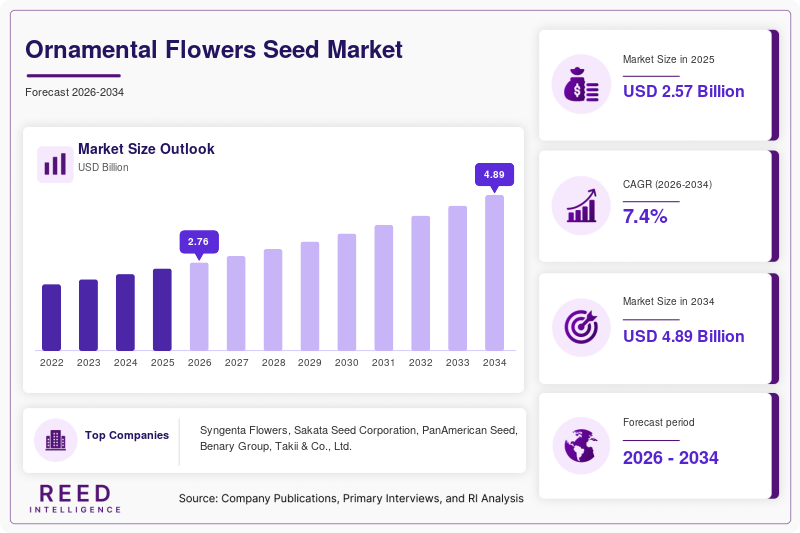
Ornamental Flowers Seed market size is projected at USD 2.76 billion in 2026 and is expected to hit USD 4.89 billion by 2034 with a CAGR of 7.40%. Increasing investments in floriculture, urban landscaping projects, and consumer gardening activities are supporting market expansion across developed and emerging economies. The report provides extensive analysis of production volumes, distribution channels, market segmentation, and competitive landscape across key regions.
The ornamental flowers seed industry comprises the breeding, production, processing, and commercialization of flower seeds intended for decorative, landscaping, and floriculture purposes. Global seed production exceeded 165 billion units in 2025, with hybrid flower varieties accounting for approximately 44% of total output. Commercial floriculture represented nearly 48% of total consumption, while home gardening contributed about 34%. Rising participation in urban gardening and increasing demand for aesthetic landscaping continue to strengthen Ornamental Flowers Seed market share.
Ornamental Flowers Seed Market Trends
Rising Adoption of Hybrid and High-Germination Flower Seeds
The global floriculture industry is increasingly utilizing hybrid flower seeds due to superior germination rates, uniform flowering, and enhanced disease resistance. In 2025, hybrid seed production surpassed 72 billion units, representing more than 43% of total seed volume. Adoption rates among commercial greenhouse operators exceeded 58%, while demand for premium ornamental varieties increased by 11.6% year-over-year. Technological improvements in seed coating and pelleting are supporting Ornamental Flowers Seed market trend.
The integration of digital gardening platforms and e-commerce seed distribution channels is transforming industry dynamics. Online seed sales accounted for approximately 29% of global transactions in 2025, compared with 18% in 2022. More than 48 million households purchased ornamental flower seeds through digital channels during the year. Increasing consumer preference for customized gardening solutions continues to support Ornamental Flowers Seed market trend.
Ornamental Flowers Seed Market Drivers
Expansion of Urban Landscaping and Green Infrastructure Projects
Governments and municipalities allocated more than USD 21 billion toward urban greening initiatives in 2025. Public parks, roadside beautification projects, and recreational landscapes consumed over 38 billion flower seeds globally. Urban landscaping demand increased by 9.4%, while municipal procurement of ornamental flower seeds rose by 12.1%. These developments continue to accelerate Ornamental Flowers Seed market growth.
Ornamental Flowers Seed Market Restraints
Climate Variability and Seed Production Risks
Extreme weather events affected approximately 14% of global ornamental seed cultivation areas in 2025. Temperature fluctuations and irregular rainfall patterns reduced yields by 8%–12% in several producing regions. Additionally, production losses exceeding 7 billion seed units were reported globally due to environmental stress. These factors limit consistent supply and create constraints for market expansion.
Ornamental Flowers Seed Market Opportunities
Growing Home Gardening and Hobby Cultivation Activities
More than 230 million households worldwide participated in gardening activities during 2025, with flower gardening accounting for nearly 46% of total hobby gardening expenditure. Seed packet sales increased by 13.2%, while online gardening communities expanded by over 18%. Rising disposable incomes and interest in home aesthetics create substantial opportunities for the Ornamental Flowers Seed market.
Challenges in Ornamental Flowers Seed Market
Counterfeit Seeds and Distribution Inefficiencies
Counterfeit seed products account for an estimated 4%–6% of total sales in some developing regions. Distribution losses ranging from 5% to 8% occur due to improper storage and logistics conditions. Furthermore, fragmented retail networks in emerging economies reduce market accessibility for premium seed varieties, creating ongoing challenges for the Ornamental Flowers Seed market.
Ornamental Flowers Seed Market Segmentation
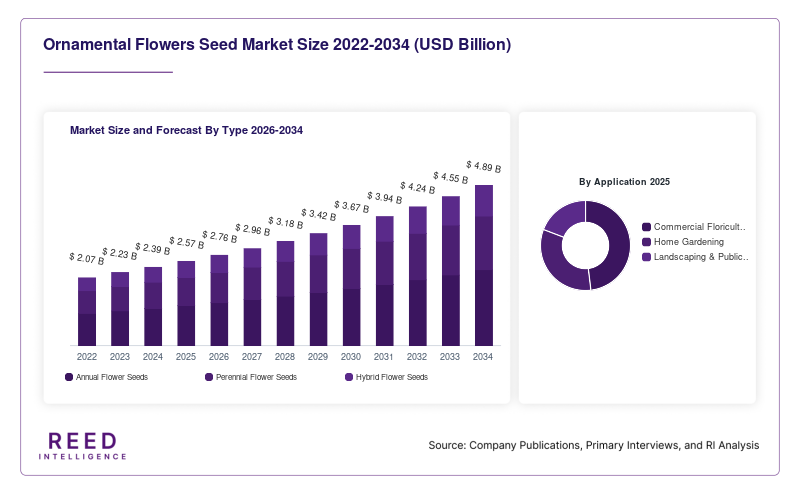
The market is segmented by type and application, with hybrid flower seeds accounting for approximately 44% of revenue and commercial floriculture contributing nearly 48% of total demand. Increasing demand from landscaping projects and home gardening activities continues to support segment expansion.
By Type
Annual flower seeds accounted for approximately 31% of total market revenue in 2025. Production exceeded 50 billion seed units, supported by strong demand for marigold, petunia, zinnia, and cosmos varieties. Germination rates typically range between 82% and 94%, making them popular for seasonal cultivation.
Perennial flower seeds represented nearly 25% of market demand. Production volume surpassed 41 billion seed units during 2025. These varieties are widely used in long-term landscaping projects and botanical gardens due to their multi-season flowering characteristics and lower replacement requirements.
Hybrid flower seeds dominated with approximately 44% market share. Production exceeded 72 billion units globally in 2025. Enhanced genetic characteristics, improved flower uniformity, disease resistance levels above 85%, and longer blooming periods support their widespread adoption.
By Application
Commercial floriculture held approximately 48% of market demand. More than 79 billion seed units were consumed by flower farms, greenhouse operators, and export-oriented floriculture businesses in 2025. Utilization rates remain high due to the requirement for consistent flower quality and yield performance.
Home gardening accounted for nearly 34% of market consumption. Over 56 billion seed units were sold to residential consumers worldwide. Usage penetration exceeded 41% among gardening households, supported by rising interest in decorative gardens, balconies, and indoor floral cultivation.
Landscaping and public gardens represented approximately 18% of total market volume. More than 30 billion seed units were utilized across parks, recreational areas, institutional campuses, and roadside beautification projects. The segment benefits from increasing investments in green infrastructure development.
Ornamental Flowers Seed Market Regional Outlook
North America Ornamental Flowers Seed Market
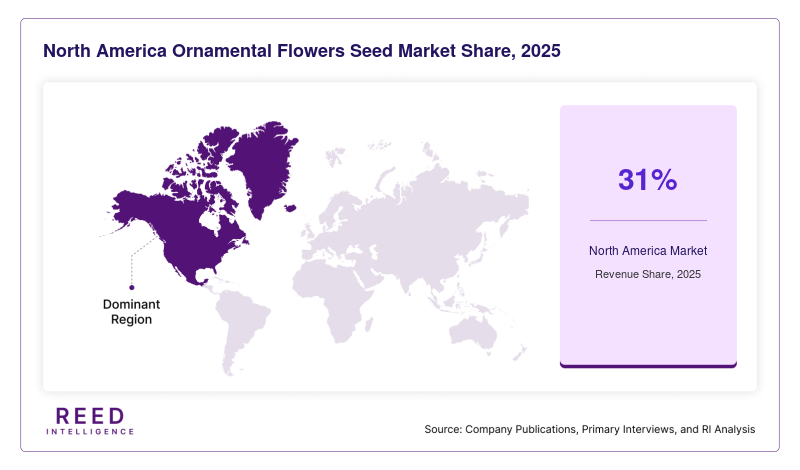
North America accounted for approximately 31% of global revenue in 2025. The United States contributed nearly 76% of regional demand, while Canada accounted for around 15%. Annual seed consumption exceeded 32 billion units, driven by residential gardening and commercial landscaping sectors.
Europe Ornamental Flowers Seed Market
Europe represented nearly 29% of the global market. Germany, the Netherlands, France, and Italy collectively contributed more than 67% of regional demand. Production exceeded 38 billion seed units, supported by advanced floriculture industries and strong gardening culture.
Asia-Pacific Ornamental Flowers Seed Market
Asia-Pacific held approximately 28% market share in 2025. China accounted for 35% of regional consumption, followed by India at 22% and Japan at 12%. Production volumes surpassed 47 billion seed units due to expanding floriculture exports and urban beautification initiatives.
Latin America Ornamental Flowers Seed Market
Latin America contributed around 8% of global demand. Brazil represented nearly 49% of regional consumption, followed by Mexico at 21%. Seed utilization exceeded 13 billion units across commercial flower farms and landscaping applications.
Middle East & Africa Ornamental Flowers Seed Market
The region accounted for approximately 4% of market revenue. South Africa, the UAE, and Saudi Arabia remain major consumers. Consumption exceeded 6 billion seed units in 2025, supported by landscaping investments and tourism-related infrastructure projects.
Top players in Ornamental Flowers Seed Market
- Syngenta Flowers
- Sakata Seed Corporation
- PanAmerican Seed
- Benary Group
- Takii & Co., Ltd.
- Hem Genetics
- Ernst Benary Samenzucht GmbH
- Dümmen Orange
- Floranova Ltd.
- Ball Horticultural Company
- American Takii Inc.
- Kieft Seed
- Thompson & Morgan
- Johnny's Selected Seeds
- West Coast Seeds
Syngenta Flowers
- Estimated market share ranges between 12% and 14% globally.
- The company maintains a strong position through extensive breeding programs covering petunia, marigold, begonia, and pansy varieties.
- Syngenta Flowers operates advanced research facilities and global distribution networks serving more than 100 countries.
- Continuous investment in hybrid seed development and disease-resistant varieties strengthens market leadership.
- Strong relationships with greenhouse growers, commercial floriculture operators, and landscaping firms enhance competitive positioning across key regional markets.
Sakata Seed Corporation
- Estimated market share ranges between 9% and 11%.
- Sakata Seed Corporation is recognized for premium-quality flower genetics and high-germination seed varieties.
- The company invests heavily in breeding innovation, producing ornamental varieties with improved color consistency and flowering performance.
- Global sales networks and diversified product portfolios support strong market penetration across Asia-Pacific, Europe, and North America.
- Long-standing expertise in floriculture and seed technology contributes to sustained growth and industry leadership.
Recent Developments in Ornamental Flowers Seed Market
- 2025: Syngenta Flowers expanded hybrid ornamental flower seed breeding programs for commercial growers.
- 2025: Sakata Seed Corporation introduced new disease-resistant ornamental flower varieties.
Ornamental Flowers Seed Market Segments
By Type
- Annual Flower Seeds
- Perennial Flower Seeds
- Hybrid Flower Seeds
By Application
- Commercial Floriculture
- Home Gardening
- Landscaping & Public Gardens
By Region
- North America
- Europe
- APAC
- Middle East and Africa
- LATAM