Punching Gear Market Size, Share Demand Report By Type (Heavy-Duty Punching Gear, Light-Duty Punching Gear), By Application (Metalworking, Automotive, Aerospace, Construction), Regional Insights & Segment Forecasts, 2026–2034
USD 3950
Punching Gear Market Size
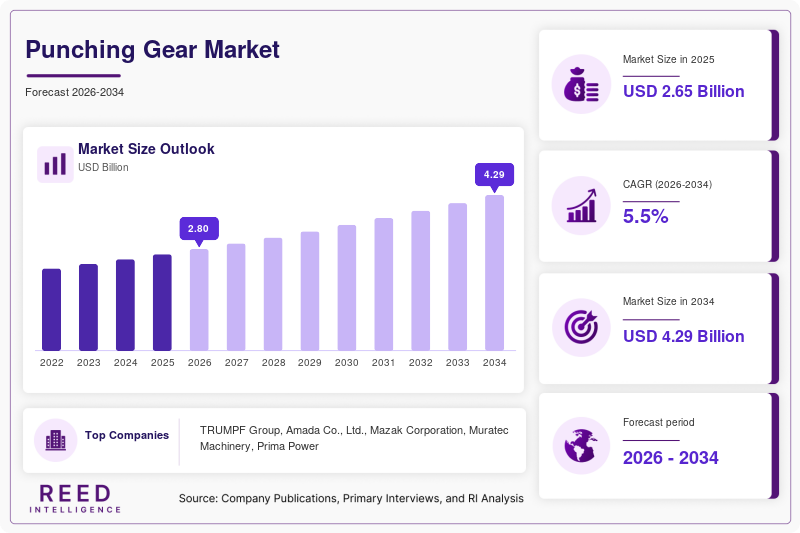
Punching Gear market size is projected at USD 2.8 billion in 2026 and is expected to hit USD 4.2 billion by 2034 with a CAGR of 5.5% during the forecast period. The increasing demand for precision metal components in various industries, the growing automation in manufacturing, and the need for efficient and high-speed punching solutions underpin market expansion. This report delivers a comprehensive analysis of the Punching Gear market, including segmentation by type and application, competitive dynamics, and regional growth patterns, equipping stakeholders with critical intelligence. The Punching Gear market continues to demonstrate steady growth potential, fueled by the expansion of the automotive and aerospace sectors, the rising demand for customized metal parts, and the continuous innovation in punching technology.
Punching gear refers to specialized industrial equipment, including tooling, dies, and presses, used to create holes, shapes, and forms in sheet metal and other materials through a punching or stamping process. These systems are critical for the production of a wide range of components in the automotive, aerospace, and construction sectors. The global market for punching gear is driven by the need for precision and efficiency in metal fabrication. The global production value of punching gear exceeded USD 2.6 billion in 2025, reflecting a 5% increase from 2022. Adoption patterns reveal that the heavy-duty punching gear segment dominates the market, accounting for 60% of total demand, followed by light-duty punching gear at 40%. The Punching Gear market's trajectory is closely linked to the growth of the global metalworking market, which is projected to reach USD 1 trillion by 2028, and the increasing adoption of automated manufacturing processes.
Punching Gear Market Trends
Growing Adoption of CNC and Automated Punching Systems
The Punching Gear market is witnessing a significant trend toward the adoption of computer numerical control (CNC) and automated punching systems, driven by the demand for higher precision, faster production, and reduced labor costs. The revenue from automated punching systems grew to USD 0.8 billion in 2025, a year-on-year increase of 8%, as 30% of new installations in 2025 featured CNC and automation capabilities. Adoption rates of automated systems in the automotive sector reached 35%, with this figure projected to exceed 50% by 2030. The Punching Gear market's trend toward automation is reinforced by the need to increase manufacturing efficiency, the growing shortage of skilled labor, and the decreasing cost of automation technology.
Increasing Focus on Tooling and Die Innovation
The increasing focus on tooling and die innovation is a major trend shaping the Punching Gear market, with manufacturers developing advanced materials and designs to improve tool life and part quality. The market has seen a 15% increase in the adoption of advanced tooling materials, such as carbide and powdered metallurgy, since 2022, with 20% of new tooling solutions in 2025 featuring these advanced materials. The use of 3D printing for prototyping and low-volume die production has also gained traction. The Punching Gear market's trend toward innovation is reinforced by the need to process increasingly complex and high-strength materials, the demand for longer tool life, and the continuous push for higher production speeds.
Punching Gear Market Drivers
The Punching Gear market's expansion is primarily driven by the increasing demand for precision metal components in the automotive, aerospace, and construction industries, with the global automotive market valued at USD 3.5 trillion in 2025. The growing trend of lightweighting in automotive and aerospace, which requires complex sheet metal parts, has also been a major driver. The increasing adoption of automation and Industry 4.0 practices in manufacturing has fueled demand for advanced punching systems. Additionally, the rising need for customized metal parts and the expansion of the industrial sector have driven market growth. The Punching Gear market's growth is further reinforced by the continuous innovation in tooling and machine technology, leading to higher productivity and quality.
Punching Gear Market Restraints
Despite favorable growth prospects, the Punching Gear market faces significant constraints, primarily related to the high capital cost of advanced punching equipment and the cost of specialized tooling. The complexity of setup and the need for skilled operators can also be a barrier. The Punching Gear market's growth is also tempered by the competition from alternative metal forming processes, such as laser cutting and waterjet cutting, and the potential for economic downturns affecting industrial investment.
Punching Gear Market Opportunities
The Punching Gear market presents significant opportunities in the rapidly expanding market for electric vehicles (EVs), where the global market is projected to reach USD 1.5 trillion by 2028. The adoption of specialized punching gear for the production of EV battery components and lightweight chassis parts is expected to grow at a CAGR of 8% through 2034. Emerging opportunities also exist in the development of punching gear for advanced high-strength steels and other new materials. The Punching Gear market's opportunity profile is further enhanced by the growing trend of reshoring manufacturing and the increasing investment in industrial automation.
Challenges in Punching Gear Market
The Punching Gear market faces persistent challenges related to the management of tool wear and maintenance, as tooling costs can be significant, and downtime for tool changes can impact productivity. The complexity of achieving high precision and quality in punching operations presents a challenge. The market is also contending with the challenge of training a skilled workforce capable of operating and maintaining advanced equipment. Additionally, the Punching Gear market is challenged by the need for continuous innovation to keep pace with evolving material and manufacturing requirements.
Punching Gear Market Segmentation
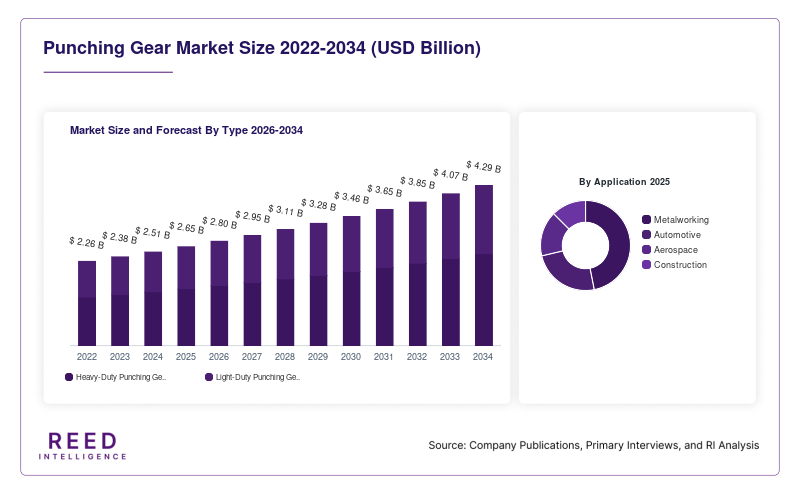
The Punching Gear market is segmented by Type and Application to provide a comprehensive market perspective. By Type, Heavy-Duty Punching Gear dominates with a 60% market share, driven by its use in large-scale industrial applications. The Application segment is led by Metalworking, which accounts for 35% of the market, followed by Automotive at 28%, Aerospace at 22%, and Construction at 15%.
By Type
Heavy-Duty Punching Gear represent the largest segment in the Punching Gear market, commanding a 60% share, with a revenue of USD 1.68 billion in 2025. These systems are characterized by their high tonnage capacity, ability to process thick and high-strength materials, and use in large-scale production. Technical specifications include high tonnage capacity, large table sizes, and robust construction. The Punching Gear market's heavy-duty segment is driven by its use in automotive, aerospace, and heavy machinery applications.
Light-Duty Punching Gear capture a 40% share of the Punching Gear market, with a revenue of USD 1.12 billion in 2025. These systems are characterized by their lower tonnage, higher speed, and use in precision applications. Technical specifications include lower tonnage, high-speed operation, and suitability for thinner materials. The Punching Gear market's light-duty segment is growing at a steady CAGR, driven by the demand for electronics and precision parts.
By Application
Metalworking dominates the Punching Gear market, accounting for 35% of sales, representing a revenue of USD 0.98 billion in 2025. This segment includes use in general metal fabrication, where punching gear is essential for creating various components. Usage penetration exceeds 70% in the metal fabrication sector. The Punching Gear market's metalworking segment is characterized by its focus on versatility and cost-effectiveness.
Automotive accounts for 28% of the Punching Gear market, with a revenue of USD 0.78 billion in 2025. This segment encompasses use in the production of body panels, chassis, and other components, where precision and efficiency are critical. The segment is growing at a steady CAGR, driven by the automotive industry. The Punching Gear market's automotive segment is characterized by its focus on high-volume production and quality.
Aerospace represents 22% of the Punching Gear market, with a revenue of USD 0.62 billion in 2025. This segment includes use in the production of aircraft components, where precision and high-quality materials are essential. The segment is growing at a steady CAGR, driven by the expansion of the aerospace sector. The Punching Gear market's aerospace segment is characterized by its focus on precision and material quality.
Construction comprises the remainder of the Punching Gear market, accounting for 15% of total sales, with a revenue of USD 0.42 billion in 2025. This segment includes use in structural steel fabrication and other construction components. The segment is projected to grow at a steady CAGR through 2034. The Punching Gear market's construction segment is characterized by its focus on structural integrity and cost-effectiveness.
Punching Gear Market Regional Outlook
Asia-Pacific Punching Gear Market
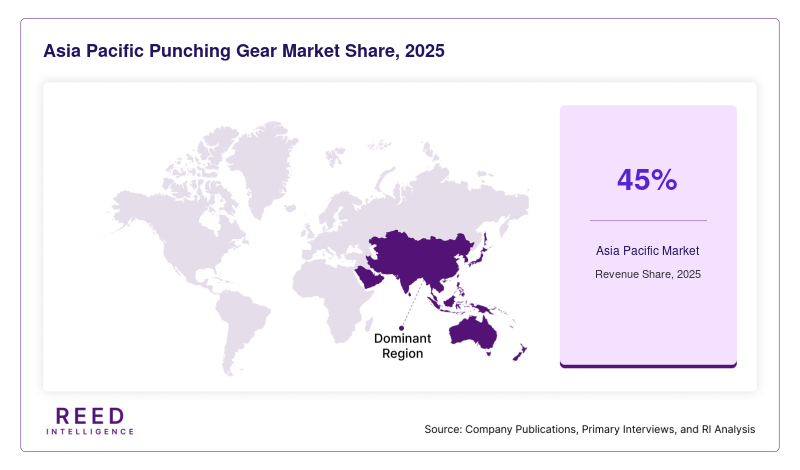
Leads the Punching Gear market, commanding a 45% share, with a revenue of USD 1.26 billion in 2025. China, Japan, and India are the primary drivers, accounting for 70% of regional demand, driven by the large manufacturing base and the rapid industrialization. The Asia-Pacific Punching Gear market is characterized by its high growth rate and focus on cost-effective solutions.
North America Punching Gear Market
Represents the second-largest market, capturing a 25% share with a revenue of USD 0.70 billion in 2025. The United States dominates regional demand, accounting for 80% of consumption, driven by the strong automotive and aerospace sectors. The Punching Gear market in North America is characterized by its focus on innovation and automation.
Europe Punching Gear Market
Accounts for 20% of the global Punching Gear market, with a revenue of USD 0.56 billion in 2025. Germany, the UK, and France collectively represent 55% of the regional market, driven by the strong manufacturing and automotive industries. The Punching Gear market in Europe is characterized by its focus on quality and engineering.
Middle East & Africa and Latin America Punching Gear Market
Together account for the remaining 10% of the Punching Gear market, with the UAE leading the Middle East market and Brazil leading the Latin American market. Both regions are projected to grow at CAGRs exceeding 6%, driven by the increasing industrial investments.
Top players in Punching Gear Market
- TRUMPF Group
- Amada Co., Ltd.
- Mazak Corporation
- Muratec Machinery
- Prima Power
- Bystronic Laser AG
- Salvagnini Italia S.p.A.
- Haas Automation, Inc.
- Okuma Corporation
- FANUC Corporation
- KOMATSU Ltd.
- HACO Group
- LVD Group
- Dener Makina
- Euromac (IMAS S.r.l.)
TRUMPF Group
TRUMPF holds a dominant position in the Punching Gear market, with an estimated 18% global market share, particularly strong in the European and North American segments. The company's portfolio of punching and machine tools is widely recognized for its quality, precision, and innovation. TRUMPF's market leadership is reinforced by its significant R&D investment, with the company allocating over EUR 100 million annually to machine tool development. TRUMPF commands over 22% of the European market and 15% of the North American market, positioning it as a key player in the Punching Gear market's premium segment.
Amada Co., Ltd.
Amada is a leading player in the Punching Gear market, commanding approximately 15% of the global market share through its comprehensive portfolio of metalworking equipment, including advanced punching machines. The company's expertise in sheet metal processing and its strong presence in the Asian and North American markets have solidified its position. Amada's focus on developing highly automated and efficient punching solutions has strengthened its position. The company's commitment to innovation has enhanced its brand equity among manufacturers.
Mazak Corporation holds a significant 10% market share, with particular strength in the North American market, where it commands a 12% share. The company's focus on integrated manufacturing solutions is a key differentiator. Muratec Machinery is a major player in the global metalworking market, holding a 9% share, with a strong position in punching and fabrication equipment.
Recent Developments in Punching Gear Market
- 2025: TRUMPF launched a new generation of automated punching machines with integrated AI for process optimization, offering a 15% increase in productivity.
- 2025: Amada introduced a new series of electric punching presses with advanced energy-saving features, reducing power consumption by 20%.
Punching Gear Market Segments
By Type
- Heavy-Duty Punching Gear
- Light-Duty Punching Gear
By Application
- Metalworking
- Automotive
- Aerospace
- Construction
By Region
- North America
- Europe
- APAC
- Middle East and Africa
- LATAM