Vanilla and Vanillin Market Size, Share Demand Report By Type (Natural Vanilla, Synthetic Vanillin, Bio-Vanillin), By Application (Food & Beverages, Pharmaceuticals, Cosmetics & Personal Care, Industrial), Regional Insights & Segment Forecasts, 2026–2034
USD 3950
Vanilla and Vanillin Market Size
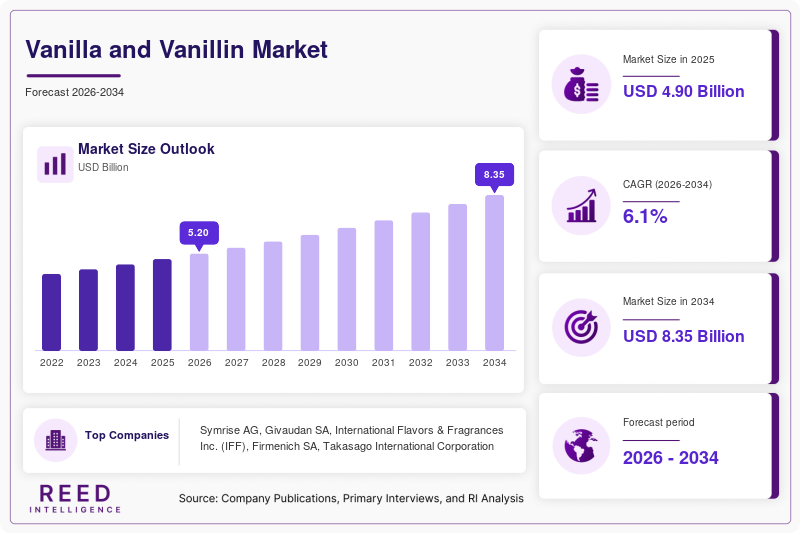
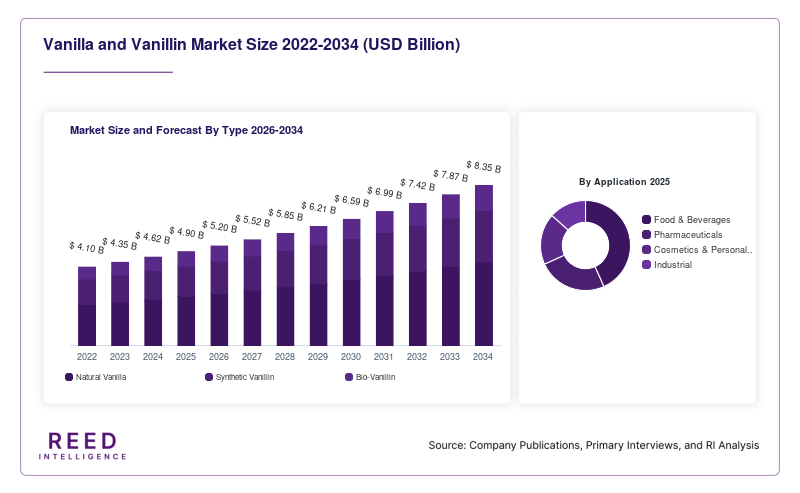
Vanilla and Vanillin market size is projected at USD 5.2 billion in 2026 and is expected to hit USD 8.1 billion by 2034 with a CAGR of 6.1% during the forecast period. The increasing global demand for vanilla as a natural flavoring in food and beverages, the growing preference for natural and clean-label ingredients, and the rising use of vanillin in pharmaceuticals and cosmetics underpin market expansion. This report delivers a comprehensive analysis of the Vanilla and Vanillin market, including segmentation by type and application, competitive dynamics, and regional growth patterns, equipping stakeholders with critical intelligence. The Vanilla and Vanillin market continues to demonstrate robust growth potential, fueled by the global trend toward natural and premium ingredients, the expansion of the food and beverage industry, and the continuous innovation in vanillin production technology.
Vanilla and vanillin are flavoring agents with a distinct and widely recognized flavor profile. Natural vanilla is derived from the orchids of the genus Vanilla, while vanillin is its primary chemical component, which can be produced synthetically from petrochemicals or bio-based sources. The global market for vanilla and vanillin is driven by its widespread use as a flavoring agent. The global production volume of vanilla and vanillin exceeded 20,000 metric tons in 2025, reflecting a 5% increase from 2022. Adoption patterns reveal that the synthetic vanillin segment dominates the market, accounting for 70% of total demand, followed by natural vanilla at 18%, and bio-vanillin at 12%. The Vanilla and Vanillin market's trajectory is closely linked to the growth of the global food and beverage market, which is projected to reach USD 1.5 trillion by 2028, and the increasing consumer demand for natural and authentic flavors.
Vanilla and Vanillin Market Trends
Growing Demand for Natural and Clean-Label Vanilla
The Vanilla and Vanillin market is witnessing a significant trend toward natural and clean-label vanilla, driven by consumer preference for authentic and sustainably sourced ingredients. The revenue from natural vanilla grew to USD 1.8 billion in 2025, a year-on-year increase of 7%, as 40% of new product launches in 2025 featuring vanilla specified natural sourcing. Adoption rates of natural vanilla in the premium food and beverage sector reached 30%, with this figure projected to exceed 45% by 2030. The Vanilla and Vanillin market's trend toward natural is reinforced by the increasing consumer awareness of food origins, the growing demand for transparency, and the development of sustainable sourcing partnerships.
Increasing Adoption of Bio-Vanillin
The increasing adoption of bio-vanillin is a major trend shaping the Vanilla and Vanillin market, driven by the demand for sustainable and natural alternatives to synthetic vanillin. The market has seen a 20% increase in the production of bio-vanillin since 2022, with 15% of new product launches in 2025 featuring bio-based formulations. The use of bio-vanillin in applications like chocolate and ice cream has also gained traction. The Vanilla and Vanillin market's trend toward bio-vanillin is reinforced by the need for sustainable and natural ingredients, the development of cost-effective production methods, and the growing consumer preference for environmentally friendly products.
Vanilla and Vanillin Market Drivers
The Vanilla and Vanillin market's expansion is primarily driven by the increasing global demand for vanilla flavoring in the food and beverage industry, with the global flavor market valued at USD 30 billion in 2025 and growing. The growing preference for natural and clean-label ingredients, driven by consumer health and wellness trends, has also been a major driver for natural vanilla. The rising use of vanillin in pharmaceuticals and cosmetics, where it is used as a flavoring or fragrance, has fueled demand. Additionally, the expansion of the processed food sector has driven the demand for cost-effective vanillin. The Vanilla and Vanillin market's growth is further reinforced by the continuous innovation in vanillin production technology.
Vanilla and Vanillin Market Restraints
Despite favorable growth prospects, the Vanilla and Vanillin market faces significant constraints, primarily related to the high cost and supply volatility of natural vanilla, which is subject to climate change and agricultural challenges. The potential for price fluctuations in synthetic vanillin due to raw material costs can also be a restraint. The Vanilla and Vanillin market's growth is also tempered by the competition from other natural and artificial flavorings.
Vanilla and Vanillin Market Opportunities
The Vanilla and Vanillin market presents significant opportunities in the rapidly expanding market for clean-label and organic products, where the global market is projected to reach USD 200 billion by 2028. The adoption of natural and organic vanilla in this sector is expected to grow at a CAGR of 8% through 2034. Emerging opportunities also exist in the development of sustainable and bio-based vanillin production. The Vanilla and Vanillin market's opportunity profile is further enhanced by the growing trend of premiumization and product differentiation.
Challenges in Vanilla and Vanillin Market
The Vanilla and Vanillin market faces persistent challenges related to the management of supply chain sustainability and the fight against vanilla adulteration. The complexity of ensuring the authenticity and quality of natural vanilla presents a challenge. The market is also contending with the challenge of balancing cost with the demand for natural and sustainable products. Additionally, the Vanilla and Vanillin market is challenged by the need for continuous innovation to meet evolving consumer preferences and regulatory requirements.
Vanilla and Vanillin Market Segmentation
The Vanilla and Vanillin market is segmented by Type and Application to provide a comprehensive market perspective. By Type, Synthetic Vanillin dominates with a 70% market share, driven by its cost-effectiveness. The Application segment is led by Food & Beverages, which accounts for 65% of the market, followed by Pharmaceuticals at 18%, Cosmetics & Personal Care at 12%, and Industrial at 5%.
By Type
Synthetic Vanillin represent the largest segment in the Vanilla and Vanillin market, commanding a 70% share, with production reaching 14,000 metric tons in 2025. This product is characterized by its low cost and consistent quality. Technical specifications include high purity, consistent flavor profile, and cost-effectiveness. The Vanilla and Vanillin market's synthetic segment is driven by its use in mass-market food and beverage applications.
Natural Vanilla capture an 18% share of the Vanilla and Vanillin market, with production of 3,600 metric tons in 2025. This product is characterized by its complex, authentic flavor profile and premium positioning. Technical specifications include source origin (Madagascar, Mexico, etc.), vanillin content, and quality grades. The Vanilla and Vanillin market's natural segment is driven by its use in premium and gourmet products.
Bio-Vanillin represent the remaining 12% of the Vanilla and Vanillin market, with production of 2,400 metric tons in 2025. This product is characterized by its production from natural sources (like ferulic acid) and its clean-label appeal. Technical specifications include natural origin, sustainable production, and consistent flavor. The Vanilla and Vanillin market's bio-vanillin segment is growing at the fastest CAGR, driven by the demand for sustainable alternatives.
By Application
Food & Beverages dominates the Vanilla and Vanillin market, accounting for 65% of sales, representing 13,000 metric tons in 2025. This segment includes use in ice cream, chocolate, baked goods, and beverages, where vanilla is a key flavor. Usage penetration exceeds 80% in the ice cream sector. The Vanilla and Vanillin market's food segment is characterized by its focus on flavor and cost.
Pharmaceuticals accounts for 18% of the Vanilla and Vanillin market, with a volume of 3,600 metric tons in 2025. This segment encompasses use in medicines and supplements as a flavoring agent. The segment is growing at a steady CAGR. The Vanilla and Vanillin market's pharmaceutical segment is characterized by its focus on purity and quality.
Cosmetics & Personal Care represents 12% of the Vanilla and Vanillin market, with a volume of 2,400 metric tons in 2025. This segment includes use in perfumes, lotions, and other personal care products as a fragrance. The segment is growing at a steady CAGR. The Vanilla and Vanillin market's cosmetics segment is characterized by its focus on scent and stability.
Industrial comprises the remainder of the Vanilla and Vanillin market, accounting for 5% of total sales, with 1,000 metric tons in 2025. This segment includes use in industrial applications. The segment is projected to grow at a steady CAGR through 2034.
Vanilla and Vanillin Market Regional Outlook
Asia-Pacific Vanilla and Vanillin Market
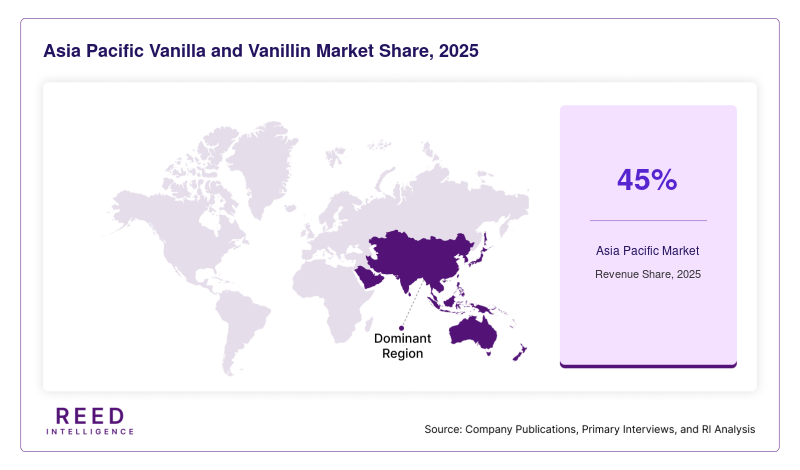
Leads the Vanilla and Vanillin market, commanding a 45% share, with a revenue of USD 2.34 billion in 2025. China, India, and Indonesia are the primary drivers, accounting for 70% of regional demand, driven by the large food and beverage manufacturing base. The Asia-Pacific Vanilla and Vanillin market is characterized by its high growth rate and focus on cost-effective solutions.
North America Vanilla and Vanillin Market
Represents the second-largest market, capturing a 25% share with a revenue of USD 1.30 billion in 2025. The United States dominates regional demand, accounting for 80% of consumption, driven by the strong food and beverage industry. The Vanilla and Vanillin market in North America is characterized by its focus on innovation and clean-label products.
Europe Vanilla and Vanillin Market
Accounts for 20% of the global Vanilla and Vanillin market, with a revenue of USD 1.04 billion in 2025. Germany, France, and the UK collectively represent 55% of the regional market, driven by the strong food and beverage and cosmetics sectors. The Vanilla and Vanillin market in Europe is characterized by its focus on quality and sustainability.
Middle East & Africa and Latin America Vanilla and Vanillin Market
Together account for the remaining 10% of the Vanilla and Vanillin market, with South Africa leading the African market and Brazil leading the Latin American market. Both regions are projected to grow at CAGRs exceeding 6%, driven by the increasing food and beverage consumption.
Top players in Vanilla and Vanillin Market
- Symrise AG
- Givaudan SA
- International Flavors & Fragrances Inc. (IFF)
- Firmenich SA
- Takasago International Corporation
- Kerry Group
- Comax Flavors
- Synergy Flavors
- Apple Flavor & Fragrance Group
- Mane SA
- Robertet Group
- Biolandes
- Virginia Dare Extract Co.
- Nielsen-Massey Vanillas
- Prova
Symrise AG
Symrise holds a dominant position in the Vanilla and Vanillin market, with an estimated 18% global market share, particularly strong in the European and North American segments. The company's portfolio of vanilla extracts and vanillin is widely recognized for its quality and innovation. Symrise's market leadership is reinforced by its significant R&D investment and its sustainable sourcing initiatives. Symrise commands over 22% of the European market and 15% of the North American market, positioning it as a key player in the Vanilla and Vanillin market.
Givaudan SA
Givaudan is a leading player in the Vanilla and Vanillin market, commanding approximately 14% of the global market share through its comprehensive portfolio of flavor and fragrance ingredients. The company's expertise in natural flavors and its strong presence in the global market have solidified its position. Givaudan's focus on developing sustainable and innovative vanilla solutions has strengthened its position. The company's commitment to quality has enhanced its brand equity.
International Flavors & Fragrances Inc. (IFF) holds a significant 12% market share, with particular strength in the global flavors market, where it commands a 14% share. The company's focus on integrated solutions is a key differentiator. Firmenich SA is a major player in the global fragrance and flavor market, holding a 10% share.
Recent Developments in Vanilla and Vanillin Market
- 2025: Symrise announced a new partnership with a leading vanilla producer to ensure sustainable sourcing and support for vanilla farming communities.
- 2025: Givaudan launched a new range of clean-label bio-vanillin products, offering a sustainable alternative to synthetic vanillin.
Vanilla and Vanillin Market Segments
By Type
- Natural Vanilla
- Synthetic Vanillin
- Bio-Vanillin
By Application
- Food & Beverages
- Pharmaceuticals
- Cosmetics & Personal Care
- Industrial
By Region
- North America
- Europe
- APAC
- Middle East and Africa
- LATAM