Hybrid Microcirculation Detector Market Size, Share Demand Report By Product Type (Portable Hybrid Detectors, Wearable Hybrid Detectors), By Technology (Laser Doppler Integrated Systems, Near-Infrared Hybrid Systems), By Application (Vascular Diagnostics, Critical Care Monitoring), By End Use (Hospitals, Diagnostic Centerss), By Region & Segment Forecasts, 2026–2034
USD 3950
Market Overview
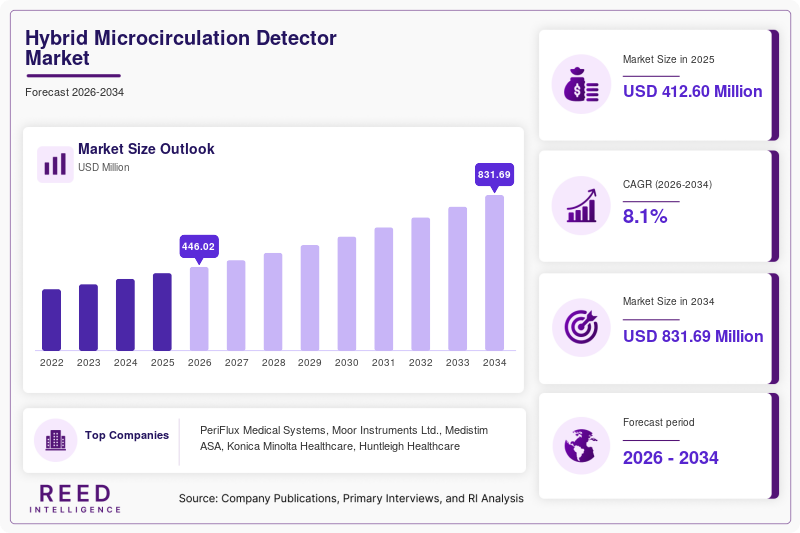
The global Hybrid Microcirculation Detector Market size was valued at USD 412.6 million in 2026 and is projected to reach USD 768.4 million by 2034, expanding at a CAGR of 8.1% during 2026–2034. The market is gaining momentum as healthcare providers increasingly prioritize early detection of tissue perfusion disorders, vascular complications, diabetic foot ulcers, and critical care circulation abnormalities. Hybrid microcirculation detectors combine multiple sensing technologies such as laser Doppler flowmetry, near-infrared spectroscopy, thermal imaging, and optical coherence systems to provide deeper diagnostic precision.
One major global factor supporting market growth has been the rising burden of chronic diseases linked with vascular dysfunction, including diabetes, hypertension, sepsis, and peripheral artery disease. Hospitals and specialty clinics are investing in real-time bedside monitoring tools that can reduce complications and improve treatment outcomes.
Healthcare digitization has also strengthened the Hybrid Microcirculation Detector Market by enabling wireless data transfer, AI-assisted interpretation, and cloud-based patient monitoring systems. These developments are increasing adoption in acute care settings and outpatient diagnostics.
Key Highlights
- North America held the dominant regional share of 36.8% in 2025, while Asia Pacific is expected to record the fastest CAGR of 9.7% through 2034.
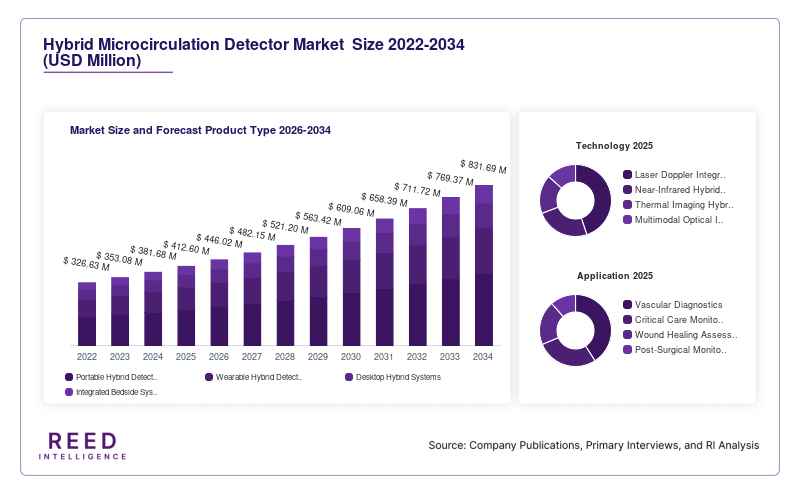
- By product type, portable hybrid detectors led with 58.4% share in 2025, while wearable hybrid detectors are projected to grow at 10.2% CAGR.
- By technology, laser Doppler integrated systems accounted for 41.6% share, while multimodal optical imaging systems are forecast to grow at 10.5% CAGR.
- By end use, hospitals remained dominant with 49.2% share, while ambulatory surgical centers are expected to grow at 9.4% CAGR.
- By application, vascular diagnostics led with 33.1% share, while wound healing assessment is anticipated to expand at 9.8% CAGR.
- The United States, the dominant country, was valued at USD 118.4 million in 2024 and USD 126.7 million in 2025.
Market Trends
AI-Based Perfusion Analytics
Artificial intelligence is increasingly being integrated into hybrid microcirculation systems. Advanced software can identify circulation anomalies, compare historical trends, and assist physicians with risk stratification. This trend is helping reduce interpretation time and improving clinical workflow efficiency.
Shift Toward Portable and Point-of-Care Devices
Healthcare providers are adopting compact devices for bedside use, emergency departments, and home healthcare settings. Portable hybrid systems allow rapid screening without requiring dedicated imaging rooms, which is expanding the addressable market.
Market Drivers
Growing Need for Early Detection of Circulatory Disorders
Rising cases of diabetic ulcers, shock conditions, and post-surgical ischemia are driving demand for tools that can detect microvascular changes before visible symptoms emerge. Hybrid systems provide actionable data during early stages of disease.
Expansion of Critical Care Monitoring Infrastructure
Hospitals are increasing investment in intensive care units and surgical monitoring systems. Hybrid microcirculation detectors support continuous perfusion assessment, which helps clinicians manage high-risk patients more effectively.
Market Restraint
High Equipment Cost and Budget Constraints
Advanced hybrid systems combine multiple imaging and sensing modules, increasing purchase and maintenance costs. Smaller hospitals and clinics in cost-sensitive markets may delay adoption due to capital expenditure limitations.
Market Opportunities
Integration with Telehealth Platforms
Remote patient monitoring is creating opportunities for connected hybrid detectors that transmit circulation data to specialists. This model may improve follow-up care for chronic wound and vascular patients.
Untapped Demand in Emerging Healthcare Markets
Developing economies are expanding diagnostic infrastructure and specialty care centers. As awareness rises, suppliers can capture new demand through affordable portable systems and localized service networks.
Segmental Analysis
By Product Type
Portable Hybrid Detectors: Portable systems accounted for 58.4% share in 2025 due to ease of bedside deployment, lower space requirements, and flexible use across departments.
Wearable Hybrid Detectors: Wearable systems are projected to grow at 10.2% CAGR through 2034. Their growth will be driven by continuous monitoring for post-operative recovery and chronic disease management outside hospital settings.
By Technology
Laser Doppler Integrated Systems: Laser Doppler integrated detectors held 41.6% share in 2025 because they provide reliable blood flow measurement with established clinical acceptance.
Multimodal Optical Imaging Systems: This segment is forecast to grow at 10.5% CAGR. Adoption will rise as clinicians seek broader tissue oxygenation and perfusion mapping from one platform.
By Application
Vascular Diagnostics: Vascular diagnostics represented 33.1% share in 2025 owing to increasing screening for peripheral arterial disease and circulation insufficiency.
Wound Healing Assessment: This segment will grow at 9.8% CAGR through 2034. Hospitals and diabetic clinics will adopt these systems to monitor tissue regeneration and optimize treatment plans.
By End Use
Hospitals: Hospitals captured 49.2% share in 2025 as they remain primary users for surgery, emergency care, and ICU monitoring.
Ambulatory Surgical Centers: This segment is expected to grow at 9.4% CAGR. Expansion will be supported by rising outpatient surgeries requiring short-term perfusion monitoring.
By Mode of Operation
Handheld Devices: Handheld systems held 54.7% share in 2025 because they allow clinicians to conduct fast point-of-care assessments.
Integrated Bedside Systems: These systems are projected to grow at 8.9% CAGR as advanced hospitals expand connected monitoring ecosystems.
Regional Analysis
North America
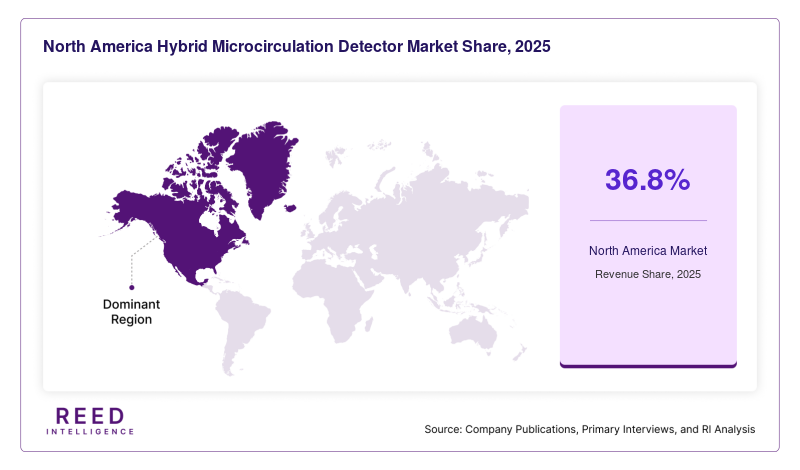
North America accounted for 36.8% of the Hybrid Microcirculation Detector Market in 2025 and is projected to grow at a 7.5% CAGR through 2034. The United States dominated the region due to high adoption of advanced diagnostic equipment and strong reimbursement pathways. Demand is supported by increasing diabetic foot management programs.
Europe
Europe represented 27.4% share in 2025 and will grow at a 7.8% CAGR during the forecast period. Germany led the regional market owing to its strong medical device manufacturing ecosystem and rising investment in vascular diagnostics across university hospitals.
Asia Pacific
Asia Pacific held 22.6% share in 2025 and is expected to expand at the fastest 9.7% CAGR through 2034. China dominated regional revenue due to rapid hospital modernization, growing chronic disease burden, and increasing domestic production of monitoring equipment.
Middle East & Africa
Middle East & Africa captured 7.1% share in 2025 and is forecast to grow at 8.0% CAGR. Saudi Arabia led the region as healthcare transformation programs continue to support procurement of modern critical care and imaging devices.
Latin America
Latin America held 6.1% share in 2025 and is anticipated to grow at 7.4% CAGR through 2034. Brazil remained the dominant country due to growing private hospital networks and broader access to vascular treatment services.
Competitive Landscape
The Hybrid Microcirculation Detector Market remains moderately consolidated with established imaging and diagnostic technology firms competing through innovation, partnerships, and product miniaturization. Companies are focusing on software-enabled monitoring, AI analytics, and portable system launches.
PeriFlux Medical Systems remained a leading participant due to its broad perfusion monitoring portfolio and strong presence in hospital networks. In a recent development, the company launched a next-generation hybrid detector with wireless data synchronization for critical care applications.
Moor Instruments Ltd. is active in laser Doppler and tissue viability systems. Medistim ASA focuses on intraoperative flow assessment technologies. Konica Minolta Healthcare has expanded optical imaging capabilities for vascular diagnostics. Huntleigh Healthcare continues to strengthen bedside circulation monitoring solutions.
Competition is expected to intensify as regional manufacturers introduce cost-effective devices and multinational firms expand distribution partnerships in Asia Pacific and Latin America.
Key Players List
- PeriFlux Medical Systems
- Moor Instruments Ltd.
- Medistim ASA
- Konica Minolta Healthcare
- Huntleigh Healthcare
- ADInstruments
- Compumedics Limited
- Getinge AB
- Masimo Corporation
- Nonin Medical Inc.
- Smiths Medical
- Nihon Kohden Corporation
- Omron Healthcare
- Philips Healthcare
- GE HealthCare
Recent Developments
- Several manufacturers introduced wireless-enabled hybrid microcirculation detector systems for ICU connectivity.
- AI-assisted perfusion scoring modules entered commercial deployment in tertiary hospitals.
- Regional distributors in Asia Pacific signed partnerships with European device makers.
- Compact wearable prototypes moved into pilot trials for post-operative recovery monitoring.
- Hospitals increased procurement of portable circulation detectors for emergency and trauma units.
Hybrid Microcirculation Detector Market Segments
Product Type
- Portable Hybrid Detectors
- Wearable Hybrid Detectors
- Desktop Hybrid Systems
- Integrated Bedside Systems
Technology
- Laser Doppler Integrated Systems
- Near-Infrared Hybrid Systems
- Thermal Imaging Hybrid Systems
- Multimodal Optical Imaging Systems
Application
- Vascular Diagnostics
- Critical Care Monitoring
- Wound Healing Assessment
- Post-Surgical Monitoring
End Use
- Hospitals
- Diagnostic Centers
- Ambulatory Surgical Centers
- Research Institutes
By Region
- North America
- Europe
- APAC
- Middle East and Africa
- LATAM