Hydrogen and Fuel Cells Market Size, Share & Trends Analysis Report By Hydrogen Production Technology (Steam Methane Reforming, Coal Gasification, Electrolysis, Other Production Technologies), By Fuel Cell Type (PEMFC, SOFC, PAFC, MCFC, AFC), By Application (Industrial, Transportation, Stationary Power, Portable & Backup Power), By End Use (Refining & Chemicals, Mobility, Power Generation, Industrial Manufacturing, Residential & Commercial) and By Region (North America, Europe, Asia-Pacific, Lat
USD 3950
Hydrogen and Fuel Cells Market Size
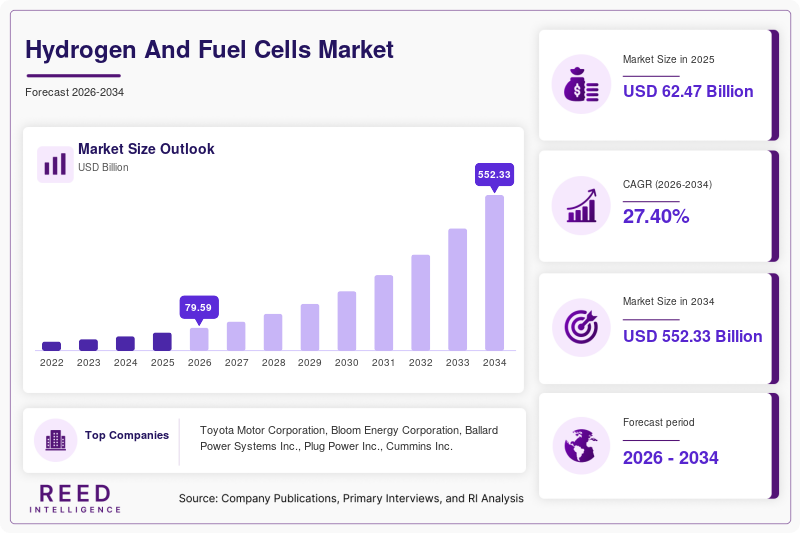
The global hydrogen and fuel cells market was valued at USD 62.47 billion in 2025 and is projected to grow from USD 79.59 billion in 2026 to USD 558.60 billion by 2034, registering a CAGR of 27.40% during the forecast period from 2026 to 2034.
The hydrogen and fuel cells market is transitioning from a policy-led emerging energy segment toward a broader industrial, mobility and distributed-power market. Existing hydrogen demand remains concentrated in refining, ammonia, methanol and other industrial processes, while newer applications such as heavy transport, power generation, synthetic fuels and low-emissions industrial feedstocks are developing from a much smaller base. The IEA reported that global hydrogen demand exceeded 100 million tonnes in 2025, while low-emissions hydrogen demand remained a small portion of total consumption.
The supply side is also changing. Electrolysis capacity expanded rapidly, with global installed electrolysis capacity surpassing 4 GW in 2025, while more than 2.5 GW was under construction for operation in 2026. China has become particularly important in electrolyzer deployment and manufacturing, accounting for a substantial share of global installed capacity and manufacturing capability.
Hydrogen and Fuel Cells Market Drivers
Industrial Decarbonization Is Expanding the Addressable Market for Low-Emissions Hydrogen
Hydrogen already has an established industrial demand base, particularly in refining and chemical production, creating an existing consumption infrastructure that can potentially transition toward lower-emissions supply. The IEA reports that hydrogen demand remains concentrated in established applications, while more than 2 Mtpa of low-emissions hydrogen consumption could come from refineries and industrial facilities by 2030 based on projects that are operational, under construction or have reached final investment decision.
The market mechanism is a substitution opportunity: existing hydrogen users can replace hydrogen produced through unabated fossil-fuel pathways with lower-emissions hydrogen without necessarily changing the fundamental industrial process. This supports electrolyzer projects, low-carbon hydrogen production, storage and distribution infrastructure. Refining, ammonia, methanol and emerging hydrogen-based steel production are therefore important demand channels. The counterbalance is that low-emissions hydrogen remains more expensive in many locations, while uncertain offtake commitments can delay final investment decisions.
Electrolyzer Deployment Is Creating a New Equipment and Infrastructure Demand Layer
Electrolysis is becoming an increasingly important component of the hydrogen value chain as developers seek to connect renewable or low-carbon electricity with hydrogen production. According to the IEA, installed water-electrolysis capacity surpassed 4 GW in 2025 after doubling during the year, with more than 2.5 GW under construction.
This creates demand beyond hydrogen itself, including electrolyzer stacks, power electronics, compression, water treatment, storage and hydrogen-delivery infrastructure. China is a major contributor to this equipment expansion and accounted for 65% of global installed electrolysis capacity and capacity that had reached final investment decision in the IEA's 2025 assessment. The commercial impact is strongest for electrolyzer manufacturers and integrated project developers. However, manufacturers outside China face margin and utilization pressure, while project cancellations and delays demonstrate that announced capacity does not automatically translate into operating assets.
Heavy-Duty Mobility and Distributed Power Are Broadening Fuel-Cell Applications
Fuel cells are gaining traction in applications where vehicle range, payload utilization, refueling time or continuous power availability are important considerations. The IEA identifies heavy trucks as the fastest-growing fuel-cell road-transport segment, although fuel-cell vehicles continue to face higher total costs than battery-electric and diesel alternatives in many applications.
Stationary power provides another demand channel. In 2025, Bloom Energy announced collaborations with Oracle to deploy fuel-cell technology at selected U.S. data centers and expanded its relationship with Equinix to more than 100 MW across 19 data centers. The mechanism is particularly relevant where customers value onsite generation, reliability and rapid deployment. Infrastructure availability, hydrogen or fuel supply, capital costs and competing battery or grid technologies remain constraints.
Hydrogen and Fuel Cells Market Restraints
High Hydrogen Production Costs and Uncertain Offtake Delay Project Investment
The largest constraint is the gap between the economics of many low-emissions hydrogen projects and the price that potential customers are willing to pay. The IEA reports that project delays and cancellations have reduced the potential low-emissions hydrogen production pipeline for 2030, with announced capacity falling from the previous year's estimate. It also identifies high costs, uncertain demand, regulatory uncertainty and slow infrastructure development as persistent barriers.
This affects the market through financing and utilization. Developers need sufficiently reliable offtake to justify capital expenditure, while customers often require competitive delivered hydrogen prices before committing to long-term contracts. Public support mechanisms can reduce this gap, but dependence on subsidies introduces policy risk and can make project schedules sensitive to regulatory changes.
Hydrogen Infrastructure Gaps Limit Adoption Outside Concentrated Industrial Clusters
Hydrogen requires dedicated or adapted production, storage, transport and dispensing infrastructure. Unlike electricity, the infrastructure needed for hydrogen mobility and distributed use is not yet uniformly available. This creates a chicken-and-egg problem: infrastructure investment requires sufficient demand, while many potential users hesitate to adopt hydrogen without reliable and affordable supply.
The IEA notes that infrastructure development remains a barrier and that project delays are particularly significant for electrolyzer-based developments. The constraint is particularly relevant to mobility applications because fuel-cell vehicles require dependable refueling networks. Industrial clusters can reduce this problem by concentrating production and consumption, but geographically dispersed applications require additional investment in pipelines, liquefaction, storage or hydrogen transport.
Hydrogen and Fuel Cells Market Opportunities
Hydrogen Hubs Can Link Production, Infrastructure and Multiple Offtakers
Regional hydrogen hubs create an opportunity to overcome the infrastructure problem by locating production, transportation infrastructure and several end users within connected industrial ecosystems. In the United States, the Department of Energy has advanced regional clean hydrogen hubs covering applications such as industrial production, transportation, fertilizer and power. The Gulf Coast and Midwest hubs received award commitments of up to USD 2.2 billion in 2024, while additional hubs received initial funding tranches.
The commercial mechanism is improved asset utilization: a single hydrogen-production system can potentially supply several customers rather than depending on one offtaker. This can support investment in electrolyzers, storage, pipelines, compression and fuel-cell applications. The limitation is project execution. Hub development involves multiple counterparties, permitting requirements and infrastructure investments, so funding announcements do not guarantee immediate commercial-scale operation.
Hydrogen-Based Industrial Fuels Can Create New Demand Beyond Conventional Hydrogen Consumption
Hydrogen is increasingly being evaluated as an input for low-carbon ammonia, methanol, synthetic fuels and direct-reduced iron. China's 2026 hydrogen demonstration program explicitly includes green ammonia and methanol, hydrogen-based chemical feedstock substitution and hydrogen metallurgy alongside fuel-cell vehicles.
The opportunity arises because these applications can consume hydrogen at industrial scale, creating larger and more predictable demand than some early mobility applications. The development also broadens the addressable market for electrolyzers, hydrogen storage and related infrastructure. Adoption depends on the economics of the resulting products, availability of renewable or low-carbon electricity, hydrogen certification and the willingness of industrial customers to sign long-term offtake contracts.
Hydrogen Production Technology Analysis
By Hydrogen Production Technology
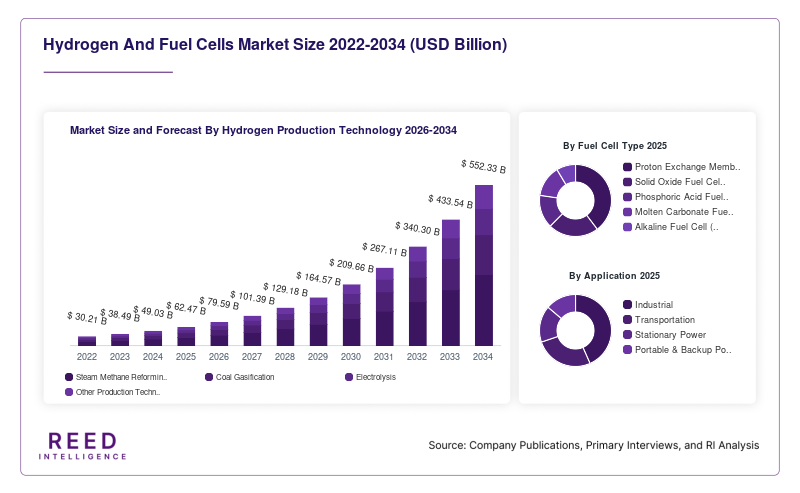
Electrolysis accounted for approximately 18% of the hydrogen-production technology segment in 2025 and is projected to expand at about 31.2% CAGR through 2034. Its growth is linked to the development of low-emissions hydrogen projects and increasing deployment of electrolyzers. The IEA reports that installed electrolysis capacity surpassed 4 GW in 2025 and more than 2.5 GW was under construction for 2026 operation.
Electrolysis also benefits from policy programs designed to establish hydrogen production connected to renewable and low-carbon electricity. The EU's 2024 hydrogen auction allocated funding to renewable-hydrogen producers, while the 2025 auction selected additional projects for grant preparation. The principal risks are electricity costs, electrolyzer utilization, project financing and uncertain hydrogen offtake.
Steam Methane Reforming accounted for approximately 48% of the hydrogen-production technology segment in 2025. Its position reflects the existing industrial hydrogen infrastructure serving refining and chemical applications. The IEA reports that global hydrogen production remains dominated by unabated fossil fuels, while low-emissions production remains a small portion of overall supply.
Carbon-capture-equipped reforming can provide an alternative lower-emissions production pathway in regions with favorable natural-gas economics and carbon-storage infrastructure. The IEA notes that in areas with relatively inexpensive natural gas, including the United States and Middle East, CCUS-based hydrogen can remain comparatively competitive in the near term.
Other production-technology CAGR: Coal Gasification is projected to grow at approximately 14.8% CAGR, while Other Production Technologies are projected to grow at approximately 22.0% CAGR through 2034.
Fuel Cell Type Analysis
By Fuel Cell Type
PEMFC accounted for approximately 42% of the fuel-cell segment in 2025. Its position is linked to transportation and distributed-power applications where relatively rapid response, compact system design and compatibility with hydrogen fuel make PEM technology relevant. The U.S. Department of Energy identifies PEM fuel cells as a core area for transportation and stationary applications and continues R&D focused on lowering costs and improving durability.
The technology is particularly relevant to buses, commercial vehicles, material handling and backup power. Improvements in catalyst loading, membrane durability and manufacturing can improve economics, but hydrogen availability and fuel-cell-system cost remain important adoption constraints.
SOFC accounted for approximately 19% of the fuel-cell segment in 2025 and is projected to grow at about 29.5% CAGR through 2034. Its growth is associated primarily with stationary power applications, where high-efficiency electricity generation and onsite power can be valuable. DOE identifies solid oxide fuel cells as an active R&D area for stationary applications.
Data centers and other facilities requiring reliable power create additional demand potential. Bloom Energy's expansion with Equinix and collaboration with Oracle demonstrate how fuel-cell-based onsite power is being integrated into digital infrastructure.
Other fuel-cell-type CAGR: PAFC is projected to grow at approximately 20.7%, MCFC at 18.9%, and AFC at approximately 23.4% through 2034.
Application Analysis
By Application
Industrial applications accounted for approximately 44% of the market in 2025. The segment benefits from hydrogen's established use as a feedstock in refining and chemical production. The IEA reports that almost all current hydrogen demand remains concentrated in established industrial uses, particularly refining, ammonia, methanol and fossil-based direct-reduced iron.
This creates a comparatively established demand base relative to newer hydrogen applications. The transition toward lower-emissions production can increase spending on electrolyzers, hydrogen storage and associated infrastructure without requiring the complete creation of a new end-use market.
Transportation accounted for approximately 24% of the market in 2025 and is projected to grow at about 32.1% CAGR through 2034. Heavy-duty trucks are currently the strongest fuel-cell road-transport application, according to the IEA. China also holds a dominant position in the global fuel-cell commercial-vehicle stock.
Toyota's third-generation fuel-cell system, announced in 2025, is designed for commercial applications and is planned for use in heavy-duty vehicles across Japan, Europe, North America and China from 2026 at the earliest.
Other application CAGR: Stationary Power is projected to grow at approximately 28.6% CAGR, while Portable & Backup Power is projected to grow at approximately 24.2% CAGR through 2034.
End-Use Analysis
By End Use
Refining & Chemicals accounted for approximately 38% of the market in 2025. The segment benefits from hydrogen's established role as a feedstock rather than depending entirely on emerging energy applications. The IEA identifies refining, ammonia and methanol among the principal existing hydrogen-demand sectors.
The main market transition is therefore from conventional hydrogen production toward lower-emissions production. This creates demand for electrolyzers, carbon-management systems and hydrogen infrastructure while preserving the underlying need for hydrogen in industrial processes.
Mobility accounted for approximately 23% of the market in 2025 and is projected to grow at about 32.6% CAGR through 2034. The segment is being driven primarily by heavy commercial vehicles and other applications where operating range, payload and refueling requirements can favor hydrogen fuel cells in selected use cases.
Toyota's planned deployment of its third-generation fuel-cell system across commercial vehicles demonstrates continued manufacturer investment in this area. China is also expanding hydrogen applications beyond fuel-cell vehicles, with its 2026 national pilot program covering heavy transport, industrial applications and hydrogen-based fuels.
Other end-use CAGR: Power Generation is projected to grow at approximately 28.1%, Industrial Manufacturing at 25.8%, and Residential & Commercial at approximately 23.9% through 2034.
Hydrogen and Fuel Cells Market Regional Analysis
Asia-Pacific Represents the Largest and Fastest-Growing Regional Market
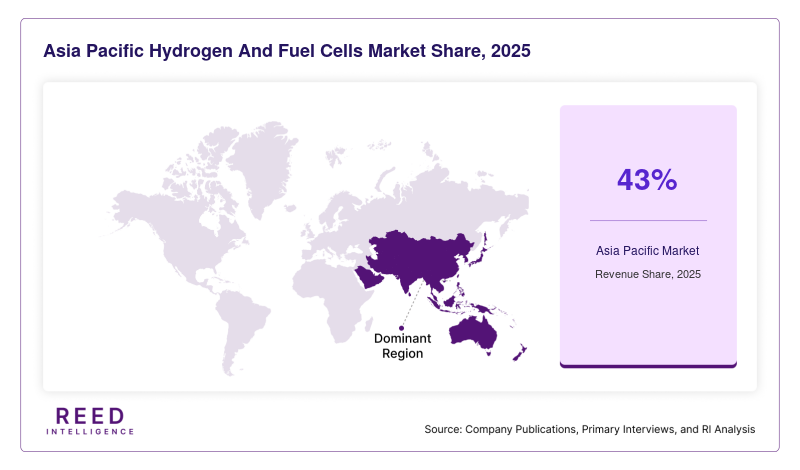
Asia-Pacific accounted for approximately 43% of the global market in 2025 and is projected to grow at about 30.2% CAGR through 2034. The region combines large industrial hydrogen consumption with substantial electrolyzer manufacturing, fuel-cell vehicle deployment and government-supported hydrogen programs. The IEA identifies China as the leading country in electrolyzer deployment and manufacturing, accounting for 65% of global installed electrolysis capacity and capacity that had reached FID in its 2025 assessment.
China's 2026 hydrogen pilot program is expanding the focus from fuel-cell vehicles to industrial hydrogen, green ammonia and methanol, hydrogen metallurgy and other applications. Japan and South Korea are also important markets for fuel-cell power and hydrogen applications, while Japan has maintained long-running government-industry programs for hydrogen and fuel-cell commercialization.
The regional growth mechanism therefore extends across the entire value chain, from electrolyzers and hydrogen production to commercial vehicles, stationary power and industrial consumption. Constraints include project economics, infrastructure development and differences in national hydrogen-policy execution.
North America Maintains a Major Market Through Hydrogen Hubs, Industry and Fuel-Cell Power
North America accounted for approximately 27% of the market in 2025 and is projected to grow at about 26.8% CAGR through 2034. The United States has established regional hydrogen hubs intended to connect production, storage, transportation and end-use demand. DOE announced funding commitments for the Gulf Coast and Midwest hubs in 2024 and subsequently advanced additional hubs through initial funding tranches.
The region also has opportunities in industrial hydrogen, heavy transportation and stationary power. Fuel cells are increasingly being evaluated for data centers and other facilities requiring reliable onsite generation. Bloom Energy's agreements with Oracle and Equinix provide examples of commercial deployment in this application.
The main growth mechanism is the combination of federal support, industrial demand, infrastructure development and private investment. However, project execution, permitting, hydrogen costs and changes in policy support can influence deployment schedules.
Europe Builds Demand Through Renewable Hydrogen Support and Industrial Decarbonization
Europe accounted for approximately 20% of the market in 2025 and is projected to grow at about 25.4% CAGR through 2034. European policy has focused strongly on creating production incentives and demand mechanisms for renewable hydrogen. The European Commission's 2024 Innovation Fund hydrogen auction offered a €1.2 billion budget for renewable hydrogen producers, while selected projects are required to reach financial close and begin production within specified timeframes.
In January 2026, six winning projects from the 2024 auction signed grant agreements receiving a combined €270.6 million, including projects targeting maritime offtakers.
The regional market mechanism is therefore closely linked to industrial decarbonization, maritime fuels, renewable hydrogen production and cross-border energy integration. High renewable-electricity costs, permitting requirements and uncertain offtake remain constraints.
Latin America Represents an Emerging Production and Export-Oriented Market
Latin America accounted for approximately 6% of the market in 2025 and is projected to grow at about 24.1% CAGR through 2034. The region has potential to develop hydrogen production around renewable-energy resources and export-oriented industrial projects. The commercial mechanism is different from mature industrial markets: development can be linked to the availability of low-cost renewable electricity, ports and large-scale projects rather than only domestic fuel-cell demand.
Potential applications include ammonia, methanol, refining, mining and heavy transport. However, project economics depend on infrastructure, financing, export agreements and regulatory frameworks. Consequently, project execution and long-term offtake agreements remain important determinants of regional deployment.
Middle East & Africa Expand Through Low-Cost Production Potential and Industrial Applications
Middle East & Africa accounted for approximately 4% of the market in 2025 and is projected to grow at about 23.2% CAGR through 2034. The region has opportunities to combine existing energy infrastructure with hydrogen production and export projects. The IEA notes that areas with relatively low natural-gas costs, including the Middle East, may have comparatively favorable economics for hydrogen produced with CCUS in the near term.
The region's potential applications include refining, ammonia, methanol, steel, shipping fuels and export-oriented hydrogen projects. Saudi Arabia's NEOM project is among the large-scale projects highlighted by the IEA in the development of low-emissions hydrogen production.
The main constraints are infrastructure development, financing, export-market certainty, water availability in some locations and the need for long-term international offtake agreements.
Hydrogen and Fuel Cells Market Competitive Landscape
Competition in the hydrogen and fuel cells market is developing across several layers rather than around a single product category. Hydrogen producers compete on production cost, electricity or natural-gas access, project scale, carbon intensity, storage and transportation. Electrolyzer suppliers compete through system efficiency, manufacturing scale, durability, cost and project integration. Fuel-cell companies compete through system efficiency, durability, power density, lifecycle cost and application-specific integration.
The competitive environment is also becoming more geographically differentiated. The IEA reports that China has become the dominant center for electrolyzer deployment and manufacturing, while manufacturers in other regions face pressure from lower-cost Chinese equipment and weaker project pipelines.
In fuel cells, technology suppliers are pursuing different application strategies. Toyota is developing fuel-cell systems for commercial vehicles, while Bloom Energy is expanding stationary fuel-cell applications in data centers. DOE-funded research is simultaneously targeting fuel-cell durability, catalyst utilization, manufacturing and system integration.
Key Market Players
- Toyota Motor Corporation
- Bloom Energy Corporation
- Ballard Power Systems Inc.
- Plug Power Inc.
- Cummins Inc.
- Bloom Energy
- FuelCell Energy, Inc.
- Air Liquide
- Linde plc
- Siemens Energy AG
- Nel ASA
- thyssenkrupp nucera AG & Co. KGaA
- ITM Power plc
- Shell plc
- Air Products and Chemicals, Inc.
Hydrogen and Fuel Cells Market Recent Developments
- February 2025 — Toyota announced its third-generation fuel-cell system in February 2025, with the system designed specifically for commercial applications and planned for use in heavy-duty commercial vehicles. Toyota stated that the system would offer improved fuel efficiency and lower costs compared with its preceding generation.
- February 2025 — Bloom Energy announced an expanded agreement with Equinix in February 2025 covering more than 100 MW of electricity capacity across 19 U.S. data centers, with approximately 75 MW already operational and another 30 MW under construction.
Hydrogen And Fuel Cells Market Segments
By Hydrogen Production Technology
- Steam Methane Reforming
- Coal Gasification
- Electrolysis
- Other Production Technologies
By Fuel Cell Type
- Proton Exchange Membrane Fuel Cell (PEMFC)
- Solid Oxide Fuel Cell (SOFC)
- Phosphoric Acid Fuel Cell (PAFC)
- Molten Carbonate Fuel Cell (MCFC)
- Alkaline Fuel Cell (AFC)
By Application
- Industrial
- Transportation
- Stationary Power
- Portable & Backup Power
By End Use
- Refining & Chemicals
- Mobility
- Power Generation
- Industrial Manufacturing
- Residential & Commercial
By Region
- North America
- Europe
- APAC
- Middle East and Africa
- LATAM