Integration Orchestration Middleware Market Size, Share & Trends Analysis Report By Integration Type (Application Integration, Data Integration, API Integration, Business Process Integration, Event-Driven Integration), By Deployment (Cloud, On-Premises, Hybrid), By Organization Size (Large Enterprises, Small & Medium Enterprises), By End User (BFSI, IT & Telecommunications, Healthcare, Retail & E-commerce, Manufacturing, Government & Public Sector, Other End Users) and By Region (North America,
USD 3950
Integration Orchestration Middleware Market Size
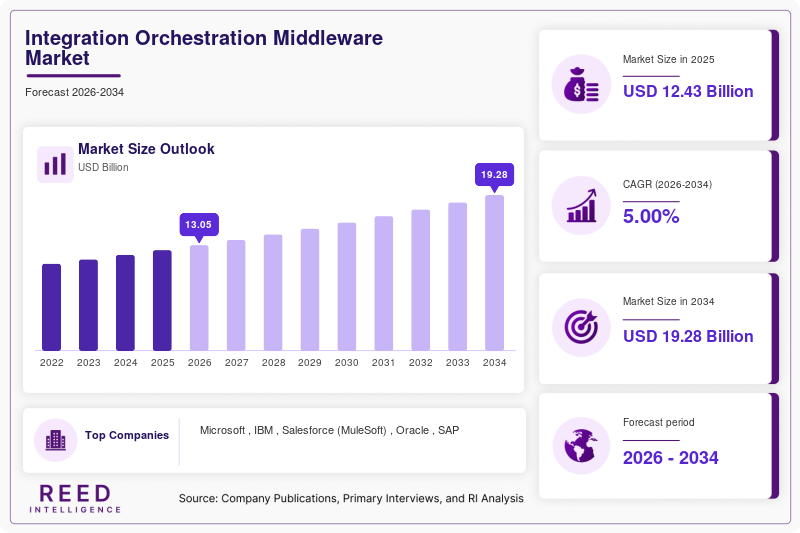
The Integration Orchestration Middleware Market was valued at USD 12.43 billion in 2025 and is estimated to reach USD 13.05 billion in 2026. The market is projected to reach USD 19.28 billion by 2034, representing a 5.00% CAGR during 2026–2034.
Integration orchestration middleware provides the technology layer through which enterprises connect applications, APIs, data sources, business processes and events and coordinate how information moves between them. The market has expanded beyond traditional enterprise application integration toward cloud-native integration platforms, API management, event-driven architectures, workflow automation and hybrid integration.
The underlying market mechanism is driven by IT-system fragmentation. Enterprises rarely operate a single technology environment; instead, they combine SaaS applications, cloud infrastructure, databases, legacy systems, partner platforms and increasingly AI services. Integration middleware reduces the need to create individual point-to-point connections between every system by providing reusable connectors, workflows, APIs and orchestration capabilities.
Integration Orchestration Middleware Market Drivers
Expansion of SaaS, Cloud and Hybrid IT Environments
The proliferation of SaaS applications and cloud infrastructure is increasing the number of connections enterprises must maintain. Applications that previously operated within a relatively centralized IT environment now interact with cloud services, external APIs, partner systems and on-premises applications.
This increases demand for middleware capable of supporting multiple protocols and environments. Azure Logic Apps, for example, is designed to integrate cloud and on-premises systems using workflows and connectors, while Microsoft's broader integration portfolio combines API, messaging, event and data-integration services.
The commercial effect is a shift from project-specific integration development toward reusable integration platforms that can support multiple business processes.
Increasing API and Application Complexity
APIs have become a fundamental mechanism for connecting internal applications, external services and digital products. As API inventories expand, organizations need not only connectivity but also API discovery, security, governance, monitoring and lifecycle management.
Microsoft's architecture guidance demonstrates this convergence by combining Logic Apps for workflow orchestration with API Management for API publication, authentication, rate limiting, caching and governance.
Consequently, middleware vendors increasingly compete by combining integration, API management and workflow capabilities rather than treating them as isolated technologies.
Integration Requirements Created by AI
AI adoption is generating a new integration layer because AI applications need access to enterprise data, APIs, applications and business processes. Gartner's 2026 iPaaS analysis identifies AI as a major force changing expectations for integration platforms.
IBM has similarly positioned its webMethods Hybrid Integration platform around connecting AI, APIs, applications, events, files, B2B/EDI and mainframe data.
This creates demand for middleware capable of securely exposing enterprise capabilities to AI applications while maintaining authentication, governance and operational controls.
Integration Orchestration Middleware Market Restraints
Integration Complexity and Legacy-System Constraints
Many enterprises still operate legacy applications and infrastructure that were not designed for modern API- or event-driven architectures. Integrating these environments can require custom connectors, data transformation, specialized expertise and extensive testing.
Microsoft's enterprise-integration architecture explicitly supports scenarios involving both cloud and on-premises systems, illustrating the continuing importance of hybrid environments.
The challenge is therefore not simply purchasing middleware; organizations must also map processes, clean data, establish governance and redesign integration architecture.
Security, Governance and Operational Complexity
Integration middleware creates pathways between business-critical applications and data. Poorly governed integrations can create security vulnerabilities, uncontrolled API access, data inconsistencies and operational dependencies.
As a result, enterprise buyers increasingly require authentication, authorization, monitoring, rate limiting, encryption, auditability and policy management alongside connectivity. Microsoft's API Management architecture, for example, incorporates authentication, rate limiting, caching and governance functions.
Integration Orchestration Middleware Market Opportunities
AI-Agent and Agentic Workflow Integration
AI agents create a new opportunity for integration middleware because agents must interact with enterprise applications and execute actions through controlled interfaces. Integration platforms can provide the connectors, APIs, workflow logic and governance required to translate AI-generated actions into enterprise-system operations.
IBM's recent webMethods developments include conversational workflow creation and AI-assisted integration development, demonstrating how AI is becoming part of both the consumer side and development side of integration platforms.
Low-Code and No-Code Integration
Low-code integration can expand the addressable customer base by allowing business analysts and application teams to create workflows without developing every connection from scratch. Microsoft's Logic Apps platform uses visual workflow design and a large connector ecosystem to simplify integration development.
This can reduce dependency on specialist integration developers for standardized use cases while allowing professional developers to concentrate on complex integration requirements.
Hybrid and Event-Driven Integration
Enterprises are increasingly combining cloud applications with on-premises systems, messaging platforms and event-driven services. This creates demand for middleware that can coordinate synchronous APIs, asynchronous messaging, scheduled workflows and real-time events within a common architecture.
Azure's portfolio combines Logic Apps, Service Bus and Event Grid for these different integration patterns, while IBM similarly emphasizes APIs, events, files and hybrid integration.
Integration Orchestration Middleware Market Integration Type Analysis
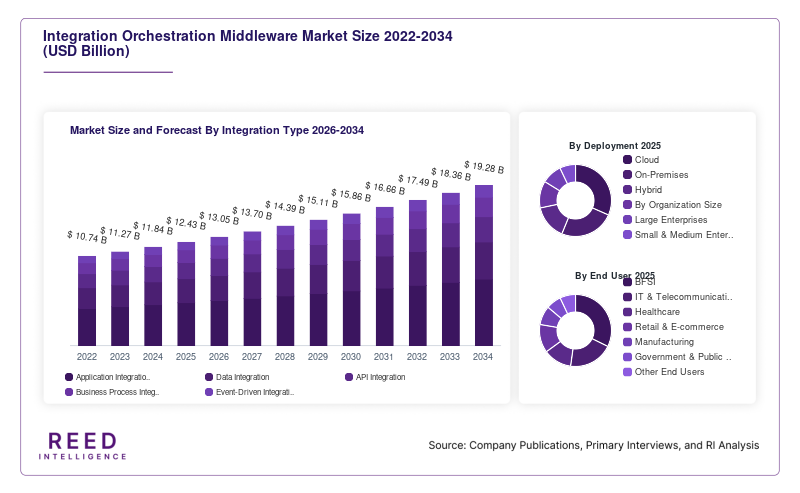
Application integration is internally modelled as the largest integration-type segment, accounting for approximately 29% of the 2025 market, equivalent to USD 3.60 billion. Its importance comes from the need to connect CRM, ERP, HR, finance, supply-chain and customer-facing applications across increasingly distributed IT environments.
Data integration is modelled at 22% of the 2025 market, representing approximately USD 2.73 billion. The segment covers movement and transformation of information between databases, applications, cloud services and analytical environments.
API integration is internally allocated 21% of the 2025 market, equivalent to USD 2.61 billion. API-based connectivity is increasingly important because enterprises use APIs to expose, consume and reuse functionality across internal applications, external partners and digital products.
Business process integration represents a modelled 16% share, or approximately USD 1.99 billion in 2025. Its value comes from coordinating multiple applications around end-to-end processes such as order management, customer onboarding, claims processing and supply-chain workflows.
Event-driven integration is modelled at 12%, representing approximately USD 1.49 billion in 2025. The segment is positioned for continued adoption as enterprises seek near-real-time responses to application events, transactions and operational changes.
Integration Orchestration Middleware Market Deployment Analysis
Cloud deployment is internally modelled as the largest deployment segment at 55% of the 2025 market, equivalent to USD 6.84 billion. Cloud integration reduces infrastructure-management requirements and aligns naturally with SaaS and cloud-native application environments. Microsoft's Logic Apps, for example, is delivered as a managed iPaaS environment with automatic scaling
Hybrid deployment represents an internally modelled 30% share, or USD 3.73 billion in 2025. Hybrid environments remain important because enterprises often need to connect cloud applications with legacy systems and on-premises databases.
On-premises deployment accounts for approximately 15% of the 2025 market, equivalent to USD 1.86 billion. The segment remains relevant in regulated, security-sensitive and legacy-intensive environments where organizations retain direct control over infrastructure and data.
Integration Orchestration Middleware Market Organization Size Analysis
Large enterprises are internally modelled to represent 68% of the 2025 market, equivalent to USD 8.45 billion. Large organizations typically operate more applications, APIs, business units and legacy systems, creating greater demand for centralized integration governance and orchestration.
SMEs account for the remaining 32%, representing approximately USD 3.98 billion in 2025. Adoption is increasingly enabled by cloud-based and low-code integration platforms that reduce the infrastructure and specialist-development requirements associated with traditional enterprise middleware.
Integration Orchestration Middleware Market End-User Analysis
BFSI is internally modelled at 20% of the 2025 market, representing approximately USD 2.49 billion. Banks and financial institutions require integration across core banking systems, payment platforms, customer applications, regulatory systems and third-party services.
IT and telecommunications account for an internally modelled 18%, equivalent to USD 2.24 billion. The sector has extensive requirements for API connectivity, cloud orchestration, service integration and real-time event processing.
Healthcare represents approximately 15% of the 2025 market, or USD 1.86 billion. Integration demand is linked to electronic health records, clinical applications, laboratories, medical devices, billing systems and external healthcare services.
Retail and e-commerce are modelled at 13%, representing approximately USD 1.62 billion. Integration connects commerce platforms, payment services, inventory, logistics, CRM, marketing and customer-service applications.
Manufacturing accounts for approximately 12%, equivalent to USD 1.49 billion in 2025. Integration requirements span ERP, manufacturing systems, supply-chain applications, IoT environments and logistics platforms.
Government and public-sector organizations are modelled at 10%, representing approximately USD 1.24 billion. Demand is associated with connecting citizen services, administrative applications, databases and legacy government systems.
Other end users account for the remaining 12%, or approximately USD 1.49 billion. This includes education, transportation, energy, media, professional services and other industries adopting multi-application digital architectures.
Integration Orchestration Middleware Market Regional Analysis
North America Integration Orchestration Middleware Market
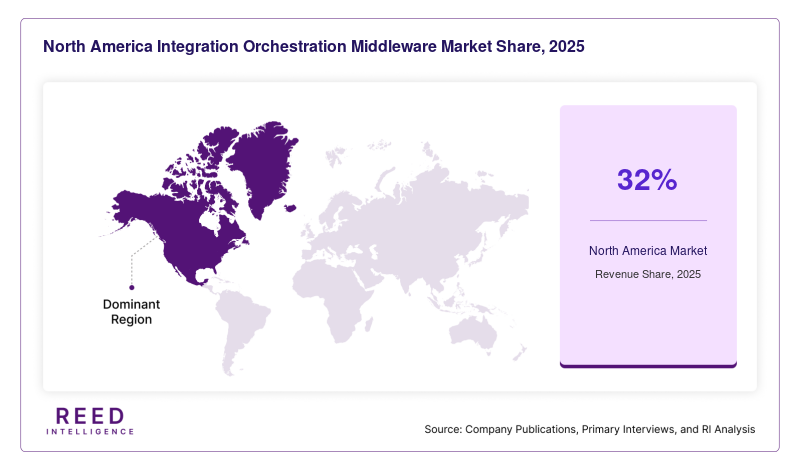
North America is internally modelled as the largest regional market, representing 32% of the 2025 market, or approximately USD 3.98 billion. The region benefits from high enterprise cloud adoption, extensive SaaS usage, mature API ecosystems and early deployment of AI-enabled enterprise applications.
The presence of major integration-platform providers also supports ecosystem development across cloud, API management, automation and enterprise middleware.
Europe Integration Orchestration Middleware Market
Europe is modelled at 27% of the 2025 market, equivalent to approximately USD 3.36 billion. Enterprises across the region are modernizing legacy infrastructure while maintaining strong requirements around data governance, security and regulatory compliance.
The need to connect heterogeneous systems across large organizations supports demand for hybrid integration and centralized API governance.
Asia-Pacific Integration Orchestration Middleware Market
Asia-Pacific is internally modelled at 25% of the 2025 market, representing approximately USD 3.11 billion and assigned the fastest regional growth rate in the model. Expanding cloud adoption, digital transformation, e-commerce, financial technology and enterprise software deployment are increasing the number of applications requiring integration.
The region also provides an expanding customer base for cloud-native and low-code integration platforms.
Latin America Integration Orchestration Middleware Market
Latin America is modelled at 9% of the 2025 market, equivalent to approximately USD 1.12 billion. Cloud migration and modernization of enterprise applications are creating demand for integration platforms, although budget constraints and shortages of specialized integration expertise can affect adoption.
Middle East and Africa Integration Orchestration Middleware Market
The Middle East and Africa are modelled at 7% of the 2025 market, representing approximately USD 0.87 billion. Digital-government programs, financial-services modernization, cloud adoption and enterprise digitization are creating integration requirements, particularly in major technology hubs.
Integration Orchestration Middleware Market Competitive Landscape
The integration orchestration middleware market is highly competitive because traditional middleware providers increasingly overlap with cloud-platform vendors, API-management providers, iPaaS companies and workflow-automation platforms.
Gartner's 2026 iPaaS evaluation identifies a broad vendor landscape that includes AWS, Boomi, Celigo, Google, IBM, Informatica, Jitterbit, Microsoft, Oracle, Salesforce/MuleSoft, SAP, SEEBURGER, SnapLogic, Tray.ai, Workato and Zapier, demonstrating the breadth of competition within modern integration platforms.
Microsoft combines Logic Apps, API Management, Service Bus, Event Grid, Data Factory and Functions within its Azure Integration Services portfolio.
Key Market Players
- Microsoft
- IBM
- Salesforce (MuleSoft)
- Oracle
- SAP
- Boomi
- Informatica
- Workato
- SnapLogic
- Celigo
- Jitterbit
- SEEBURGER
- AWS
Integration Orchestration Middleware Market Recent Developments
- Gartner's 2026 iPaaS research highlights AI as a major change in the integration-platform market, with AI initiatives creating new integration requirements and influencing platform capabilities.
- IBM announced webMethods Hybrid Integration in 2025, combining AI, APIs, applications, events, files, B2B/EDI and mainframe integration within a unified platform approach.
Integration Orchestration Middleware Market Segments
By Integration Type
- Application Integration
- Data Integration
- API Integration
- Business Process Integration
- Event-Driven Integration
By Deployment
- Cloud
- On-Premises
- Hybrid
- By Organization Size
- Large Enterprises
- Small & Medium Enterprises
By End User
- BFSI
- IT & Telecommunications
- Healthcare
- Retail & E-commerce
- Manufacturing
- Government & Public Sector
- Other End Users
By Region
- North America
- Europe
- APAC
- Middle East and Africa
- LATAM